 FEXLINK Research Institute
The short answer
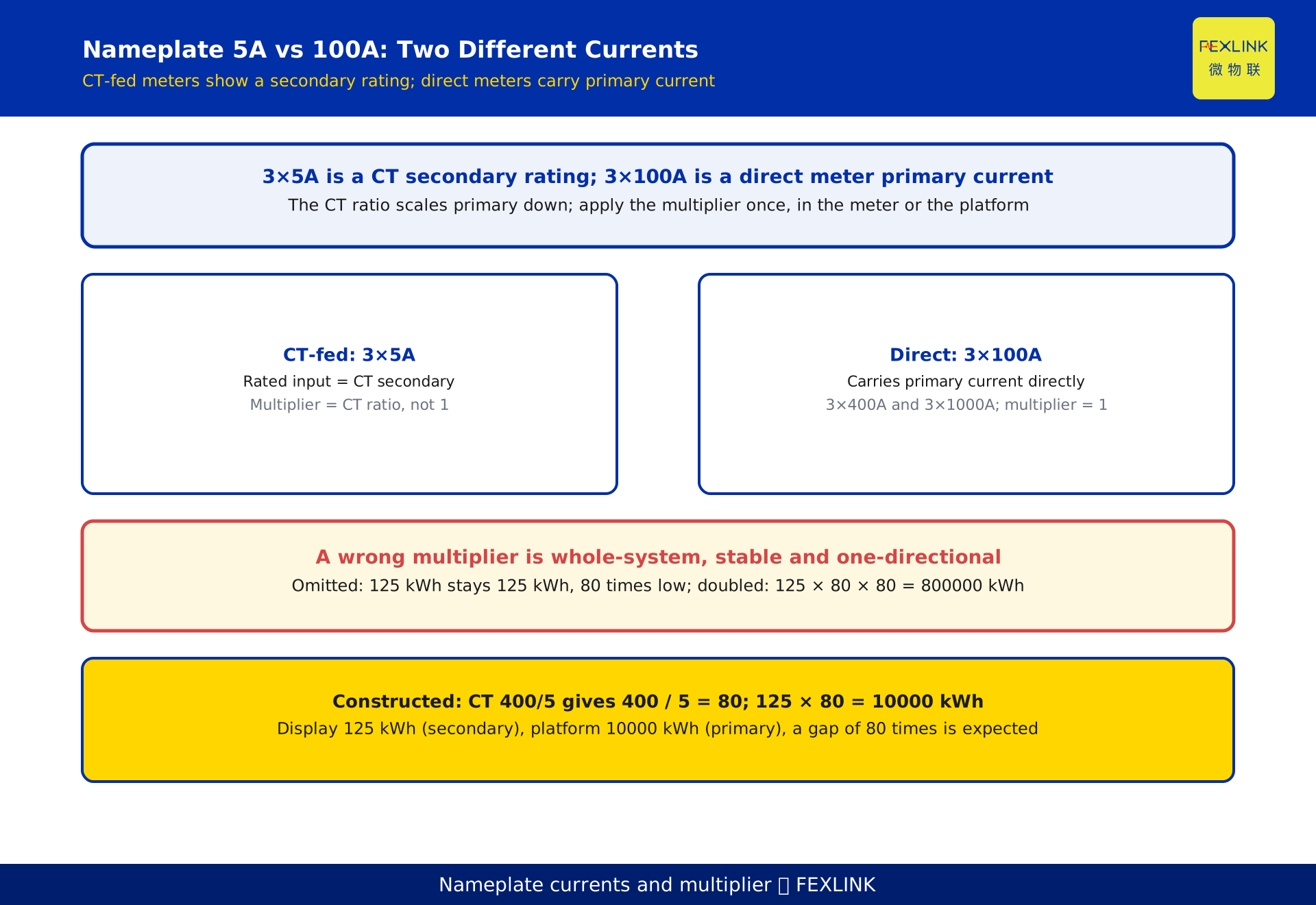
The 3×5A and 3×100A on a nameplate are different quantities. The first is the rated input current when a meter is fed from a current transformer (CT) secondary; the second is the primary current a direct-connected meter carries. With a CT, the meter accumulates secondary-side energy, so primary energy equals the reading times the CT ratio: for 400/5 the ratio is 400 / 5 = 80, and 125 kWh becomes 125 × 80 = 10000 kWh. Direct-connected 3×100A, 3×400A and 3×1000A models use a multiplier of 1. Apply the multiplier once, in the meter or the platform; twice or never makes every value uniformly too large or too small, not one meter occasionally wrong.
1. Two kinds of current on the nameplate
Decide first whether current enters the meter directly or arrives scaled down by a CT; both kinds can share one nameplate.
3×5A states the rated input current, normally the CT secondary. Primary current passes through the CT primary winding, never through the meter body. 3×100A, 3×400A and 3×1000A state currents the meter carries continuously when inserted directly into the primary circuit, with no external CT.
The registry lists DL/T 448, the named framework for technical administration of electric energy metering installations. This article cites the name only: no version year, clause number, accuracy-class table or error limit, with the currently effective text and project metering documents governing. The verified coefficient fact base has no entries for CT, ratio, multiplier or nameplate, so none of its coefficients is used.
One rule: check the connection method and whether a CT is installed. With a CT, the secondary rating describes the meter's input range, not circuit size; without one, the nameplate current guides the primary level.
2. Why a 5A meter measures a 400A circuit
A CT scales a large primary current down to a small secondary current. A nameplate 400/5 means 400 A primary and 5 A secondary, so the meter never sees more than 5 A; circuit size depends on the CT ratio.
A 3×5A meter therefore does not measure only 5A — it looks only at the secondary. With 400/5, a primary approaching 400 A gives a secondary approaching 5 A; a different CT ratio covers a different primary range. This explains platform energy being off by dozens of times: the meter accumulates secondary energy, and one omitted ratio discards the portion the CT scaled away.
Two boundaries: never open-circuit a CT secondary; verify the ratio against each CT nameplate, not a drawing. Wiring practice is outside this article.
3. How the multiplier is computed: CT ratio, voltage ratio and combined multiplier
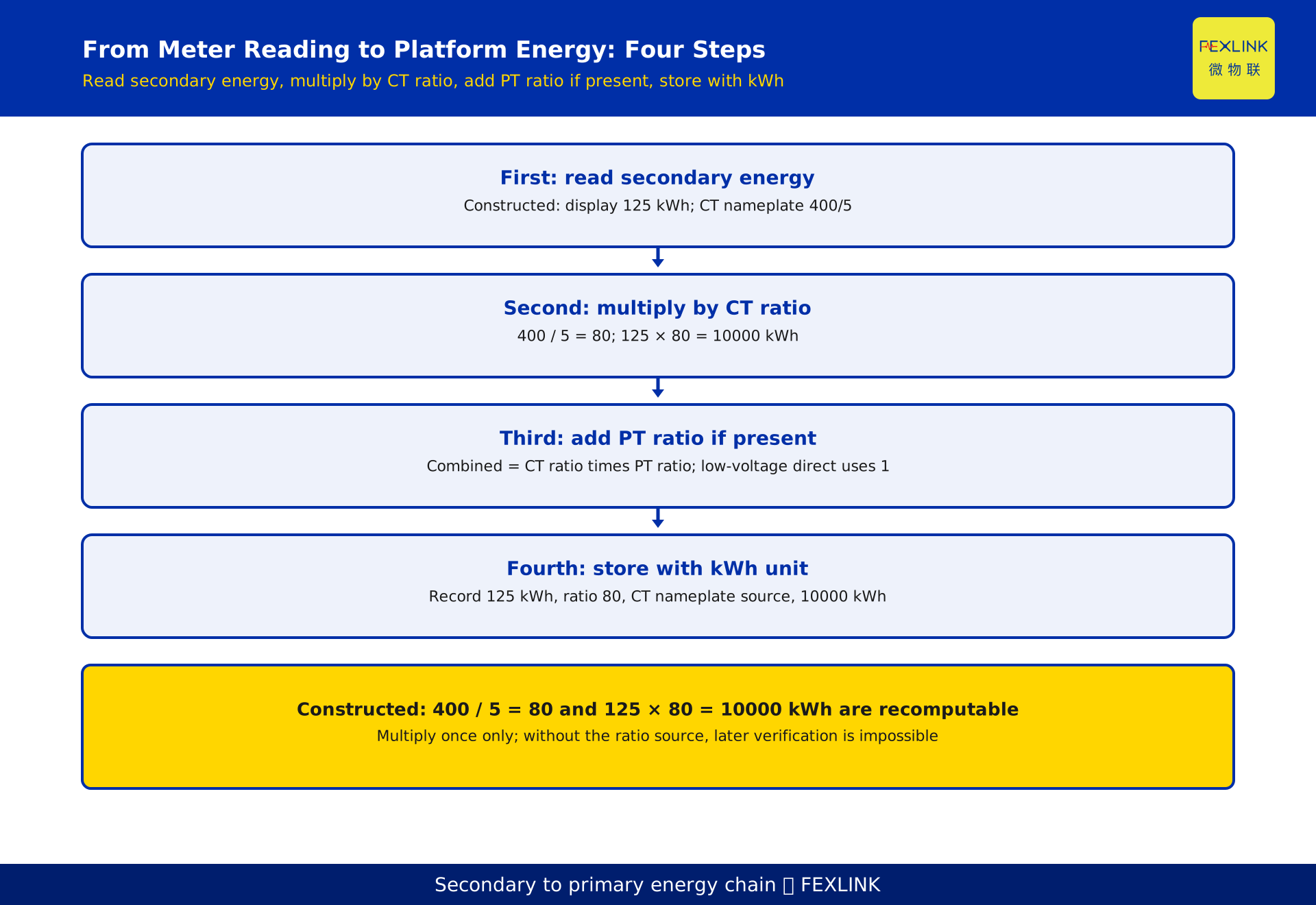
The multiplier is how many times the meter reading must be enlarged to equal the primary quantity. On a low-voltage circuit with only a CT, it is the CT ratio, rated primary current divided by rated secondary current. The constructed 400/5 CT gives 400 / 5 = 80.
High-voltage metering adds a voltage transformer (PT): energy is the product of voltage and current, so the combined multiplier is the CT ratio times the PT ratio. A low-voltage direct circuit has no PT and its voltage multiplier is 1; where only a CT exists, do not invent a second voltage factor. No PT ratio table is given; transformer nameplates and metering documents govern.
The chain has four steps: read secondary energy, multiply by the CT ratio, multiply by the PT ratio if present, store with the kWh unit. Record the reading, multiplier, its source CT nameplate and the result; without the source, verification is impossible.
Do not confuse this multiplier with the engineering-value scale in a point table: that one belongs to the parsing layer, this one to the metering layer. Register them separately so 80 cannot collide with the parsing decimal convention.
4. Where the multiplier lives: set it once, in the meter or the platform
The multiplier can live in the meter's internal settings or in the platform's acquisition point configuration. Choose one; the test is which side of the CT the display shows.
If the meter is set to 80, the display shows primary energy and the platform accepts it with 1. If the meter stays in secondary accumulation and shows 125 kWh, the platform converts with 80 into 10000 kWh. Multiplying by 80 in both places gives 800000 kWh; in neither place leaves 125 kWh. Both errors are systematic and stable in direction.
Leave a three-step record: capture the CT ratio and meter setting; set the platform multiplier to 80 or 1 by the display convention; reconcile both sides at one instant and archive result, time and owner. Repeat after any CT, meter or configuration change. Keep the multiplier in the platform: settings are easier to version, while field devices leave no change record.
5. Worked example: from a 400/5 circuit to a platform reading
Constructed to explain the arithmetic; anonymised, representing no real customer or project.
A low-voltage circuit connects through a CT to a 3×5A meter. The CT reads 400/5, so the multiplier is 400 / 5 = 80; there is no PT, so the voltage multiplier is 1. Over one billing interval secondary energy rises by 125 kWh, giving primary energy of 125 × 80 = 10000 kWh, which the platform should record.
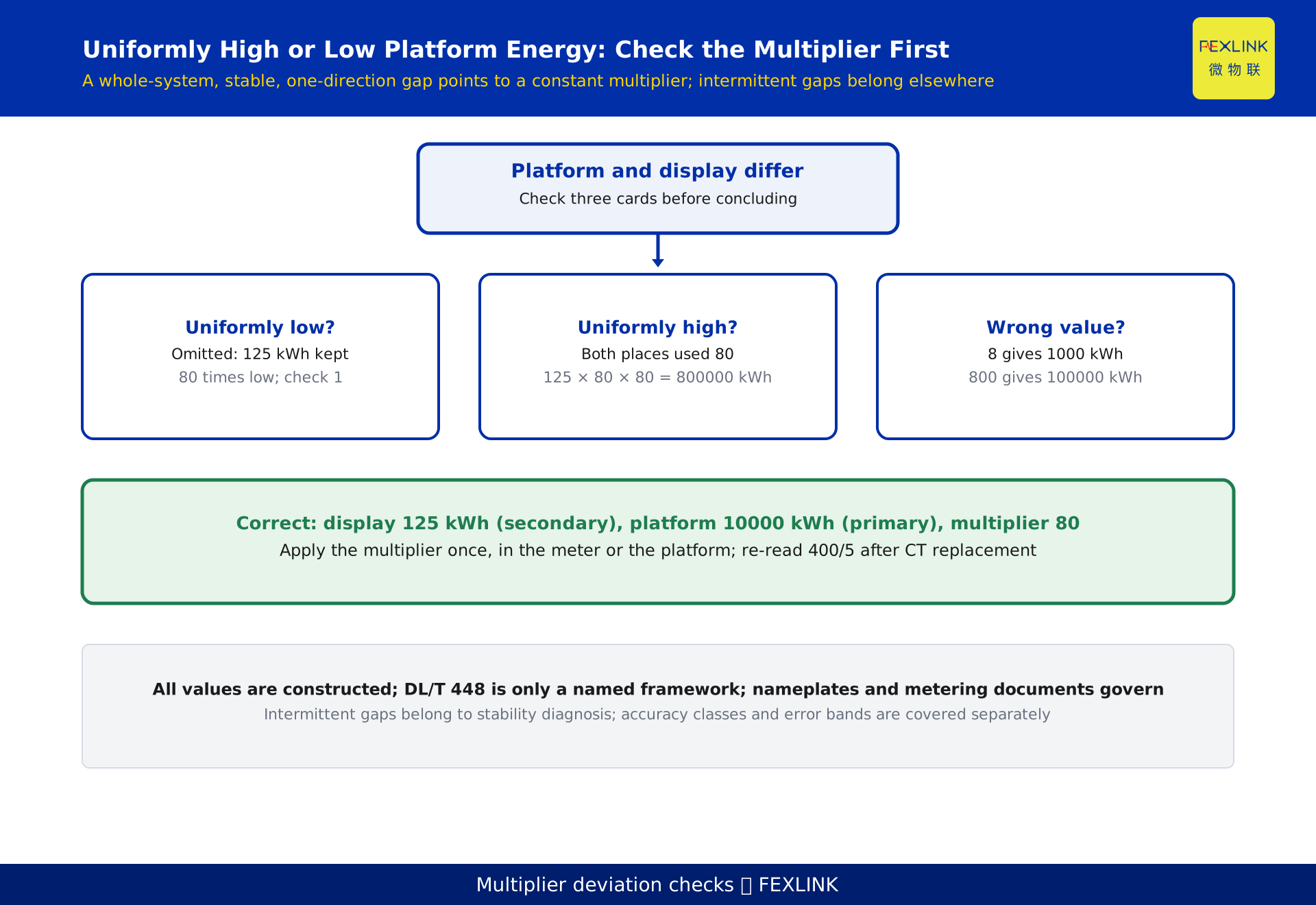
Three recomputable errors: omitting the multiplier leaves 125 kWh, 80 times too small; setting 80 in the meter and again on the platform gives 125 × 80 × 80 = 800000 kWh, 80 times too large; entering 8 gives 125 × 8 = 1000 kWh, 10 times too small, and 800 gives 125 × 800 = 100000 kWh, 10 times too large.
Reconcile five items — display, platform, CT nameplate ratio, meter setting, platform setting — at one instant. Correctly, the display is 125 kWh (secondary), the platform 10000 kWh (primary), multiplier 80; a gap of 80 times is expected. If the display is primary, both sides should be equal.
6. Direct-connected 100A models: three boundaries for multiplier 1
Direct-connected models have no CT layer: 3×100A, 3×400A and 3×1000A are the primary currents the meter carries, the multiplier is 1, and the platform applies no ratio.
Confirm three things: no CT or PT is actually installed (some cabinets contain bypassed transformers); the meter matches its nameplate range and no 5A setting was carried over; the acquisition point did not inherit an old template with a multiplier of 80.
If platform energy is uniformly 80 times the display, check the platform multiplier before suspecting the meter. Matching values with a consistent trend close the circuit. Which range suits which primary circuit belongs to parameter-table and selection work, covered separately.
7. What a wrong multiplier looks like: uniformly high or uniformly low
A multiplier error is not intermittent. It is whole-system, stable and one-directional, because a constant is applied to all accumulated energy.
Uniformly low values come from an omitted multiplier: the platform is set to 1, or a PT circuit has only the CT ratio applied. The example records 125 kWh, 80 times below 10000 kWh. Uniformly high values come from applying it twice or using a wrong value: meter and platform each multiply by 80, or 400 / 5 = 80 is misread as 400 times. Both 800000 kWh and 100000 kWh belong here.
Check the source (CT and PT nameplates, meter setting, platform configuration, applied once), the value (was 80 mistyped as 8 or 800?) and the convention (secondary or primary display, kWh storage). Move to hardware faults only if all three disagree. A deviation confined to certain intervals, or one that comes and goes, is not a multiplier problem; a constant does not change by itself, and that belongs to stability diagnosis.
8. Where the current ranges sit: product and system responsibilities
The ESA-22111~22161-R all-element smart meter is offered in rated-current ranges from 3×5A to 3×1000A. By connection method they split into CT-secondary 5A ranges and direct-connected ranges of 100A and above. This article does not reproduce the parameter table; the current product knowledge base and selection manual govern the range-to-model mapping.
The meter accumulates energy in its own input convention; gateway and platform restore primary energy using the on-site CT ratio. The digital electrical supervision system holds acquisition-point configuration, multiplier versions and reconciliation records. A wrong multiplier changes the platform configuration, not the meter. Models, ranges and customisable options follow the latest product knowledge base; this is not a selection or purchasing recommendation.
Commission each circuit: record the connection method, copy the CT nameplate ratio (1 for direct connection), confirm the meter setting, configure the platform multiplier, reconcile at one instant, archive. Keep the checklist under version control and rerun it after CT replacement.
9. Boundary with neighbouring articles
This article answers one question: how to read nameplate currents, compute the multiplier, and where to write it. Its increment is the concrete CT-ratio algorithm, the apply-once rule, and the recomputable example 400 / 5 = 80 and 125 × 80 = 10000 kWh.
How a metering chip integrates samples belongs to the metering-principles article; accuracy classes and error bands to the accuracy article; range selection to the parameter-table article. Read this article for secondary or primary quantity; the principles article for energy computation; the accuracy article for precision; the selection article for range choice. An intermittent link belongs to stability diagnosis and is outside this article.
FAQ
Q: A nameplate says 3×5A. Does that mean the meter only works on a small 5A circuit?
No. 3×5A is the rated input current, normally the CT secondary; the CT ratio decides the primary circuit size. With a 400/5 CT it covers a 400 A primary circuit while seeing no more than 5 A. A direct range such as 3×100A passes primary current straight through the meter.
Q: For a 400/5 CT, is the multiplier 80 or 400?
It is 80, rated primary current divided by rated secondary current: 400 / 5 = 80. The 400 is an ampere rating, not a multiple, and writing it as the ratio makes platform energy uniformly 80 times too large. With a PT, the combined multiplier is the CT ratio times the PT ratio; no PT ratio table is given here.
Q: The meter already has a multiplier set. Should the platform multiply again?
No. Establish whether the display shows secondary or primary energy. For a secondary quantity such as 125 kWh, the platform converts with 80; if the meter is set to 80 and shows primary energy, the platform receives it with 1. Multiplying by 80 twice yields 800000 kWh. The test is which side the display shows, not whether filling both places feels safer.
Q: Platform energy is dozens of times below the display. Is the meter broken?
Check the constant multiplier first. A whole-system, same-direction deviation almost always means an omitted multiplier, a mistyped value, or a convention mismatch. Recompute along the chain in section 3 from the reading, multiplier source and platform configuration. A meter fault rarely makes every value differ by exactly one multiple; suspect hardware only after those checks disagree.
Q: After replacing a CT, can the old multiplier setting still be used?
No. The CT ratio is the only source of the multiplier; once 400/5 becomes a different ratio, the old 80 no longer holds. Re-read the nameplate, confirm the meter setting, update the platform multiplier, reconcile at the same instant, and archive both ratios, both readings and the owner. Version control for multipliers beats later reverse-engineering from an energy discrepancy.
Scope and limitations
- This article covers reading nameplate current, CT ratio and energy multiplier on CT-connected and direct-connected low-voltage circuits. The PT ratio appears only as a formula; no PT ratio table, transformer selection, wiring practice, error verification or trade-settlement rule is included.
- Figures including 3×5A, 3×100A, 3×400A, 3×1000A, 400/5, 400 / 5 = 80, 125 kWh, 125 × 80 = 10000 kWh, 125 × 80 × 80 = 800000 kWh, 125 × 8 = 1000 kWh, 125 × 800 = 100000 kWh, multiplier 1, 10 times too large or too small, and display 125 kWh against platform 10000 kWh are constructed, anonymised, represent no real customer or project, and are not a configuration template. Nameplates, vendor manuals and project metering documents govern.
- The related standard is DL/T 448, cited only as the named framework for metering-installation administration; no version year, clause number, accuracy-class table or error limit is asserted, and the effective text governs. The coefficient fact base has no entries for CT, ratio, multiplier, nameplate or current.
- Functional descriptions of the ESA-22111~22161-R all-element smart meter and the digital electrical supervision system follow the latest product knowledge base. Ranges and communication interfaces are customisable options; this is not a selection or purchasing recommendation.
- Boundaries with the principles, accuracy, parameter-table, selection and stability-diagnosis articles are set out in section 9. Neighbouring article IDs stay in metadata and facts only.
- Constructed values are labelled. Other description draws on public explanations of CT ratios, direct versus transformer-connected metering and combined-multiplier conversion, plus vendor-disclosed functions. All deliverables remain DRAFT_PENDING_REVIEW and require independent review; the generator does not self-approve.
Frequently Asked Questions
A nameplate says 3×5A. Does that mean the meter only works on a small 5A circuit?
No. 3×5A is the rated input current, normally the CT secondary; the CT ratio decides the primary circuit size. With a 400/5 CT it covers a 400 A primary circuit while seeing no more than 5 A. A direct range such as 3×100A passes primary current straight through the meter.
For a 400/5 CT, is the multiplier 80 or 400?
It is 80, rated primary current divided by rated secondary current: 400 / 5 = 80. The 400 is an ampere rating, not a multiple, and writing it as the ratio makes platform energy uniformly 80 times too large. With a PT, the combined multiplier is the CT ratio times the PT ratio; no PT ratio table is given here.
The meter already has a multiplier set. Should the platform multiply again?
No. Establish whether the display shows secondary or primary energy. For a secondary quantity such as 125 kWh, the platform converts with 80; if the meter is set to 80 and shows primary energy, the platform receives it with 1. Multiplying by 80 twice yields 800000 kWh. The test is which side the display shows, not whether filling both places feels safer.
Platform energy is dozens of times below the display. Is the meter broken?
Check the constant multiplier first. A whole-system, same-direction deviation almost always means an omitted multiplier, a mistyped value, or a convention mismatch. Recompute along the chain in section 3 from the reading, multiplier source and platform configuration. A meter fault rarely makes every value differ by exactly one multiple; suspect hardware only after those checks disagree.
After replacing a CT, can the old multiplier setting still be used?
No. The CT ratio is the only source of the multiplier; once 400/5 becomes a different ratio, the old 80 no longer holds. Re-read the nameplate, confirm the meter setting, update the platform multiplier, reconcile at the same instant, and archive both ratios, both readings and the owner. Version control for multipliers beats later reverse-engineering from an energy discrepancy.