 FEXLINK Research Institute
The short answer
A meter's accuracy class is its allowed error band under reference conditions: class 1.0 means ±1%, class 0.5S means ±0.5%, and the "S" means the band still holds at light load. Settlement points must be equipped to the class required by DL/T 448; internal management metering is usually fine at class 1.0. The annual cost of a class gap is roughly annual energy times the error-band gap, so size the electricity bill first, then choose the class.
1. How to read an accuracy class: the number is the error band
Start by translating the word "class." A meter accuracy class is not a ranking of "better versus worse" — it is the allowed error band: how far the reading may stray from the true value under reference temperature, reference voltage and rated load.
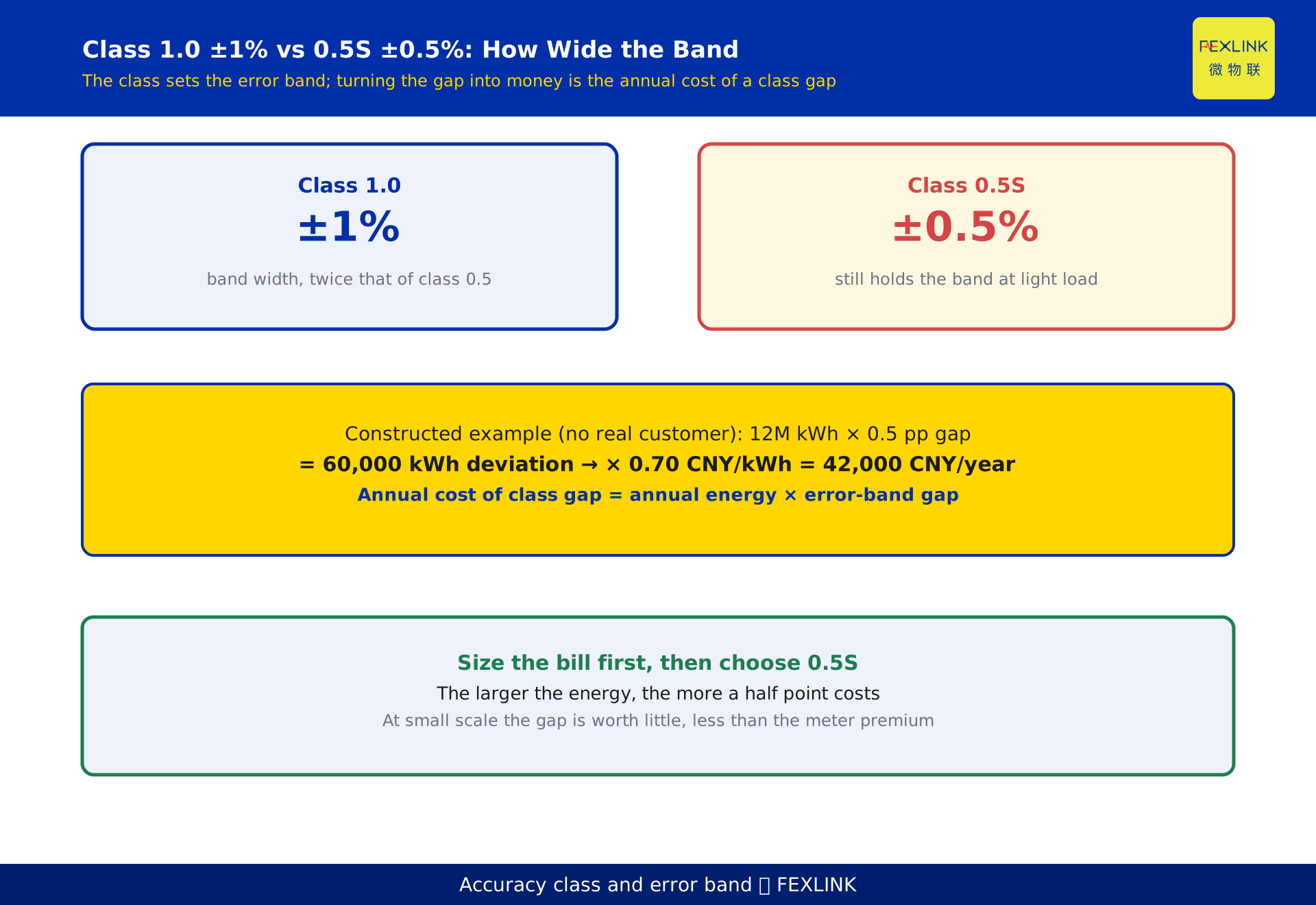
- Class 1.0 = ±1%: near full-scale current, the reading may sit 1% above or below the true value.
- Class 0.5 = ±0.5%: the error is halved.
- Class 0.5S = ±0.5%, with one extra "S".
Note that class 1.0 and class 0.5 differ in band width: the class 1.0 band is exactly twice as wide as the class 0.5 band. The wider the band, the more the same amount of energy can float up or down. In settlement, the number this meter reads turns directly into money; widen the band by an inch and the bill wobbles by an inch with it.
2. What the "S" means: why it stays accurate at light load
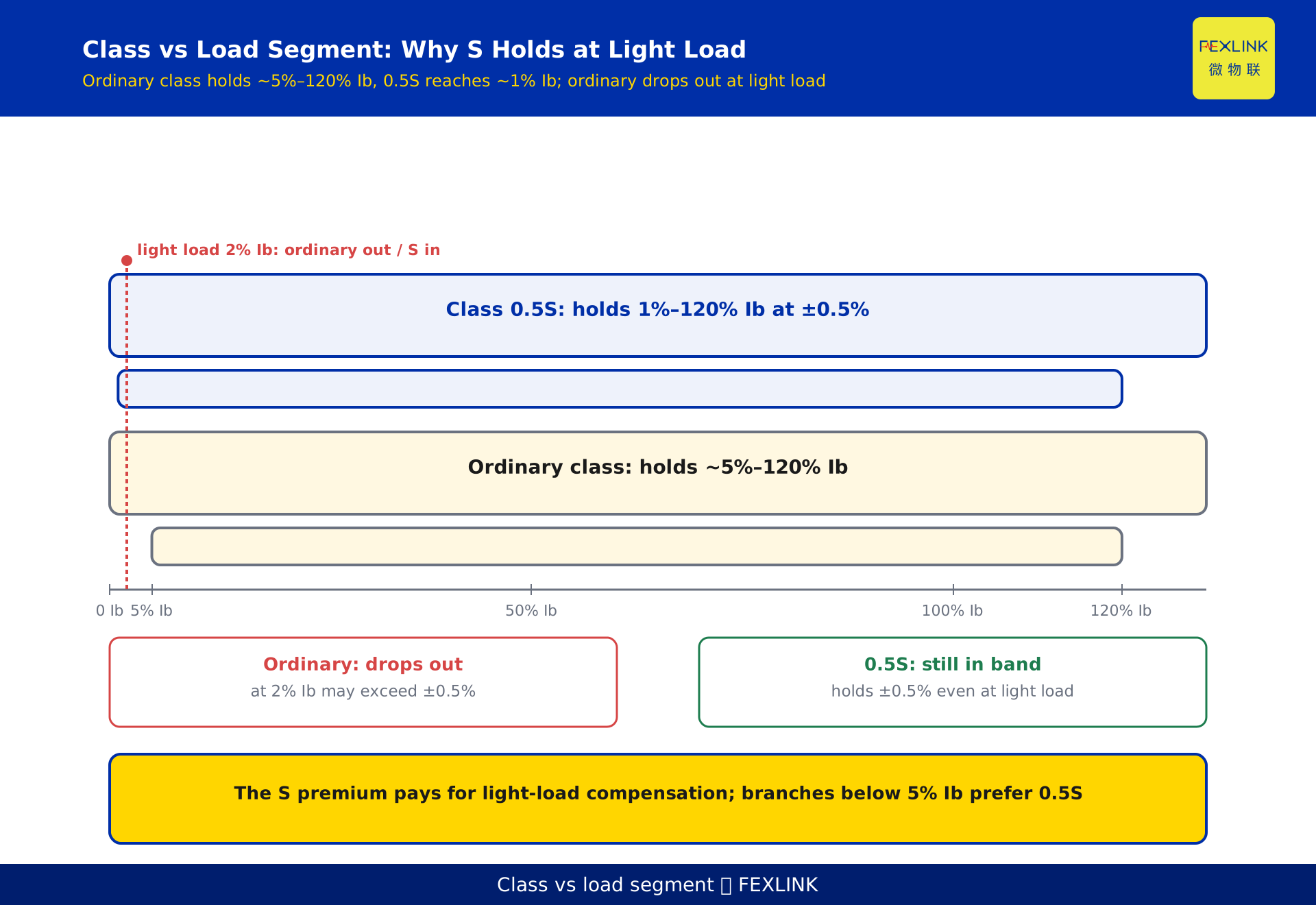
An ordinary class (such as class 0.5) typically holds its accuracy only from about 5% of rated current Ib downward — below that, in the light-load region, it "drops out of guarantee" and the reading may exceed ±0.5%. The 0.5S class pushes the accuracy-holding range down to about 1% Ib and keeps ±0.5% all the way up to 120% Ib (per IEC 62053-22).
Why does this matter? Many metering points run at light load year-round: street-lighting circuits, night standby, small branch loads — currents may be only ten or twenty percent of rated. On an ordinary class 0.5 meter, the light-load reading can drift; on a 0.5S meter it stays in band. The S is not "more precise," it is "does not drop out at light load" — the one point most easily missed when selecting a tariff or assessment meter.
3. How much does a class gap actually cost: a worked example
The following is a constructed example to show the arithmetic; the figures represent no real customer or project.
A campus substation, annual energy 12 million kWh. If its tariff point is moved from class 0.5S (±0.5%) to class 1.0 (±1%), the error-band gap is Δ = 0.5 percentage points. Upper bound of annual deviation energy = 12,000,000 × 0.5% = 60,000 kWh At an illustrative tariff of 0.70 CNY/kWh, the value of that deviation energy = 42,000 CNY per year
This is the "annual cost of a class gap = annual energy × error-band gap." The point is not the number itself but its scale: the larger the annual energy, the more money the same half percentage point represents; at small scale, half a point is only a few thousand kWh, far less than the purchase premium of a higher-class meter.
4. Why the sum never reconciles: the trap of a low class
Pain point one: to save on unit price, a low-class meter is chosen for the settlement tariff point. The settlement reading goes straight onto the bill, and its band is wider than it should be, so the monthly reading is systematically a few tenths of a percent high or low; over a year the totals stop reconciling, and the operator is told to replace and re-install the meter, or even to top up the bill on the counterparty's figures — a cost far beyond the meter saving originally chased.
The opposite pain point: specifying 0.5S tariff meters everywhere. Management points (breakdown, assessment, diagnosis) feed only internal reports; what they need is comparability and visible trends, and the extra precision of 0.5S over 1.0 is unusable in that analysis. Management points are often more than ten times as numerous as settlement points, so fitting 0.5S throughout multiplies the budget.
5. How DL/T 448 grades each metering point
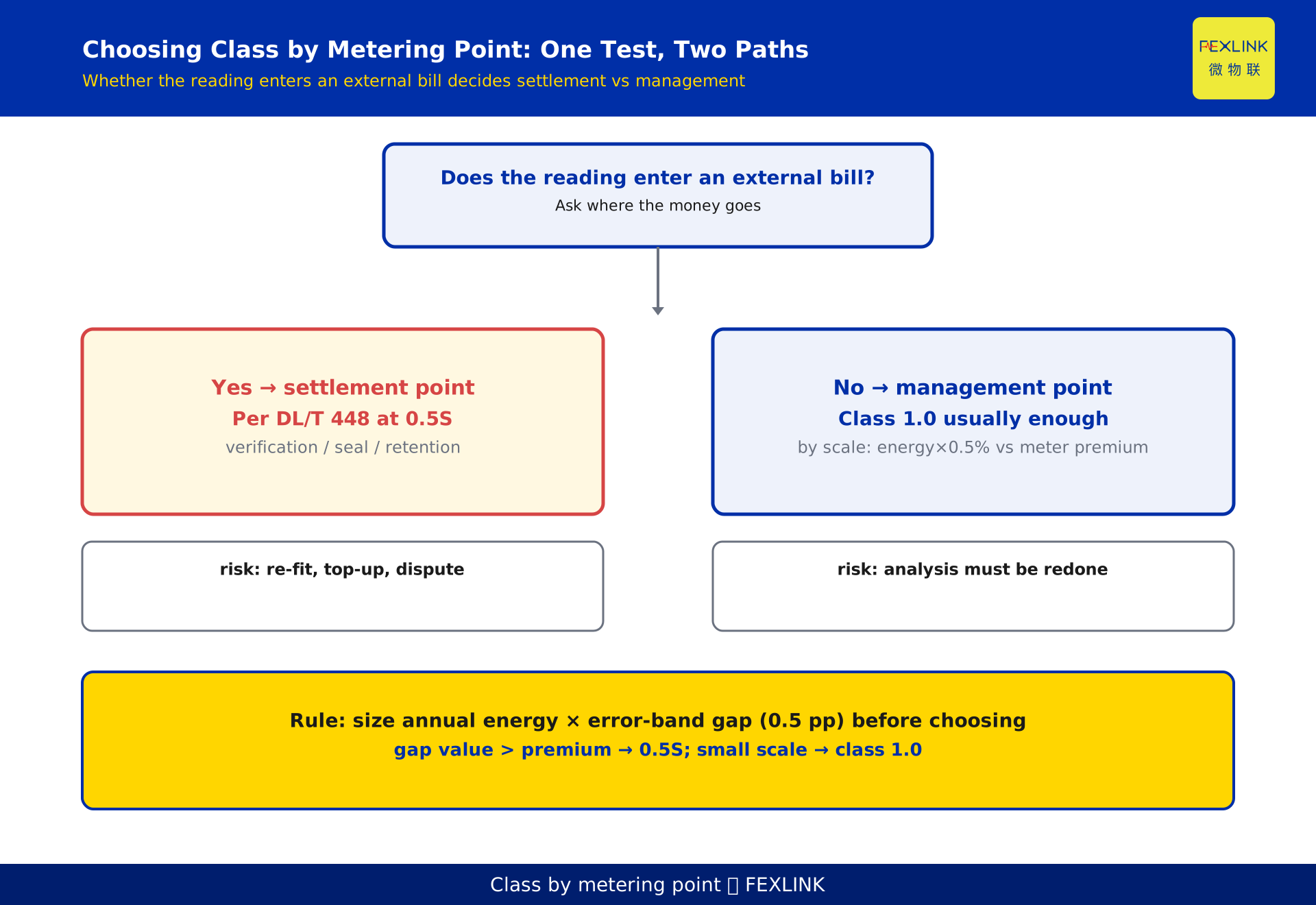
DL/T 448 assigns accuracy classes by the importance of the metering point: the closer to "money," the higher the requirement. Tariff points — the grid boundary, trade settlement, and external transfer or tenant billing — require a high class with verification, sealing, and data retention. Internal management metering for breakdown, assessment and diagnosis is usually fine at class 1.0. The exact clause numbers and class tables follow the current DL/T 448; this article does not repeat the classification framework of KD-0451 but opens up the "math behind the numbers."
6. Class recommendations for three point types
- Tariff boundary / external settlement points: equip to the high class required by DL/T 448 (for example 0.5S), and require verification, sealing, traceability and tamper resistance; a reading that cannot survive challenge simply does not stand.
- Internal assessment points: class 1.0 is usually enough. Assessment compares "who is high, who is low, and for how long"; consistent basis and same-period comparability matter more than extra decimal places.
- Breakdown / diagnostic points: class 1.0 suffices; coverage density matters more than raising the class. Spend the money on "reaching the main circuits," not on "0.5S on every panel."
On the product side, this line leads naturally. The ZSA embedded multi-function smart meter suits high-density circuit metering on the management side, fitting a dozen panels in one cabinet; settlement positions that need long-term archiving and complete, queryable data are better served by an ESA all-element smart meter that supports full-element collection and retention. Model, range, channel count and communication interface are customizable items governed by the selection manual.
7. A desensitized engineering scene: a campus substation's selection math
A campus with one high-voltage tariff point, three transfer/tenant settlement points and sixty management points — sixty-four points in total. Settlement points are fitted at 0.5S, management points at 1.0:
- The value of deviation energy was computed in section 3: at a tariff-point annual energy of 12 million kWh, the error-band gap corresponds to 42,000 CNY per year — a scale that justifies 0.5S.
- The sixty management points each see annual energy on the order of a few hundred thousand kWh; the deviation-energy value implied by the band gap is far smaller than the purchase premium of a 0.5S meter, so class 1.0 is the economical choice.
- Conclusion: put the budget into the class and retention of the four settlement points; run the sixty-four management points at 1.0, and the whole stays compliant without being crushed by precision premiums.
8. Decision rule: size the bill first, then pick the class
A rule you can actually execute, with no "it depends":
- First ask where the money goes: does the reading enter an external bill? If yes, it is a settlement point — equip to the DL/T 448 class. If no, it is a management point — class 1.0 is usually enough.
- Then size the scale: for a settlement point, compute annual deviation energy = annual energy × error-band gap (the 0.5 percentage points that 0.5S saves over 1.0). When that deviation-energy value exceeds the premium of a higher-class meter, go to 0.5S; at small scale, class 1.0 already meets the bar.
- List light-load points separately: branches that run below 5% Ib year-round should prefer 0.5S, since ordinary classes drop out there.
In one line: do the math first, then choose the class; settlement by the rule, management by the scale.
9. Common misconceptions
- Misconception one, "higher precision is always better." Putting 0.5S on management points buys decimal places nobody uses.
- Misconception two, "the class decides everything." Even an accurate meter fails settlement if the ratio is mis-set, the seal is absent, or retention is missing.
- Misconception three, "light load does not matter." A light-load point on an ordinary class can drift undetected.
FAQ
Q: How far apart can readings of class 1.0 and 0.5S be?
In band width. Near full load, class 1.0 may stray up to ±1% while class 0.5S may stray up to ±0.5%; in the light-load region an ordinary class may drop out beyond ±0.5% while 0.5S still holds. The absolute gap grows with energy.
Q: Should internal management meters also go to 0.5S?
Generally no. Management metering needs comparability and visible trends; class 1.0 is usually enough. Keep the budget for the class, verification and data retention of settlement points.
Q: Why care so much about the S rating on light-load circuits?
Light-load currents may be only ten or twenty percent of rated, where ordinary classes lose guaranteed accuracy and the reading becomes unreliable; 0.5S extends the accuracy-holding range down to about 1% Ib, staying in band even at light load.
Q: Must we really follow DL/T 448 for the class?
Settlement and tariff metering must be equipped with the accuracy class, verification and sealing it requires; internal management metering is usually fine at class 1.0. The exact classes and periods follow the current DL/T 448; this article cites no clause numbers.
Q: How do I quickly decide whether to go to 0.5S?
Do one sum: annual deviation energy = annual energy × 0.5% (the error-band gap). When the electricity value of that deviation energy exceeds the premium of a higher-class meter, go to 0.5S; at small scale, class 1.0 is sufficient.
Scope and limitations
- This article extends the classification framework of KD-0451, focusing on the accuracy-class numbers (0.5S / 0.5 / 1.0) and the meaning of the S rating; its increment is the algorithm "annual cost of a class gap = annual energy × error band." Classification and configuration flow are in KD-0451.
- The error bands are definitional knowledge: class 1.0 ±1% and class 0.5S ±0.5% refer to allowed error under reference conditions; the S rating's light-load accuracy-holding range (about 1%–120% Ib) follows IEC 62053-22, and the ordinary-class lower bound of about 5% Ib is a common contrasting statement.
- The accuracy-class allocation and verification/sealing requirements of DL/T 448 follow the current valid version; this article cites no clause numbers and does not reproduce its class tables.
- The annual energy of 12 million kWh, the error-band gap of 0.5 percentage points, the annual deviation energy of 60,000 kWh, the illustrative tariff of 0.70 CNY/kWh and the converted 42,000 CNY per year in sections 3 and 7 are all constructed examples for illustrating the algorithm, representing no real customer, project or quotation; actual selection must be computed from on-site annual energy, tariff and meter quotations.
- Products referenced — the ZSA embedded multi-function smart meter, the ESA all-element smart meter and the digital electrical intelligent supervision system — have parameters, ranges, channel counts and communication interfaces that are customizable, governed by the latest selection manual and product knowledge base; this article is not a procurement recommendation.
Frequently Asked Questions
How far apart can readings of class 1.0 and 0.5S be?
In band width. Near full load, class 1.0 may stray up to ±1% while class 0.5S may stray up to ±0.5%; in the light-load region an ordinary class may drop out beyond ±0.5% while 0.5S still holds. The absolute gap grows with energy.
Should internal management meters also go to 0.5S?
Generally no. Management metering needs comparability and visible trends; class 1.0 is usually enough. Keep the budget for the class, verification and data retention of settlement points.
Why care so much about the S rating on light-load circuits?
Light-load currents may be only ten or twenty percent of rated, where ordinary classes lose guaranteed accuracy and the reading becomes unreliable; 0.5S extends the accuracy-holding range down to about 1% Ib, staying in band even at light load.
Must we really follow DL/T 448 for the class?
Settlement and tariff metering must be equipped with the accuracy class, verification and sealing it requires; internal management metering is usually fine at class 1.0. The exact classes and periods follow the current DL/T 448; this article cites no clause numbers.
How do I quickly decide whether to go to 0.5S?
Do one sum: annual deviation energy = annual energy × 0.5% (the error-band gap). When the electricity value of that deviation energy exceeds the premium of a higher-class meter, go to 0.5S; at small scale, class 1.0 is sufficient.