 FEXLINK Research Institute
The short answer
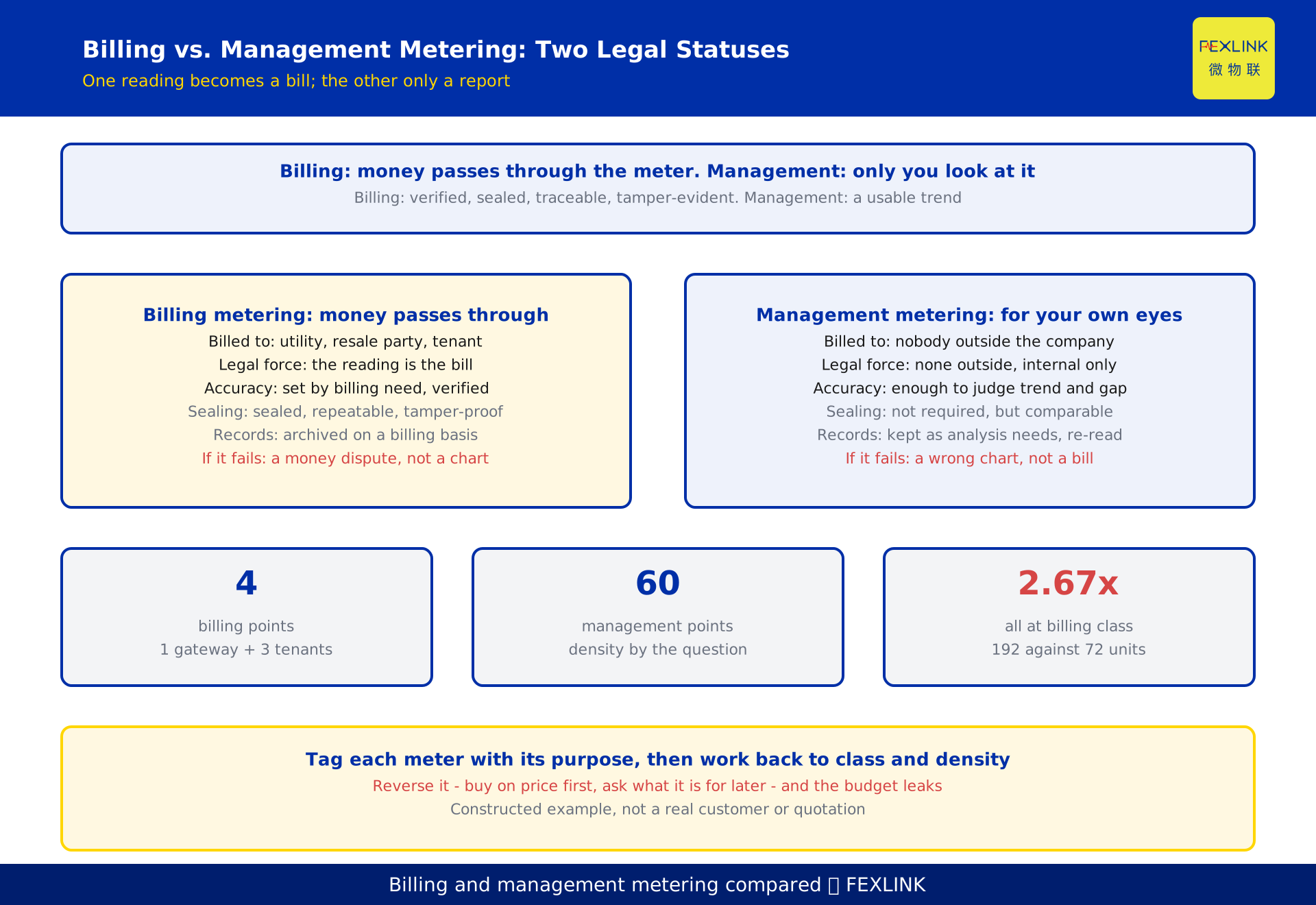
Billing metering is the meter money passes through. Its reading becomes an invoice: the power you buy from the utility, resell inside a park, charge to a tenant, or apportion for common areas. Management metering is the meter you look at yourself. Its reading goes into a report, a performance review, a diagnosis, and never into anyone else's bill.
Same enclosure, two legal statuses. A billing point must be verified, sealed, traceable and tamper-evident; when it drifts, the number has to be reproducible and arbitrable. A management point only has to be accurate enough to show a trend and a gap.
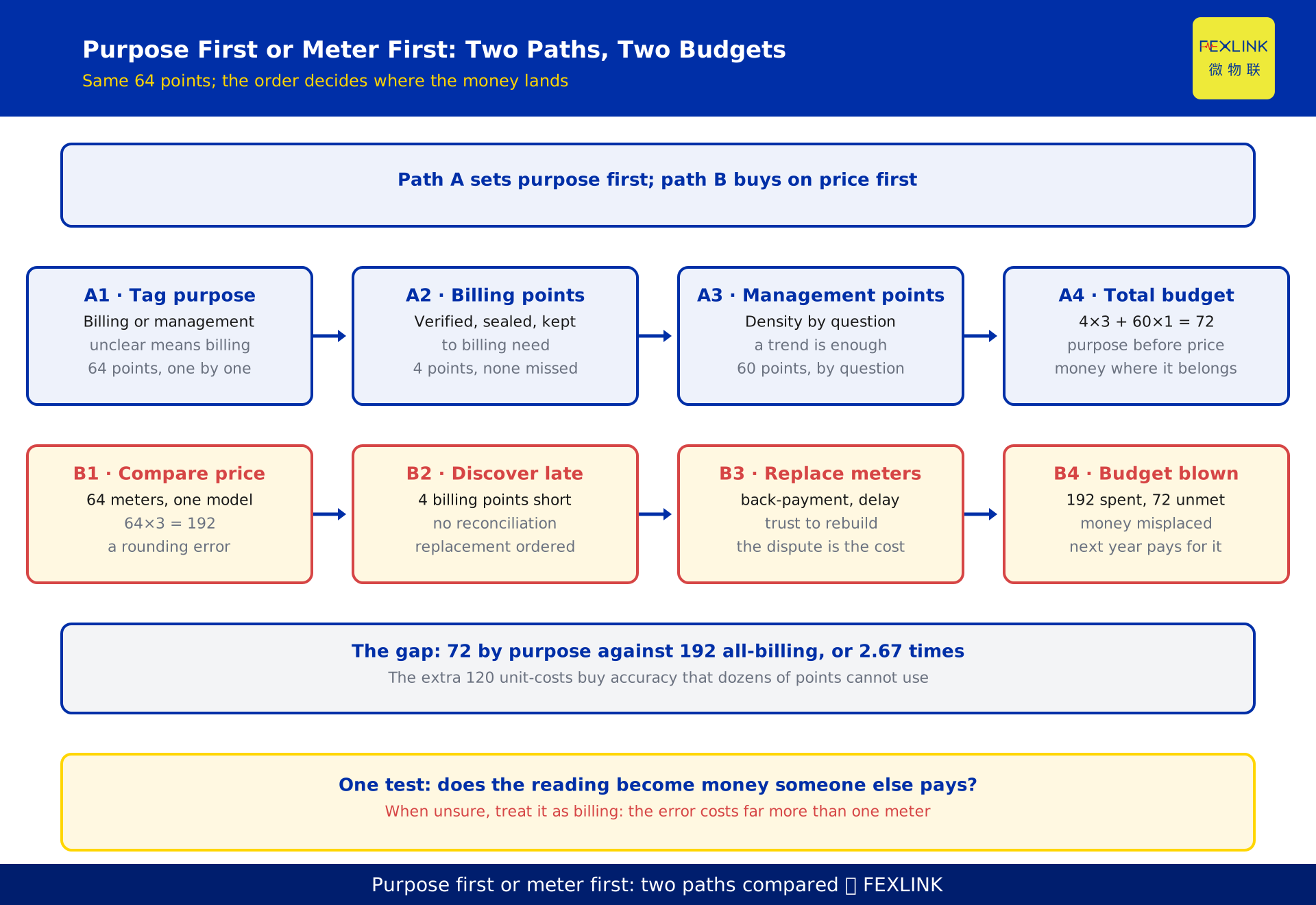
So tag every point with its purpose first, work back to accuracy class and density, then cost the result. Reverse that order — compare prices, buy meters, then wonder what each is for — and the budget leaks.
1. Same enclosure, two legal statuses
Two meters in one cabinet can look identical. One reading becomes an invoice at month end; the other appears on page three of a weekly report. The difference is not the hardware. It is whether the number on this meter turns into money.
Three questions settle the classification:
- Will this reading appear on a bill to a party outside the company?
- When the numbers disagree, will that party ask to recompute or arbitrate?
- If the meter is wrong, is the loss money — or just an analysis to be redone?
One yes makes it a billing point. Three noes make it a management point.
The order matters: ask about the path of the money before you ask about the features of the meter. Do it the other way and someone will say the meter is fully featured, so it can go anywhere. That sentence is where budgets start leaking.
2. Billing metering: money passes through this meter
The definition is short: the measurement result is used directly as the basis for settlement with an outside party — utility, another entity in the park, tenant.
Because the number settles money, four requirements are not optional.
Verified. The meter must demonstrate its accuracy; a manufacturer's claim is not a demonstration. Verification and rotation intervals follow current DL/T 448 and local metering rules; none is given here.
Sealed. The seal exists so that "nobody touched it" can be evidenced: if wiring or parameters change, the seal leaves a trace, and a dispute has a shared basis.
Traceable. From reading to invoice, every step leaves a record: reading, multiplier, tariff, apportionment rule, issue time. Break the chain and the dispute stops at that link.
Tamper-evident. Parameter settings, tariff switching and data edits need permission control and a log, so that "it was never changed" can be proven.
Together they produce one outcome: a problem must be reproducible and arbitrable.
A mis-specified billing point is therefore not merely "inaccurate data", which can be corrected in a report. It is a dispute about money — accounts do not reconcile, the meter is replaced, back-payment may follow, usually far more than the money saved on the meter.
3. Three billing scenarios: gateway, resale, tenancy
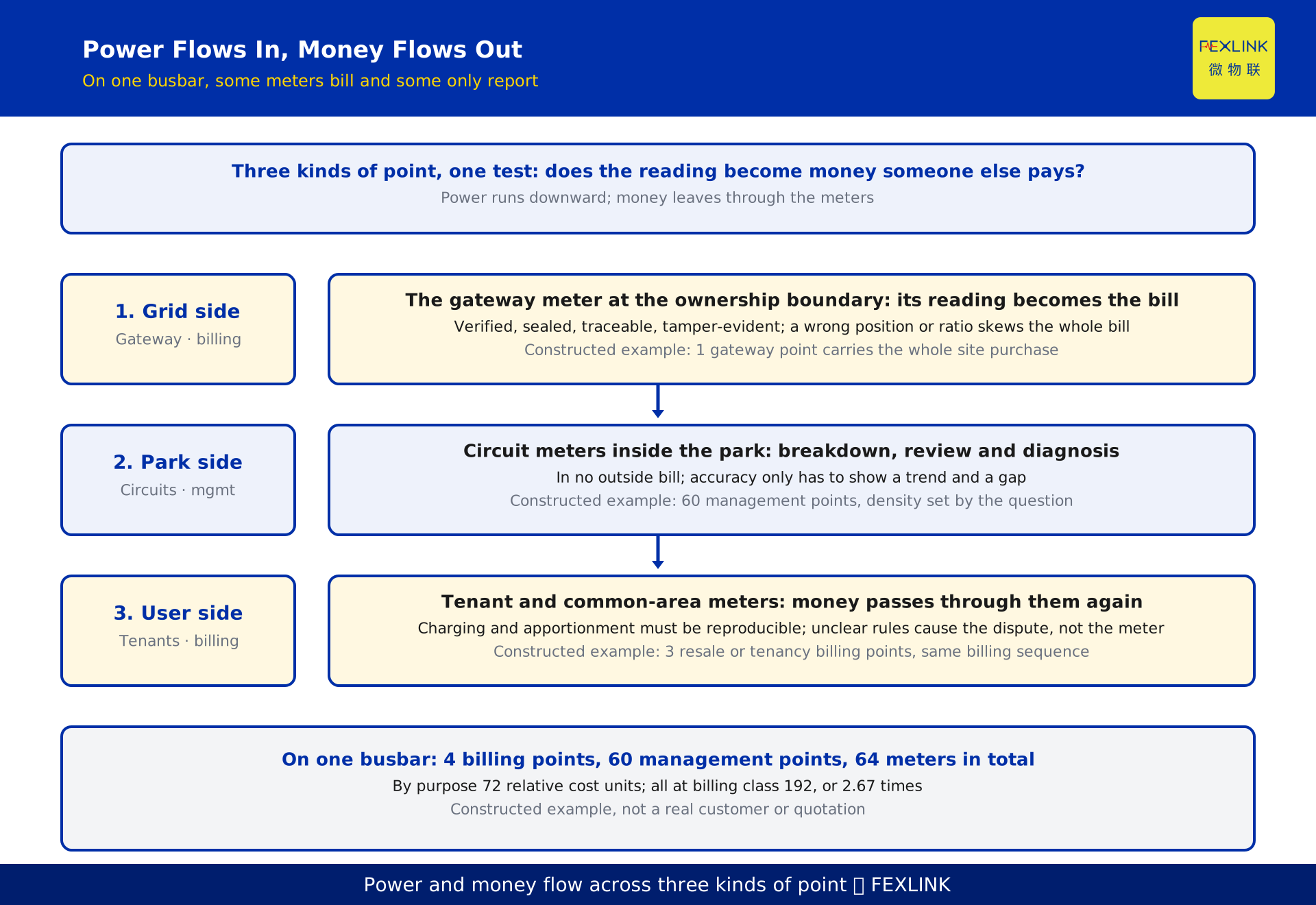
Billing metering lands on three kinds of point, all sharing one sentence: money passes through this meter.
① Gateway metering. At the point of ownership demarcation between user and utility, it is the legal basis for the bill and usually the boundary of asset and responsibility. Put it in the wrong place, wire it wrong, or set the multiplier wrong, and the whole bill is wrong — and wrong in a way that looks right, because readings stay smooth. A supply point normally has one gateway, so no cross-check between meters will catch the error — only periodic verification.
② Resale metering. A park, commercial complex or industrial estate supplies power to other entities inside it and charges them. This is the case most often mistaken for an internal matter: everyone is inside one fence. But once money changes hands, it is external settlement. The hidden difficulty is allocating losses and common-area use: what comes in is gateway energy, what goes out is sub-meter energy, and the difference needs a rule every party accepts. For it to hold, the sub-meter data must survive a re-check.
③ Tenancy metering. Charging tenants for electricity and apportioning common areas — lifts, lighting, chillers, pumps. Disputes are usually not about accuracy but about an apportionment rule never written down: area or consumption, vacant units, the month of departure.
4. Management metering: not in the bill, only in the report
Management metering serves internal management only, in three uses.
Breakdown. Splitting consumption into lighting, HVAC, motive power and special processes, to answer where the electricity goes.
Performance review. Comparing workshops, crews, lines or machines: who is high, who is low, for how long. What matters is comparability — same meters, basis and period. Inconsistent bases turn a review into an argument.
Diagnosis. Finding anomalies, benchmarking, identifying savings. What matters is seeing a difference: a line well above its peers is worth investigating; one slightly above may just be a different load profile.
The accuracy requirement across all three: enough to judge a trend and a gap. Fitting management points to billing-class meters buys no extra analytical value, because the analysis is limited by load variation, production rhythm and statistical basis — factors far larger than meter class.
5. DL/T 448: why one standard covers both jobs
Both kinds of metering rest on one document: DL/T 448-2016, Technical management code for electrical energy metering devices. It is an electric power industry standard issued by the National Energy Administration, effective 2017-05-01, applying to the technical management of metering devices used for trade settlement and economic and technical assessment across generation, transformation, transmission, distribution and consumption.
That sentence supports this article's argument: one document places trade settlement and economic-technical assessment inside a single technical management framework. Same origin, so they share one system; different requirements, so they cannot share one grade.
Note what the standard does not do: it governs how a device is technically managed, not which category a meter belongs to. The company declares the purpose attribute first; the standard attaches requirements to it. Classification and accuracy-class requirements follow current DL/T 448; no clause numbers or class tables appear here — that is KD-0455's job.
6. Purpose first, meter second: a four-step configuration
Step one: inventory the points and tag each purpose. The list carries point ID, circuit, measured object, purpose, whether an outside party is charged, and owner. The purpose column accepts only billing or management; anything unclear is treated as billing (see section 8). This step costs nothing and sets the direction of the next three; budget overruns usually start here.
Step two: specify the billing points to billing requirements. Accuracy class (set by settlement need, not by "higher is better"), verification and sealing, calibration and cross-check, communication and data retention. Retention is most often skipped — billing data earns its keep on the day of the dispute.
Step three: specify the management points to the analytical granularity. Answer what judgement the meter supports before deciding density and accuracy: a breakdown by end use means metering the main end uses; per-line intensity means the line incomer; fault-finding means the key equipment. Granularity sets density, and density drives most of the budget.
Step four: total the budget. Only now does a budget mean anything: what must be spent, what can be trimmed, whether the saving can move to calibration and retention at the billing points. When you cut, cut granularity — not settlement requirements.
One companion decision: keep billing and management data in separate ledgers — different retention, permissions and outlets; that is where a platform such as the digital electrical supervision system earns its place.
7. Two classic mismatches, and where the money goes
Mismatch one: a low-grade or unverified meter on a billing point. The usual story: a park retrofit standardises on one model and buys it for the gateway and internal points alike. The internal points are fine; the gateway is not. Figures no longer reconcile with the utility, the meter is ordered replaced, back-payment may follow. Cost comes in three layers: replacement, back-payment or concession, and the time spent rebuilding trust.
Mismatch two: gateway-class meters on every management point. The usual story: "higher accuracy is better" becomes a purchasing principle, and dozens of management points go to billing class. Unit cost rises several-fold and analytical value does not: management analysis needs comparability, not the same trend at more decimal places. The arithmetic is easy to miss: management points usually outnumber billing points by more than ten to one, so a multiple on unit price becomes a multiple on the budget.
A constructed example (relative multiples; not a real quotation or customer). A park has 1 gateway point, 3 resale or tenancy billing points and 60 management points — 64 in total. Take a management-class meter's unit cost as 1, a billing-class meter's as 3:
- Configured by purpose: 4 × 3 + 60 × 1 = 72
- All at billing class: 64 × 3 = 192, which is 2.67 times 72, or 120 extra unit-costs
- All at management class: 64 × 1 = 64, apparently saving 8, but 4 billing points no longer meet the requirement
The third saves 8 and buys replacement and dispute. The second spends 120 more and buys accuracy nobody uses. Opposite directions, same root: the meters were bought before anyone decided what they were for.
8. A point list and one conservative rule
The list looks like this, one row per point:
| Point | Circuit | Measured object | Purpose | Accuracy and sealing | Retention |
|---|---|---|---|---|---|
| P-01 | HV incomer | Whole-site purchase | Billing | To billing requirement, sealed, periodic calibration | Long-term archive |
| P-02 | Transformer 1 LV side | Building 1 total | Management | Enough for trend | As analysis needs |
| P-03 | 3F tenant panel | Tenant consumption | Billing | To billing requirement, sealed | Long-term archive |
With the list, meter selection has a basis; without it, selection becomes a price comparison.
One conservative rule: when the purpose is unclear, treat the point as billing. The errors are not symmetric. Calling a billing point "management" costs a replacement, a back-payment and a dispute; calling a management point "billing" costs one extra meter. Lean to the controllable side and revisit the over-specified points next project.
Product choice follows: dense management circuits suit panel-mounted meters that meter per circuit, a role filled by the ZSA embedded multi-function smart meter. Billing positions needing long-term archiving suit an ESA all-factor smart meter, which supports all-factor measurement and data retention. Model, range, channels and interface are configurable; the selection manual governs.
Frequently asked questions (FAQ)
Q: Can I use a management meter on a billing point for now and sort it out later?
No. The difference is not whether it measures but whether it can serve as a settlement basis: verification, sealing, traceability, tamper evidence. Miss one and it may not hold in a dispute.
Q: Should internal performance meters also be sealed and verified?
Not mandatory. What matters is comparability: same batch, basis and period. Keep a periodic cross-check; full sealing and archiving are not required.
Q: Do resale and tenancy count as "external"?
Yes. Once money changes hands, the reading becomes an amount someone else pays — inside one legal entity too: once an apportionment rule reaches a bill, that meter is billing.
Q: Can both kinds of meter sit on one platform?
Yes, but keep separate ledgers: different retention, permissions and outlets. On a single dashboard, billing data gets edited or deleted casually and the traceability chain breaks.
Q: It is already wrong. Which end do I fix first?
Fix the billing points. Re-walk the list against "money passes through this meter" and complete verification, sealing and retention there. Downgrading management points can wait a cycle.
Q: How far apart are class 0.5S, class 0.5 and class 1?
That is a question about the accuracy classes themselves, which this article deliberately does not open. Error limits and applications are covered in KD-0455.
Scope and limitations
- This article covers the classification framework and the configuration decision: classify by purpose, then work back to accuracy class and density. The error limits belong to KD-0455; no class table appears here.
- The current edition governs. DL/T 448-2016, Technical management code for electrical energy metering devices, is an electric power industry standard issued by the National Energy Administration, effective 2017-05-01, covering trade settlement and economic-technical assessment metering from generation to consumption. Device classification and accuracy-class requirements follow the current text.
- This article gives no accuracy-class values, no verification or rotation intervals and no meter prices; intervals follow current DL/T 448 and local rules, prices follow a quotation.
- The figures 64 / 72 / 192 / 2.67 in section 7 are a constructed example using relative cost multiples, not a real customer, quotation or industry average; the arithmetic is self-consistent.
- For carbon accounting, apply the current GB/T 32150 (2025 edition, effective 2026-07-01, replacing 2015). No emission factors are given.
- Product side: the ZSA embedded multi-function smart meter serves dense management circuits; the ESA all-factor smart meter serves positions needing long-term archiving; the digital electrical supervision system and the 4×3×2 energy-carbon autonomy framework carry the separation of the two data streams. Parameters follow the selection manual; this is not a procurement recommendation.
Frequently Asked Questions
Billing Metering vs. Management Metering
Billing metering is the meter money passes through