 FEXLINK Research Institute
The short answer
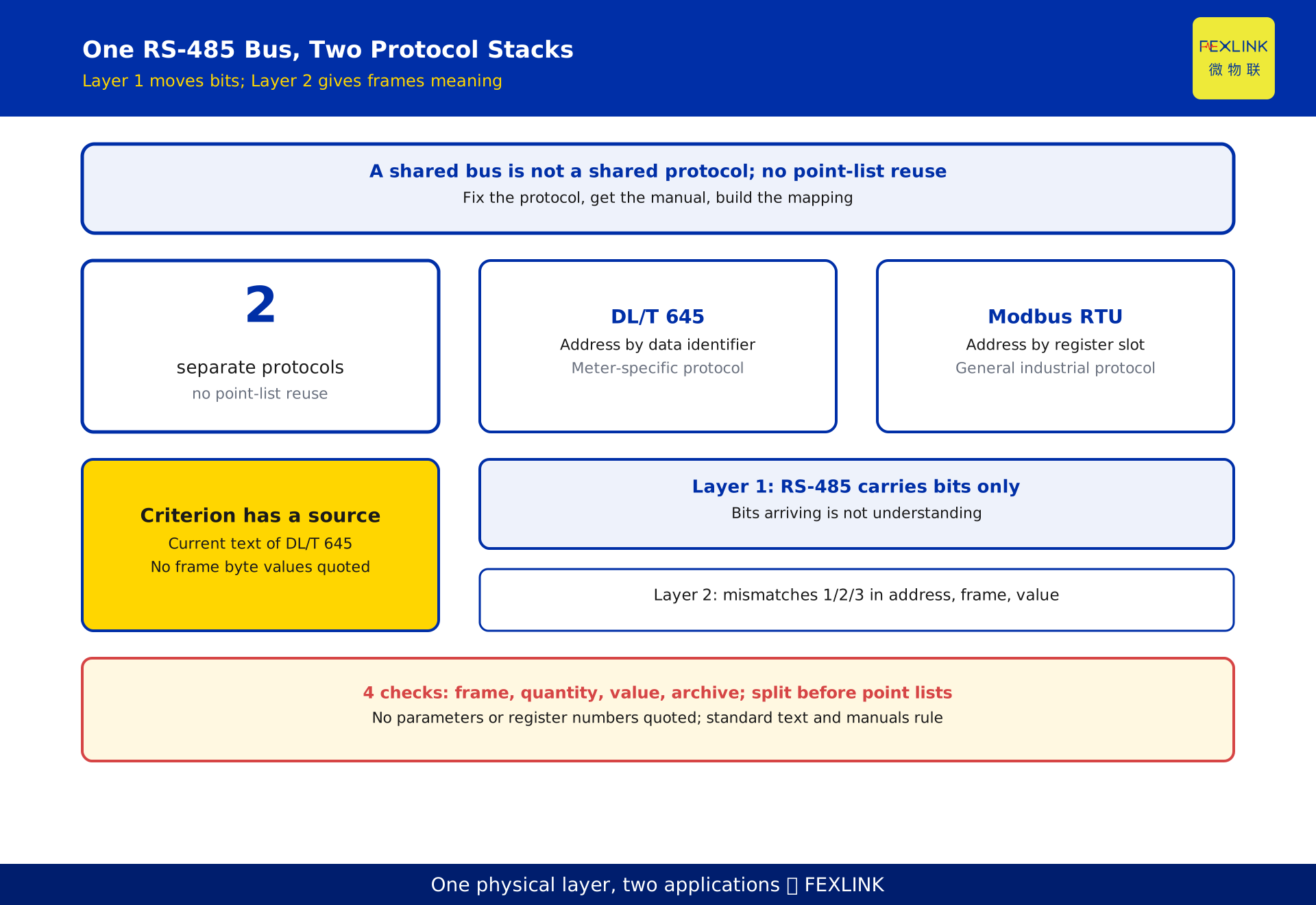
DL/T 645 and Modbus RTU are not interchangeable. Both can run on one RS-485 bus, yet they are different application-layer protocols: the first is an industry protocol for multifunction energy meters addressing quantities by data identifier, the second a general industrial protocol addressing them by register address. Reading a DL/T 645 meter with a Modbus point list will not work. Confirm from the nameplate, the vendor manual or a captured frame which protocol the meter speaks, then parse it with a gateway that supports it. If the platform accepts Modbus only, the gateway performs conversion; the point list is not edited to force a read.
One bus, two application-layer protocols
RS-485 covers the physical layer only: differential-pair electrical behaviour, how bits leave the driver and how devices share the bus. It says nothing about whether bits mean voltage, energy or status. A wired bus proves that bits arrive, not that both ends understand them. Both device kinds may share one bus, but framing must be consistent or each side treats the other frames as noise.
The confusion sits above it. Layer 1 is the physical layer; Layer 2 is framing plus the application protocol. DL/T 645 and Modbus RTU each define how a frame starts and ends, how addresses are carried, how a request is expressed and how a reply is checked. Confirm Layer 1 first, then decide which protocol Layer 2 uses; the order cannot be reversed. "Both are serial, both use RS-485, so they should be similar" is the usual trap: matching parameters only guarantees that bytes arrive. Which rule cuts those bytes into frames, and which field carries which quantity, is fixed by the protocol alone.
DL/T 645: frames and data identifiers
DL/T 645 is a power-industry standard, the communication protocol for multifunction energy meters. It governs exchange between a meter and a data terminal and specifies the interface, data-link frame format and application commands; reading, writing and broadcast time setting each have a command form. This article describes structure only. It quotes no start delimiter, address-field length, checksum algorithm or parameter: values follow the currently effective standard text, the nameplate and the vendor manual.
Addressing is the key difference. Each quantity is named by a data identifier: the request states which identifier to read and the reply carries the data for it. Quantities are organised by identifier, not laid out in consecutively numbered slots. Identifier length and encoding may also differ between versions, so whether the same quantity carries the same identifier on two meters must be checked in the manual, never assumed. The frame is equally self-contained, with fixed positions for start, address, control, length, data, check and end. A Modbus tool sending a read-register request produces no valid DL/T 645 command; the meter stays silent or discards the frame.
Modbus RTU: register addressing
Modbus RTU is a general industrial protocol built on master-slave polling: one master issues a request and only the addressed slave replies. A request carries a slave address, a function code, a starting register address and a quantity; the function code says which register class to read, and the address says which slot to start from. Frame boundaries come from silence on the bus rather than from a fixed start delimiter.
A point list maps each quantity to a register class, slot, word count, byte order, scaling and unit. It is supplied by the vendor, not derived from the protocol; the same quantity in a different slot is normal, not a fault. The order on the Modbus side is manual, point list, reading. Filling a DL/T 645 data identifier into a register address may return a number, but nothing establishes which quantity or scaling it represents: a value is read but cannot be trusted.
Why a point list cannot be reused: three mismatches
Mismatch 1 is the addressing target. DL/T 645 finds a quantity by data identifier while Modbus finds one by register slot, with no natural one-to-one correspondence. Treating the identifier code as an address yields neither the intended quantity nor any agreed quantity.
Mismatch 2 is framing and addressing. Start and end rules, address fields, control fields and checks differ, and a meter address is not a slave number. Sending one protocol request to a device speaking the other usually returns no valid reply at all.
Mismatch 3 is data representation. Encoding, byte order, scaling and units for the same energy value may differ across the two systems. Even after a mapping is built, its source and the verification record must be written down item by item. The conclusion is plain: protocol conversion means parsing plus mapping, not reusing a point list under a different filename.
Fix the meter version and the vendor manual first
Before touching a point list, fix three things in a recordable form: the nameplate and port marking, the vendor protocol manual, and one captured request-and-reply pair. Together they establish whether the meter speaks DL/T 645 or Modbus RTU, which version, and what its parameters and address are. With no manual, capture frames first; do not guess register addresses. Never guess the version either: identifier systems may change between versions, and the same model in another batch may be configured differently. "Supports DL/T 645" says nothing about a point list. Record version, parameters and address so replacement and later reproduction have a baseline.
This is also where the scope ends. Physical wiring and bus-parameter checks have their own article, as does the full workflow for bringing an unknown meter online. This article addresses one question only: why two protocols cannot be interchanged. It does not repeat wiring steps or a meter-reading workflow.
How a gateway serves both protocol families
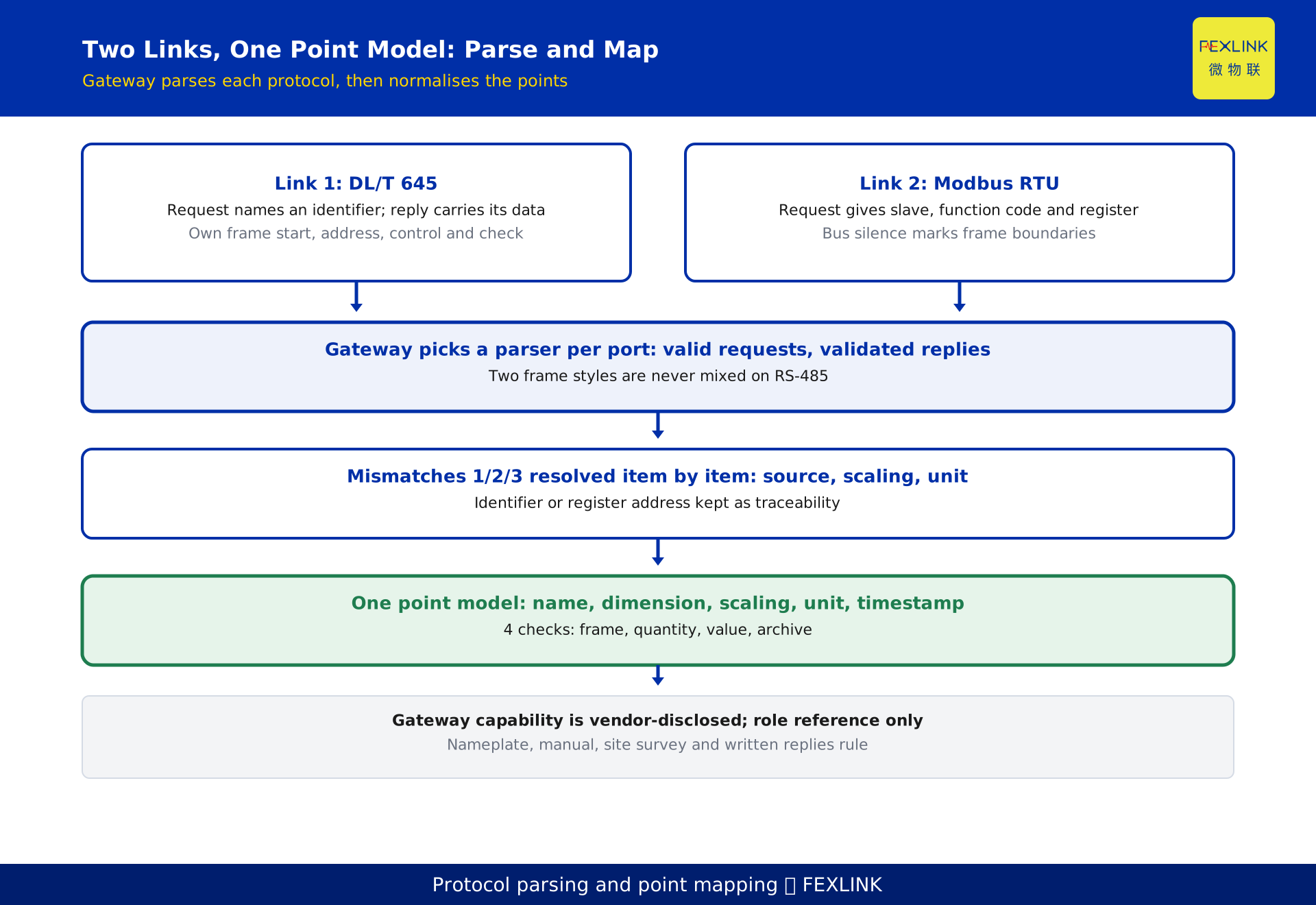
When both meter families are present, the landing point is the gateway, not a debugging tool. The gateway selects the matching parser per port or per meter, sends valid requests and validates replies on each link, then maps both sides into one platform point model: point name, dimension, scaling, unit and timestamp are unified, while the source protocol and the original identifier or register address are kept as a traceability field.
The FEXLINK FG-0221-ER protocol-conversion gateway handles downstream parsing and conversion, the FEXLINK ESX-0223-GR edge computing gateway handles aggregation and uplink, and the L1 access layer of the Taiyi intelligent control hub normalises points after multi-protocol parsing. These names and capabilities are vendor-disclosed and appear here only as role references; they are excluded from the conclusion, selection advice and acceptance criteria. Exact models, port counts and protocol lists follow the nameplate, selection manual, site survey and written vendor replies.
The principle is two links and one point model. The platform sees one point name, but the record must retain which protocol, identifier or register slot produced it; otherwise a later review, scaling change or meter swap cannot be traced. Forcing both families into one Modbus point list erases that field.
Commissioning order: frame, quantity, value
Step 1 is framing: confirm the physical layer, parameters and address, capture one complete request and reply, and identify the protocol type and version. This step asks only whether a valid reply exists, not what the value is.
Step 2 is the quantity: read one known quantity using that manual, align reply fields with the point list, and write down the identifier or register address, byte order, scaling and unit. Cross-check against the meter display to confirm the intended quantity, not its neighbour.
Step 3 is the value: extend to all points, then check timestamps, quality flags, abnormal values and backfill, storing acquisition time separately from upload time. Step 4 is archiving: file the protocol version, parameters, point-list version, mapping table and verification record together. The order is fixed as frame, quantity, value, archive; jumping straight to values removes the anchor for any later investigation.
Worked example: a mixed-meter register
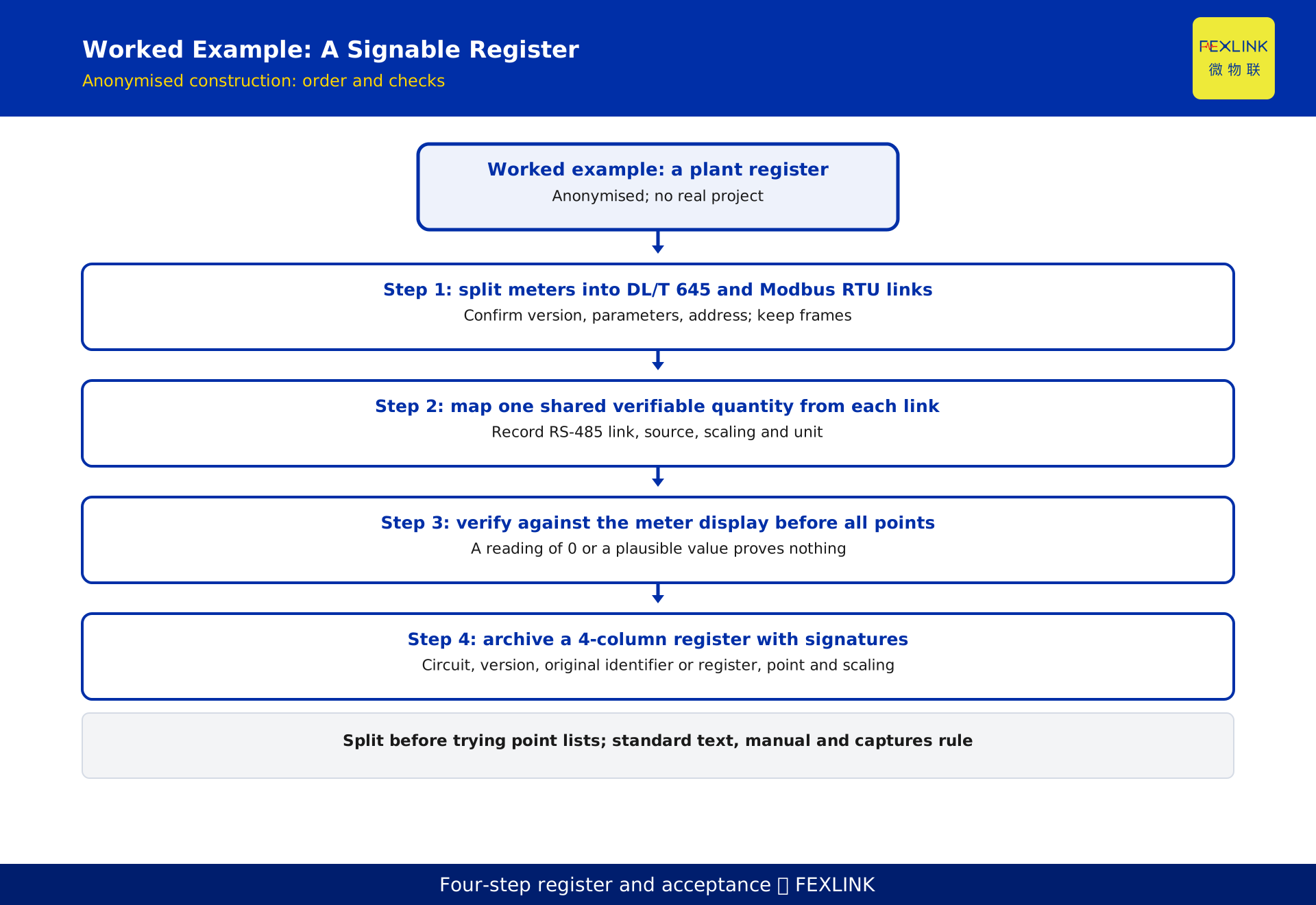
A plant distribution room holds two meter batches: one nameplate states DL/T 645, the other ships with a Modbus RTU point list, and the platform accepts unified points only. The example is anonymised, contains no customer, location or inferable combination, and represents no real project.
Step 1 splits the work. Group the meters by circuit into two links, one parsed as DL/T 645 and one as Modbus RTU; confirm version, parameters and address on each and keep captured frames. Step 2 builds the mapping. Pick one quantity both sides can verify, state its source identifier or register slot, byte order, scaling and unit, and map both to the same point name.
Step 3 verifies: read once on each link, compare with the meter display, and extend to all points only after the dimensions agree. Step 4 archives both point lists, the mapping table, captured frames and a signed check sheet in one register with 4 columns: circuit and meter address, protocol version, original identifier or register, and point with scaling. Missing any column leaves the job unfinished. Trying point lists before splitting stacks the errors of both batches.
Acceptance checks and scope boundaries
Acceptance watches three things. Protocol reproducibility: any meter can be captured with request and reply frames matching the record. Mapping reproducibility: recomputing a point from the mapping table matches the raw reply, with scaling and unit stated. Replacement reproducibility: after a like-for-like meter swap, re-checking the quantity from the register still matches. All three leave a signed record.
The boundary is clear. Modbus RTU layering and master-slave concepts, physical wiring and bus-parameter checks belong to other articles, as does the end-to-end workflow for an unfamiliar meter. This article answers what the relationship is, why the protocols cannot be mixed, and how the gateway and point list divide the work. It teaches no wiring, lists no frame fields and supplies no register map. One line sums it up: one bus is not one protocol, and one protocol is not one point list. Fix the protocol before choosing hardware, obtain the manual before writing a point list, and build the mapping before connecting a platform.
Frequently asked questions (FAQ)
Q: If both use RS-485, why can a Modbus tool not read a DL/T 645 meter?
RS-485 only guarantees that bits arrive. The tool emits a Modbus request frame, which the DL/T 645 meter parses under its own frame rules and cannot accept as a valid command. Reading depends on a shared application protocol, not a shared bus.
Q: What is the quickest way to tell which protocol a meter speaks?
Check the nameplate and the vendor manual, then capture one request-and-reply pair and compare its framing. If neither is available, ask the vendor for the protocol manual rather than reverse-engineering register addresses. Record version, parameters and address together.
Q: If the gateway converts protocols, is the vendor manual still needed?
Yes. Conversion makes frames parseable; which identifier or slot holds a quantity, and what scaling and unit apply, still come from the manual. A mapping table must be built from the manual and on-site checks, not invented by the gateway.
Q: Can both meter families share one RS-485 bus?
It is not recommended. Their framing and addressing rules differ, so sharing a bus invites interference. In practice each protocol gets its own port or link, and the gateway normalises them on the platform side; follow the site survey and device manuals.
Q: If a reading looks reasonable, is the point list correct?
No. Wrong scaling, byte order or a neighbouring quantity can yield 0 or a plausible value. Verify one known quantity against the meter display, write down the identifier or register, scaling and unit, then extend to all points.
Scope and limitations
This article applies to plants and distribution rooms that already have multifunction energy meters and need meters of different protocols feeding one platform; it addresses electrical engineers and protocol commissioning staff. The layering argument, three mismatches, gateway parsing plus mapping, four-step commissioning order and anonymised four-step register are engineering method summaries. They are not commitments about port counts, protocol lists, conversion performance or integration time.
DL/T 645 is cited only as the protocol source. No start delimiter, address-field length, checksum algorithm, communication parameter, identifier code or register number is quoted; values follow the currently effective standard text, the meter nameplate, the vendor protocol manual, captured frames and written vendor replies. Whether a device supports a protocol or version is settled by device documents and on-site verification; this article issues no compatibility verdict. The worked example is anonymised and represents no real project. The FEXLINK FG-0221-ER protocol-conversion gateway, the FEXLINK ESX-0223-GR edge computing gateway and the L1 access layer of the Taiyi intelligent control hub are vendor-disclosed names and capabilities used only as role references, excluded from the conclusion, selection advice and acceptance criteria. All deliverables remain DRAFT_PENDING_REVIEW and require independent review; the generator does not self-approve.
Frequently Asked Questions
What Is the Relationship Between DL/T 645 and Modbus
DL/T 645 and Modbus RTU are not interchangeable