 FEXLINK Research Institute
The short answer
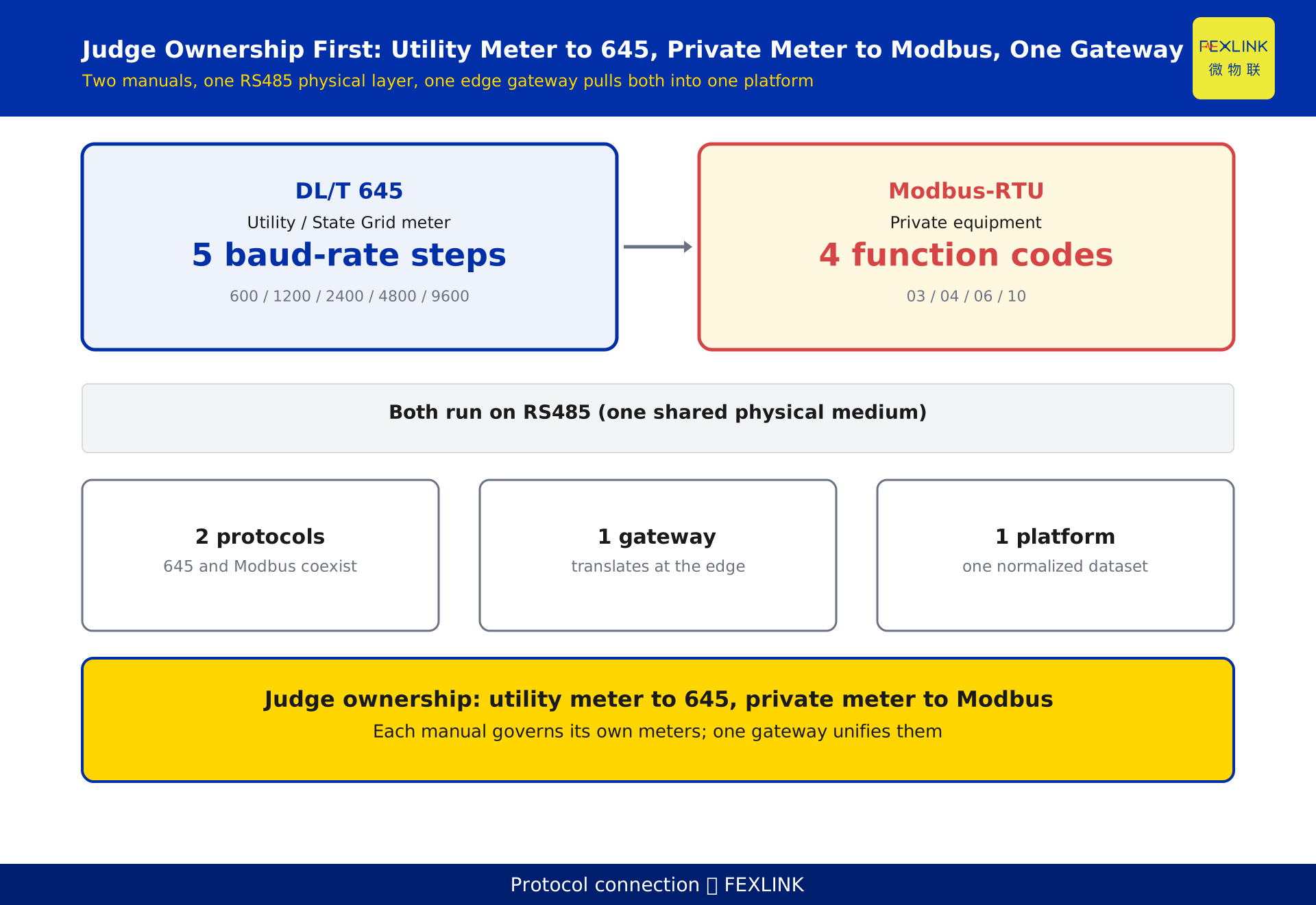
In a mixed-deployment project, when the utility's revenue meters and the company's own device meters cannot talk to each other, the equipment is not broken — two manuals are fighting. One sentence settles it: first decide whose meter it is. State Grid / utility meters are connected per DL/T 645; privately owned meters, inverters and VFDs are connected per Modbus-RTU. Both share RS485 at the physical layer, so one protocol-conversion gateway at the edge translates both and pulls the two meter families into the same platform. Getting this wrong is what forces "two drivers on the platform and a slipped schedule"; getting it right means each manual governs its own meters and one gateway closes the loop.
1. Two protocols, two birthplaces
DL/T 645 and Modbus-RTU come from completely different origins, and that is the root of every difference.
DL/T 645 (currently DL/T 645-2007, the Multifunction Electricity Meter Communication Protocol) is a communication standard the power industry tailor-made for electricity meters. It is master-slave and half-duplex, aimed mainly at utility-managed revenue and State Grid meters. Its goal is narrow but specialized: meter reading and metered-data acquisition. Its common baud rates are five steps — 600 / 1200 / 2400 / 4800 / 9600 — and its frame opens with 68H and closes with 16H, with a 6-byte address ordered low-byte first.
Modbus-RTU is a general-purpose master-slave bus protocol from the industrial world. Its physical layer runs over RS485 or RS232, and its frame is built from slave address, function code, data and CRC16. The common function codes are 03 (read holding register), 04 (read input register), 06 (write single register) and 10 (write multiple registers). It was not born for meters; it was born for "any device you might want to read or write" — inverters, VFDs, privately owned meters and PLCs all use it.
One is the "meter-specific language"; the other is the "industrial general-purpose language". That is the first boundary: the ownership of the meter decides which language to speak.
2. Why both can run on RS485
Despite very different application-layer frames, the two protocols are highly consistent at the physical layer: both DL/T 645 and Modbus-RTU commonly use the RS485 bus.
RS485 is a differential serial physical interface — half-duplex, multipoint, letting many slaves hang on one bus. It saves wiring and resists interference, which suits spread-out, fixed field devices such as meters and instruments. That is exactly why a utility's meters and a company's own meters often land on the same RS485 bus: they "speak" different protocols but "walk" the same road.
This is the premise that lets a mixed project be connected at low cost: you do not change the wire, you do not change the meter — you only translate the two protocols into one language at some node.
3. Frame structure: why the platform needs two drivers
The reason the platform "needs two drivers" lies in incompatible application-layer frames.
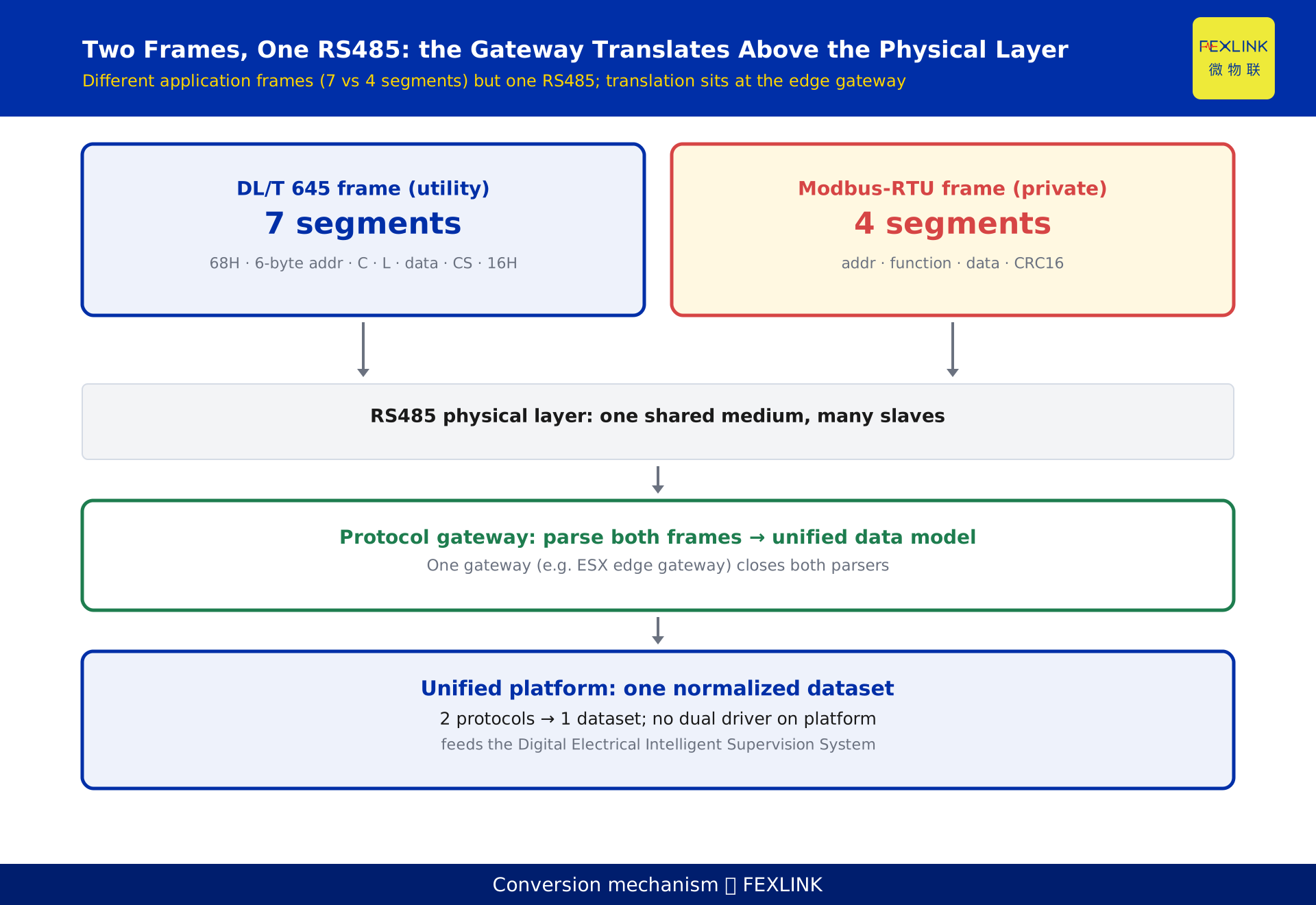
The DL/T 645 frame is made of 7 segments: start delimiter 68H, 6-byte address (low-byte first), control code C, data length L, data field, checksum CS and end delimiter 16H. It encodes "what to read" into a data identifier (DI) that points to a specific metered quantity, so the model is tightly coupled to the meter.
The Modbus-RTU frame has only 4 segments: slave address, function code, data and CRC16. It encodes "what to read" into a function code plus a register address (for example 03 plus 0x0000 reads a holding register).
The address meaning, the check method (645 uses an additive sum CS; Modbus uses CRC16), the start/end delimiters and the data encoding are all different. If the platform parses directly, it must implement two separate parsing logics — that is the real body of "two drivers". Exact frame formats and data identifiers follow the current standard text; this article only draws the boundary and does not open the byte-level examples.
4. Where the gateway translates
Since the physical layer already shares RS485, translation needs no rewiring — you only insert a conversion node above the application layer and below the platform.
The position is normally at the edge: a protocol-conversion gateway (or a gateway with edge-computing power) hangs on the RS485 bus, parses the DL/T 645 frames and the Modbus-RTU frames separately, and maps them into the platform's unified "point / data model". To the platform, it only sees one normalized dataset and does not care which manual sits underneath.
That is what "one gateway closes the loop" means: conversion happens at the edge, and the platform recognizes only one data format. Devices such as the ESX edge-computing gateway (edge-computing gateway) play exactly this translation role — they take the two meter types on RS485 on one side and push normalized data to the upper system on the other. Where the site is dominated by industrial-bus devices, the CW industrial gateway (industrial gateway) is an equivalent alternative for the same duty.
5. Mixed-project strategy: decide ownership before wiring
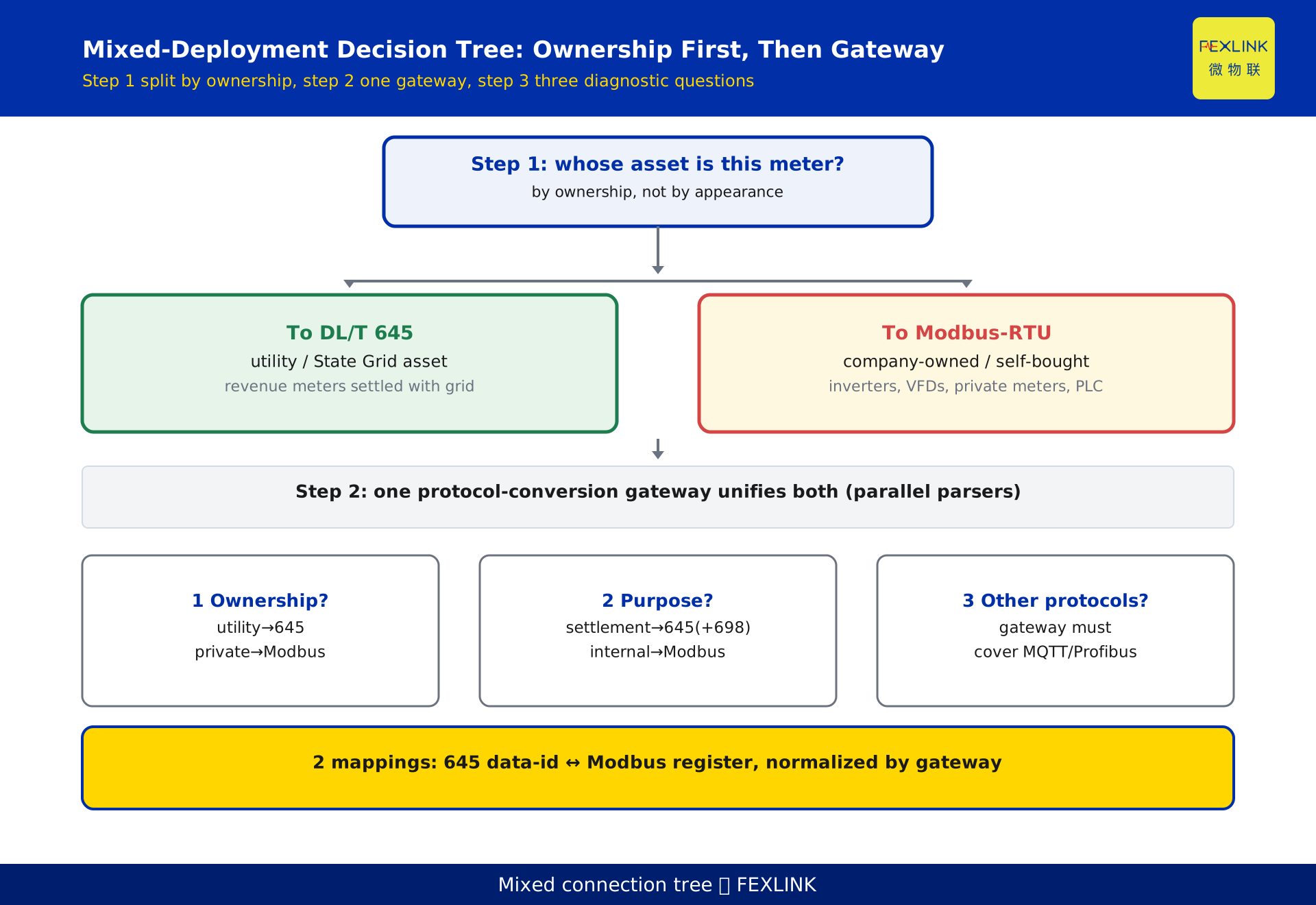
On a real project, mixed connection follows a fixed order: decide first, map second, wire third.
Step one, split the meters into two piles by asset ownership. State Grid / utility assets and revenue meters used for settlement always go to DL/T 645; company-owned meters and devices used for internal management or equipment monitoring go to Modbus-RTU.
Step two, confirm the physical layer. If both connect over RS485 they can share the bus; if a Modbus device runs RS232, a serial conversion is needed.
Step three, deploy one protocol-conversion gateway that closes both parsing logics and feeds the platform uniformly.
Note the distinction: this article is about the boundary between the standards themselves. The problem of different brands' "point tables not matching" under the same protocol is what KD-0458 covers — that is a register-address mapping difference within one Modbus, a point-table issue, not a wrong protocol choice. Their increments are respectively "decide the protocol by ownership" and "align point tables under one protocol".
6. Ask about ownership first: three diagnostic questions
Many people ask "which gateway, how many ports" before connecting, but the better first question is "whose meter is this". Three diagnostic questions:
One, is this meter a utility asset or company-owned? The former is basically DL/T 645; the latter is mostly Modbus.
Two, is this meter for settlement or only internal monitoring? Anything settled with the grid must run DL/T 645 (and the companion DL/T 698 collection system); internal energy-efficiency monitoring can take Modbus devices directly.
Three, is there a third protocol on site (MQTT, Profibus, and so on)? If so, the gateway's conversion capability must cover it, not just two RS485 paths.
Clarify ownership before choosing the gateway model, and you avoid the rework of "the gateway arrived but the driver cannot be written".
7. A mixed-deployment example
The following is constructed to illustrate the connection strategy and does not represent any real customer or project.
A campus digitizes its power distribution. On site are two meter families: six utility-installed revenue and time-of-use meters, State Grid assets, running DL/T 645; and about 24 privately owned sub-metering meters and rooftop-PV inverters running Modbus-RTU. Together that is 2 protocols and about 30 meters / devices, hung on two RS485 buses in the same plant building.
The campus deploys 1 ESX edge-computing gateway, configures a DL/T 645 driver and a Modbus-RTU driver, parses the 645 metered data identifiers and the Modbus register maps respectively, normalizes them into platform points, and feeds the Digital Electrical Intelligent Supervision System. The original worry was "the platform needs two drivers and the schedule slips a month"; in reality the edge translation is done by the gateway, the platform only consumes one normalized dataset, and the integration cycle shrinks to about one week.
What this example shows is that the problem is not "two protocols" but "where the translation sits". Judge ownership right and pick the gateway right, and the schedule does not slip.
8. DL/T 698 versus DL/T 645: a hierarchy, not a swap
Finally, a pair of often-confused standards. DL/T 645 is a "meter-level" standard: it defines communication between a master station and a single electricity meter. DL/T 698, the Electricity Information Collection and Management System, is a "system-level" standard: it defines how a collection system (master station, collection terminals, channels) is organized, managed and polled.
Simply put, 645 answers "how to talk to one meter"; 698 answers "how a collection system manages thousands of meters". They are a "system vs meter" hierarchy, not a replacement: in real systems the 698 collection terminal often talks to each meter precisely through 645. Mixed projects that touch utility collection-system interfaces must understand both layers and not force one to fit the other.
FAQ
Q: Can the utility's meters also be read with Modbus?
Generally no. Utility revenue and State Grid meters ship to DL/T 645 and do not expose a Modbus interface; forcing a read either fails or needs an extra protocol-conversion device. The basis for the decision is asset ownership, not which protocol you prefer.
Q: Can a company-owned meter run on DL/T 645?
Yes, but there is no need. A privately owned meter can connect if the vendor supports 645, but most private devices (inverters, VFDs, PLCs) only offer Modbus. Unless there is a unified 645-ization requirement, staying on the device's native protocol is simpler.
Q: Both protocols on RS485 — will they interfere?
Shared physical layer does not necessarily collide, provided addresses do not clash and baud rates are separated or split across buses. The 645 and Modbus slave-address spaces are independent, so split by meter ownership across different buses or gateway ports to avoid parse errors.
Q: Can one gateway run both the 645 and Modbus drivers at once?
Yes. Mainstream protocol-conversion gateways support parallel multi-protocol operation: different ports on the same device load 645 and Modbus drivers separately, then feed upstream uniformly. At selection time, confirm the gateway's protocol library covers both.
Q: What if there are also MQTT or Profibus devices?
Then look at the gateway's conversion breadth, not just its RS485 dual-protocol support. Before connecting, use the three diagnostic questions from section 6 to list every protocol, and pick an edge gateway that covers them all, so adding a device later does not mean swapping the gateway.
Scope and limitations
- This article discusses the applicable boundary between DL/T 645 and Modbus-RTU and the mixed-connection strategy, aimed at system integrators and electrical engineers who need energy / electrical data acquisition.
- The DL/T 645-2007 frame structure described here (68H start, 6-byte address, control code C, data length L, data, checksum CS, 16H end) and common baud rates (600/1200/2400/4800/9600), together with the Modbus-RTU frame structure (address + function code + data + CRC16) and function codes (03/04/06/10), follow each standard's public content. Exact frame formats and data identifiers follow the current standard text.
- The example (a campus: 6 State Grid meters on 645, about 24 private devices on Modbus, 2 protocols, about 30 meters/devices, 1 gateway, about one week of integration) is constructed to illustrate the strategy and does not represent any real customer or project.
- The descriptions of the ESX edge-computing gateway and the CW industrial gateway are qualitative (protocol conversion, edge normalization and upload) and contain no specification numbers such as current, voltage, port count or baud rate. Specific selection follows the product manual; this article is not a procurement recommendation.
- DL/T 698 and DL/T 645 are in a "system-level vs meter-level" hierarchy; this article only states their positioning and does not open 698's architecture or quantitative indicators.
- The related solution, the Digital Electrical Intelligent Supervision System, is mentioned only as the carrier of the data loop and its technical details and indicators are not expanded.
Frequently Asked Questions
Can the utility's meters also be read with Modbus?
Generally no. Utility revenue and State Grid meters ship to DL/T 645 and do not expose a Modbus interface; forcing a read either fails or needs an extra protocol-conversion device. The basis for the decision is asset ownership, not which protocol you prefer.
Can a company-owned meter run on DL/T 645?
Yes, but there is no need. A privately owned meter can connect if the vendor supports 645, but most private devices (inverters, VFDs, PLCs) only offer Modbus. Unless there is a unified 645-ization requirement, staying on the device's native protocol is simpler.
Both protocols on RS485 — will they interfere?
Shared physical layer does not necessarily collide, provided addresses do not clash and baud rates are separated or split across buses. The 645 and Modbus slave-address spaces are independent, so split by meter ownership across different buses or gateway ports to avoid parse errors.
Can one gateway run both the 645 and Modbus drivers at once?
Yes. Mainstream protocol-conversion gateways support parallel multi-protocol operation: different ports on the same device load 645 and Modbus drivers separately, then feed upstream uniformly. At selection time, confirm the gateway's protocol library covers both.
What if there are also MQTT or Profibus devices?
Then look at the gateway's conversion breadth, not just its RS485 dual-protocol support. Before connecting, use the three diagnostic questions from section 6 to list every protocol, and pick an edge gateway that covers them all, so adding a device later does not mean swapping the gateway.