 FEXLINK Research Institute
The short answer
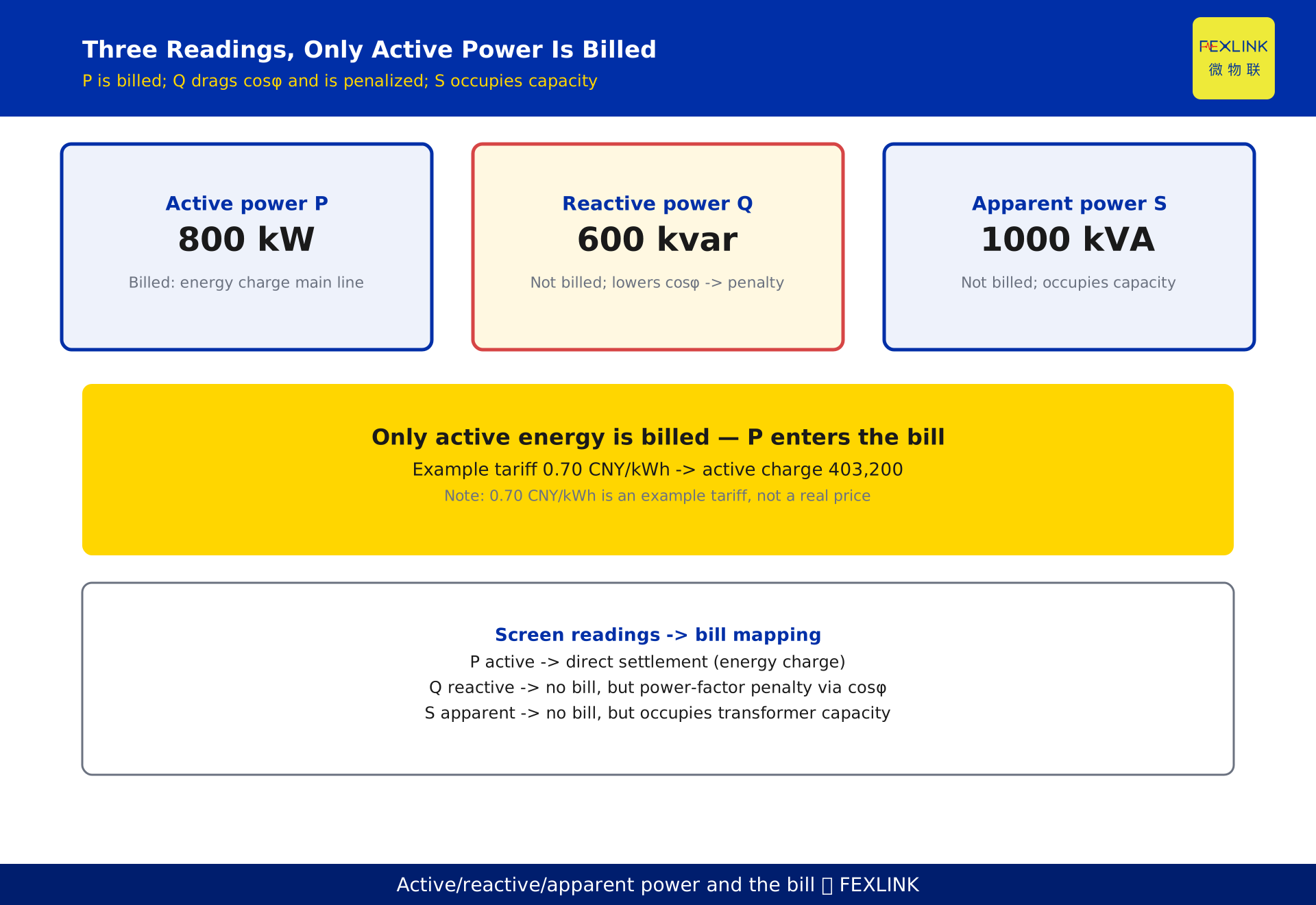
The bill is settled only on active energy (kWh). The reactive power Q (kvar) and apparent power S (kVA) shown on the meter do not enter the total directly. But a large Q drags the power factor cosφ down; once cosφ falls below the utility's assessment threshold (for most large industrial users around 0.90, subject to local rules), a power factor adjustment charge applies. Understanding how P, Q, S and cosφ relate is what explains why a poor power factor gets penalized.
1. Three quantities on the screen: P, Q, S
A three-phase smart meter screen usually cycles through three different units:
- Active power P (kW): the portion of power that actually does work and is converted into heat, light or mechanical output. Its accumulated form is active energy (kWh), the familiar "how many units of electricity were used."
- Reactive power Q (kvar): the power that inductive or capacitive loads such as motors, transformers and rectifiers exchange with the grid to build and collapse magnetic fields. It performs no useful work but circulates in the network and occupies line and transformer capacity.
- Apparent power S (kVA): the direct product of voltage and current RMS values, the "combined power" of P and Q.
The power triangle obeys S² = P² + Q², forming a right triangle with P as the adjacent side, Q as the opposite side and S as the hypotenuse. This is a fundamental AC-circuit relation (see electrotechnology textbooks and GB/T 2900 Electrotechnical Terminology).
2. The power triangle: cosφ is that angle
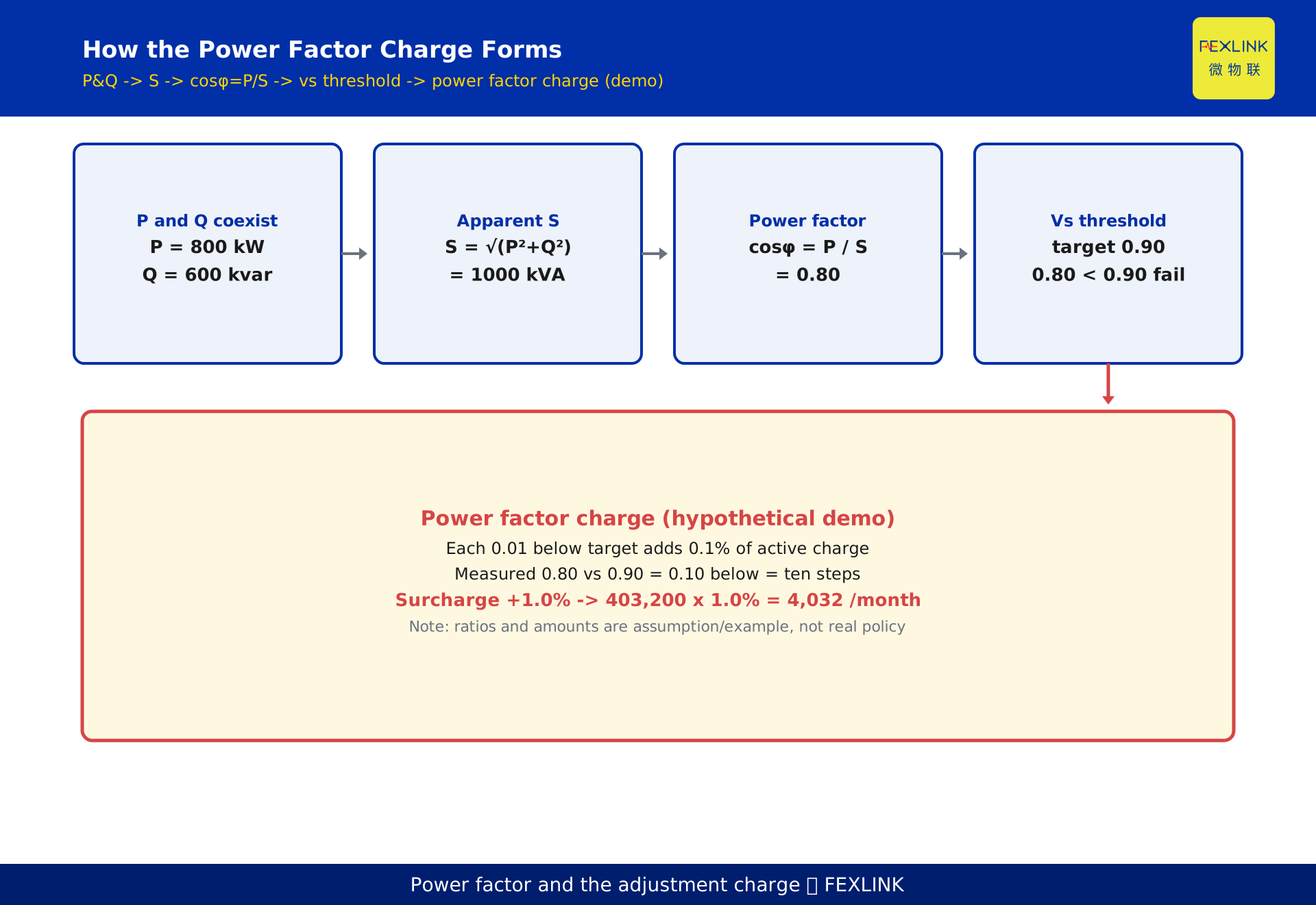
The power factor is defined as cosφ = P / S, the share of apparent power that is active, geometrically the cosine of the angle between P and S in the power triangle.
When Q = 0, S = P and cosφ = 1: energy is used at 100% efficiency. When Q is large, S is inflated by Q and cosφ shrinks; the same P then requires a larger S to be "carried," and the transformer and lines are forced to deliver a large current that does no work.
A common rule of thumb: the closer cosφ is to 1, the better. A value of 0.90 is widely used as the reference line for large industrial users (varies by region, industry and voltage level; local rules govern), and falling below it is read as "absorbing too much reactive resource from the grid."
3. Why only active energy hits the bill
The energy charge on the bill is computed as active energy × energy tariff. The logic is simple: the utility sells useful work, and the customer pays only for the active energy actually consumed and converted into product value.
Reactive power Q, although it flows in the grid, does not "consume" energy in an ideal cycle (capacitors and inductors exchange and return it within a period), so it is not billed directly per kvar. Apparent power S (kVA) also does not enter the bill directly — it represents a capacity demand that shows up in the demand/basic charge, transformer sizing and cable selection, not as a monthly "energy" line item.
This is the answer to the opening puzzle: P, Q and S all appear on the screen, but in the monthly total only the active energy behind P is the settlement main line.
4. The power factor adjustment charge: why a low cosφ is penalized
The turning point is here: although Q is not charged directly, it influences the bill indirectly through cosφ.
Utilities assess the customer's power factor. When cosφ is below the threshold, the customer is drawing large reactive power from the grid, occupying line and substation capacity without producing active output, which raises grid loss and supply cost. Hence the power factor adjustment charge: meeting the target can reduce part of the bill, missing it adds a surcharge.
The policy basis is the Power Factor Adjustment Electricity Tariff Measures issued in 1983 by the former State Price Bureau and the former Ministry of Water Resources and Electric Power, which set different assessment standards by industry and supply mode; for most large industrial users the target is around 0.90 (subject to local rules).
On the exact reward/penalty percentages: this article gives no real policy figures. For illustration only, a hypothetical figure such as "each 0.01 below the target adds 0.1% of the active charge" may be used — but that ratio is purely an assumption/example, not a real policy value, intended only to show the mechanism; actual implementation always follows local rules.
5. Mapping the screen to the bill
Matching common meter readings to the bill shows a clear map:
| Screen quantity | Unit | Enters bill total | Relationship |
|---|---|---|---|
| Active power P / active energy | kW / kWh | Yes (energy charge main line) | Direct settlement |
| Reactive power Q / reactive energy | kvar / kvarh | No (direct) | Affects power factor charge via cosφ |
| Apparent power S | kVA | No (direct) | Affects capacity demand and basic charge |
| Power factor cosφ | dimensionless | No (direct) | Triggers power factor reward/penalty |
| Current / voltage / frequency | A / V / Hz | No | Operation monitoring, not billed |
In short: P enters the bill, Q and S act indirectly, cosφ is the switch. Devices such as the fexlink ESA all-element smart meter (three-phase multifunction smart meter) show P, Q, S and cosφ together on one screen precisely so operators can see this mapping at a glance, instead of staring only at total active power.
6. Reading cosφ before and after reactive compensation
The usual way to raise cosφ is reactive compensation: connect capacitor banks (or SVG static var generators) on the load side to supply locally the reactive power the inductive loads need, cutting the reactive power Q drawn from the grid and lifting cosφ.
Reading method (desensitized example parameters, not a real customer):
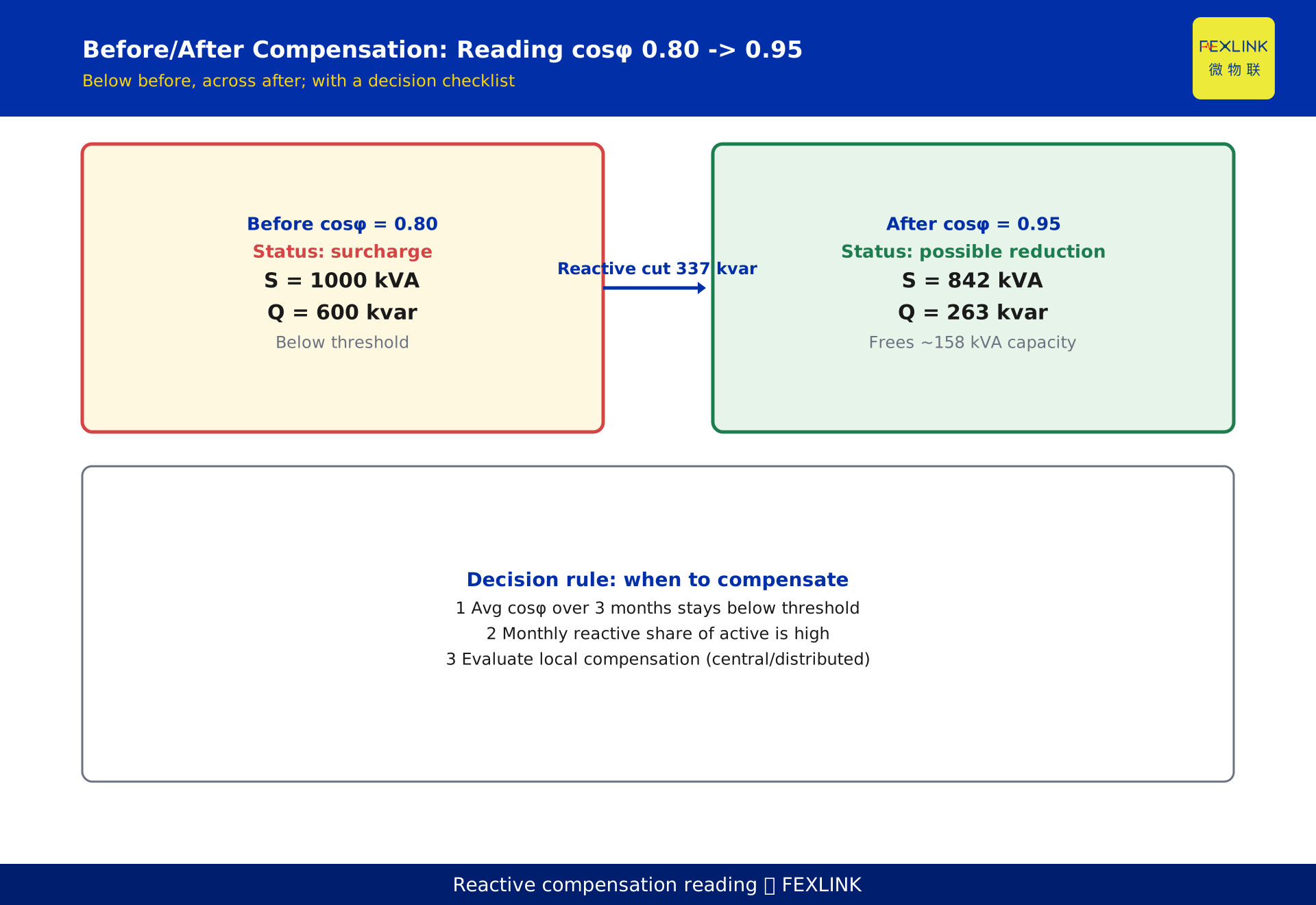
- Before compensation: active P = 800 kW, cosφ = 0.80, then S = 1000 kVA, Q = 600 kvar;
- After compensation: cosφ rises to 0.95, then S = 842 kVA, Q = 263 kvar;
- Reactive reduction ΔQ = 600 − 263 = 337 kvar.
Note: active P is unchanged (the useful work consumed is the same), but Q drops sharply, S tightens, and cosφ moves from 0.80 to 0.95, crossing the 0.90 line; the power factor charge shifts from "surcharge" toward "possible reduction." This is exactly the established point from KD-0448: the power factor charge keys on whether cosφ crosses the line, not on the absolute value of Q.
7. A desensitized example: a plant at P=800 kW, cosφ=0.80
The following is a constructed example to show the mechanism; it represents no real customer or project.
A plant feeds a batch of induction motors from one main transformer. Measured total active load P = 800 kW, pre-compensation cosφ = 0.80, giving S = 1000 kVA and Q = 600 kvar.
Assume a local tariff of 0.70 CNY/kWh (example tariff, not a real price) and 720 operating hours per month:
- Active energy = 800 kW × 720 h = 576,000 kWh;
- Active charge = 576,000 × 0.70 = 403,200 CNY.
If cosφ = 0.80 sits below the 0.90 target, and we use the hypothetical rule of adding 0.1% of the active charge per 0.01 below target for illustration: the gap is 0.10 (ten steps of 0.01), so the surcharge is 1.0%, about 4,032 CNY/month (again stressed: this ratio and amount are assumption/example, not real policy values).
After reactive compensation raises cosφ to 0.95, Q drops to 263 kvar and S to 842 kVA; the power factor charge turns toward possible reduction, and the transformer releases roughly 158 kVA of capacity headroom.
8. Engineering decision advice: when to invest in compensation
One clear criterion, not "it depends":
Criterion: when the average cosφ over a continuous billing period (take the most recent 3 months) stays stably below the assessment threshold, and the monthly reactive energy share of active energy is high, evaluate local reactive compensation.
Concrete steps:
- Read the meter first: use the fexlink ESA all-element smart meter or the ZSA embedded multifunction smart meter to log P, Q and cosφ continuously, confirming a steady low rather than a transient dip.
- Quantify the benefit: the capacity release and power factor charge change after compensation can be self-computed from the triangle relation in Section 6.
- Implement: prefer centralized compensation at the low-voltage bus or distributed compensation on large-load circuits, and link it to the digital electrical intelligent supervision system to watch cosφ in real time for any relapse.
9. Boundary with KD-0468 (this article's increment)
Elsewhere in the knowledge base, KD-0468 covers "how maximum demand enters the bill." This article does not expand on demand charges; it focuses on its own increment: the causal chain of P/Q/S and the power factor charge.
The chain in one line: active P is the settlement main line → reactive Q inflates apparent S and depresses cosφ → cosφ below the threshold triggers the power factor charge. This chain explains "why reactive power, though not on the bill, still gets penalized." Demand charges follow a separate link (peak power × demand tariff); the two mechanisms differ and do not substitute for each other. Readers should consult each by their own pain point.
FAQ
Q: The screen shows both active and reactive power are large. Does that double the bill?
No. The bill is settled on active energy; reactive power Q does not enter the total. But a large Q can pull cosφ down and trigger a power factor surcharge, so "higher bill" usually arrives indirectly through the power factor charge, not by direct pricing of Q.
Q: Is cosφ = 1 the best?
Theoretically the closer cosφ is to 1, the less reactive occupation. But engineering does not chase an absolute 1: over-compensation (cosφ > 1, capacitive) is also harmful and the equipment costs money. Most cases treat crossing 0.90 or the contracted threshold as the target.
Q: Exactly how much is the power factor penalty? Is there a fixed ratio?
This article gives no real policy figures. The actual reward/penalty ratios are set by provincial and municipal rules and vary with threshold and industry. The "0.1% per 0.01" here is only an assumption/example, not a real policy value; in practice follow the local utility's published rules.
Q: After installing energy-saving equipment, cosφ dropped instead. Why?
New non-linear loads such as variable-frequency drives, rectifier supplies and switched-mode power supplies absorb reactive power and lower cosφ. If only the energy retrofit is done without matching reactive compensation, active power falls but cosφ slides, and the power factor charge can eat part of the saving. This is exactly the blind spot of "watching only total active energy."
Q: Should a small shop worry about the power factor charge?
Most small general-commercial users on a single-part tariff and with modest capacity are not assessed on power factor, so the charge has limited effect. The mechanism mainly targets large industrial and some two-part tariff users explicitly assessed on power factor; applicability follows the local tariff document.
Scope and limitations
- The P/Q/S, cosφ and power factor charge chain discussed here applies to users under power factor assessment (mostly large industrial and some two-part commercial users); single-part tariff users not assessed on power factor can ignore the adjustment part.
- The power triangle relation S²=P²+Q² and cosφ=P/S is a fundamental AC-circuit theorem (see GB/T 2900 Electrotechnical Terminology and electrotechnology textbooks), an open technical fact.
- The 0.90 power factor target follows the common wording of the Power Factor Adjustment Electricity Tariff Measures (1983); regional industry, voltage level and assessment bands vary, and local rules govern.
- The "0.1% per 0.01" rule and the resulting 4,032 CNY/month are both assumption/example, not real policy values, for mechanism illustration only; real ratios follow the local utility's published documents.
- Plant parameters in the example (P=800 kW, cosφ=0.80/0.95, S=1000/842 kVA, Q=600/263 kvar, 0.70 CNY/kWh example tariff, 576,000 kWh, 403,200 CNY) are constructed to explain the issue and represent no real customer or project; actual retrofit benefit requires on-site measured data.
- The fexlink ESA all-element smart meter, ZSA embedded multifunction smart meter and digital electrical intelligent supervision system mentioned here are subject to the latest selection manual and product knowledge base; this article is not a selection or procurement recommendation.
- Standard numbers cited are current as of writing; if a standard is revised, the quantitative conclusions here require rechecking.
Frequently Asked Questions
The screen shows both active and reactive power are large. Does that double the bill?
No. The bill is settled on active energy; reactive power Q does not enter the total. But a large Q can pull cosφ down and trigger a power factor surcharge, so "higher bill" usually arrives indirectly through the power factor charge, not by direct pricing of Q.
Is cosφ = 1 the best?
Theoretically the closer cosφ is to 1, the less reactive occupation. But engineering does not chase an absolute 1: over-compensation (cosφ > 1, capacitive) is also harmful and the equipment costs money. Most cases treat crossing 0.90 or the contracted threshold as the target.
Exactly how much is the power factor penalty? Is there a fixed ratio?
This article gives no real policy figures. The actual reward/penalty ratios are set by provincial and municipal rules and vary with threshold and industry. The "0.1% per 0.01" here is only an assumption/example, not a real policy value; in practice follow the local utility's published rules.
After installing energy-saving equipment, cosφ dropped instead. Why?
New non-linear loads such as variable-frequency drives, rectifier supplies and switched-mode power supplies absorb reactive power and lower cosφ. If only the energy retrofit is done without matching reactive compensation, active power falls but cosφ slides, and the power factor charge can eat part of the saving. This is exactly the blind spot of "watching only total active energy."
Should a small shop worry about the power factor charge?
Most small general-commercial users on a single-part tariff and with modest capacity are not assessed on power factor, so the charge has limited effect. The mechanism mainly targets large industrial and some two-part tariff users explicitly assessed on power factor; applicability follows the local tariff document.