 FEXLINK Research Institute
The short answer
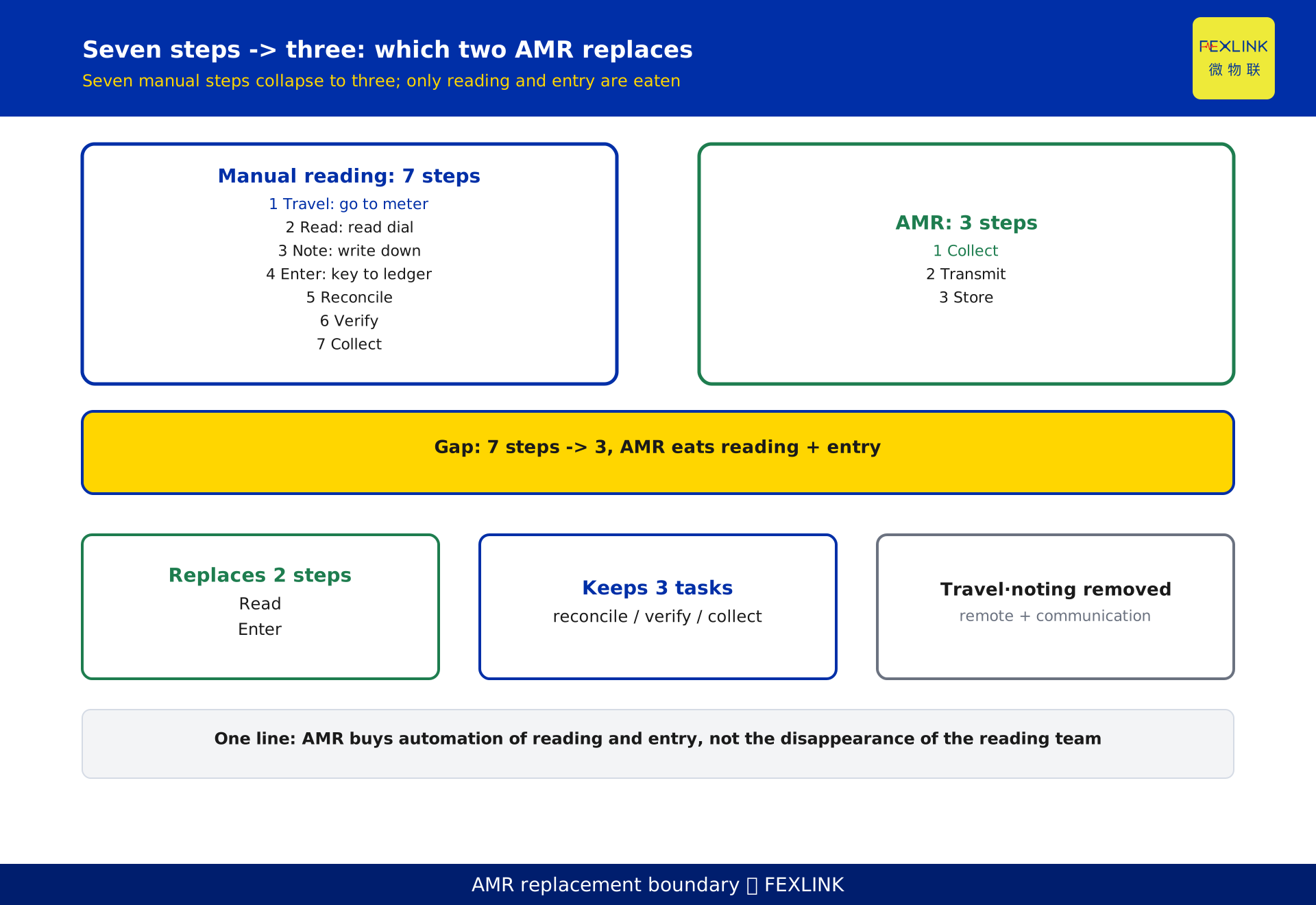
AMR does not replace the whole meter-reading workflow. It replaces exactly two of the manual steps: reading the meter and keying the value into the ledger. The manual chain runs seven steps — travel to site, read, note, enter, reconcile, verify, collect. AMR compresses that into three automated steps: collect, transmit, store. What gets eaten is reading and entry; reconciliation, verification and collection still need people. If your system still needs manual reconciliation, it usually means the meters talk but the point table is not unified and the loop was never closed. The premise is simple: meters must be communicative and the point table must be unified; close one loop first, then talk about scaling.
1. The seven-step manual chain
Manual meter reading is not "go read a number." It is a seven-step chain, and every step costs time, attention and error probability:
| Step | Action | What it costs |
|---|---|---|
| 1 Travel | The reader goes to the meter (basement, roof, pipe shaft) | Travel time |
| 2 Read | Read the dial or display by eye | Attention |
| 3 Note | Write the value on paper or a handheld | Paper / device |
| 4 Enter | Key the paper into Excel or a system back at the office | Entry hours |
| 5 Reconcile | Compare this read with last period and with usage logic | Judgement hours |
| 6 Verify | Visit the suspect meter to confirm fault vs real overuse | Re-check hours |
| 7 Collect | Push the bill to the customer, chase arrears | Business hours |
The real cost hides in the first four steps. A 120-meter campus with 2 readers doing a full sweep once a month spends 3 days on travel+read+note and 1 day entering the ledger — 4 man-days per month — and any misread, miss or delay adds rework. Most people think "reading" is only step 2, but the expensive parts are steps 1, 3 and 4.
2. AMR's three-step chain: collect, transmit, store
Automatic meter reading collapses the seven manual steps into three automatic ones:
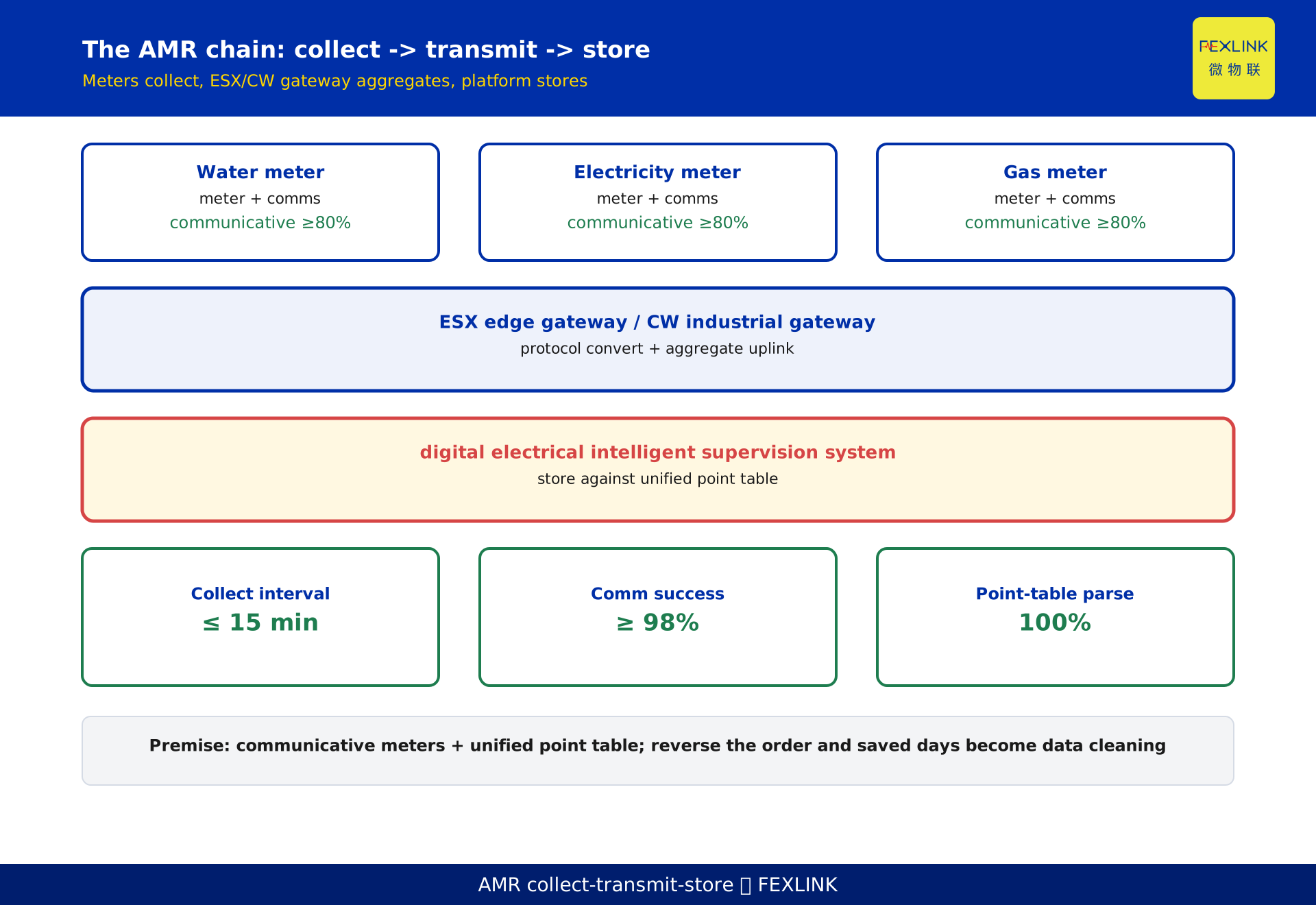
- Collect: the meter carries its own metering and communication unit and reads on a set interval (commonly ≤15 minutes), with no human on site.
- Transmit: over M-Bus, RS485, LoRa, 4G / NB-IoT the data reaches the ESX edge computing gateway or the CW industrial gateway, which converts the protocol, aggregates and forwards to the platform.
- Store: the platform (for example the digital electrical intelligent supervision system) writes the data into a time-series store against a unified point table and generates the ledger automatically.
Note what these three steps solve: how data arrives, how it travels, where it lands. They do not answer whether the data is right or who should be billed. That is exactly the work of manual steps 5, 6 and 7.
3. The replacement boundary: what is eaten, what stays
Align the seven manual steps with the three AMR steps and the boundary is clear:
- 1 Travel: removed by remote operation; no one needs to be on site.
- 2 Read: replaced by Collect.
- 3 Note: replaced by Transmit.
- 4 Enter: replaced by Store.
- 5 Reconcile: still done by a person (or a rules engine); AMR only delivers the data, it does not judge correctness.
- 6 Verify: still done by a person; a suspect meter needs a site visit.
- 7 Collect: still a business flow; AMR does not touch finance or customer service.
In one sentence: AMR truly replaces the Read and Enter steps (including the travel before them and the noting between them); reconciliation, verification and collection are the three things it does not automatically replace. This is also the increment over KD-0482 — this article only clarifies which segment is replaced; the retrofit route belongs to that one.
4. Handheld reading vs fully automatic reporting
Both shapes are often called "AMR," but the boundary is wide:
- Handheld terminal (HHU) reading: a person still travels to site, only the eye is replaced by a device. Semi-automatic — it removes misreading, not travelling.
- Fully automatic remote reporting: the meter reports on a cycle; no one needs to be on site. This is the complete AMR form.
There is only one test: does a person still need to travel. Travel needed = semi-automatic; travel not needed = fully automatic. Many projects claim AMR but only issued handhelds to readers, so travel and scheduling cost stayed — that is not real automatic reading.
5. Who uses the data once it is up (billing / losses / accountability)
Landing in the store is not the end, it is the start. The collected data feeds at least three consumers:
- Billing: automatic bills, less manual computation and fewer disputes.
- Loss analysis: water / power network loss analysis to locate theft, leakage and ageing segments.
- Accountability: department, tenant and line energy scoring to support cost and carbon allocation.
All three rest on reconciliation and verification — data quality decides whether billing is fair and whether losses compute. AMR delivers the data but does not do the quality check; that work not only stays, it gets more professional.
6. The premise: communicative meters + a unified point table
Two prerequisites are both required, and the order matters:
- Communicative meters. Mechanical meters, dead meters and old meters without a communication module cannot be read by AMR. First measure the share of communicative meters on the campus; below a threshold, replace meters or add collectors first (the retrofit route is KD-0482).
- A unified point table. Every meter needs a unified point table recording register address, unit and ratio. Without it, the platform receives bytes it cannot interpret. Point-table parse accuracy must be 100%; one wrong point table corrupts the whole dataset.
In engineering, a communication success rate ≥98% is the hard bar for a pilot to be released; below it, data completeness cannot support reconciliation or billing.
7. A worked example: 120 meters, from 4 to 1.5 man-days
The following is constructed to show the arithmetic and represents no real customer.
A campus with 120 meters (40 water, 50 electricity, 30 gas). Before: 2 readers, one full sweep per month — 3 days on travel+read+note, 1 day entering the ledger, 4 man-days per month.
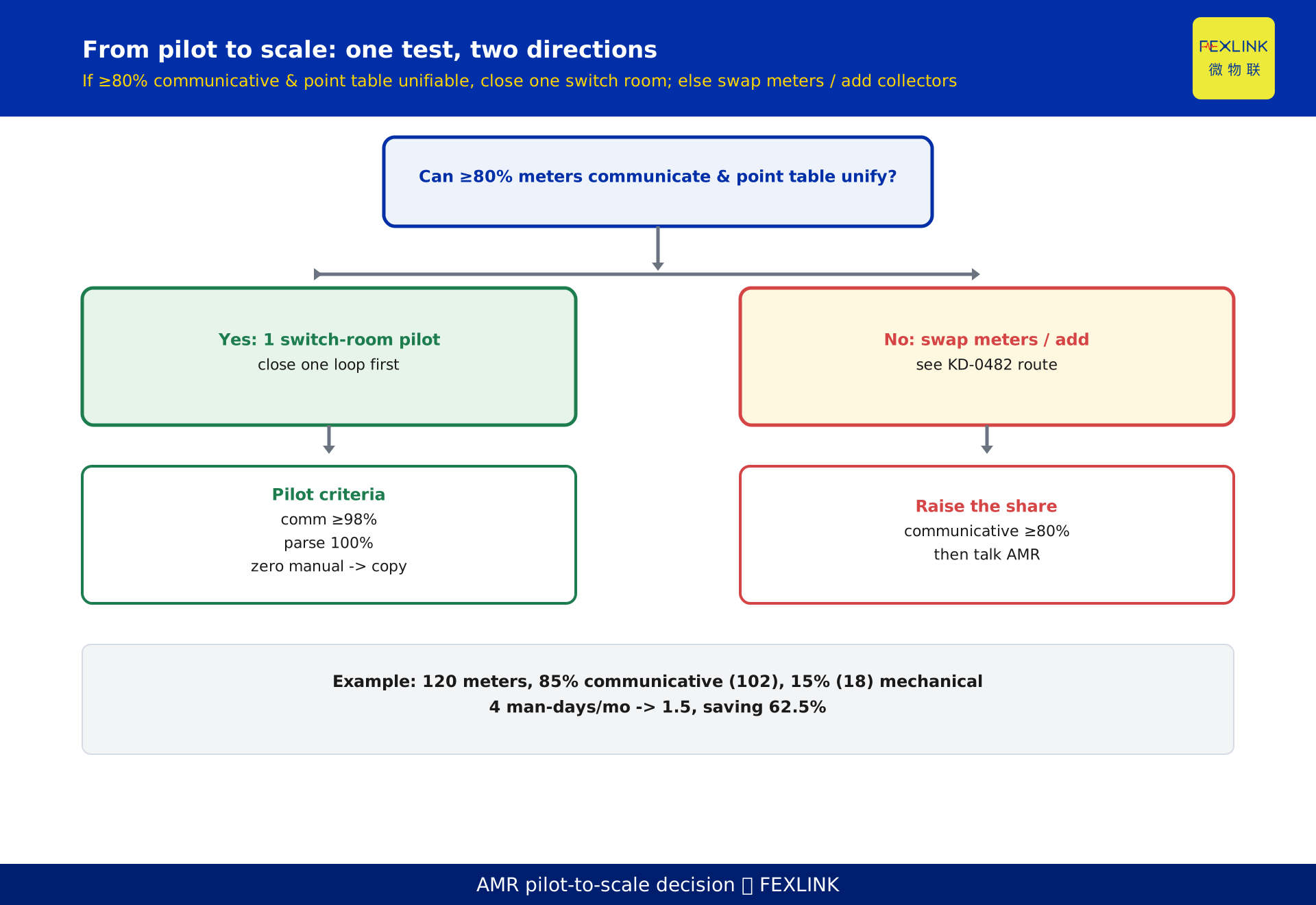
After: 85% of meters are communicative (102 meters) and collect-store automatically; the remaining 15% (18 mechanical meters) still need about 0.5 man-day; platform-side reconciliation and verification take 1 man-day. Total 1.5 man-days per month, saving 2.5 man-days per month, about 62.5%.
Note what was saved: the read and enter steps. What was added or kept: reconciliation and verification. Collection still runs on the old flow. If you only swapped the meters without unifying the point table, those 102 communicative meters still cannot enter the ledger, and the saved man-days turn into "data cleaning" man-days — the retrofit did nothing.
8. The rhythm from pilot to scale
Do not blanket the whole campus at once. The rhythm:
- Pick one segment: one switch room or one building where meters are dense and communication is easy.
- Close the loop: communication connected + point table unified + store correct, running for 1 month.
- Watch the metrics: communication success ≥98%, point-table parse 100%, zero manual reading.
- Copy sideways: replicate the same point table and gateway config to other buildings.
Close one end-to-end loop first; blanketing nine half-built segments is riskier. The costliest part of half-built is data that arrives but nobody dares to use.
9. Decision guidance: when to adopt, where to start
One clear test, no hedging:
- If ≥80% of meters can be communicative and the point table can be unified → pick 1 switch room for an end-to-end pilot; during the pilot communication success ≥98% and point-table parse 100% → copy sideways.
- If the communicative share is <80% → first walk the meter-swap / collector-add route (see KD-0482) and raise that share before talking AMR.
- Whenever the point table is not unified, unify it before collecting; reverse the order and saved man-days become data cleaning.
Bottom line: AMR buys automation of read and enter, not the disappearance of the whole reading department; check communication rate and a unified point table before scale.
10. FAQ
Q: Does AMR mean we no longer need meter readers?
Not entirely. AMR removes the Read and Enter steps, and travel is removed by remote operation, but reconciliation, verification and collection still need people. In the example, 4 man-days per month dropped to 1.5, a saving of about 62.5%, not 100%.
Q: Does handheld-terminal reading count as fully automatic AMR?
No. The handheld still needs a person on site; it only swaps the eye for a device, so it is semi-automatic. The test is "does a person still need to travel": travel needed = semi-automatic, travel not needed = fully automatic.
Q: We installed smart meters, so why is the ledger still a manual Excel?
Because only "collect" was solved, not "unified point table" and "store." The meter talks but the point table is not unified, so the platform cannot interpret the bytes; data never reaches the ledger and people keep moving it by hand. Unify the point table first, then automate the store.
Q: How do we decide whether our campus should adopt AMR?
Watch two ratios: the share of communicative meters and the share of meters whose point table can be unified. Both ≥80%, start with 1 switch room; either below 80%, first swap meters / add collectors to lift the share. Whenever the point table is not unified, unify before collecting.
Q: After AMR goes live, who does verification and collection?
Verification stays with operations / energy staff: a suspect reading needs a site visit to confirm fault versus real overuse. Collection stays a finance / customer-service flow; AMR does not touch finance or service. AMR only guarantees data arrives on time, against the point table and accurate; what follows is human work.
Scope and limitations
- This article discusses the process-replacement boundary between AMR and manual reading, for utilities and campus energy management where metering and point tables exist (water, electricity, gas). Purely mechanical, non-communicative, non-unified-point-table scenarios are outside AMR's scope.
- The "seven manual steps," "three AMR steps" and "replace read+enter, keep reconcile/verify/collect" are industry-common process descriptions used to clarify the boundary, and are not a commitment about any vendor's solution.
- The campus figures in the worked example (120 meters; 40 water / 50 electricity / 30 gas; 2 readers; 4 man-days per month; 85% communicative; 102 / 18 meters; 0.5 / 1 / 1.5 man-days; 62.5% saving) are constructed to illustrate the arithmetic and represent no real customer or project; actual labor saving depends on on-site communication rate, point-table completeness and business definitions.
- The threshold values (collection interval ≤15 minutes, communication success ≥98%, point-table parse accuracy 100%, communicative meters ≥80%) are engineering experience criteria given here; specific projects may adjust them to site conditions but should not drop below the data-availability floor.
- Model numbers and parameters for the ESX edge computing gateway, CW industrial gateway and digital electrical intelligent supervision system follow the latest selection manual and product knowledge base; this article is not a selection or procurement recommendation.
- Distinction from KD-0482 (water-meter swap and collector-add retrofit route): this article covers AMR concept and replacement boundary, KD-0482 covers the concrete retrofit route; the increment here is the step-by-step decomposition of "which segment is replaced."
Frequently Asked Questions
What AMR Actually Replaces in the Manual Meter-Reading
AMR does not replace the whole meter-reading workflow. It replaces exactly two of the manual steps: reading the meter and keying the value into the ledger