 FEXLINK Research Institute
The short answer
After a smart meter is installed you may notice a "Event Log" entry in the menu. What does it actually record? In one sentence: the event log is the meter's "black box" — it stores threshold crossings and state changes against a time stamp: the moment of a power failure, how many times overvoltage occurred, reverse phase sequence, cover opening, and more. Its value is not in real-time alarm, but in reconstructing the accident timeline and assigning responsibility after something goes wrong. For operations staff and electrical engineers the real question is not "does the meter have an event log" but "are these events enabled, can they be reported to the platform, and can they be retrieved for accountability". If this step is skipped at acceptance, a blackout or burnt equipment will still end in finger-pointing over what the voltage was and when the supply dropped.
1. What the event log really is: the meter's black box
A meter's primary job is energy measurement, but a three-phase multifunction smart meter and a power quality monitor also carry an internal "event memory". Whenever a threshold is crossed or a state changes, it writes one record containing the event type, the time of occurrence, and related parameters such as voltage value or phase. Records are kept first-in-first-out or filed by category.
It behaves like an aircraft black box: nobody looks at it while everything runs normally, but when something fails it replays exactly what happened at that moment. The event log is not there to keep you staring at a screen; it is there for post-incident accountability, trend review, and cross-checking against platform data.
The boundary with the neighbouring article KD-467 should be stated up front. KD-467 covers the interpretation of continuous data — for example how to read a THD (total harmonic distortion) curve or a voltage-deviation trend. This article covers only discrete-event logging and accountability, and does not go into continuous-waveform interpretation. The incremental value here is the event black box in accident accountability, not a tutorial on reading THD curves.
2. The common event list: what the meter actually records
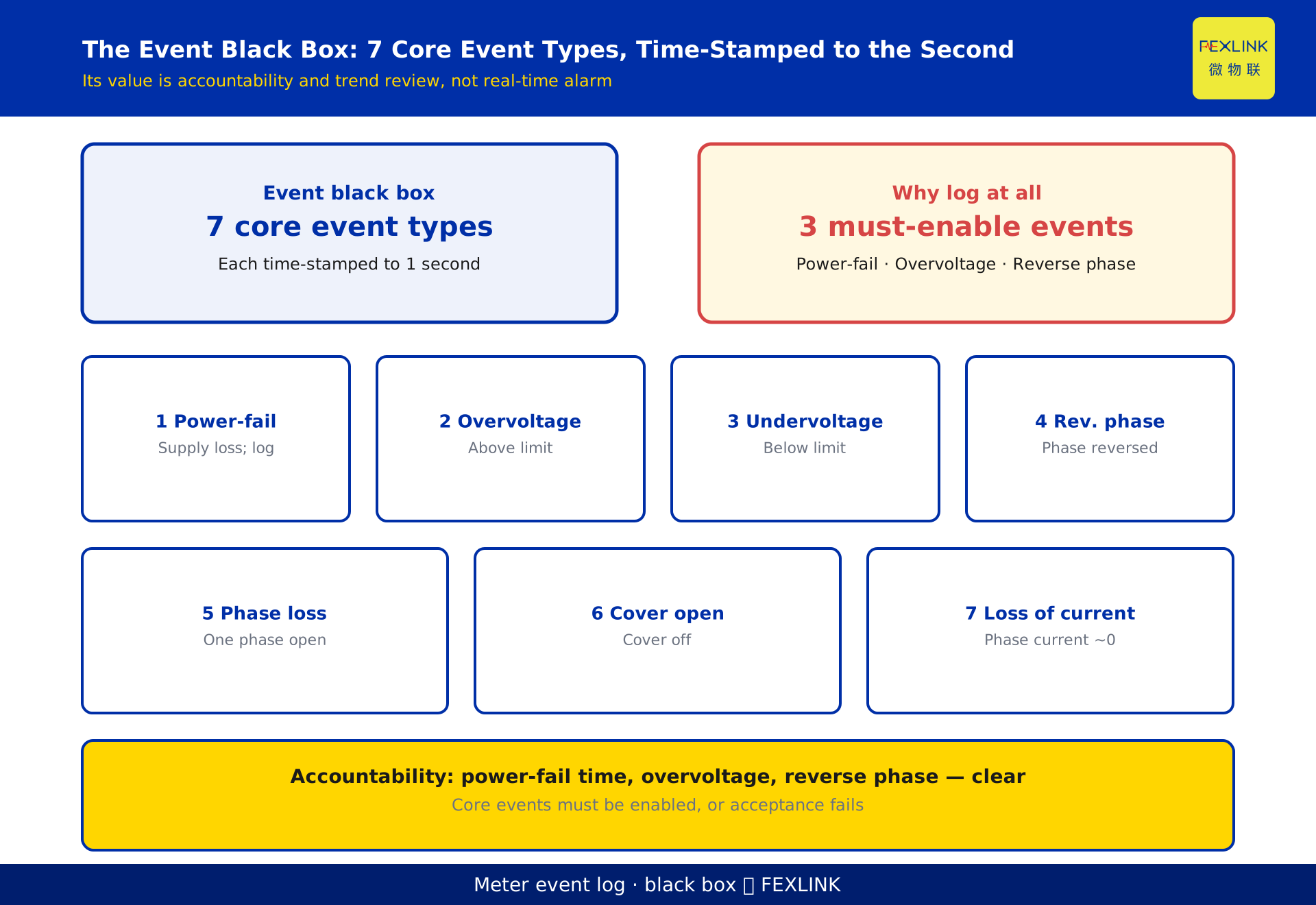
In a three-phase multifunction smart meter, the common event categories are roughly seven:
- Power-fail / loss of supply: supply interruption, recording the loss and restoration moments.
- Overvoltage: voltage above the upper threshold, recording the number of crossings and their duration.
- Undervoltage: voltage below the lower threshold, recording the number of crossings and duration.
- Reverse phase sequence: the three phases are reversed or run backward, recording the moment.
- Phase loss / missing phase: one phase opens, recording the phase and moment.
- Cover opening: the meter cover is opened, recording open and close moments (anti-tamper and anti-theft).
- Loss of current: current on one phase drops near zero, recording the phase and moment.
Each of these seven event types carries a time stamp at roughly one-second resolution. One caveat: whether to record, at what resolution, and how many records to keep are usually configurable parameters. The factory default may be "partially enabled", which is exactly why acceptance must verify them one by one. Event logging itself is a standard capability of smart meters and power quality monitors, but "enabled or not, and which ones" is a site configuration question — it cannot be assumed.
3. Division of labour: event log vs real-time alarm
Someone will ask: if there is a real-time alarm, why keep an event log? The split is clear:
- A real-time alarm is in the present tense: the moment a threshold is crossed it pushes a message to the operator who must act now. It answers "do we know right now".
- The event log is in the past tense: it archives every occurrence with a time stamp. It answers "can we review afterwards and assign responsibility".
Real-time alarms get missed — the network drops, the operator is away, the alarm is buried in a flood of notifications. The event log does not get missed, because it is written to the meter's local memory and uploaded later when communication recovers or on manual polling. The correct pairing is: real-time alarm fights the fire, event log audits the books. Treating them as either/or is the most common misconception on site.
4. How an accident timeline gets reconstructed
The core strength of the event log is stringing scattered instantaneous anomalies into one timeline. The reconstruction usually goes:
- Poll the event log: pull all events over a period from the meter or the platform.
- Sort by time stamp: arrange power-fail, overvoltage, reverse phase sequence and so on into a sequence by occurrence time.
- Correlate with continuous data: use the event times to line up the voltage and current curves and confirm the magnitude of the excursion.
- Assign responsibility windows: from each event's time stamp, decide which segment belongs to the upstream network and which to on-site maintenance.
The key is "time-stamp alignment". If the power-fail moment recorded by the meter and the upload moment received by the platform do not match, the timeline shifts and the accountability conclusion distorts. Therefore the time-stamp resolution (typically one second) and the clock synchronization between meter and platform directly affect how credible the assignment of responsibility is. This is also why at acceptance you check not only "was it recorded" but "does it line up".
5. Worked example: one factory's power-fail — overvoltage chain
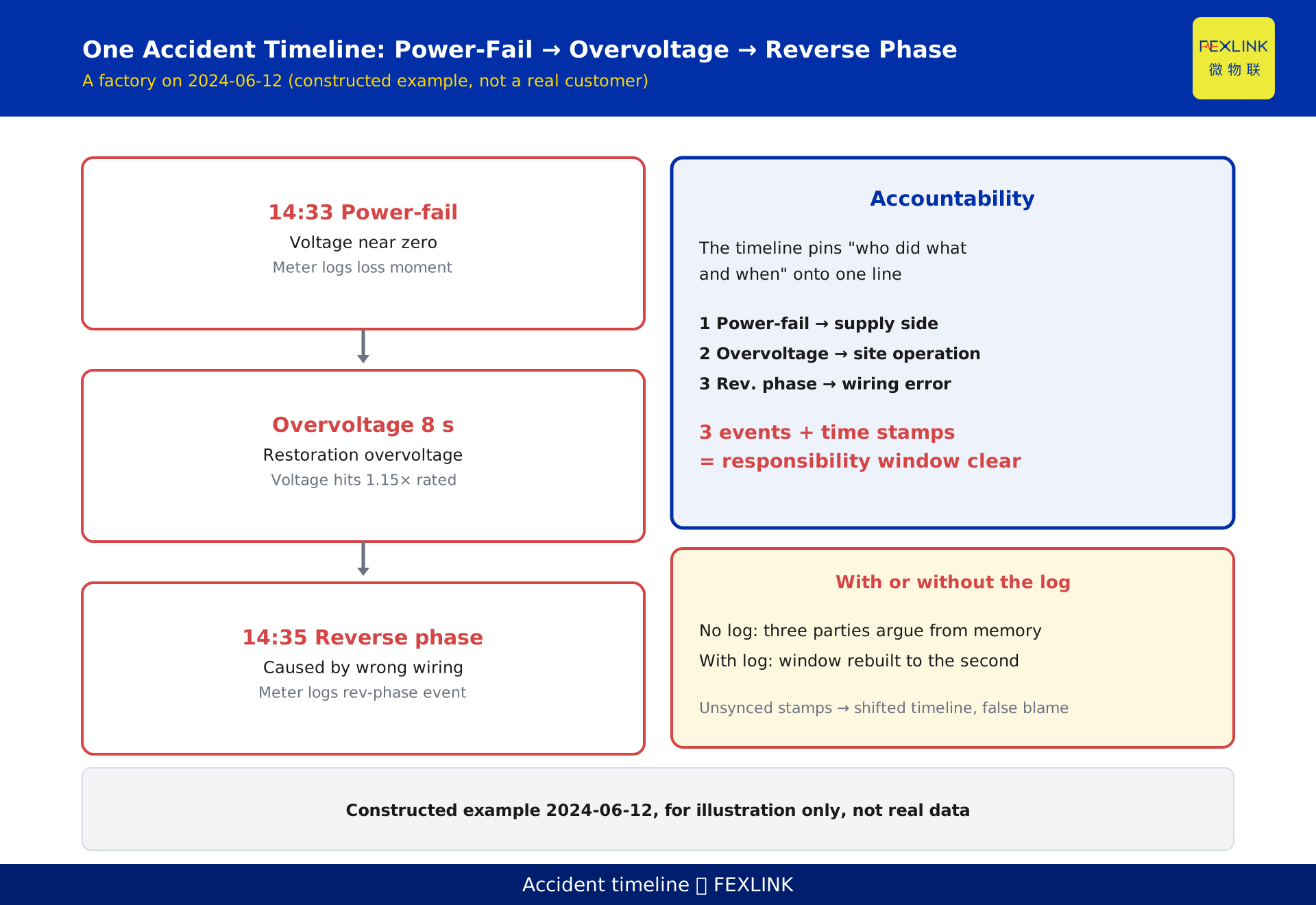
The following timeline is constructed to illustrate the mechanism. It does not represent any real customer, project, or device data.
A factory suffered a power failure (loss of supply) at 2024-06-12 14:33; voltage fell close to zero and the meter recorded the loss moment. About two minutes later the upstream restored supply, but the closing transient produced an overvoltage that pushed voltage to roughly 1.15 times the rated value, lasting 8 s; the meter logged one overvoltage event with start, end, and duration. Then at 14:35 a maintenance worker mis-wired the connection, causing reverse phase sequence, which the meter logged as a reverse-phase-sequence event.
Post-incident review: the power failure came from the upstream network, so responsibility sits with the supply side; the overvoltage was a switching overvoltage at restoration, belonging to the on-site operation; the reverse phase sequence was a wiring error during maintenance. The three events, each carrying its own time stamp, nailed down "who did what and when" onto one line — this is the irreplaceable value of the event black box in accountability. Without it the three parties argue from memory; with it the responsibility window is obvious.
6. After the data is reported: retention, retrieval, accountability
Keeping the event log in the meter locally is not enough; it must reach the platform to be retrieved and used for accountability:
- Reporting: the meter is polled periodically by a concentrator or gateway over an RS485 Modbus interface, or it actively pushes on event occurrence.
- Retention: the platform archives by time and supports retrieval by event type, time range, and phase.
- Accountability: the event timeline is aligned with work orders, permits, and fault records to form an auditable evidence chain.
What matters is whether the data "can be found". Many sites did record, but nobody polled it, the platform was not configured to ingest it, or the retrieval entry was buried too deep to reach during an incident. In other words, having the event function "on" is only step one; "reportable and retrievable" is the real precondition for accountability.
7. Why this is not the THD article
This article covers only discrete-event logging. The neighbouring KD-467 covers continuous-data threshold interpretation — THD, voltage deviation, unbalance and similar "does the continuous curve exceed the limit" questions. The boundary:
- This article: an event is a discrete point of "happened / did not happen", focused on time stamp and trace, used for accountability.
- KD-467: an indicator is a continuous quantity of "how long, how much over", focused on magnitude and duration, used for operational assessment.
So the incremental value here is the event black box in accident accountability, not a lesson on reading THD curves — for the continuous waveform, see KD-467. This article stays within its lane.
8. The acceptance checklist you must check
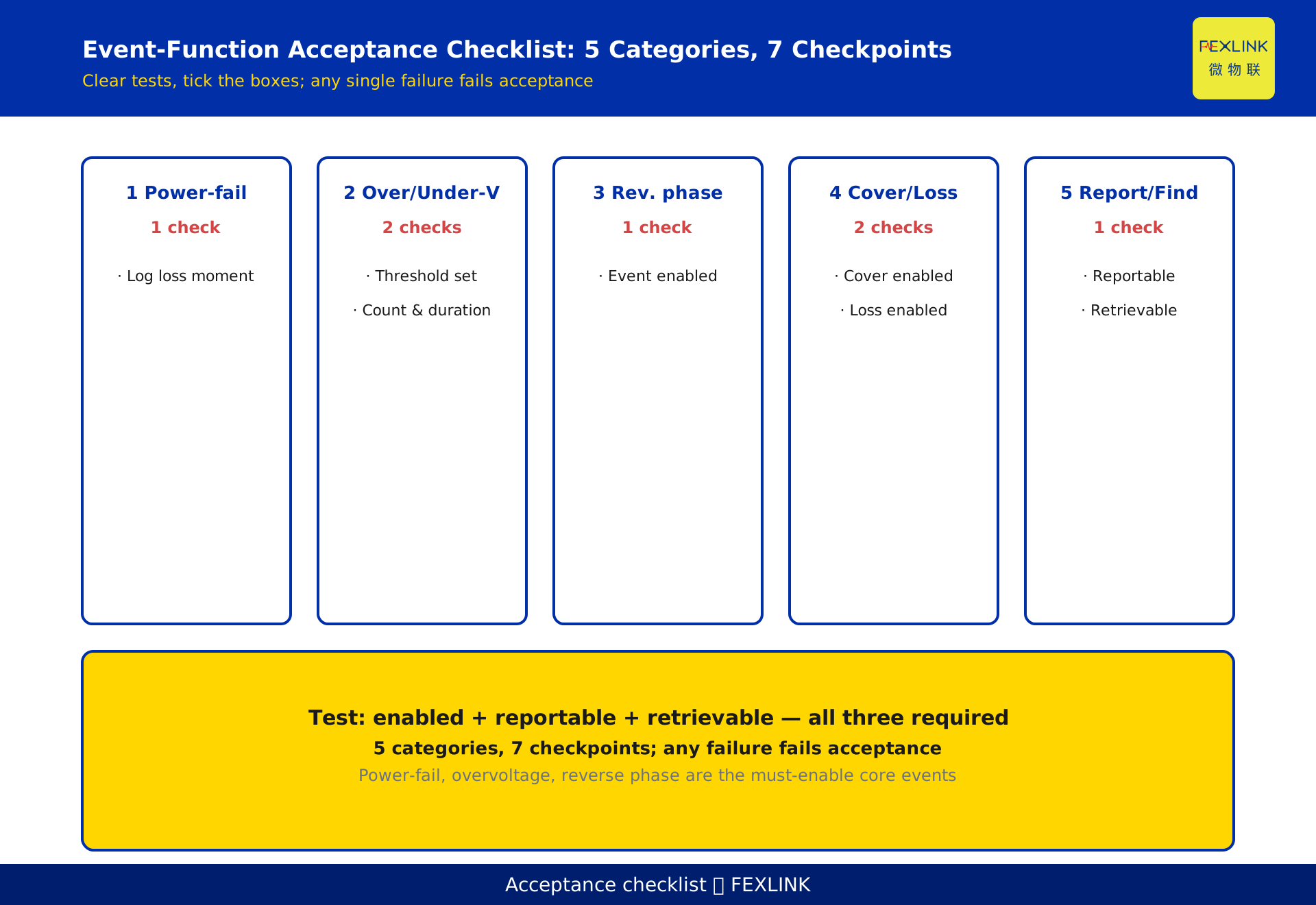
Put the event function into the acceptance checklist: recommended as five categories and seven checkpoints, and any single failure fails the acceptance:
- Power-fail event enabled, able to record the loss moment (mandatory).
- Overvoltage and undervoltage thresholds and counters configured, able to record count and duration (two mandatory points).
- Reverse phase sequence event enabled (mandatory).
- Anti-tamper events such as cover opening and loss of current enabled (two mandatory points).
- Event data can be reported to the platform and retrieved by type and time range (mandatory).
Among these, power-fail, overvoltage and reverse phase sequence are the three most-used, must-enable core events for accountability. The acceptance criterion is one sentence: events enabled, reportable, retrievable — all three are non-negotiable. Writing this line into the acceptance sheet works better than any verbal instruction.
9. Common myths: the event log is not a nice-to-have
Myth 1: with a real-time alarm you do not need the event log. Wrong — alarms get missed, logs do not.
Myth 2: the event log is enabled by default. Wrong — many meters ship with only partial events enabled; parameters must be checked one by one.
Myth 3: if it is recorded, accountability is automatic. Wrong — without reporting and retrieval, the record is dead data sitting in the meter.
Myth 4: more event types are always better. Wrong — what matters is whether the core events (power-fail, overvoltage, reverse phase sequence) are enabled and reportable; the rest can be chosen by site need. Enabling everything blindly only adds storage and retrieval burden.
10. FAQ
Q: Does the event log consume a lot of meter storage?
Usually not. Events are far smaller than continuous sampling data; a single event is only dozens of bytes. Even keeping about 1,000 records is enough to cover the window an accident investigation needs. What really matters is "once stored, can it be polled and reported", not the capacity itself.
Q: After a power failure, can the meter still log the power-fail event?
Yes. A three-phase multifunction smart meter has a backup power source (supercapacitor or battery) that supports writing the "loss moment" at the instant of failure and retransmits after recovery. So the power-fail event itself is among the most reliable entries in the log.
Q: Is the event log the same as fault recording?
No. The event log is discrete — "what happened, when" — small in size and kept long term. Fault recording captures the high-density voltage and current waveform for several cycles around the incident, used to analyse the transient mechanism. They complement each other: the event log locates accountability, the waveform explains the mechanism.
Q: What happens if reverse phase sequence is left unhandled?
Reverse phase sequence makes three-phase motors run backward, scrambles metering phase order, and can cause some protections to mis-operate. It does not trip or stop the machine, yet quietly damages equipment or biases metering. That is why it must be enabled as a core event, so you can trace afterwards which wiring caused it.
Q: How do I quickly confirm the event function works at acceptance?
Tick the eighth-section checklist item by item: power-fail, overvoltage and reverse phase sequence must be enabled and reportable; cover opening and loss of current enabled as needed; finally retrieve on the platform over a time range and confirm the event list comes back. Any single failure fails the acceptance.
Scope and limitations
- The event-logging function discussed here applies to smart meters and power quality monitors that carry an event-log capability (such as the fexlink ESE power quality monitor and the fexlink ESA all-element smart meter, a three-phase multifunction smart meter). Basic electromechanical or simple meters usually lack this function.
- The seven event categories listed are common to three-phase multifunction energy meters. Whether a specific device supports them, and at what resolution and record count, are configurable; refer to the device selection manual and product knowledge base. This article is not a selection recommendation.
- The standards and protocols cited — DL/T 645-2007, IEC 62056 (DLMS/COSEM), and the GB/T 17215 series — are referenced as methodological basis for event-data reading and storage. If a standard is revised, the quantitative conclusions here must be rechecked against the current valid version.
- The factory timeline in section 5 (power-fail at 2024-06-12 14:33, overvoltage lasting 8 s, reverse phase sequence at 14:35) is constructed to illustrate the mechanism and does not represent any real customer, project, or device data.
- Time-stamp resolution is typically about one second, depending on the device and its time-sync method. Without clock synchronization, the event time stamp and the platform time may diverge; verify the sync state before drawing accountability conclusions.
- This article focuses on discrete-event traceability in accident accountability. The threshold interpretation of continuous data (THD, voltage deviation, unbalance, etc.) is covered by the neighbouring KD-467 and is outside this article's scope.
Frequently Asked Questions
What Does a Meter's Event Log Record
After a smart meter is installed you may notice a "Event Log" entry in the menu