 FEXLINK Research Institute
The short answer
Class 0.5S and class 1.0 differ in the permitted relative error band on registered energy: roughly ±0.5% versus ±1% in the main load range, a gap of 0.5 percentage point. The S extends the guaranteed range to lighter loads. The denominator is accumulated energy, not rated current or full scale; the band is tiered by load point and power factor, not one flat line. Settlement points follow DL/T 448 and need a verifiable installation; internal metering is usually fine with class 1.0 or 2.0. Read the parameter first: a meter class is not the overall error of platform data.
1. The denominator is registered energy, not rated current
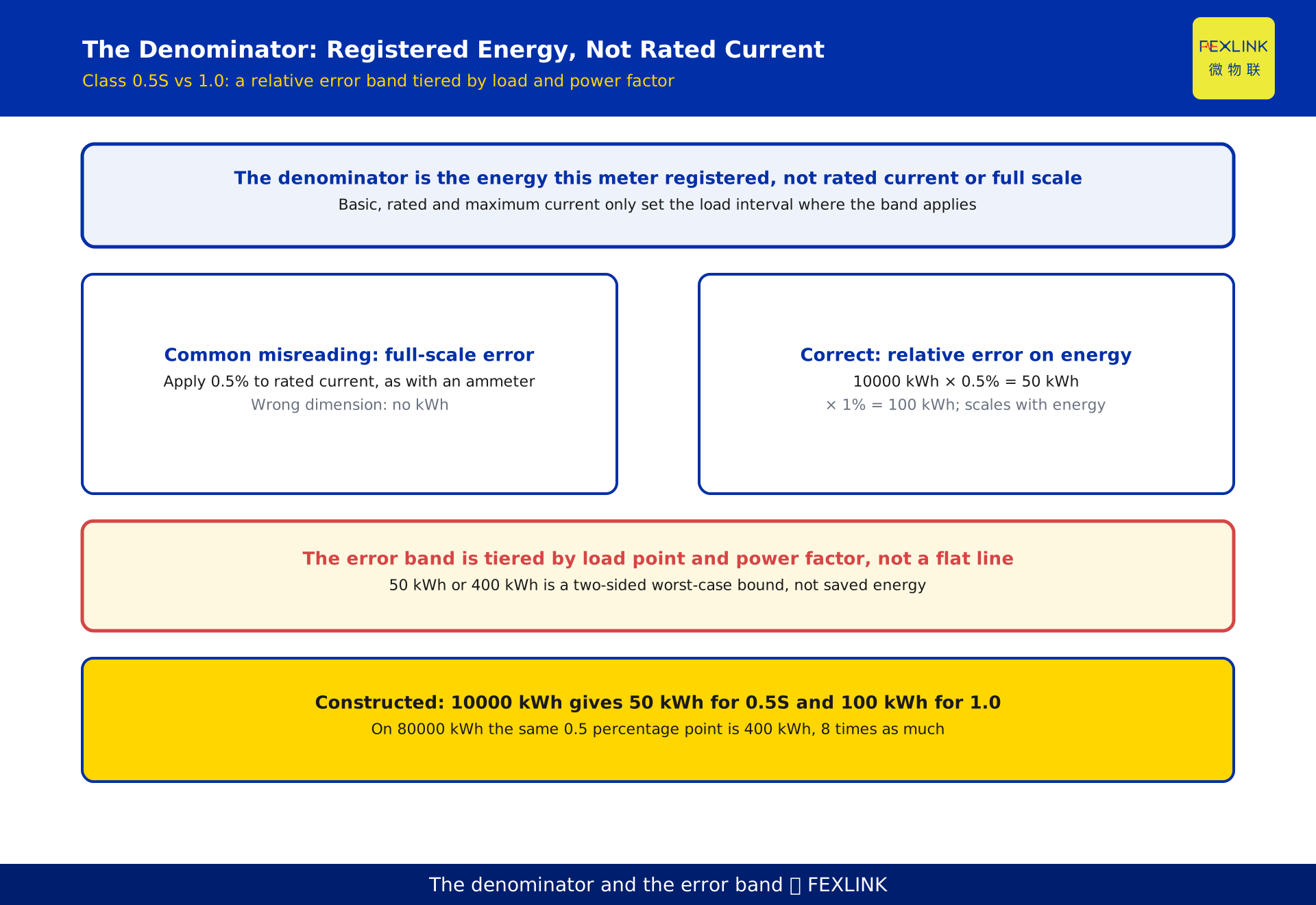
An accuracy class is a percentage relative error on accumulated energy: in reference conditions and the main load range, the upper bound on departure from the true value. For 10000 kWh, ±0.5% means ±50 kWh and ±1% means ±100 kWh.
The common misreading imports the full-scale fiducial error of ammeters and restates the class as "0.5% of rated current". Basic, rated and maximum current only define the load interval where the band applies; they are not the denominator.
Two more points: the band is an upper limit, not a typical error, and a compliant meter normally performs far better; it is also bidirectional, not "0.5% saved every year". The useful question is how far the worst-case bound differs for the same energy.
2. The error band is not a flat line
A class index holds only within reference conditions and the main load range. As load current falls, power factor departs from unity, or voltage and temperature shift, the permitted error widens in tiers set by the standard. Installed meters are judged by verification, not type-test tables. So "±0.5% from top to bottom" is wrong, and multiplying a whole month by one percentage is wrong too; section 6 shows that step.
S and non-S differ in the width of the guaranteed range, not the index: 0.5 and 0.5S share the same nominal bound in the main load range and differ at light load; 0.5S and 1.0 differ in both.
Standard attribution matters too. Class 0.5S and other S classes are covered by IEC 62053-22 for type tests of transformer-operated static active-energy meters; class 1 and class 2 by IEC 62053-21. They do not share a document, and no universal error table can be compared row by row. The 0.5 percentage point is only order-of-magnitude shorthand; per-load-point limits belong to the effective standard.
3. How large is the gap: half a percentage point in the main load range
Make the gap recomputable. On 10000 kWh the 0.5S bound is 50 kWh and the 1.0 bound 100 kWh, a difference of 50 kWh, exactly half. On 80000 kWh the same 0.5 percentage point is 400 kWh, 8 times as much. The gap scales with volume, which is why a boundary point matters more than a small branch circuit.
That difference holds only in the main load range. Light load, low power factor and conditions away from the reference envelope are tiered by the standard, so 0.5 percentage point no longer describes the two classes; forcing them into one formula invents a coefficient.
50 kWh or 400 kWh is a bidirectional worst-case bound, not a gain; "class 0.5S saves this much each year" gets the sign wrong.
4. Reading the S: a wider guaranteed range, not a flat band
An S class extends the guaranteed range to about 1% of rated current; a non-S class normally starts being "in band" at about 5%. Night standby, lighting feeders and small branches run light for long periods, where a non-S meter may leave the guaranteed range and 0.5 percentage point understates the gap. The added value is ratio-error compensation at small currents: guaranteed, reviewable light-load performance.
Extension is not a constant ±0.5%: at lighter tiers and other power factors the permitted error widens, and the S lengthens the guaranteed range rather than flattening the band. A nameplate prints one class mark and no per-tier limits.
Ask how much of this point's energy occurs at light load. If the share is high, isolate the point and verify its current range and S mark; do not inflate 0.5 percentage point to reach a preferred conclusion.
5. Four columns to read on a datasheet
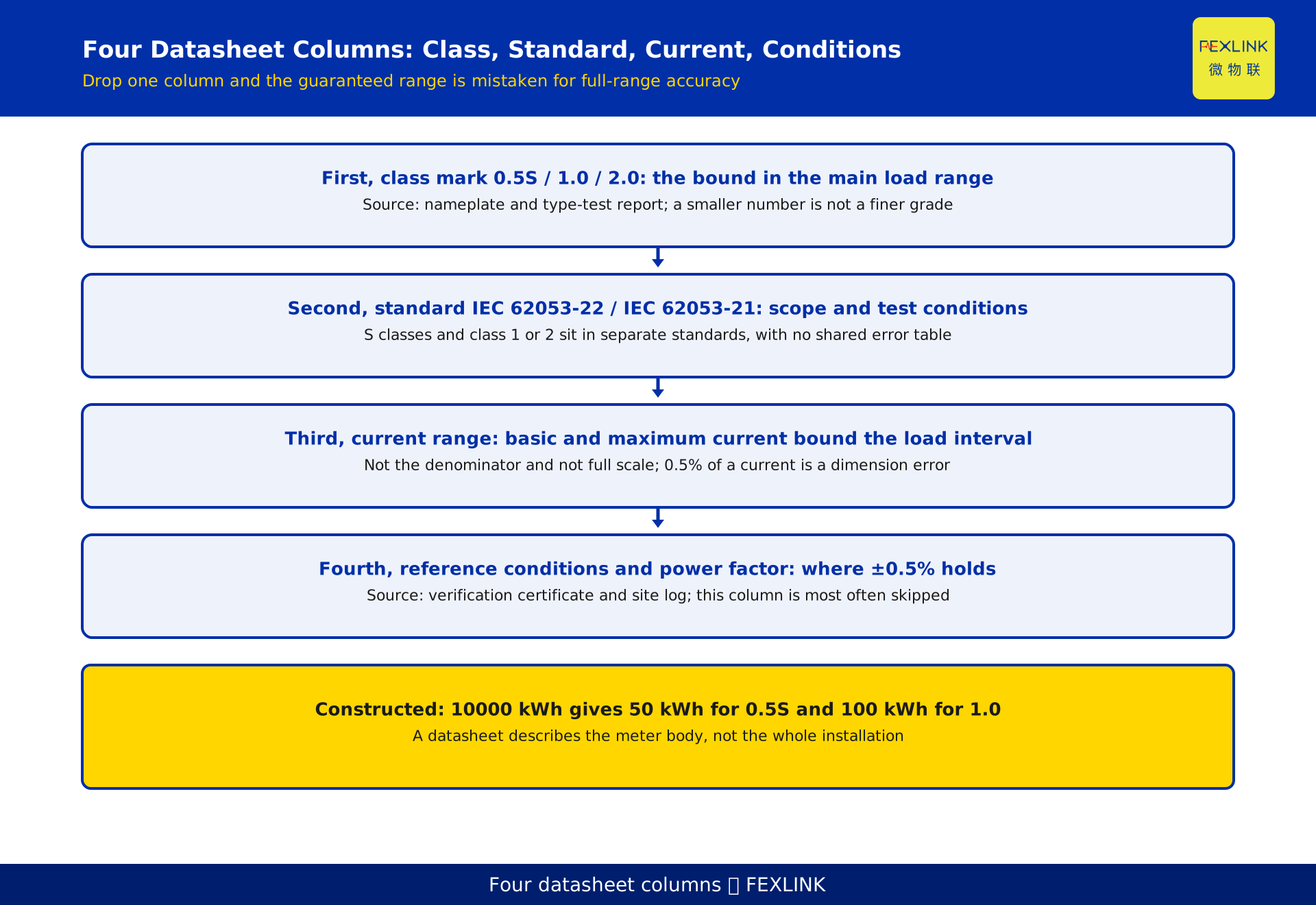
Read four columns together; drop one and the guaranteed range is mistaken for full-range accuracy.
| Field | What it constrains | Common misreading | Source to check |
|---|---|---|---|
| Class mark 0.5S / 1.0 / 2.0 | Main-load error bound | Smaller means "more advanced"; S is a finer grade | Nameplate, type-test report |
| Standard IEC 62053-22 / IEC 62053-21 | Scope, test conditions | Both classes in one error table | Standard number on report |
| Current range | Load interval for the band | As error denominator or full scale | Nameplate, manual |
| Reference conditions, power factor | Where ±0.5% holds | Guarantee under any field condition | Certificate, site log |
The last column is most often skipped: reference-condition compliance says nothing about field wiring or transformers. A datasheet describes the meter body, not the installation.
Products contribute stable reading and traceability: the ESA all-element smart meter and ZSA embedded multifunction smart meter acquire per-circuit readings, and the digital electrical supervision system turns them into ledgers, curves and reconciliation evidence. Model, range, accuracy and interface are customisable per the selection manual; they do not choose a class or replace verification.
6. Constructed example: multiply by tier, not by the whole month
All figures below are constructed examples, anonymised, representing no real customer or project; they are not verification evidence.
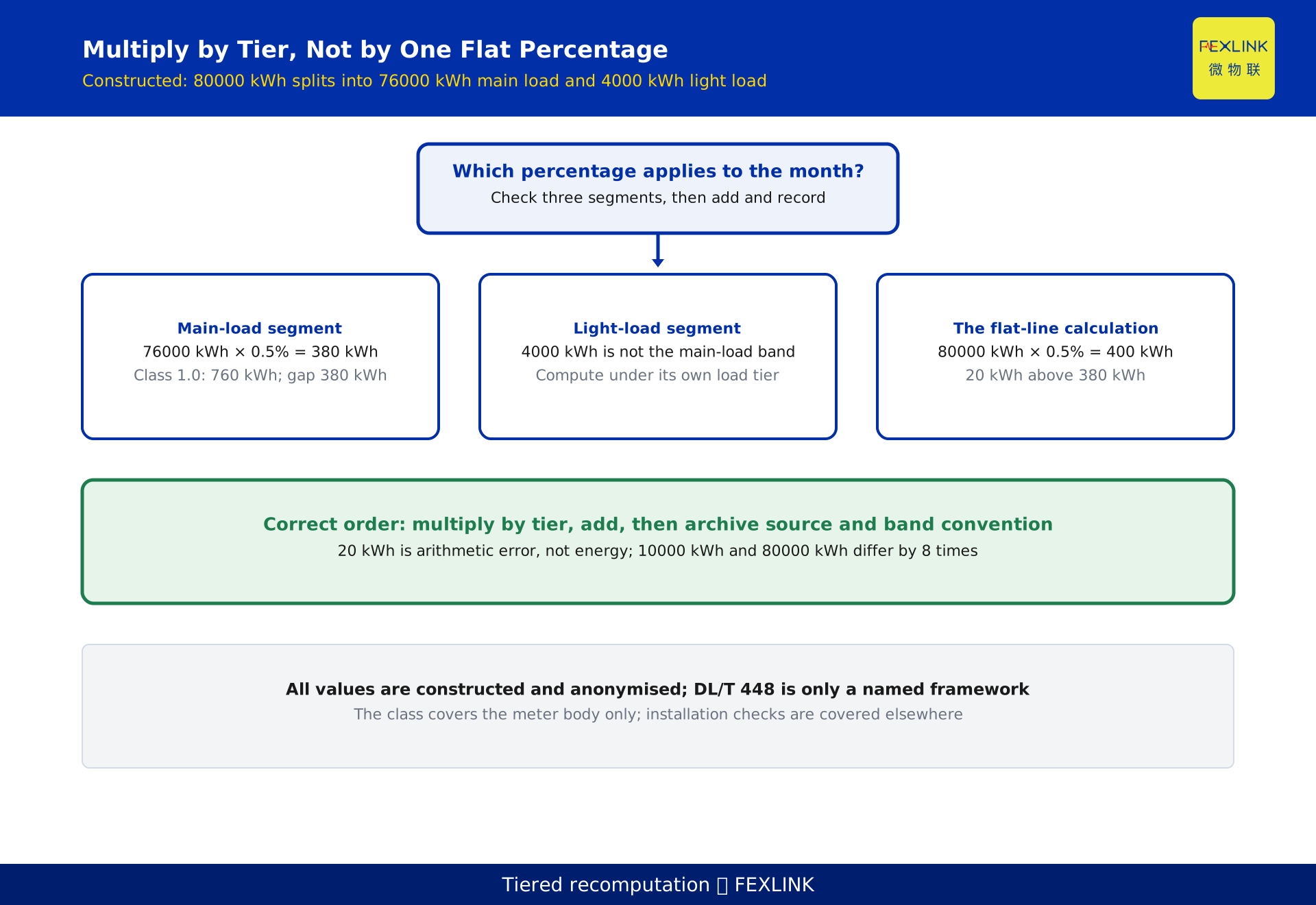
A boundary metering point records 80000 kWh in one month: 76000 kWh at main load and 4000 kWh at light load.
- Main load: 76000 × 0.5% = 380 kWh for 0.5S; 76000 × 1% = 760 kWh for 1.0; gap 380 kWh.
- Light-load 4000 kWh does not inherit the main-load percentage; it needs the tier for that region. No limit is supplied or invented here.
- Multiplying the whole 80000 kWh by 0.5% gives 400 kWh, 20 kWh above the tiered 380 kWh: those 20 kWh are arithmetic error, not energy.
Keep three records: energy source, band convention and reviewer with date. Without the source nobody can verify which segment the percentage belongs to; without the convention the ledger keeps a number with no boundary. Multiply by tier, add, then archive the source.
7. A class covers the meter body, not the platform
A meter class covers only the meter's own registration at reference conditions. Transformer errors, secondary voltage drop, polarity, multiplier settings, truncation, lost packets and unit conversion can each dominate half a percentage point. "A 0.5S meter makes the platform accurate to 0.5%" is wrong: one link is narrowed.
Check in three steps: installation (transformer accuracy, secondary circuit, ratio and multiplier against the ledger, sealing and verification), the four datasheet columns, then same-window reconciliation of display, main meter, sub-meters and platform. Reverse that order and an installation fault is misdiagnosed as an inaccurate meter.
Boundaries: nameplate current and multiplier conversion, the metering-chip error chain, truncation and intermittent loss each have their own article. This one reads the class parameter.
8. Why billing demands tighter classes: three reviewable tests
Test one: is there a counterparty? A settlement reading enters an external invoice and can be challenged by a supplier, tenant or resale counterparty. A wrong internal report only forces a redo of the analysis; the more external the consequence, the tighter the parameter.
Test two: the band is multiplied by energy. The same 0.5 percentage point is 50 kWh on 10000 kWh and 400 kWh on 80000 kWh, a factor of 8. Small branches rarely justify the cost of an upgrade.
Test three: can the evidence be reviewed? DL/T 448 governs the whole installation: meter, transformers, secondary circuit, verification, sealing and retention. A 0.5S nameplate without transformer class, certificate and original readings will not survive a dispute.
Together the three answer the title: billing is stricter because the consequence is external, exposure scales with volume, and the reading must be defensible. Internal, sub-metering and diagnostic points are usually well served by class 1.0 or 2.0; covering more circuits and reconciling beats a uniform upgrade. The applicable class is set by the effective DL/T 448 and project metering documents; no clause number or class table is reproduced.
9. Decision table by use, and neighbouring boundaries
| Use | Fields to read first | What to verify | Class direction |
|---|---|---|---|
| External settlement boundary | Class mark, standard, certificate | Installation and evidence chain | Higher class under effective rules |
| Internal assessment, sub-metering | Class mark, reference conditions | Same-period comparability | Class 1.0 usually sufficient |
| Light-load circuit | Current range, S mark | Light-load energy share | Isolate; prefer an S class |
| Temporary monitoring | Class mark, completeness | Trend, missing intervals | Class 2.0, or indicative only |
This table gives a reading order, not a purchasing verdict: set the use, read the four columns, then discuss an upgrade. Responsibility boundaries, annual exposure, upgrade economics and installation classification are covered elsewhere. The increment is to treat 0.5S and 1.0 as datasheet fields and make the denominator, guaranteed range, tiered convention and recomputation explicit.
FAQ
Q: How much better is class 0.5S than class 1.0?
The nominal upper bound differs by 0.5 percentage point in the main load range: on 10000 kWh, 50 kWh versus 100 kWh, a gap of 50 kWh. Light-load and low-power-factor tiers follow the standard and cannot be described by that difference; both figures are bidirectional bounds, not typical errors or energy saved.
Q: Is the class number a percentage of rated current?
No. It is a percentage relative error on accumulated energy, with registered energy as the denominator. Basic, rated and maximum current only define the load interval where the band applies; using them as the denominator imports the full-scale error convention of an ammeter.
Q: Does an S class hold ±0.5% at every load?
No. It extends the guaranteed range to about 1% of rated current, while a non-S class is normally in band from about 5%, but permitted error still widens in lighter-load tiers. The nameplate prints only the class mark; per-load-point limits come from the effective standard and type-test report.
Q: After fitting a class 0.5S meter, is platform data accurate to 0.5%?
No. The class governs the meter body only. Transformer errors, secondary voltage drop, multiplier settings, truncation, lost packets and unit conversion all sit on the same chain, and any can dominate. Check the installation first, then reconcile over the same period.
Q: Should internal management meters also be upgraded to 0.5S?
Usually not. Internal readings feed internal reports, where same-period comparability and trends matter more; class 1.0 or 2.0 normally suffices. Covering more circuits and keeping reconciliation solid returns more than a uniform upgrade. Genuine settlement points follow the applicable rules.
Scope and limitations
- This parameter and data interpretation article reads 0.5S, 1.0 and 2.0 as nameplate and datasheet fields. Its increment is the denominator convention, tiering by load point and power factor, the four-column checklist and tiered recomputation. Responsibility boundaries, annual exposure, upgrade economics and installation classification are covered elsewhere.
- Standards: DL/T 448 is cited only as the named framework for metering installations and point classification. IEC 62053-22 covers 0.5S and other S classes for transformer-operated static meters in type testing; IEC 62053-21 covers class 1 and class 2, with the effective catalogue governing editions. No clause number, class table or per-load-point limit is reproduced; compliance rests on verification.
- ±0.5% and ±1%, and roughly 1% and 5% of rated current, are nominal reference-condition shorthand, not field guarantees; 0.5 percentage point is only an order-of-magnitude figure. Actual parameters come from nameplates, type-test reports, certificates and vendor documents, and must not be used for quotations, verification decisions or dispute evidence.
- Figures 10000, 80000, 76000, 4000, 380, 760, 400, 20, 50 and 100 kWh, the factor of 8, and the percentages in sections 1, 3, 6 and 8 are constructed examples, anonymised, representing no real customer or quotation. Real calculations use site billed energy, load profiles, tariffs and verification records.
- Product references follow the latest product knowledge base; ranges, accuracy specifications and interfaces are customisable options. This is not purchasing advice.
- Constructed values are labelled; other description draws on public explanations of accuracy classes, S-class light-load performance, the scopes of IEC 62053-22 and IEC 62053-21, and installation administration. All deliverables remain DRAFT_PENDING_REVIEW and require independent review; the generator does not self-approve.
Frequently Asked Questions
How much better is class 0.5S than class 1.0?
The nominal upper bound differs by 0.5 percentage point in the main load range: on 10000 kWh, 50 kWh versus 100 kWh, a gap of 50 kWh. Light-load and low-power-factor tiers follow the standard and cannot be described by that difference; both figures are bidirectional bounds, not typical errors or energy saved.
Is the class number a percentage of rated current?
No. It is a percentage relative error on accumulated energy, with registered energy as the denominator. Basic, rated and maximum current only define the load interval where the band applies; using them as the denominator imports the full-scale error convention of an ammeter.
Does an S class hold ±0.5% at every load?
No. It extends the guaranteed range to about 1% of rated current, while a non-S class is normally in band from about 5%, but permitted error still widens in lighter-load tiers. The nameplate prints only the class mark; per-load-point limits come from the effective standard and type-test report.
After fitting a class 0.5S meter, is platform data accurate to 0.5%?
No. The class governs the meter body only. Transformer errors, secondary voltage drop, multiplier settings, truncation, lost packets and unit conversion all sit on the same chain, and any can dominate. Check the installation first, then reconcile over the same period.
Should internal management meters also be upgraded to 0.5S?
Usually not. Internal readings feed internal reports, where same-period comparability and trends matter more; class 1.0 or 2.0 normally suffices. Covering more circuits and keeping reconciliation solid returns more than a uniform upgrade. Genuine settlement points follow the applicable rules.