 FEXLINK Research Institute
The short answer
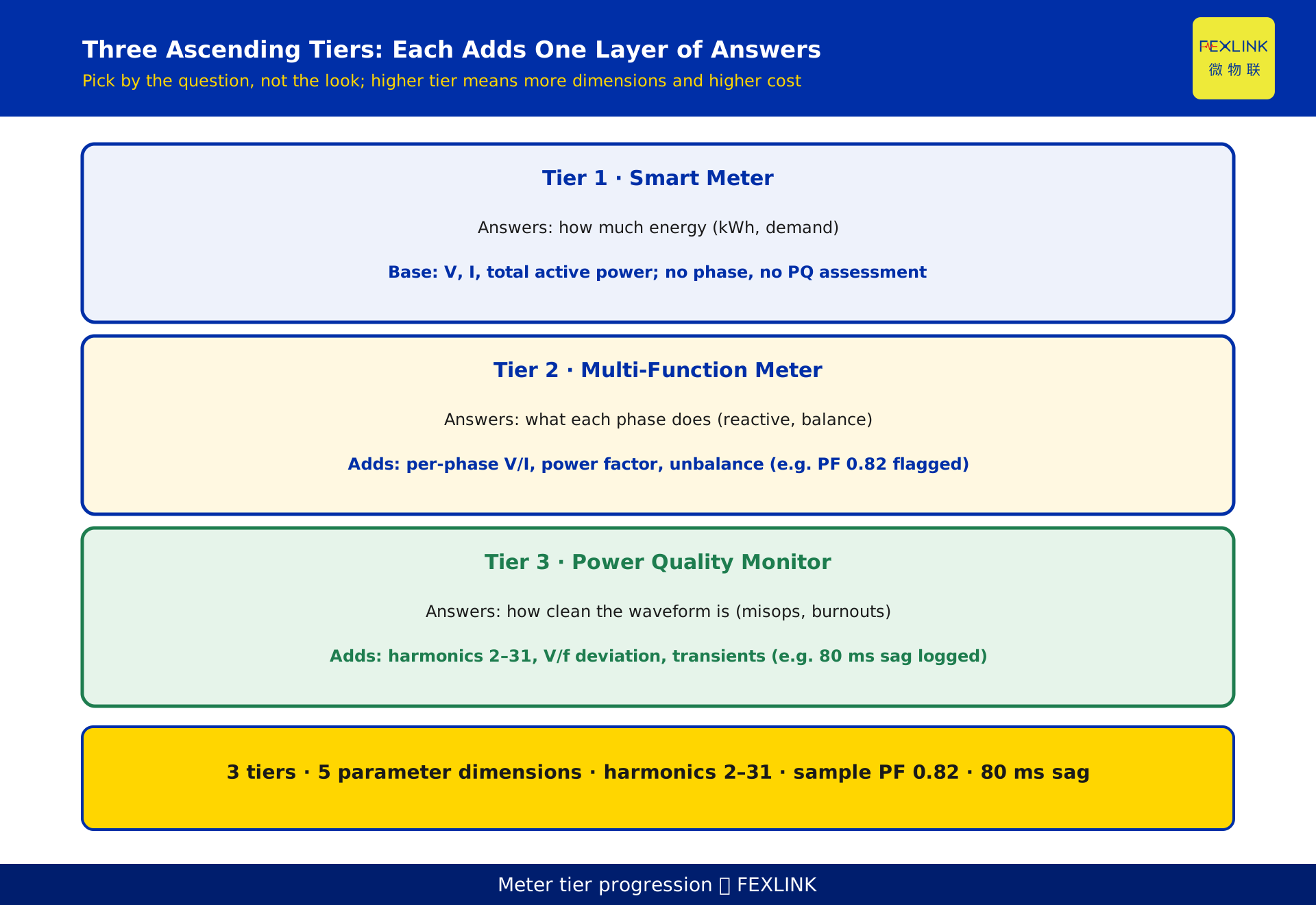
Smart meters, multi-function meters and power quality monitors are three ascending levels of metering depth, not three near-identical "more or less the same" devices. A smart meter answers "how much energy was used" - energy (kWh), demand, and the by-product readings of voltage, current and power. A multi-function meter adds phase and power factor on top of energy. A power quality monitor adds harmonics (commonly covering the 2nd through 31st harmonics or more, depending on the model), voltage and frequency deviations, three-phase unbalance, plus transient events such as sags and flicker.
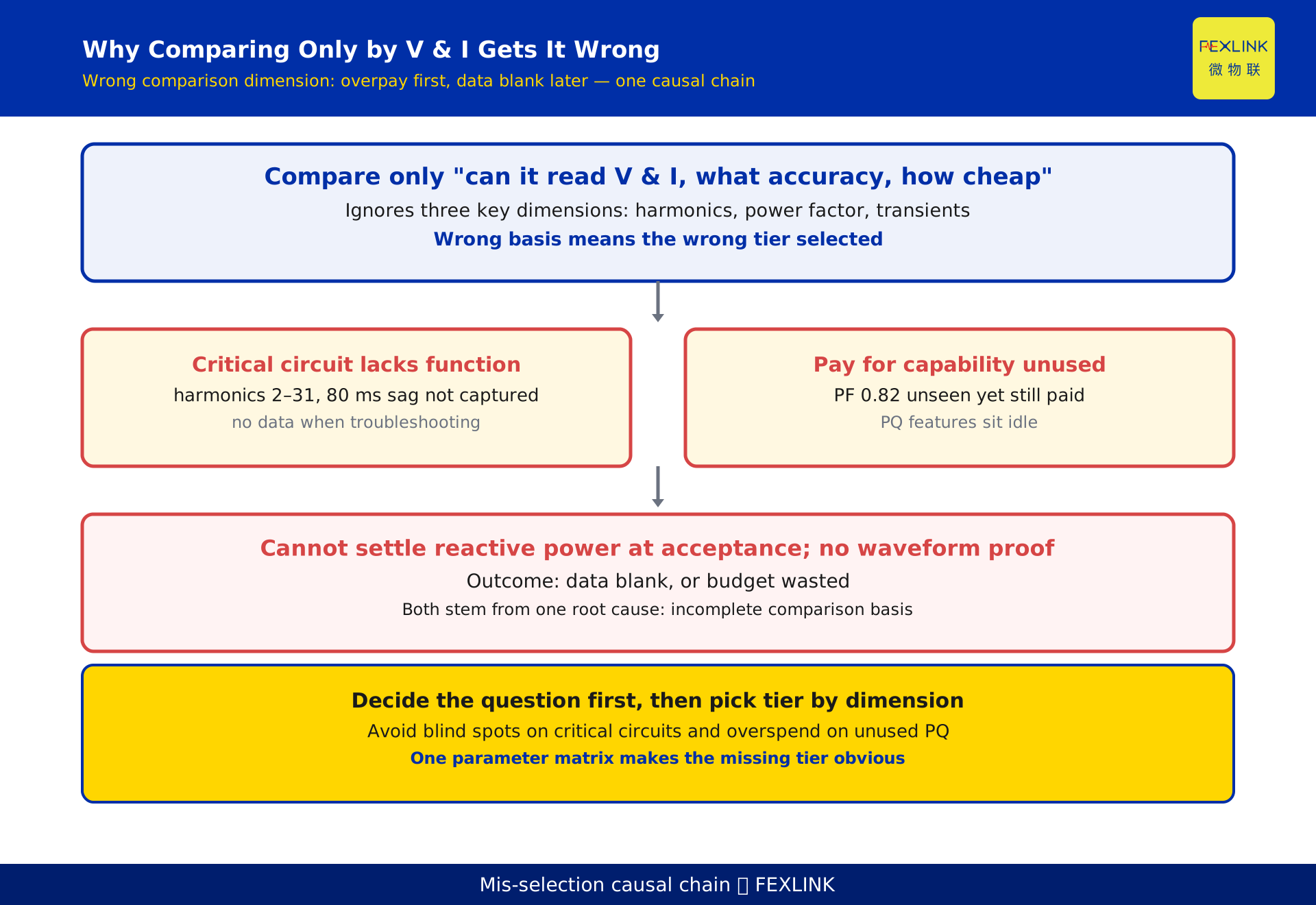
So pick the meter by the question you need to answer: if you only care about the bill and total consumption, a smart meter is enough; if you need to calculate reactive power and analyse the load structure, move up to a multi-function meter; only when you are chasing equipment misoperation, capacitor burnout, or welding-machine interference do you need a power quality monitor. If you compare meters only by "can it read voltage and current", you will either miss harmonics on a critical circuit or pay for power-quality capability you never use.
1. They look alike, but differ in what they can answer
The most common purchasing mistake is to compare only "can it read voltage and current, what is the accuracy, how cheap is it", then pick the cheapest.
But the difference is not in the appearance - it is in what layer of question the meter can answer. On the same panel, one meter only tells you "this month we used 120,000 kWh"; another can also say "the power factor is only 0.82 and the phases are badly unbalanced"; a third can plot "the 7th and 11th harmonics are over the limit, and there was an 80-millisecond voltage sag on Tuesday morning".
A starting point: do not ask "which meter is better", ask "what question do I actually need to answer". The layer you never use is pure waste.
2. Smart meter: answers "how much energy was used"
The smart meter sits at the bottom of this chain. Its core is energy metering: forward and reverse active energy (kWh), demand, plus the by-product instantaneous values of voltage, current, active power and frequency. It answers one question reliably: over this period, how much energy did this circuit use, and how much did it cost (with the tariff applied).
Its strength is energy management and billing: sub-metering, peak/valley/flat statistics, remote reading, prepayment. Its weakness is equally clear - it does not break out the phase relationship, and it does not assess power quality. Treat it as a "multi-function meter" and, by the time you need to size reactive-power compensation or investigate an unexplained equipment trip, you discover the data was never collected.
One-line positioning: the smart meter solves "how much", not "how well".
3. Multi-function meter: adds phase and power factor on top of energy
The multi-function meter builds on the smart meter by adding phase-resolved electrical quantities: per-phase voltage, per-phase current, three-phase total active / reactive / apparent power, power factor, phase angle, and from these the unbalance and basic active / reactive energy categories. It turns "total energy" into "what is happening on each phase".
The business questions it typically answers:
- Reactive power and power factor: if the power factor stays low, do we get penalised on the bill or should we add capacitance? The per-phase power factor and demand from a multi-function meter are the basis for sizing reactive-power compensation.
- Three-phase balance: which phase is overloaded, is the neutral current abnormal - visible from per-phase currents without waiting for something to burn out.
- Load structure: split total active power by phase and by time slot to support finer energy analysis.
A multi-function meter is still "steady-state": it reports present per-phase voltages, currents and power factor but generally does not compute harmonic spectra or capture millisecond-level transients. The next layer up is the power quality monitor.
4. Power quality monitor: adds harmonics and deviation events
The power quality monitor is the top of the chain. On top of the multi-function meter it adds the power quality dimension: harmonics and interharmonics (commonly covering the 2nd through 31st harmonics or more, with the exact order coverage depending on the model), voltage deviation, frequency deviation, three-phase voltage unbalance, voltage fluctuation and flicker, plus transient events such as voltage sags / swells / interruptions and their waveform records.
It answers a different class of question: why did the equipment misoperate, why did the capacitor burn out, why does the neighbour trip when the welding machine starts, why does it reboot mysteriously at night. These phenomena are rarely explained by "how much energy was used"; they are caused by harmonics, sags and unbalance hidden in the waveform. Only a power quality monitor can nail down "which harmonic order exceeded by how much, and at what time on what day an 80-millisecond sag occurred".
Note the hierarchy: a power quality monitor almost always contains the metering of the two lower tiers (it also reports energy and power factor), but the reverse is not true - smart meters and multi-function meters generally do not reach upward to harmonic spectra and transient capture. So the higher you go, the more data dimensions you get, but unit price, storage and analysis cost also rise.
5. A parameter-coverage table (functional progression)
Put the three side by side on a "parameter dimension x meter type" matrix and the progression is obvious:
| Parameter dimension | Smart meter | Multi-function | PQ monitor |
|---|---|---|---|
| Energy kWh / demand | basic | yes | yes |
| Voltage, current, power (total active) | yes | yes | yes |
| Per-phase voltage / current / power factor | no | yes | yes |
| Reactive, apparent, unbalance | rough or no | yes | yes |
| Harmonic spectrum (2-31+) and deviation / transient | no | no | yes |
How to read it: each tier adds dimensions on top of the one below. When selecting, tick against this table: the highest-level dimension you need decides which tier you buy.
6. ZSA / ESA / ESB / ESE: how the FEXLINK product line maps onto this chain
FEXLINK's product line is laid exactly along this progression chain, and can be used as the landing point "from concept to model":
- ZSA embedded multi-function smart meter - sits at the "multi-function" tier, emphasising embedded, high-density per-circuit installation, suited to management-side metering where a single panel needs a dozen meters.
- ESA all-element smart meter - also at the multi-function tier, but positioned for "all-element" collection and long-term data retention; 3x220/380V, RS485 Modbus, with 6 current ratings (3x5A to 3x1000A) and no phase or harmonic functions, suited to settlement or critical positions that need full traceability.
- ESB three-phase unbalance monitor - takes the single "unbalance" dimension of the multi-function meter and goes deep, focused solely on three-phase unbalance as a power-quality issue.
- ESE power quality monitor - sits at the top of the chain, covering harmonics, deviations and transient events; the meter that truly answers "how clean is the waveform".
When selecting, match "concept tier to product positioning": first decide which tier you need, then see which product's positioning fits. Specific range, number of circuits, sampling rate, harmonic order coverage and communication interface are per the product's selection manual; this article does not list parameters one by one.
7. One more layer of function, what extra cost, where is the boundary
Moving up the tiers brings not only capability but three kinds of cost:
Hardware unit price. The more functions, the higher the sampling rate, the need to capture harmonics and transients - hardware cost usually rises. But whether the extra money is worth it depends on whether you need that layer of data: paying for power-quality capability you never use is a mismatch.
Data volume and storage. A power quality monitor stores spectra and event waveforms; its data volume is several to dozens of times that of a smart meter. Without matching storage and a platform, the data is collected but nobody looks at it.
Analysis threshold. Harmonic orders, THD, sag counts - these indicators need someone who can read and judge them. Buying the meter but not understanding the numbers is as good as not buying it.
The only rule for the boundary: do you have a clear business question that lands on this layer? If yes, buy it; if no, this layer is waste. Common counterexamples: putting a power quality monitor on an ordinary lighting circuit (no use for harmonic data), or putting only a smart meter on the main intake (cannot find reactive power or sags).
8. On-site judgement: what data is your existing meter actually missing
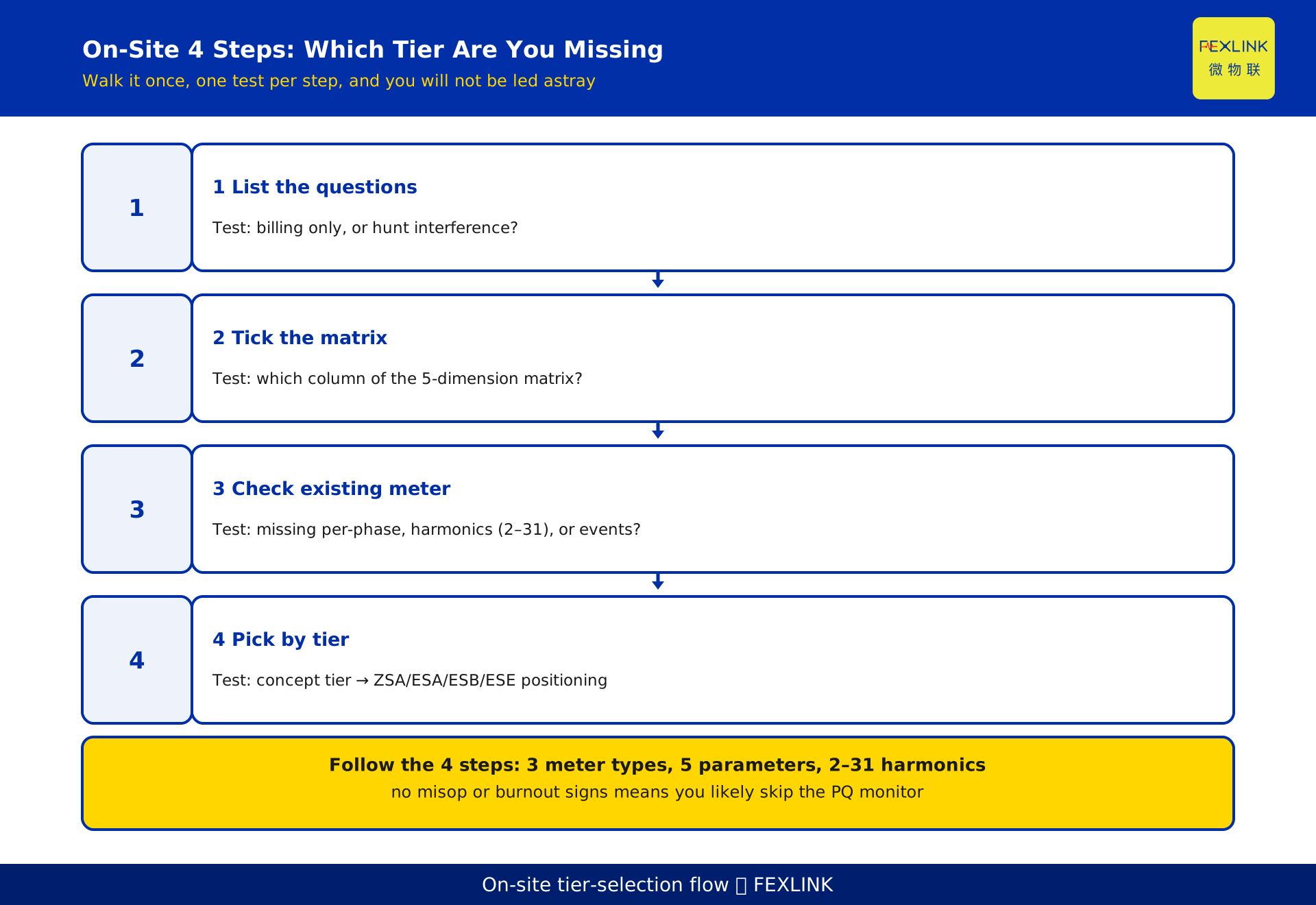
Given a panel and quotes, follow this order to locate the missing tier:
- List the questions first: what does this circuit need to answer now? Only billing and totals, or also reactive power, balance and interference?
- Tick against the section 5 matrix: which column does the highest-level parameter dimension you need fall into.
- Check the existing meter backwards: how many tiers does the existing meter cover? On critical circuits, is it per-phase, harmonics or events that are missing?
- Pick the product by tier: concept tier - the ZSA / ESA / ESB / ESE positioning in section 6 - the specific model per the selection manual.
A handy rule: if you have no "equipment misoperation / capacitor burnout / unexplained trip" phenomenon to investigate, you most likely do not need a power quality monitor; if you do not even have per-phase power factor and demand, you have not even reached the multi-function tier. Follow this line and you will not be led astray by "more functions, higher price, therefore better".
FAQ
Q: Can a smart meter be used as a multi-function meter, install it first and decide later?
No. The difference is whether phase and power-factor data were collected: a smart meter usually gives only total active energy and rough instantaneous values; per-phase power factor, reactive power and unbalance are often absent. By the time you need to size reactive compensation or check three-phase unbalance, you find the data is blank.
Q: Does a multi-function meter already include power quality monitoring?
Not fully. A multi-function meter gives steady-state quantities (per-phase voltage and current, power factor, unbalance, etc.) but generally does not compute harmonic spectra or capture transient events such as sags and flicker. To check harmonics and transients you need a power quality monitor.
Q: Can a power quality monitor be used just to bill energy?
Yes, because it usually contains energy and power-factor metering underneath. But using it only to bill energy is "using a sledgehammer to crack a nut" - high hardware and storage cost for something that only needs to count energy is not economical. Settlement and assessment should still use a meter whose positioning matches.
Q: Up to which harmonic order is it actually useful to measure?
Common power quality monitoring covers the 2nd through 31st harmonics or more, with the exact order depending on the model. For most distribution and industrial circuits, low-order harmonics (3rd, 5th, 7th, 11th, etc.) already explain most problems; higher orders usually depend on the device manual and on-site needs.
Q: Do ordinary lighting or power circuits need a power quality monitor?
Generally no. These circuits care about energy statistics and sub-metering, where a smart meter or multi-function meter fits better. Power quality monitoring should be prioritised on the main intake, on large non-linear loads (variable frequency, rectifier, welding) and at locations where equipment misoperation has occurred.
Scope and limitations
- This article is a conceptual comparison of three meter types and their functional progression, answering "which tier to buy", and does not replace model-level selection; see KD-0471 (article 471 in this series) for the specific model comparison.
- No fabricated product parameters: ZSA / ESA / ESB / ESE are described only at the "name implies positioning" tier level; range, number of circuits, sampling rate, harmonic order coverage and communication interface are per the corresponding product selection manual, and this article gives no specific values.
- The harmonic coverage "2nd through 31st or more" is a common capability description for the device class, not a hard indicator for any specific product; the exact coverage order is per the device specification.
- This article cites no standard clauses or coefficients; the numbers across languages are for tier illustration only (3 meter types, 5 parameter dimensions, 2-31 harmonics, 3-tier progression, power factor 0.82, 80-millisecond sag) and do not constitute a metering or compliance basis.
- Cases and selections are anonymised generalities ("a certain park", "a certain plant") and represent no real customer or quotation.
- Product side: ZSA embedded multi-function smart meter and ESA all-element smart meter serve multi-function-tier collection; ESB three-phase unbalance monitor focuses on unbalance; ESE power quality monitor covers harmonics and transients. The digital electrical intelligent supervision system handles collection and presentation of all three data types. Parameters are per the selection manual, and this article is not a procurement recommendation.
Frequently Asked Questions
Can a smart meter be used as a multi-function meter, install it first and decide later?
No. The difference is whether phase and power-factor data were collected: a smart meter usually gives only total active energy and rough instantaneous values; per-phase power factor, reactive power and unbalance are often absent. By the time you need to size reactive compensation or check three-phase unbalance, you find the data is blank.
Does a multi-function meter already include power quality monitoring?
Not fully. A multi-function meter gives steady-state quantities (per-phase voltage and current, power factor, unbalance, etc.) but generally does not compute harmonic spectra or capture transient events such as sags and flicker. To check harmonics and transients you need a power quality monitor.
Can a power quality monitor be used just to bill energy?
Yes, because it usually contains energy and power-factor metering underneath. But using it only to bill energy is "using a sledgehammer to crack a nut" - high hardware and storage cost for something that only needs to count energy is not economical. Settlement and assessment should still use a meter whose positioning matches.
Up to which harmonic order is it actually useful to measure?
Common power quality monitoring covers the 2nd through 31st harmonics or more, with the exact order depending on the model. For most distribution and industrial circuits, low-order harmonics (3rd, 5th, 7th, 11th, etc.) already explain most problems; higher orders usually depend on the device manual and on-site needs.
Do ordinary lighting or power circuits need a power quality monitor?
Generally no. These circuits care about energy statistics and sub-metering, where a smart meter or multi-function meter fits better. Power quality monitoring should be prioritised on the main intake, on large non-linear loads (variable frequency, rectifier, welding) and at locations where equipment misoperation has occurred.