 FEXLINK Research Institute
The short answer
What makes a water meter smart is whether its reading can leave the case, not whether it has a screen, a card slot or a valve. There is one first question: does the meter have a signal port an external device can read? If yes, a platform is possible. If not, the data still needs a person at the dial.
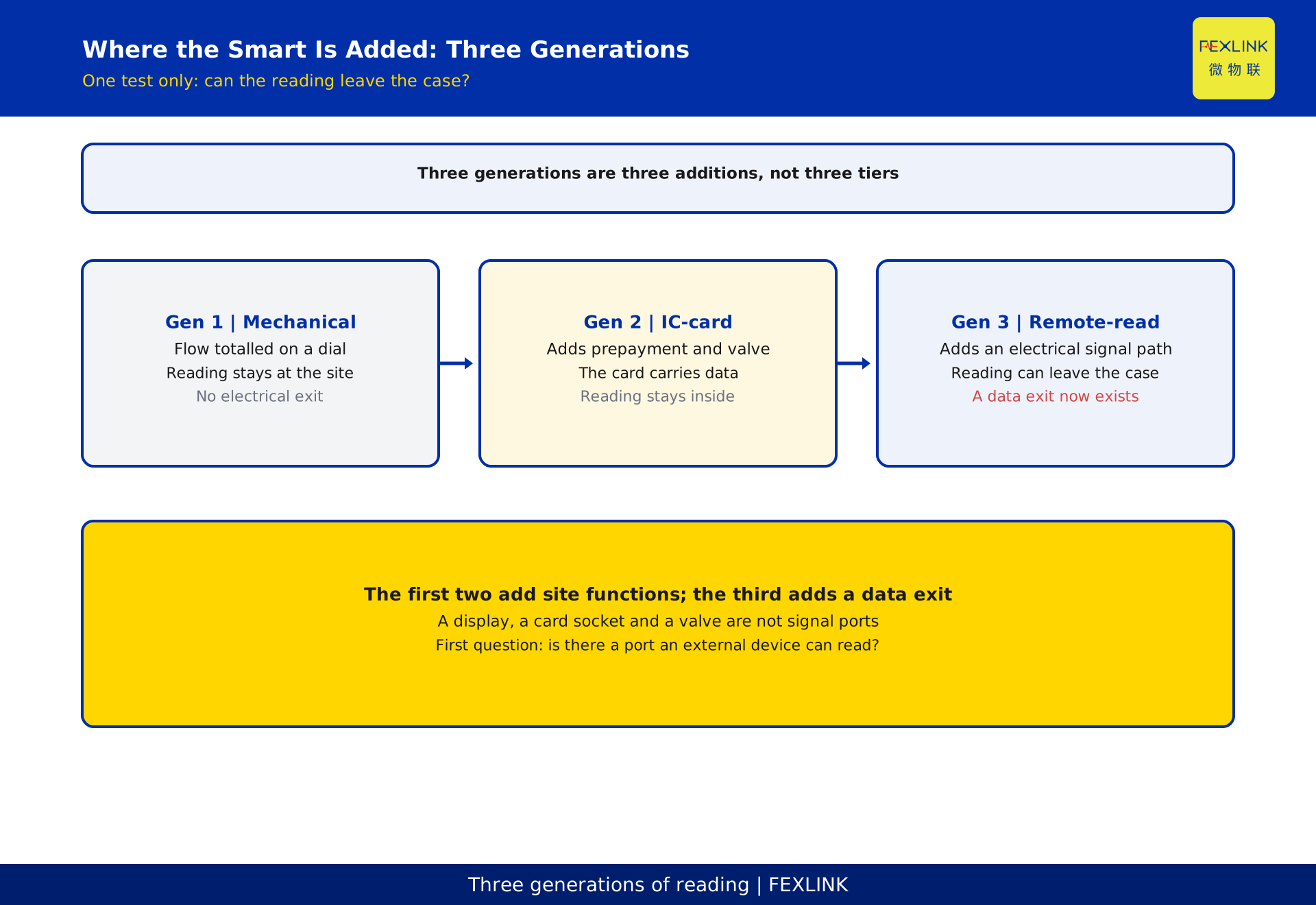
Three generations are not quality tiers but three different additions. A mechanical meter accumulates flow on a dial. An IC-card meter adds prepayment and valve control. Only a remote-read meter adds a path that turns the mechanical reading into an electrical signal and sends it out. The first two added site functions; the third added a data exit.
One test governs this article: a meter can feed a platform only if it converts the mechanical reading into a transmissible electrical signal with an interface a collector can recognise. Prepayment and remote reading are independent feature axes; neither substitutes for the other.
1. Start with the signal port
A signal port must satisfy three conditions at once. It outputs a reading or an equivalent counting event. It has a defined electrical or communication form, such as a dry contact, a wired bus or a wireless link. A collector can turn the signal back into consumption by agreed rules. Missing any one, it is still a site-read meter.
Three things are routinely mistaken for proof: a display, a card swipe and a valve. A display keeps the reading inside; a card swipe is person to meter, not meter to system; valve control runs opposite to returning data. None proves a data exit.
A review sheet should not say smart or not. It should say the port form, what is output, how the collector reads it and which platform field it lands in. Fill those four cells before comparing prices.
2. Generation one: the mechanical meter
A mechanical water meter lets flow drive a mechanism that accumulates volume on a dial; the reading exists only under the glass. Getting it means a person visits and carries the number back by transcription, photo or manual entry. It needs no power and has no electrical exit an external device could read.
A mechanical meter can be retained as a base meter, but a base meter is the metering layer, not the delivered product. The same base meter is site-read without a collection module and becomes remote-read only with collection and communication modules. A list saying base meter plus remote module and one saying smart water meter differ at acceptance.
No error bands, accuracy classes, diameters or range values are given here. If the dial is at the site, the number is not in the system.
3. Generation two: the IC-card meter
A prepayment IC-card meter uses a radio-frequency card: recharge information is written into the meter, status is written back to the card, and a valve opens or closes according to the balance. It changes the commercial model and adds an actuator, addressing advance payment and fewer site visits. The reading stays inside the meter.
Unless a communication module is added and a data interface agreed, the platform receives no consumption. A card swipe happens between a person and a meter; the card is a transport medium, not a link. Equating can be swiped with can be read remotely is why a retrofit launches to an empty dashboard.
4. Generation three: the remote-read meter
A remote-read meter normally uses a mechanical base meter for measurement, a collection module that converts dial position or flow change into an electrical signal, and a communication module that sends data out on an agreed schedule. All three layers are required. A base meter alone is a site-read unit. With no accessible output, the signal stays inside the case; with no reading source, there is nothing to upload.
Ask three questions by layer: which metering mechanism the base meter uses, which determines where the reading originates; what the collection method is, which determines whether the output is a reading or an event; and how the signal leaves the case, which determines the collector. Only then discuss integration.
Collection modules commonly use pulses or optical direct reading; communication uses wired buses or wireless networks. These are not one layer: first the mechanical quantity becomes an electrical signal, then it can be carried away.
5. Three kinds of signal port
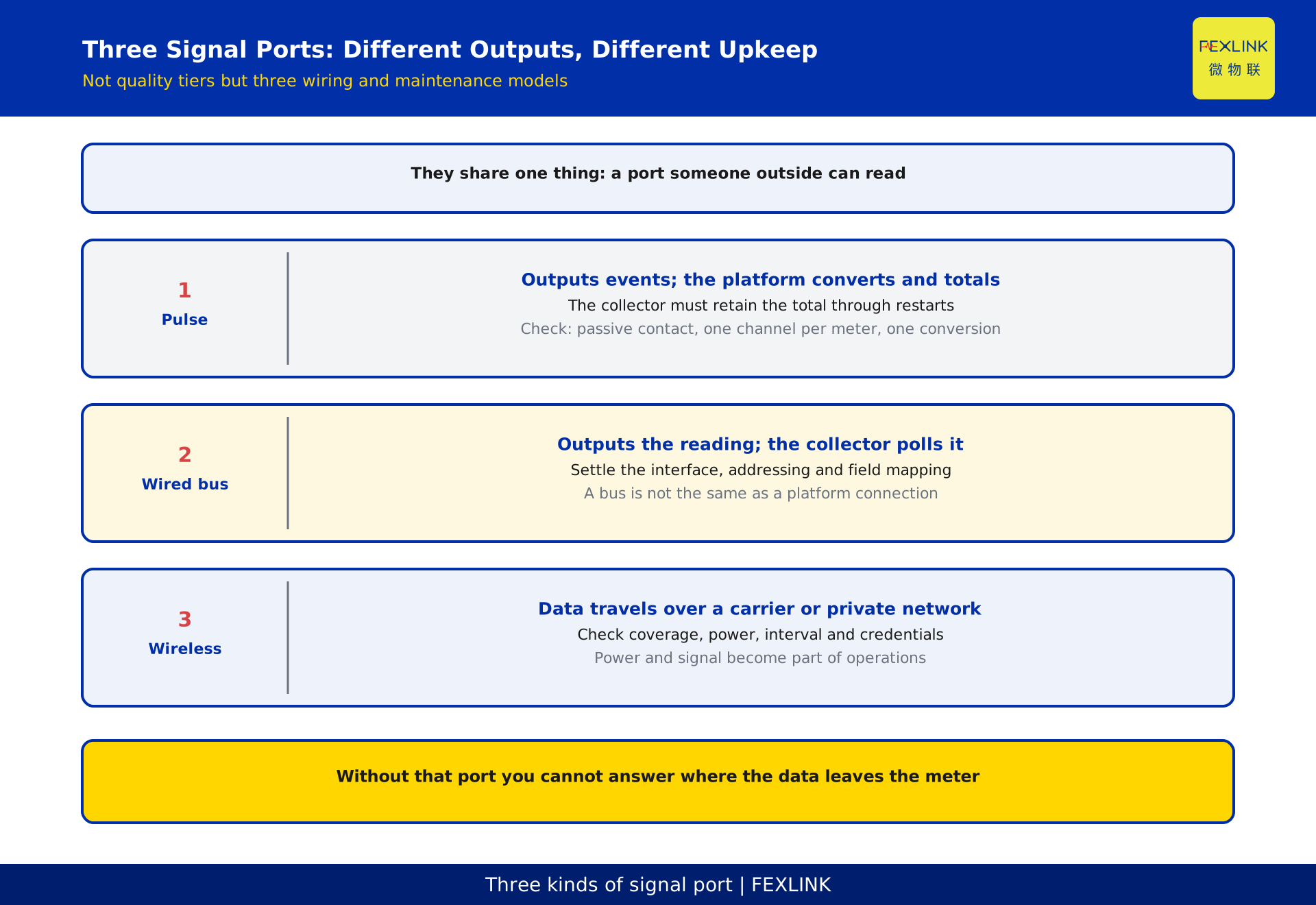
Pulse or dry contact. An internal contact changes state as consumption accumulates, and an external collector counts the transitions. It outputs an event, not a reading, so the platform must convert using that meter's pulse constant and keep a running total. The constant comes from the nameplate and manufacturer documentation; no value is given here. The total depends on the collector surviving power loss, restarts and replacement without rolling back.
Wired bus. The meter contains a communication unit and the collector polls it by an agreed method, usually obtaining the reading itself. Check the physical interface, the convention, addressing, power supply and field mapping. New builds and concentrated meter boxes with good cabling often use this route, but having a bus is not being connected to a platform: the collector and the protocol sit in between.
Wireless network. The meter contains a radio module and data travels over a carrier or private network to the platform. Check coverage, power supply, reporting interval and platform-side credentials rather than the technology name on the case.
6. Dry contacts and the collector boundary
A common arrangement for a pulse remote-read meter wires the passive dry contact to a digital status monitor or a digital-input module, which records each transition as a timestamped event. ESI digital status monitors and multi-channel digital-input modules perform this layer: turning a field state into a countable, traceable input.
The boundary matters. The collector neither creates a reading nor defines the pulse constant; it only records how many times something happened. Before wiring, confirm three things: the contact is passive and one channel maps to one meter; the collector retains the total through power loss and restarts; the conversion and multiplier are defined in one place and can be traced.
No wiring diagram, cable gauge, level threshold or debounce time is given here. The collector makes events countable; the meter and the agreement make them readable as volume.
7. Six dimensions: why the two look alike
Dimension 1 | How the reading is taken. An IC-card meter relies on the card and a site visit to the dial; a remote-read meter relies on a port read by external equipment.
Dimension 2 | Who it talks to. The first is person to meter and card to meter; the second is meter to collector and collector to platform.
Dimension 3 | Can the platform read it. The first normally cannot unless communication is added; the second is designed to be readable.
Dimension 4 | During an outage. The first carries on, since it never needed a network; the second must state whether local measurement continues, where the total is held and how values are restored.
Dimension 5 | Operational work. The first is recharge, card handling and valve issues; the second is links, power, protocols and platform fields.
Dimension 6 | Typical misunderstanding. The first is assumed remote because it is called smart; the second is assumed to produce data as soon as installed.
Both contain electronic parts, their only common trait. Mistaking appearance for capability creates two errors: buying card meters and expecting platform data, or buying remote-read meters without a collector.
8. Worked example: only 24 of 60 households reach the platform
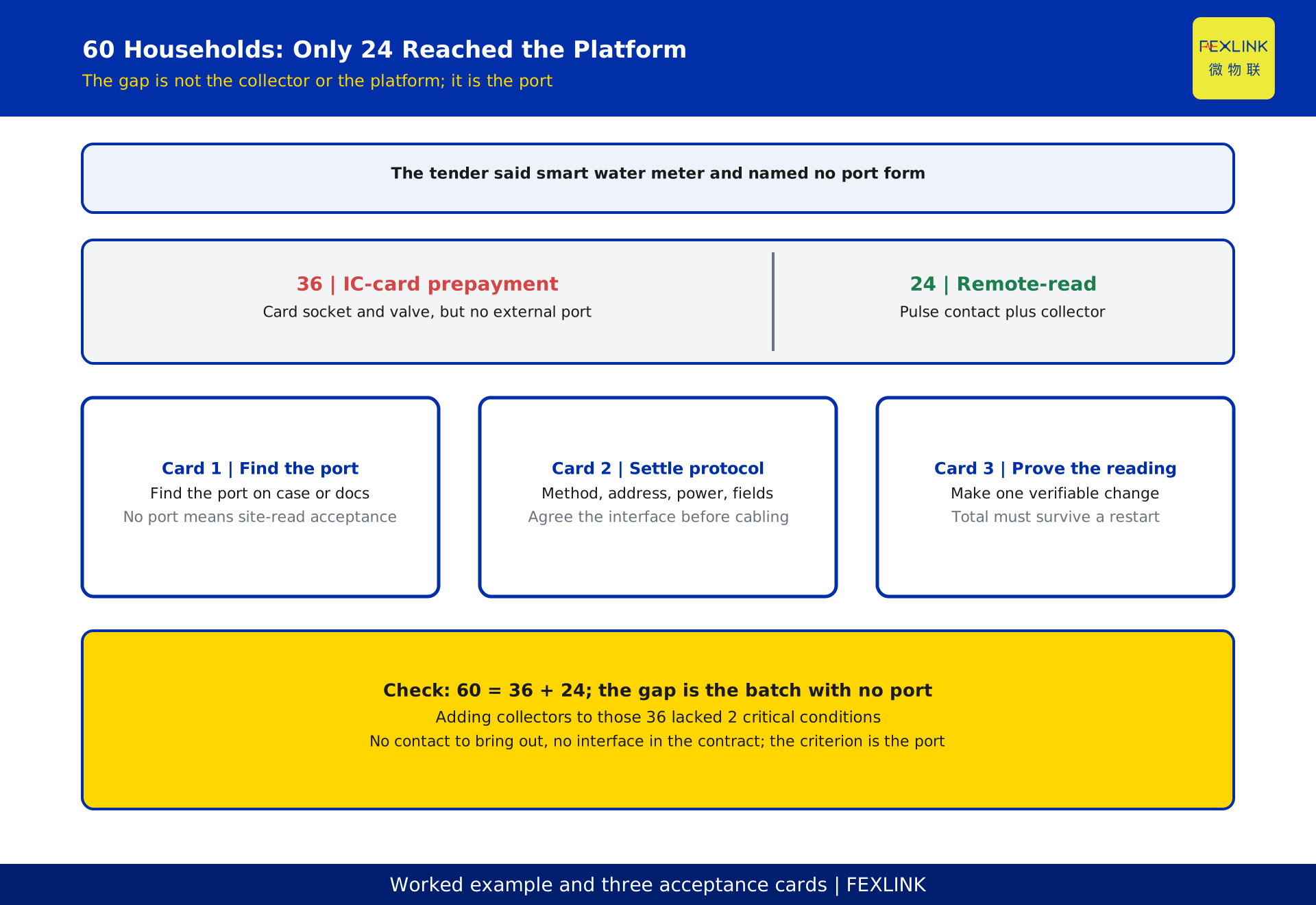
A community of 60 households replaced its water meters. The tender specification said only smart water meter, with nothing about the form of the signal port. On delivery, 36 households received IC-card prepayment meters with a card socket and valve control but no accessible external output; 24 received remote-read meters with a passive pulse contact, paired with digital-input collectors.
At go-live, only the 24 households appeared on the platform. The other 36 still depended on photographs and manual entry. Check: 60 = 36 + 24, and the gap is exactly the batch with no signal port, not a collector fault or a platform mistake. The rework time went into fixing the contract, writing the port form, the protocol and the acceptance method into the technical annex.
Someone proposed adding collectors to those 36 households. A check found 2 critical conditions missing: the meters have no pulse contact that can be brought out, and the contract defines no data interface. Until both are supplied, no number of added collectors will produce a reading. The criterion stayed the presence of a port, not price or appearance. All figures here are constructed and anonymised, with no client, place, project or price.
9. Three acceptance cards: port, protocol, reading
Card 1 | Find the port. Locate an externally connectable signal port on the case, the lead-out or the documentation, and record its form. A card socket, a button and a display do not count. If none can be found, accept the unit as a site-read meter and do not pay for remote reading.
Card 2 | Settle the protocol. Write down how the collector reads, how addresses are assigned, who supplies power, how often values are reported and which platform fields they map to. If these cannot be answered, complete the interface agreement before laying cable or buying hardware.
Card 3 | Prove the reading. Connect one sample meter, create one verifiable change in consumption, and confirm the platform number moves with it. Then verify the total does not roll back after a power cycle. A correct reading needs a real change, not a brochure.
The three cards answer whether the port exists, how it is read and whether the result is right, in that order. With no port there is nothing to agree; with no agreement there is no way to judge a number. Only when all three pass should bulk installation begin.
Frequently asked questions (FAQ)
Q: Is an IC-card prepayment meter a smart water meter?
It is an electronic prepayment meter, but not a remote-read one. It adds recharge, write-back and valve control while the reading stays inside. Platform visibility depends solely on an externally readable signal port. They can be combined, but neither implies the other.
Q: Does a remote-read meter mean nobody reads meters on site anymore?
Not necessarily. You still need a collector or platform integration, an agreed protocol and addressing, a pulse constant or reading mapping, and retention of the total through power cycles. Miss any one and platform values go missing, freeze or roll back. No completeness indicator or acceptance threshold is given here; use the project contract and field verification.
Q: Which should we choose: pulse, wired bus or wireless?
Decide on cabling, point distribution, power and the platform's integration, not on which name sounds newest. A pulse output is an event and needs counting and conversion; wired and wireless routes usually deliver a reading but require cabling or coverage plus power. They are not quality tiers, and no distance, consumption, band or battery-life figures are given here.
Q: Does wiring a dry contact to a collector give us a reading?
It gives you event counts. You still need the pulse constant from that meter's nameplate and documentation, a conversion defined in one place, and a total that survives power loss and restarts. No pulse constant, level threshold or debounce time is given here; missed and duplicate pulses belong to the neighbouring mechanism article.
Q: Is smart water meter enough as a tender specification?
No. At minimum specify the port form, whether the output is a reading or an event, how the collector reads it, which platform field it lands in and how acceptance is performed. In the worked example, 36 households needed rework because the specification never asked whether a port existed, so suppliers delivered to their own interpretation.
Scope and limitations
This article helps parks, residential communities and buildings distinguish whether a data exit exists during water-meter retrofit selection and delivery acceptance. It covers three generations of reading, three kinds of signal port, the dry-contact boundary and three acceptance cards. It does not unpack why pulse remote reading misses or duplicates counts (a neighbouring mechanism article), does not examine acquisition chains, timestamps and evidence retention (a neighbouring article), and does not calculate whether a retrofit pays for itself.
No pulse constant, error band, accuracy class, diameter, range, communication distance, power consumption, frequency band, battery life, level threshold, cable gauge, debounce time, reporting interval, completeness threshold, price or return figure is given, and this article does not replace a compliance decision. Those parameters follow current standards, the nameplate, documentation, the contract and local requirements; contractual clauses take precedence. Device model numbers, input channel counts, interfaces and storage capacity are customizable and follow the latest selection guide; this is not purchasing advice.
The 60 households, 36 IC-card meters, 24 remote-read meters, 60 = 36 + 24 and the 2 missing conditions are constructed examples with no client, place, project or price. Status is DRAFT_PENDING_REVIEW, and the author may not self-approve.
Frequently Asked Questions
What Makes a Water Meter "Smart"
What makes a water meter smart is whether its reading can leave the case, not whether it has a screen, a card slot or a valve