 FEXLINK Research Institute
The short answer
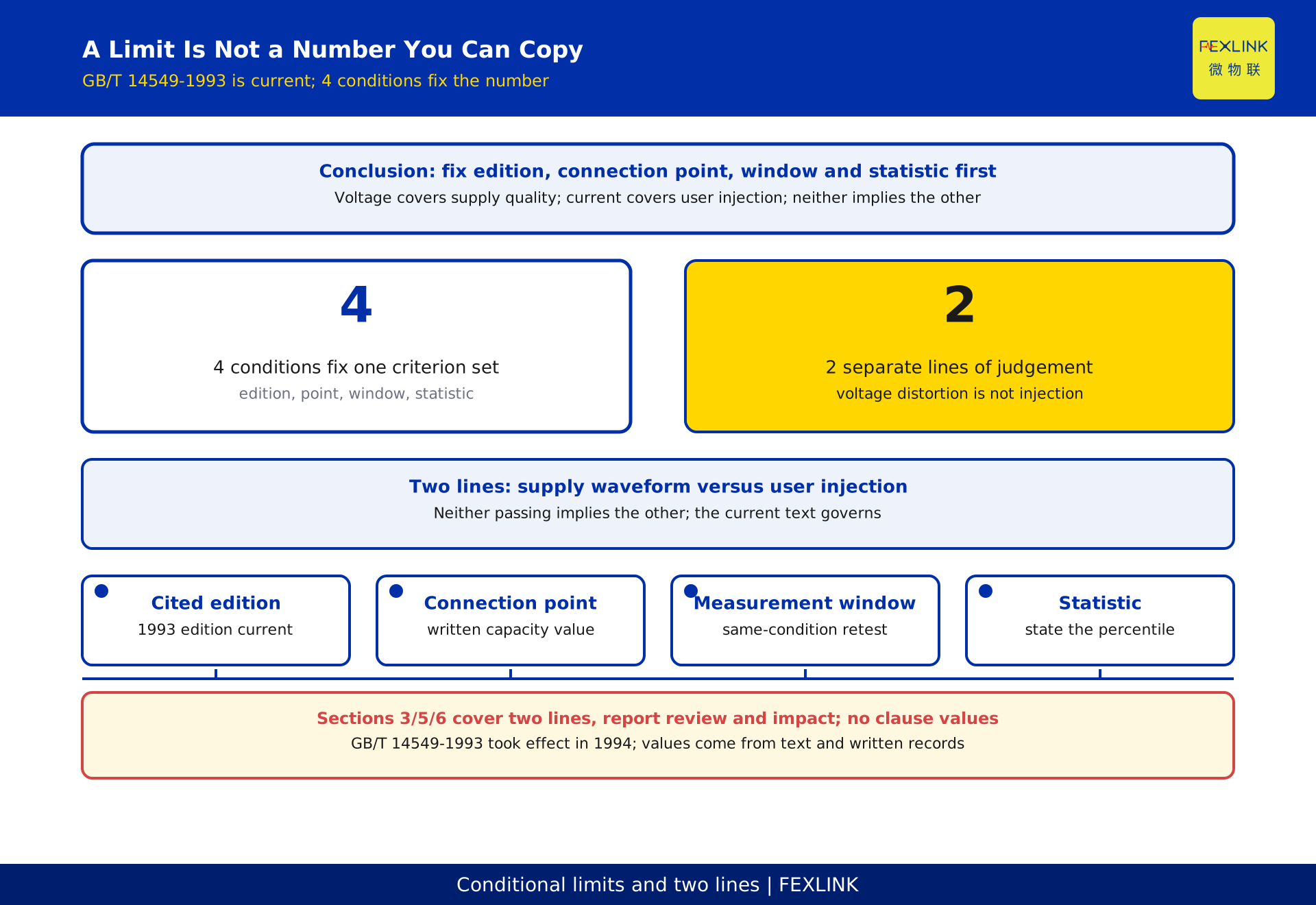
GB/T 14549-1993, "Quality of electric energy supply - Harmonics in public supply network", is the current national standard for harmonics on public networks. But "what is the limit" has no answer you can copy out of context. Voltage limits are graded by voltage level; allowable injected harmonic current is scaled by short-circuit capacity and agreed capacity at the point of common coupling. A report saying "exceeded" may only reflect a different measurement point, window or statistical basis. Exceeding a limit is not a verdict that equipment failed: it says that under agreed conditions the injected amount is above the value calculated for that connection point. Liability needs separate evidence. This article quotes no limit table values; it gives the preconditions, the two lines, the meaning of an exceedance, and the retest-to-liability chain.
I. Why "how much" carries 4 conditions
A limit holds only when 4 conditions travel with it: which edition is cited, which voltage level applies, which point of common coupling is measured with its short-circuit capacity, and which measurement window and statistical basis produced the number.
Secondary compilations are the usual trouble: the same indicator appears in incompatible forms, with grid-side quality and source-side contribution merged into one table, derived quantities presented as clause values, or headline figures quoted without the condition-dependent half. Copying them freezes uncertainty into an acceptance criterion.
A companion article on reading power-quality reports gives headline figures for spotting trends. This article does not reproduce that table; it explains the conditions behind those figures and the judgement after an exceedance.
II. Fix the scope first: which edition, which connection point, which measurement window
The national standard open-access registry lists GB/T 14549-1993 as current, issued in 1993 and effective in 1994, with no superseding standard shown. But "current" does not mean "the edition your contract cites": the contract, connection approval, design specification and the utility's written response may say otherwise. On site, the edition the project actually cites governs.
Next is the point of common coupling. The standard judges the electrical boundary between customer and public network, not an arbitrary monitoring point. Measuring at a branch panel rather than the boundary changes the conclusion and the direction of liability.
Then the measurement window and statistical basis. An instantaneous peak, a short-time statistic and a probability-based value over a prescribed window mean different things; instrument calibration and records must be documented. Until these three are fixed, any "how many times over" claim is unsupported.
III. Two separate lines: voltage quality versus current injection
The voltage side governs total harmonic voltage distortion and individual harmonic voltage ratios at the point of common coupling, graded by voltage level. The current side governs the allowable harmonic current a customer injects there.
The two cannot be inferred from each other. With high short-circuit capacity the same injection may not visibly distort voltage - hence distortion looks compliant while the utility still demands remediation. Reports show the voltage-side aggregate; liability determinations land on the current side.
So this article reproduces no voltage-level breakpoints, distortion ratios, individual harmonic ratios, allowable-current tables or scaling coefficients. Get the numbers through 3 channels: written data on the cited edition, short-circuit capacity and agreed capacity from the utility or design institute; the tables in the current effective edition; and an on-site retest with the point, window and statistical basis aligned.
IV. Why short-circuit capacity changes the allowable value
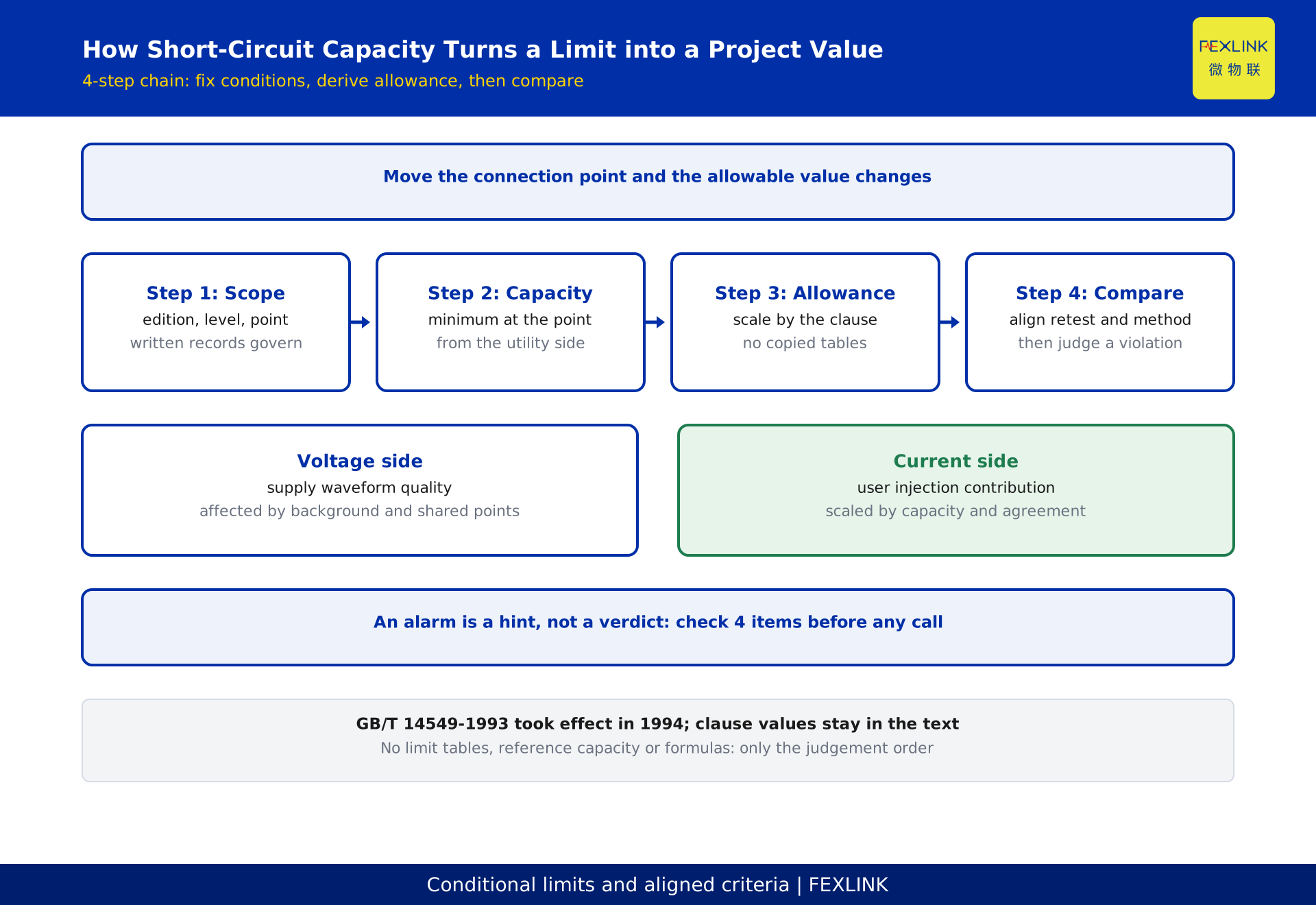
Short-circuit capacity approximates how well a connection point absorbs disturbance. The same rectifier at a strong point and at a weak feeder end produces different voltage distortion from the same injection. A fixed allowable current would be too loose at the strong point and too strict at the weak one, so the standard makes it scalable: a reference short-circuit capacity is the baseline, actual minimum short-circuit capacity at the point adjusts it, and the result is apportioned among customers sharing that point by agreed capacity.
That yields a document list: short-circuit capacity under maximum and minimum operating configurations, agreed capacity, wiring and operating configuration, the connection point definition, and the written apportionment basis. If one is missing, do not calculate a multiplier yet.
Standby transfer, parallel transformers or bus section changes alter short-circuit capacity, so a comparison conclusion must state which configuration and data set it used, or it cannot be reproduced.
V. An alarm on a report is not a standard violation
Four mismatches sit between an alarm and a violation: the point is an internal branch rather than the point of common coupling; an instantaneous peak is compared with a statistically defined criterion; background harmonics are not removed, so grid-side distortion is attributed to the customer; several customers share one point and the combined result is assigned to one of them.
A report is a lead, not a determination. Fix 4 retest requirements: return to the same point of common coupling; align window and statistical basis with the criterion; retain raw records, instrument details and wiring notes; record operating configuration and load-switching events over the same period. Otherwise "exceeded" can only mean "a reading above the alert value at a given point in a given window".
"Should we worry" therefore has an order: establish whether this is a violation in the standard's sense, then consider duration and exposure, then discuss liability. Skipping to the third step commonly ends with mitigation installed and a retest showing the background component unchanged.
VI. What exceeding means: 3 kinds of impact and their boundaries
There are 3 kinds of impact, each bounded. Equipment side: losses, heating, nuisance operation and insulation ageing risk, depending on withstand and duration. Network side: distortion affecting other customers at the same point, and possible protection, metering or communication deviation. Compliance side: remediation a connection agreement may trigger, set by written responses.
Three boundaries matter. A mild exceedance is often intrinsic to a population of rectifier loads, not evidence that one device failed. An exceedance compares injection against an allowable value, not a liability verdict; background pollution and shared-point aggregation both raise the number. Impacts depend on operating conditions, so no multipliers, service lives or failure rates are offered here.
What deserves attention is not imminent failure but whether the chain closes: written reference conditions, a reproducible retest, background removed, responsible parties signing off. With any of the 4 missing, mitigation spending cannot be shown to have worked.
VII. 4 pieces of evidence before any liability call
First, a written definition from the utility or design institute: cited edition, connection point, voltage level, short-circuit capacity, agreed capacity and apportionment basis - not verbal answers. Second, contemporaneous raw records with a basis note covering window, evaluation method, calibration and operating configuration. Third, a background reference: components still on the incoming feeder with in-plant load shut down. Fourth, aligned branch components and start-stop events tying a component to a load.
Only with all 4 does apportionment begin, following the evidence chain. If the background reference shows the same components with the plant shut down, the source may be an external shared line: in-plant mitigation may be ineffective and the cost should not fall on one party. Deliver a time-stamped comparison record and a conclusion against the current clauses, for both sides to verify.
A companion article on remediation paths develops three-layer monitoring points and fingerprint matching; this article lists only the evidence a determination requires, and its increment is the chain from conditional limits to evidence.
VIII. From retest to closure: 5 steps in a fixed order
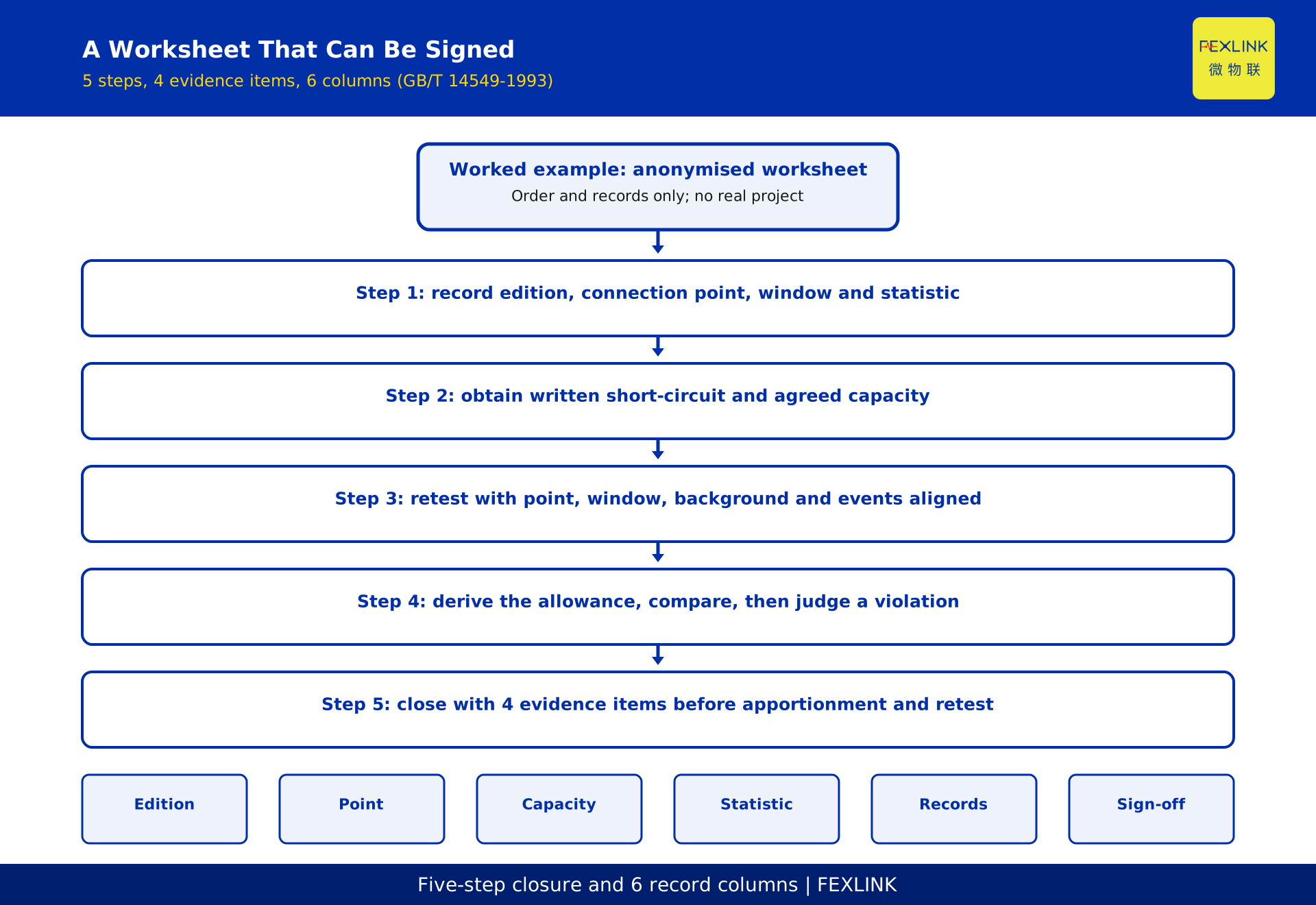
Step 1 is retest confirmation: fix the point, window, statistical method and operating configuration. Step 2 is source location: use the background reference and branch records to separate external background from in-plant loads. Step 3 is a comparison conclusion against the applicable clauses and written data, stating reference conditions rather than a bare multiplier. Step 4 is treatment or negotiation: local filtering, equipment replacement, a configuration change, or discussion with the utility. Step 5 is retest at the original point and archiving into a signable closed-loop record.
The order is fixed: evidence first, characterisation second, treatment last. The post-treatment retest must return to the original point, not one likely to pass; if configuration or load mix changes, run the process again.
For delivery use a fixed 6-column worksheet: connection point and cited edition; statistical basis and window; retest conditions and configuration; raw records; background reference; written determination and sign-off. A missing column means incomplete work, and the worksheet lets a different team recompute under the same conditions months later.
IX. Device roles and an anonymised worksheet
Roles stay distinct. The ESE power-quality monitor is the evidence tool, recording waveforms, components and event segments with denser sampling in a complaint window. The FSE power-quality controller stays on an identified branch as a routine observation point. Qianzhi engine harmonic analysis within the Taiyi intelligent control hub aligns multi-channel records to a common time base and ranks candidates. The common mistake is using a permanent observation point as an evidence point, giving "normal every day, no data when the complaint arrives". These names and capabilities are company-disclosed descriptions used only as a role comparison; they do not enter the conclusion, selection advice or acceptance basis. Conclusions still need human item-by-item verification and signature.
A plant's report showed an exceedance alert; this anonymised constructed example has no client, location, inferable combination or clause values. Review found the point sat on an internal branch; it moved to the point of common coupling for the retest, and written data on the cited edition and short-circuit capacity were requested. The background reference showed the same components with in-plant load shut down, so the conclusion stopped at "verify the background jointly with the utility and agree apportionment" rather than issuing a remediation order. The sequence: fix the scope, fix the basis, then multiples, then liability.
Frequently asked questions (FAQ)
Q: A report shows an exceedance. Do we halt production and remediate immediately?
Do not treat an alert as a conclusion. Recheck the point, statistical basis, background and shared-point aggregation, then establish whether this is a violation in the standard's sense. Usually the next action is one retest under the same conditions.
Q: Can we copy a limit table circulating online into the design basis?
No. Secondary compilations give incompatible versions of the same indicator and often present derived quantities as clause values. Point the design basis to the tables in the current effective edition, with written evidence of the cited edition, short-circuit capacity and statistical basis.
Q: If total voltage distortion is compliant, can we ignore harmonic current?
No. The voltage side governs delivered waveform quality, the current side governs customer injection; neither implies the other. At a strong point the injection can exceed its allowable value while voltage distortion stays unremarkable. Liability normally lands on the current side, after scaling by short-circuit and agreed capacity.
Q: How is the "how many times over" multiple calculated?
State reference conditions first: cited edition, voltage level, connection point and its minimum short-circuit capacity, agreed capacity, measurement window and statistical basis. Then compare a contemporaneous retest value with the allowable value from the clauses and written data. No standalone multiple is given here.
Q: Can one report decide who is liable?
No. You need at minimum the written definition, raw records with a basis note, a background reference, and aligned branch and start-stop events. If the incoming feeder still shows the same components with the plant shut down, the source may be an external shared line, and both sides should verify against the evidence chain.
Scope and limitations
This article applies to plants and substations on a public network reviewing a harmonic exceedance alert and determining liability, for electrical engineers and power-quality practitioners. The method summaries here are not compliance determinations, remediation commitments or quantified guarantees of equipment impact.
GB/T 14549-1993 is cited only as a standards source; the registry lists it as current, issued in 1993 and effective in 1994. On site the project's cited edition, the utility's written response and the connection approval govern. No specific values are reproduced: no voltage-level breakpoints, distortion or harmonic ratios, allowable-current tables, reference short-circuit capacities, scaling coefficients or apportionment formulae. No first-hand clause text was available for line-by-line verification, secondary compilations contradict each other, and a clause value is not a project determination value. Values come from the current effective edition, written data and on-site retesting.
This is a method note only. It rewrites no existing design document, topic description or project register, overturns no companion-article headline figures, and makes no site determination. The example is anonymised and represents no real project. The ESE power-quality monitor, FSE power-quality controller and Qianzhi engine harmonic analysis are company-disclosed names and capabilities used only as a role comparison; they do not enter the conclusion, selection advice or acceptance basis. All deliverables remain DRAFT_PENDING_REVIEW, require independent review, and are not self-approved by their generator.
Frequently Asked Questions
What Harmonic Limits Does GB/T 14549 Actually Set
GB/T 14549-1993, "Quality of electric energy supply - Harmonics in public supply network"