 FEXLINK Research Institute
The short answer
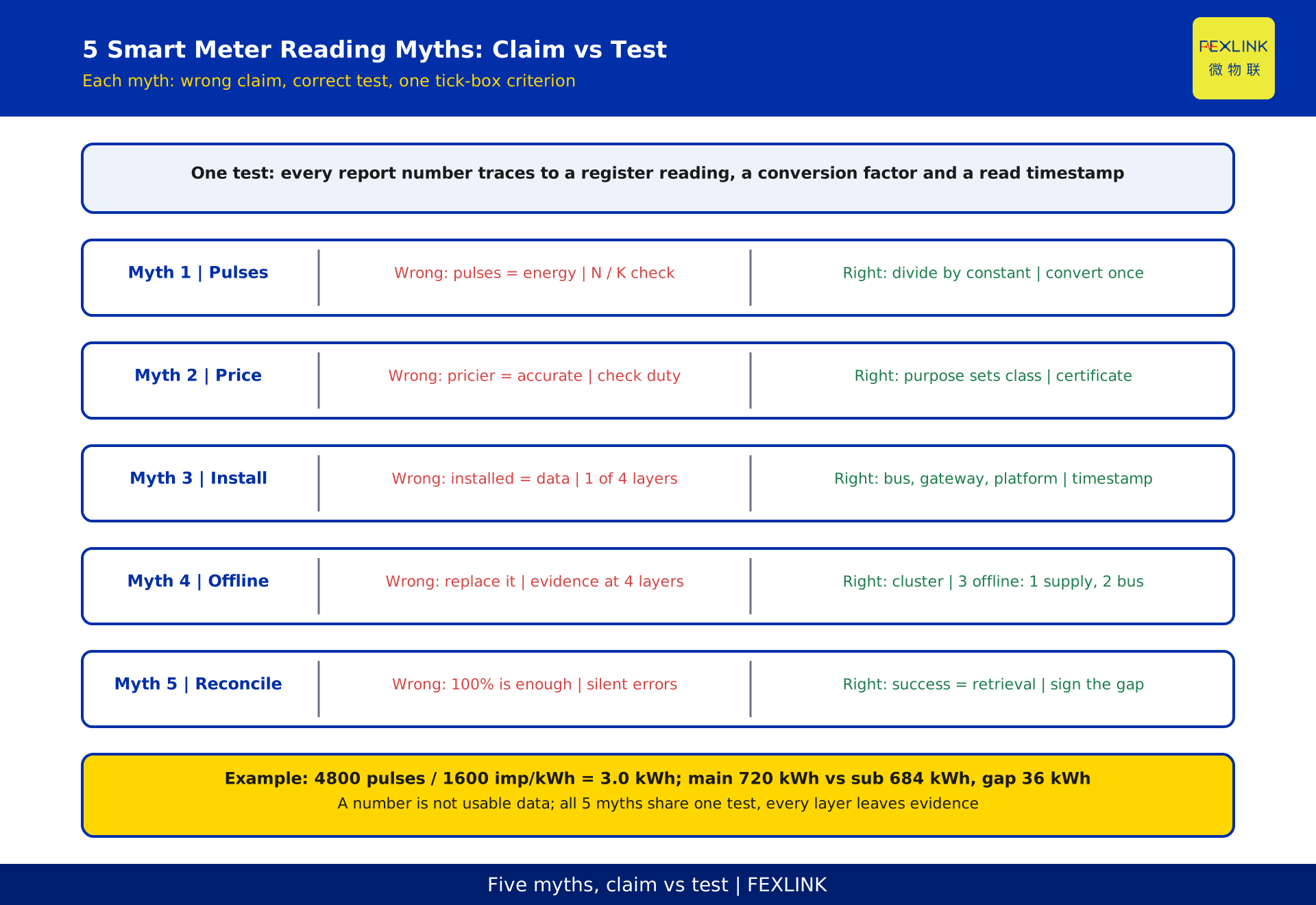
All five claims are wrong. A pulse count is not energy: divide it by the meter's pulse constant. Price is not accuracy: purpose, accuracy class and the real load range decide whether a reading is usable. Installing a meter is not reading a meter: the bus, gateway and platform sit in between. Offline rarely means a dead meter: locate the fault across four layers. Automation does not remove reconciliation: it moves data, not create trust. One test covers all five: every number in a report must trace back to a register reading, a conversion factor and a read timestamp.
1. Why these myths persist: a visible number is not yet a usable number
New managers treat any number on a screen as usable energy, skipping the chain: a register value is converted, polled over a bus, aggregated by a gateway and stored with a timestamp before becoming a report cell. If any link leaves no trace, that cell is a number, not evidence.
Three shortcuts cause the damage: a number that looks like energy is accepted as energy; an expensive device is assumed accurate; a completion certificate is assumed to mean flowing data. Each looks at only one end of the chain. This article compares five myths, each with a yes-or-no test; the concept piece next door explains what automated meter reading is.
2. Myth one: pulse counts are energy
A pulse output is counted in pulses, not kWh. The nameplate constant states pulses emitted per 1 kWh, usually imp/kWh. Conversion is E = N / K, with N the count and K that meter's constant.
Three mistakes recur: logging N as energy inflates it by K; treating the constant as an extra multiplier converts twice; one constant for mixed models makes only some circuits agree. It is a per-meter attribute, not site-wide.
Test: record nameplate constant, unit and conversion location per meter; N / K must agree with the register advance within rounding; conversion occurs at one place only, all others marked "no conversion".
Purpose matters: pulses suit short-interval power checks, while billing and reports use register readings or frozen values. Take the constant from the nameplate and documentation; this article gives no universal value.
3. Myth two: a pricier meter is a more accurate meter
Price buys functions: more circuits, harmonic and demand records, interfaces, event logs, storage depth — useful, but they do not change basic measurement error. Accuracy class comes from the nameplate and a verification certificate; the error band varies with load current, power factor and environment. At a very light long-term load, whether a reading falls inside the guaranteed range depends on the model's documentation and verification result.
Two wastes follow: an internal-analysis circuit over-specified; a monitoring-grade meter pushed into settlement without proof for disputes.
Ask three questions: will this meter carry settlement duty; which load range does it see; is there a valid verification certificate? The first sets the strictness of the others. Upgrading to settlement adds verification, sealing, matched instrument transformers and a metering ledger, not just another meter. Conditions follow current regulations and utility requirements; no class tables or limits here.
4. Myth three: installing meters means reading meters
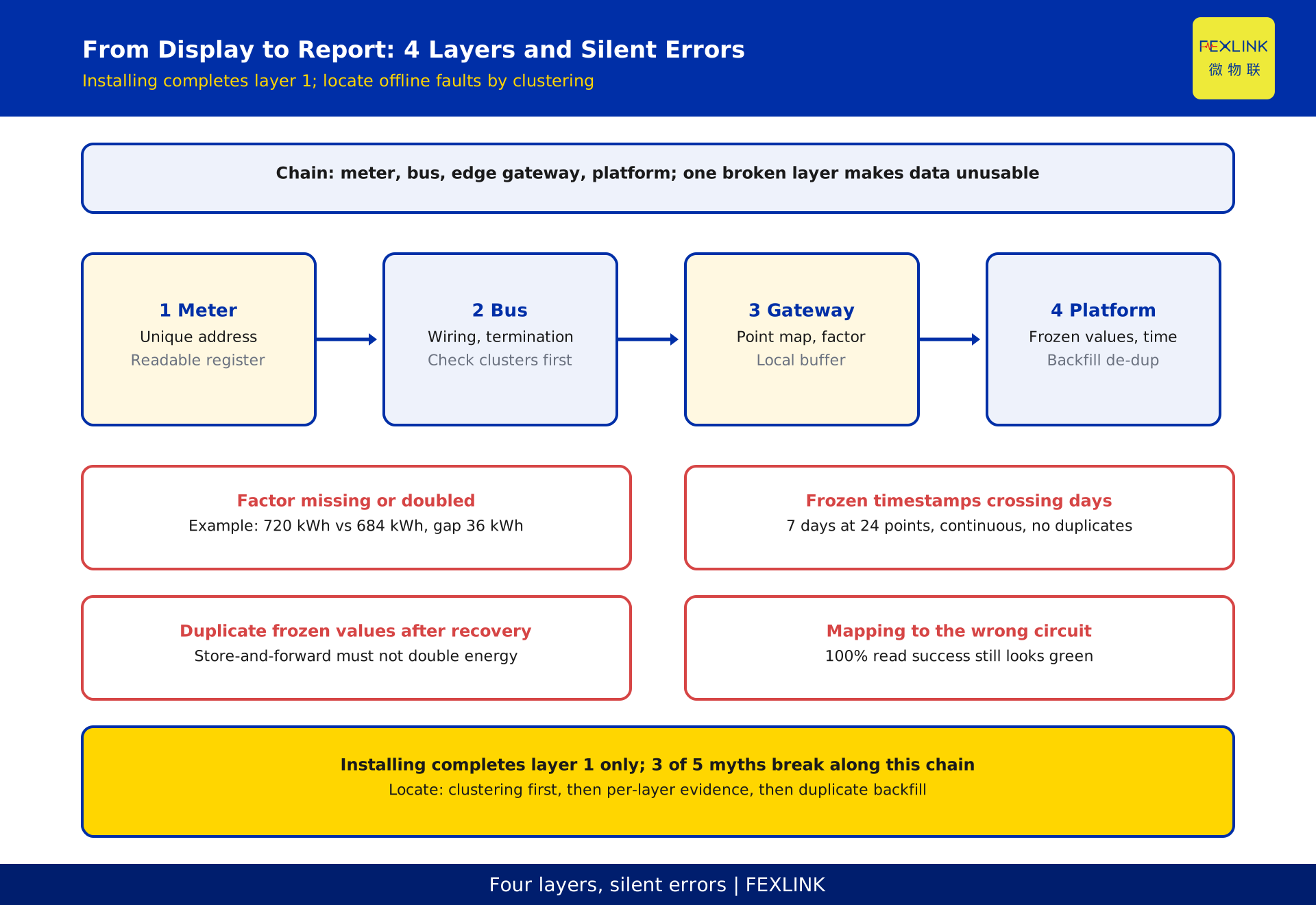
A meter mounted, powered and displaying normally has completed only the first of four layers: meter, communication bus, edge gateway or concentrator, platform. Installation delivers hardware; reading delivers timestamped data.
Each layer has deliverables. Meter: unique address, consistent protocol, readable register. Bus: correct wiring, termination, shielding and earthing. Gateway: point mapping, units, factor fields, local buffering. Platform: asset records, scheduled freezing, timestamp alignment, alarms, backfill de-duplication. Miss one and you have no data or untrustworthy data.
Two failures recur: meters with no bus connection, leaving the platform empty at handover; and crossed mappings, where data belongs to the wrong circuit. The second is more dangerous because everything looks healthy.
Test: for any meter the platform returns the same display reading at the same instant with a read timestamp; conversion is reproducible and the point table exportable. An ESA full-element smart meter provides stable readings, an ESX edge computing gateway aggregates and uploads, and a digital electrical supervision platform builds ledgers and curves — data lineage, not a verification conclusion.
5. Myth four: offline means the meter has failed
"Offline" is a platform status, not a diagnosis. It can originate in any layer: meter power loss, bus wiring and termination, gateway dropout or changed parameters, platform records and alarm configuration.
Start with clustering. Several meters offline on one segment: check bus and gateway. One offline: check its supply, address and port. This converges most problems to one layer.
Replacing the meter often changes nothing, since the new unit joins the same faulty segment. Calling a clustered failure a bad batch sends the team into a returns process while the fault stays on the wall.
Test: one piece of evidence per layer — display and local reading, bus and termination record, gateway state and buffer log, platform last-read timestamp and alarm log. After repair, frozen values over several days must be complete, not duplicated; store-and-forward must never create duplicate energy.
6. Myth five: automation removes the need for reconciliation
A 100% read success rate says "retrieved", not "retrieved correctly". Automation moves readings from the display into a database; the more completely it moves them, the faster a wrong number spreads across a report.
Four silent errors raise no alarm: a factor applied zero times or twice, frozen timestamps crossing day boundaries, values written twice after recovery, and mappings assigning one circuit's data to another. All present as complete data, continuous curves and a green dashboard; only reconciliation exposes them.
Reconcile on three levels: display versus platform at the same instant (conversion, timestamps); main meter advance versus the sum of sub-meters (omissions, duplicates); this period versus the last (basis changes). The difference trigger is project-set, written into the plan, not a standard limit. Crossing it means pausing reports, attributing the gap and signing the finding — not spreading it across a circuit.
Human work moves from copying numbers to judging anomalies and filing evidence. Test: frozen values continuous with no duplicates; the main-versus-sub difference has a record, a cause and a signature; basis changes leave comparable recalculations.
7. Anonymized example: 8 meters, one trap for each myth
All figures below are constructed, representing no real customer, project or quotation; the constant and trigger are illustrative, not standard values.
A park's low-voltage distribution room was refitted with 8 meters. Trap one, pulses: one meter accumulated 4800 pulses in 30 min; with an illustrative constant of 1600 imp/kWh, E = N / K gives 3.0 kWh. Logging 4800 as energy inflates it 1600 times, while the register advance is near 3.0 kWh — one comparison reveals it.
Trap two, selection: a long-term light-load circuit was bought fully featured. A purpose review showed it only feeds internal analysis, so the budget moved to circuits that need recording and accuracy was aligned to purpose, not price.
Trap three, handover: all 8 meters were powered, but the platform had records for only 5; the other 3 returned nothing. The installation certificate said "installed"; the data certificate should say "not complete".
Trap four, offline: on day one 3 meters showed offline. Clustering found 1 with lost supply and 2 sharing a bus segment with A/B conductors reversed; replacing meters would not fix those 2. After repair all 8 were online and backfilled values were checked for duplicates.
Trap five, reconciliation: the main meter advanced 720 kWh while the 8 sub-meters totalled 684 kWh, a difference of 36 kWh, or 36 / 720 = 5.0%. The park's trigger sat below this, so reports were paused. The factor field was active in both gateway and platform; after making it active in one place, the difference returned to an explainable range. Here 5.0% is a project review trigger, not a pass limit.
All five say the same: having a number is not having usable data; every layer must leave recomputable evidence.
8. Five myths: wrong claim, correct test
- Myth one. Wrong: "pulse counts are energy". Right: "divide by this meter's pulse constant first". Test: the point table carries constant and unit; N / K matches the register advance.
- Myth two. Wrong: "the pricier meter is more accurate". Right: "purpose sets the class; the load range decides usability". Test: written answers on settlement duty, load range and verification proof.
- Myth three. Wrong: "installed meters produce data". Right: "four layers, each with deliverables". Test: any meter returns a same-instant, timestamped reading.
- Myth four. Wrong: "offline, replace the meter". Right: "use clustering to locate one layer". Test: evidence at all four layers, no duplicate frozen values after repair.
- Myth five. Wrong: "automated reading means no reconciliation". Right: "success rate governs retrieval; reconciliation governs correctness". Test: the difference has a record, a cause and a signature.
None depends on a brand or fixed parameter; they are tests, not a configuration list.
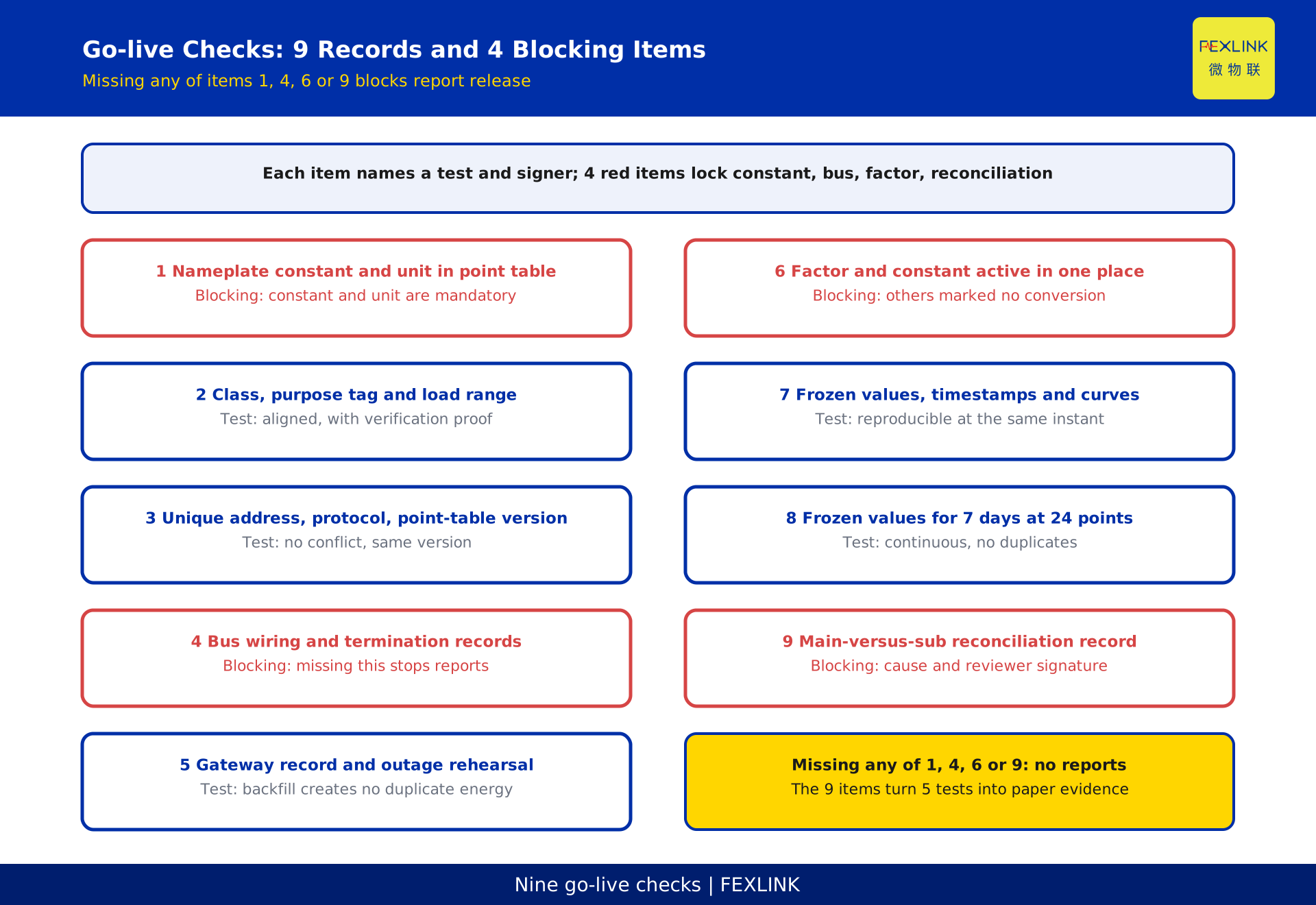
9. Nine sign-off checks before go-live
Tick each item, noting a reason for any gap. If any of items 1, 4, 6 or 9 is missing, do not issue reports.
- Nameplate pulse constant, unit and conversion location recorded per meter.
- Accuracy class, purpose tag and actual load range aligned.
- Unique addresses, protocol and point-table version consistent.
- Bus wiring, termination and shield earthing records complete.
- Gateway registered, one outage-to-recovery backfill rehearsal done.
- Factor and constant conversion active at one place; others marked no conversion.
- Frozen values, timestamps and platform curves aligned.
- Frozen values continuous and non-duplicated for 7 consecutive days at 24 points per day.
- Main-versus-sub reconciliation record, anomaly attribution and reviewer signature complete.
These nine turn five tests into paper evidence; keep them and any dispute has a baseline.
Frequently asked questions (FAQ)
Q: Where do I find the pulse constant, and is there a universal value?
Check the nameplate, manufacturer documentation and that circuit's point table; all three should agree. There is no universal value: constants differ by model and rating, and mixed models need per-meter records. If unconfirmed, back-calculate from the register advance over the same window rather than guessing.
Q: Is a higher accuracy class never a bad choice?
Not bad, just not always value for money. Class follows purpose: settlement duty gets the settlement package, internal analysis gets what analysis needs. Money belongs in load-range coverage, a valid verification certificate and matched instrument transformers. Class tables and error limits come from current regulations and manufacturer documentation; no figures here.
Q: The platform says online but the reading has not moved for days. Is the meter dead?
Do not replace it yet. Online with a frozen reading usually points to timestamps, point mapping or gateway buffering: check the last read timestamp, whether the curve repeats one value, and the local display. If the display advances but the platform does not, look at the link or configuration. Only a static display justifies investigating the meter and load.
Q: With a 100% read success rate, do we still need manual reconciliation?
Yes. Success rate counts retrieval, not conversion, timestamps or mappings. A factor applied twice, values crossing a day boundary and duplicate backfill leave the rate intact while writing wrong numbers into reports. Reviewing differences, trends and evidence is a permanent duty after go-live, not a transition measure.
Q: We avoided all five myths and the bill still disagrees with settlement data. What now?
First confirm one basis: same metering point, period, factor and rounding rule. If it matches and a gap remains, check instrument transformer configuration, verification and sealing status, and the utility's boundary. This article addresses the usability of a reading chain; it does not replace a statutory verification conclusion or judge settlement data.
Scope and limitations
- This article covers selection, go-live and data acceptance for low-voltage automated meter reading in parks, property portfolios and factories, for newcomers and project owners. It excludes high-voltage cubicle testing, instrument transformer commissioning tests, and verification and sealing.
- It provides no universal pulse constant, accuracy class table, error limit percentage, difference pass limit or verification interval. Use the nameplate, manufacturer documentation, current verification regulations, utility requirements and project agreements.
- The example in section 7 is constructed and represents no real customer, site, project or quotation. 1600 imp/kWh is illustrative, not a standard value; 5.0% is a project-set review trigger, not a compliance limit; 720 kWh, 684 kWh, 36 kWh, 4800 pulses and 3.0 kWh are internally consistent constructed figures.
- Definitions of "online", "offline" and "read success rate" vary by platform. Apply the definitions and alarm rules of the platform used in the project.
- Products and systems are named only to show each layer's responsibility, not as a selection recommendation or performance commitment. Range, circuit count, power supply and communication interfaces are customizable and follow the actual configuration.
- This article does not replace utility settlement data, statutory verification or a specialist appraisal. Disputes follow the contract and the competent authority's requirements.
Frequently Asked Questions
5 Persistent Myths About Smart Meter Reading
All five claims are wrong. A pulse count is not energy: divide it by the meter's pulse constant