 FEXLINK Research Institute
The short answer
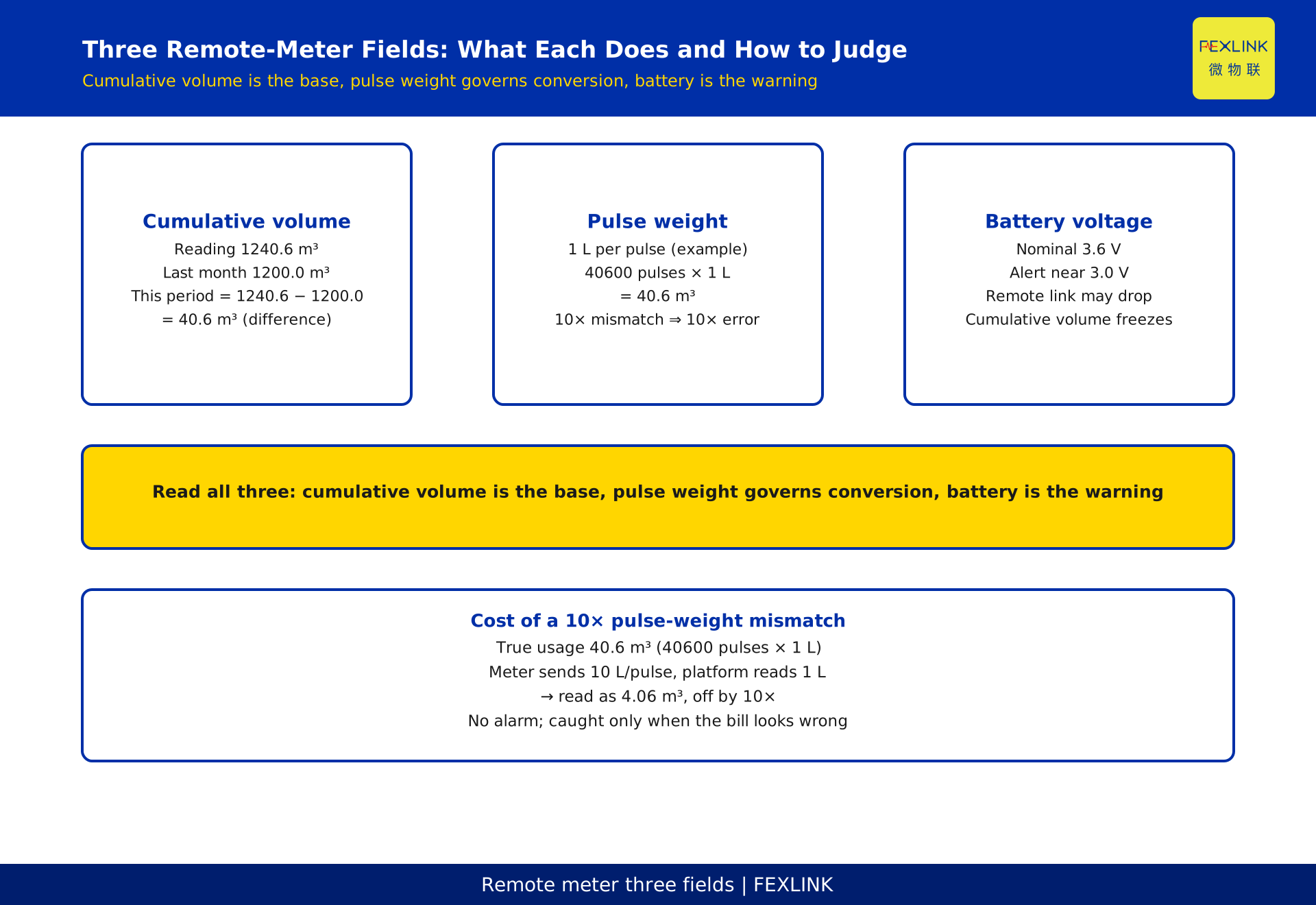
A remote water meter on the platform exposes three fields you should watch together: cumulative volume is the settlement body, normally in m³ (cubic metres); the pulse weight (how much water each count pulse represents, i.e. the pulse equivalent) decides whether the count conversion is right; battery voltage is the health warning for remote communication and data reporting. Reading only cumulative volume — and ignoring pulse weight and battery voltage — means you notice a stuck or wrong meter only long after the damage is done. Read all three together to confirm the reading is trustworthy and the meter is still powered. The rest of this article explains how to read each field and how to judge them jointly.
Cumulative volume: the reading and the difference between two reads
Cumulative volume is the core field of a remote meter (and of platform meter reading). It records the total water that has passed through the meter since commissioning, normally in m³. In billing by meter, per-tenant allocation, and loss analysis, the figure that matters is never "this one reading" but the difference between two reads.
Example: the platform reads cumulative volume 1240.6 m³ this time, and the same meter position read 1200.0 m³ last month; the current consumption is the difference, 40.6 m³ (1240.6 − 1200.0 = 40.6). Treating cumulative volume as "this period's usage" and billing on it directly is the most common beginner mistake.
To judge whether a reading is trustworthy, step one is to see whether it "moves". Normally, when water is used, cumulative volume should increase with the pulses. If it stays frozen across several reading cycles, do not suspect the pipe first — check power supply and communication first (see section four). Cumulative volume itself is silent: it only records "how much water has passed so far"; whether that is trustworthy is vouched for by the two companion fields.
Pulse weight: how many litres one pulse represents
Most remote meters use a pulse generator that turns mechanical counting into electrical pulses; one count pulse is emitted after a fixed amount of water passes. The "pulse weight" or "pulse equivalent" is how much water one pulse represents. Because meter models and pulse methods differ, this value is not uniform — common examples are 1 L per pulse or 10 L per pulse — and it must match the meter's pulse specification.
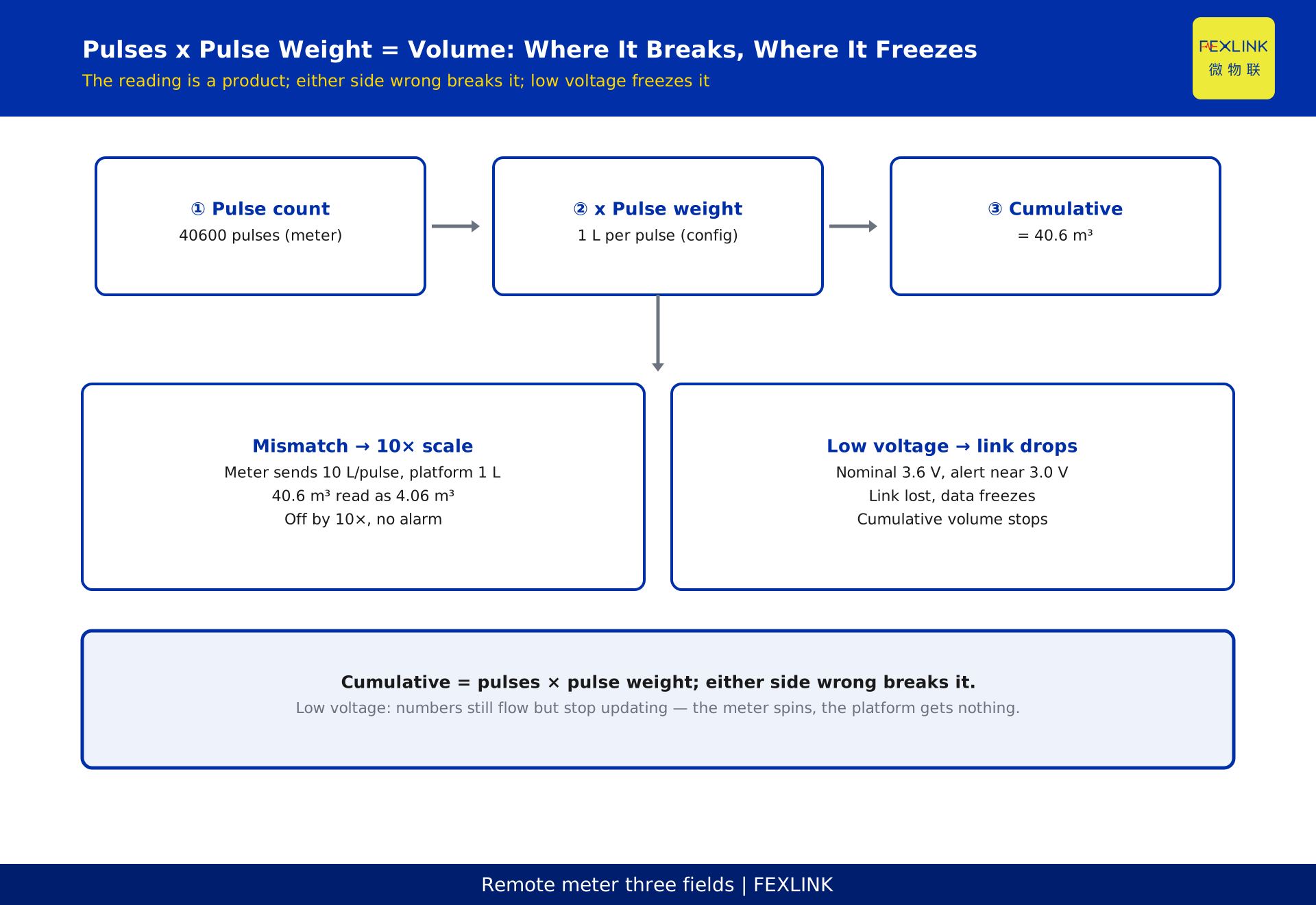
Constructed example (for conversion only, not any real customer): a meter is set to 1 L per pulse and the platform reads 40600 pulses, so the corresponding volume is 40600 × 1 L = 40600 L = 40.6 m³ (1 m³ = 1000 L). Here the pulse weight is the "denominator" of the count conversion — if it is mismatched, the whole cumulative volume is scaled up or down proportionally.
The most typical consequence of a pulse-weight mismatch is an "integer multiple error". Using the same constructed example: if the meter actually emits 10 L per pulse but the platform still converts at 1 L per pulse, the true 40.6 m³ is read as 4.06 m³ — off by 10×. This error raises no alarm; the numbers still appear, only the magnitude is completely wrong, and it is usually found only when the bill looks obviously abnormal.
Battery voltage: why it is the remote meter's "life warning"
Most remote meters are powered by a built-in lithium battery (typically a 3.6 V lithium thionyl chloride cell, common ratings such as ER14505, ER26500). The battery drives both the metering pulse and the remote communication and scheduled reporting. Battery voltage is therefore not just "is there any charge left" but a precondition for the remote function to work at all: once voltage falls below the manufacturer's threshold, communication may break and data may freeze — on the surface the meter still spins, but the platform gets nothing.
This threshold is a typical value and should follow the product specification. Generally, for a nominal 3.6 V lithium cell, dropping below about 3.0 V enters the alarm band and a replacement should be scheduled promptly. Left unattended, the remote meter may stop reporting or freeze its data, and cumulative volume stops updating.
Important: battery voltage is a "health warning", not a "measurement accuracy" indicator. Normal voltage does not guarantee correct counting (pulse weight, pulse generation, and wiring can all go wrong), and low voltage does not mean the meter is broken immediately — what it gives you is a time window of "replace the battery soon or the remote link may drop at any time". Treat it as a countdown, and you will be far calmer than scrambling after a dropout.
Judging the three fields together: which to check first
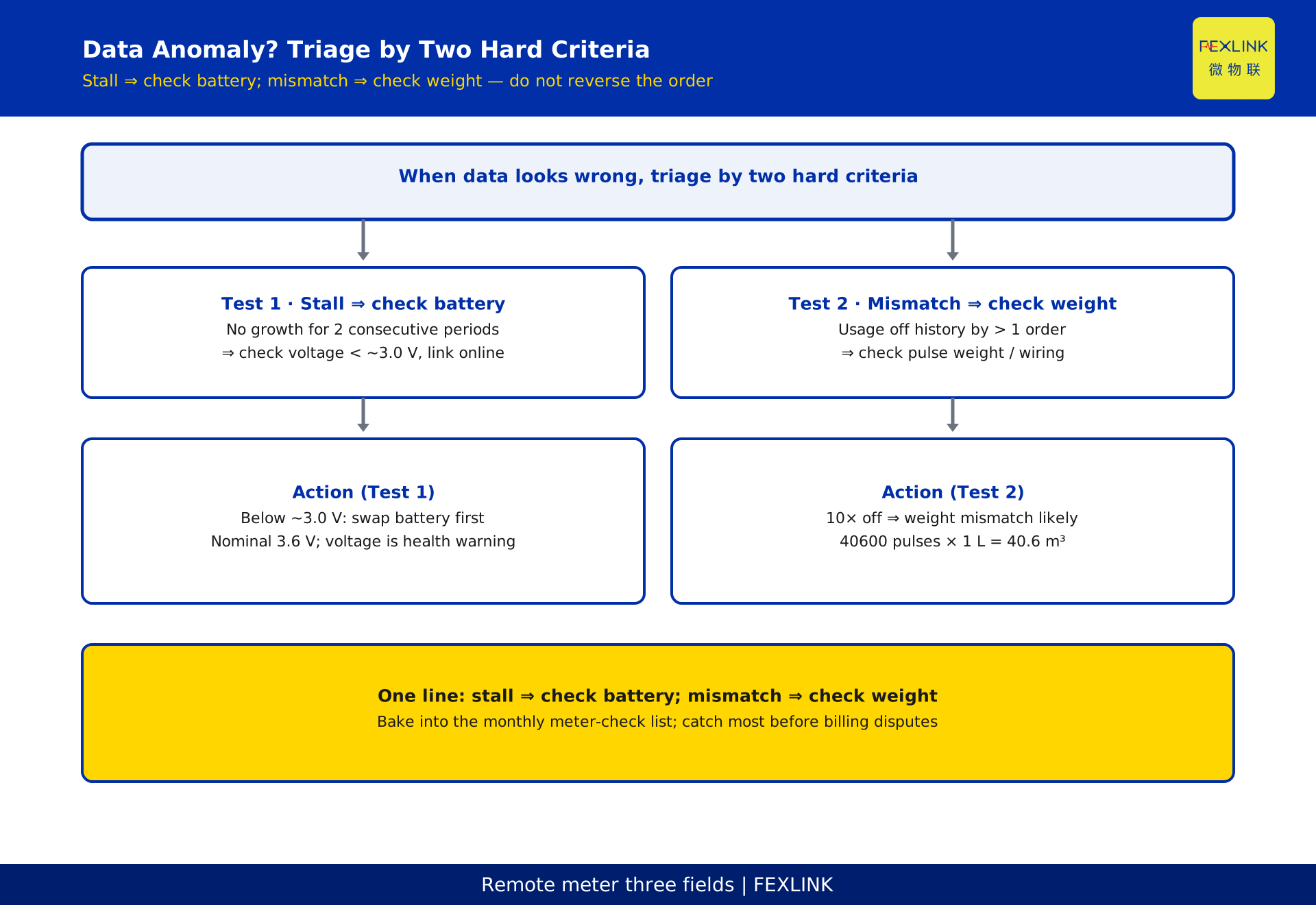
The three fields are not a flat list; they are read with priority. In practice, when "the data looks wrong", troubleshoot in this order:
- Is cumulative volume stalled? If it shows no growth across several cycles, first check whether battery voltage is low and whether communication is lost; 90% of "meter reports nothing" starts here.
- Is this period's magnitude reasonable? If the difference diverges sharply from historical usage, occupancy, or season, first verify the pulse weight and pulse generation / wiring, and confirm the platform's pulse equivalent matches the meter.
- Final confirmation of trustworthiness: only when pulse weight is correct, the meter is powered normally, and communication is online does cumulative volume qualify as the basis for billing and allocation.
One-line rule: cumulative stall ⇒ check battery voltage first; magnitude mismatch ⇒ check pulse weight first. Reversing the order (e.g. opening the meter the moment usage looks odd) often mis-diagnoses a power or communication problem as a meter fault.
How a pulse-weight mismatch amplifies the count error
This section pushes the constructed example one step further to show why the pulse weight must be strictly aligned with the meter's pulse generation. A remote meter's cumulative volume is essentially "pulse count × pulse weight": pulses come from the meter, weight comes from the platform configuration. If one side changes and the other does not, the result is misaligned.
Same constructed example: the meter actually emits 10 L per pulse, but the platform weight is wrongly set to 1 L per pulse. The true 40.6 m³ (from 40600 pulses) is read as 4.06 m³ — off by 10×. Conversely, if the platform is set to 10 L per pulse while the meter actually emits 1 L, the 4.06 m³ is read as 40.6 m³. Both directions disguise a systematic integer-multiple error as "normal usage fluctuation".
Troubleshooting tip: after replacing a meter, replacing its pulse generator, or changing a platform configuration, always reconcile "pulse count × pulse weight" against the on-site mechanical reading (or a manual read in the same period). An integer-multiple difference means a pulse-weight or pulse-generation mismatch, not a sudden change in user consumption.
How the products land: bringing the three fields into the platform
Reading the three fields accurately and completely depends on connecting three segments: "meter pulse → count acquisition → platform reconciliation". For a pulse-output remote meter, the meter emits count pulses; the ESI Digital-state Monitor stably acquires, counts, and logs those pulses locally, avoiding missed pulses from communication jitter. When many meters need centralised counting, an 8-channel digital-counting module such as CX-08R06AI08-C1 (8DI counting) aggregates pulses from several meter positions, then performs unit conversion and reporting.
At the solution layer, the Unified Water-Electricity Sub-metering Solution brings water and electricity metering acquisition, pulse-weight configuration, reconciliation, and alarming under unified management; the data finally lands in FEXCloud for long-term archiving, curves, and period comparison. The product side only reads and logs — it does not set the pulse weight. The weight must align with the meter's pulse specification; parameters, ranges, and interfaces are customisable and should follow the latest selection manual and product knowledge base.
Desensitised field scenario: reconciling reads at a park
A park (generic, not a real customer) allocates water bills per tenant. The operator watched only cumulative volume and found several tenants' usage "suddenly shrank" with no alarm. Following this article's order: first check battery voltage — some meter positions had already dropped to the about 3.0 V alarm line, the remote link dropped intermittently, and cumulative volume showed a stalled segment; then reconcile the still-reporting positions with "pulse count × pulse weight" and find that a few meters had the platform weight set to 1 L per pulse while the meter actually emitted 10 L per pulse — the reading was shrunk 10×, exactly explaining the "usage shrank".
This is a desensitised scenario to show the order; it represents no real park, customer, or project. It confirms the article's core conclusion: cumulative volume is the settlement body, pulse weight decides whether conversion is right, battery voltage is the health warning, and the three fields must be read together.
Decision advice: two hard criteria
Two hard criteria for operators:
- Criterion 1 (check power first): if cumulative volume shows no growth for two consecutive reading cycles, immediately check whether that meter's battery voltage is below about 3.0 V and whether communication is online; below the threshold, replace the battery first, then deal with anything else.
- Criterion 2 (verify conversion next): if this period's usage deviates from the historical like-for-like by more than one order of magnitude, prioritise verifying the pulse weight and pulse generation / wiring, and do an integer-multiple reconciliation of "pulse count × pulse weight" against the on-site reading, rather than suspecting the user first.
Together they are: cumulative stall ⇒ check battery voltage first; magnitude mismatch ⇒ check pulse weight first. Bake these two actions into the monthly meter-check list and most "data anomalies" will be caught before they become billing disputes.
FAQ
Q: Why is reading cumulative volume alone not enough?
Cumulative volume only records "how much water has passed so far"; whether it is trustworthy is vouched for by the pulse weight and the battery voltage. A pulse-weight mismatch scales the whole reading up or down by an integer multiple, and low battery voltage makes the remote link drop and the cumulative total freeze. Reading only cumulative volume means the anomaly is often old by the time it is found.
Q: Are pulse weight and pulse equivalent the same thing?
Yes — two names for the same parameter, both meaning "how much water one count pulse represents". This article calls it pulse weight (pulse equivalent) uniformly, and it must match the meter's pulse specification; a mismatch makes the count differ by an integer multiple and raises no alarm.
Q: Below what voltage should the battery be replaced?
Generally, for a nominal 3.6 V lithium cell, dropping below about 3.0 V enters the alarm band and replacement should be scheduled promptly; the exact threshold follows the product specification. Voltage is a health warning for the remote function, not a measurement-accuracy indicator, and normal voltage does not guarantee correct counting.
Q: If cumulative volume stops moving, is the meter definitely broken?
Not necessarily. In most cases low battery voltage or a lost communication link makes the remote report stop and the data freeze, while the meter itself still counts mechanically. Check battery voltage and communication first before opening the meter.
Q: What to watch after replacing a meter or changing a configuration?
Always reconcile "pulse count × pulse weight" against the on-site mechanical reading (or a manual read in the same period). An integer-multiple difference almost certainly means a pulse-weight or pulse-generation mismatch, not a sudden change in consumption.
Scope and limitations
- This article belongs to "parameter and data interpretation" and focuses on how to read and jointly judge the three fields "cumulative volume, pulse weight (pulse equivalent), battery voltage" in remote-meter platform data; its increment is field-level reading interpretation + battery voltage as a health warning + joint three-field judgement. The pulse-loss mechanism (KD-0503) and the electricity-meter CT ratio (KD-0505) are not rewritten; this article stays at the water-meter field level.
related_standardsis empty; the article cites no standard number, standard limit, or real product specification value; all numeric examples are constructed to illustrate the point, are desensitised, and represent no real customer, park, project, or quotation. Real values follow the product specification and on-site measurement.- All figures in the text — 1240.6 m³, 1200.0 m³, 40.6 m³, 40600 pulses, 1 L per pulse, 1 m³ = 1000 L, 3.6 V, about 3.0 V, 10×, 4.06 m³ — are constructed examples; the 3.6 V lithium cell (e.g. ER14505, ER26500) is a typical description of a common power method for this meter class, and about 3.0 V is a typical way to write the alarm threshold — neither is a fixed guaranteed value, and the actual value follows the product specification.
- For the ESI Digital-state Monitor, CX-08R06AI08-C1 (8DI counting), Unified Water-Electricity Sub-metering Solution, and FEXCloud, parameters, ranges, accuracy specifications, and communication interfaces are customisable and follow the latest selection manual and product knowledge base; this article is not a procurement or selection conclusion.
- Battery voltage is a health warning, not a measurement-accuracy criterion; error sources such as pulse-weight mismatch, pulse generation, wiring, pulse loss, and platform unit conversion each have their own dedicated article. This article only explains "how to read these three fields and which to check first when something is wrong".
Frequently Asked Questions
Why is reading cumulative volume alone not enough?
Cumulative volume only records "how much water has passed so far"; whether it is trustworthy is vouched for by the pulse weight and the battery voltage. A pulse-weight mismatch scales the whole reading up or down by an integer multiple, and low battery voltage makes the remote link drop and the cumulative total freeze. Reading only cumulative volume means the anomaly is often old by the time it is found.
Are pulse weight and pulse equivalent the same thing?
Yes — two names for the same parameter, both meaning "how much water one count pulse represents". This article calls it pulse weight (pulse equivalent) uniformly, and it must match the meter's pulse specification; a mismatch makes the count differ by an integer multiple and raises no alarm.
Below what voltage should the battery be replaced?
Generally, for a nominal 3.6 V lithium cell, dropping below about 3.0 V enters the alarm band and replacement should be scheduled promptly; the exact threshold follows the product specification. Voltage is a health warning for the remote function, not a measurement-accuracy indicator, and normal voltage does not guarantee correct counting.
If cumulative volume stops moving, is the meter definitely broken?
Not necessarily. In most cases low battery voltage or a lost communication link makes the remote report stop and the data freeze, while the meter itself still counts mechanically. Check battery voltage and communication first before opening the meter.
What to watch after replacing a meter or changing a configuration?
Always reconcile "pulse count × pulse weight" against the on-site mechanical reading (or a manual read in the same period). An integer-multiple difference almost certainly means a pulse-weight or pulse-generation mismatch, not a sudden change in consumption.