 FEXLINK Research Institute
The short answer
A few thousand mechanical water meters heading for automatic reading should not all be swapped at once. Split them first by "age plus billing role": settlement or billing interface meters that are near the end of their service life go straight to IoT meters; ordinary meters still well within life, used only for internal accounting, keep the old body and get a pulse collector added. Run both routes in parallel and spend the budget on the meters where billing accuracy matters most—typically cutting total spend to about a third of a full swap, delivered on a three-year rolling plan.
1. Two routes, one question: touch the meter or not
Mechanical water meters are read by hand, so estimate reads, missed reads and transcription slips are hard to avoid. What worries operators most is not knowing, at month end, who used how much and who should be billed for it. The two automatic-reading routes differ on a single point: whether you replace the meter body itself.
The full-swap route replaces every old mechanical meter with an electronic meter that has a communication module built in. Readings go to the cloud directly, no longer depending on a person walking the line. It is the most complete answer, but every unit needs a shutoff, removal, reinstall, re-registration and re-calibration, so the one-time spend is large.
The add-a-collector route leaves the mechanical meter in place and adds a signal transmitter that converts the register's rotation into pulses or a digital signal, which an edge gateway then collects and forwards. The old meter keeps metering; it simply "learns to talk." This route does not touch the meter body, so the work is small and the unit cost is low—but the reading accuracy depends on the collector and on the condition of the old meter.
The two routes are not an either/or. They divide the labor by the meter's attributes.
2. The swap route: what you gain, what it costs
The biggest win of swapping to IoT meters is that the reading is already data. Each meter communicates independently, so the platform can pull the latest reading at any time; the on-time read rate can approach 100%, and estimate and missed reads essentially disappear. For a billing interface meter, that means the invoice lines up with the reading, and disputes drop.
The cost is real too. A swap needs valve closure, water stoppage, removal and reinstall, re-registration and re-calibration; the per-unit work cost is far above adding a collector. In old residential blocks or complex plant networks, the shutoff windows are hard to schedule and complaints pile up. More important, swapping a whole estate before the meters have reached end of life throws away assets that still meter correctly. That is poor economics.
So the swap route fits two kinds of meters: those with a high billing role and strict accuracy demand—the settlement interface meters—and those already at or near their mandatory replacement age. If it must be replaced anyway, do it once, inside the retrofit.
3. The add-a-collector route: where the error boundary sits
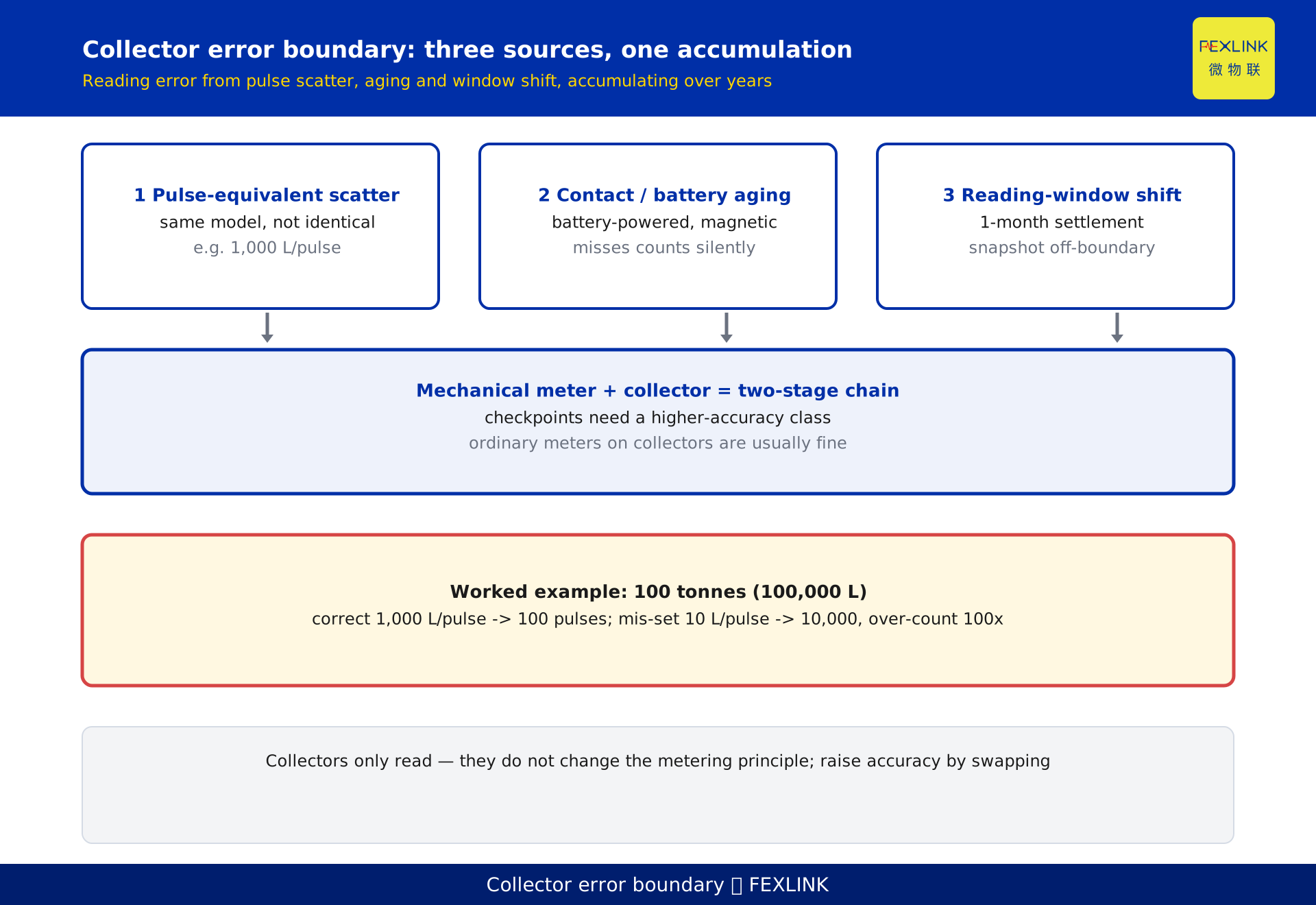
A pulse collector turns the mechanical motion of a water meter into an electrical signal. It does not meter; it only "translates" the old register's count. Its reading error therefore does not come from the collector's own precision, but from two engineering factors: how the pulse equivalent is configured, and signal loss.
Set the pulse equivalent wrong—say 1 cubic meter per pulse entered as 10 liters per pulse—and the whole consumption curve shifts, silently. Signal loss is subtler: a dead battery, a loose connection, or a few dropped pulses under interference accumulate into a visible drift over months. In public engineering experience, such add-on schemes often show a noticeable divergence from manual re-reads after a year or two of operation.
The error boundary is not in a spec sheet; it is in the maintenance discipline. Collector readings must be periodically compared against manual re-reads and calibrated to the old meter's verification cycle. Treat it as a one-off "install and forget" job and the error creeps up quietly. That is exactly why this route suits a transition, not a permanent fix.
4. The split rule: what must be swapped, what can wait
Here is an executable rule, with no hedging:
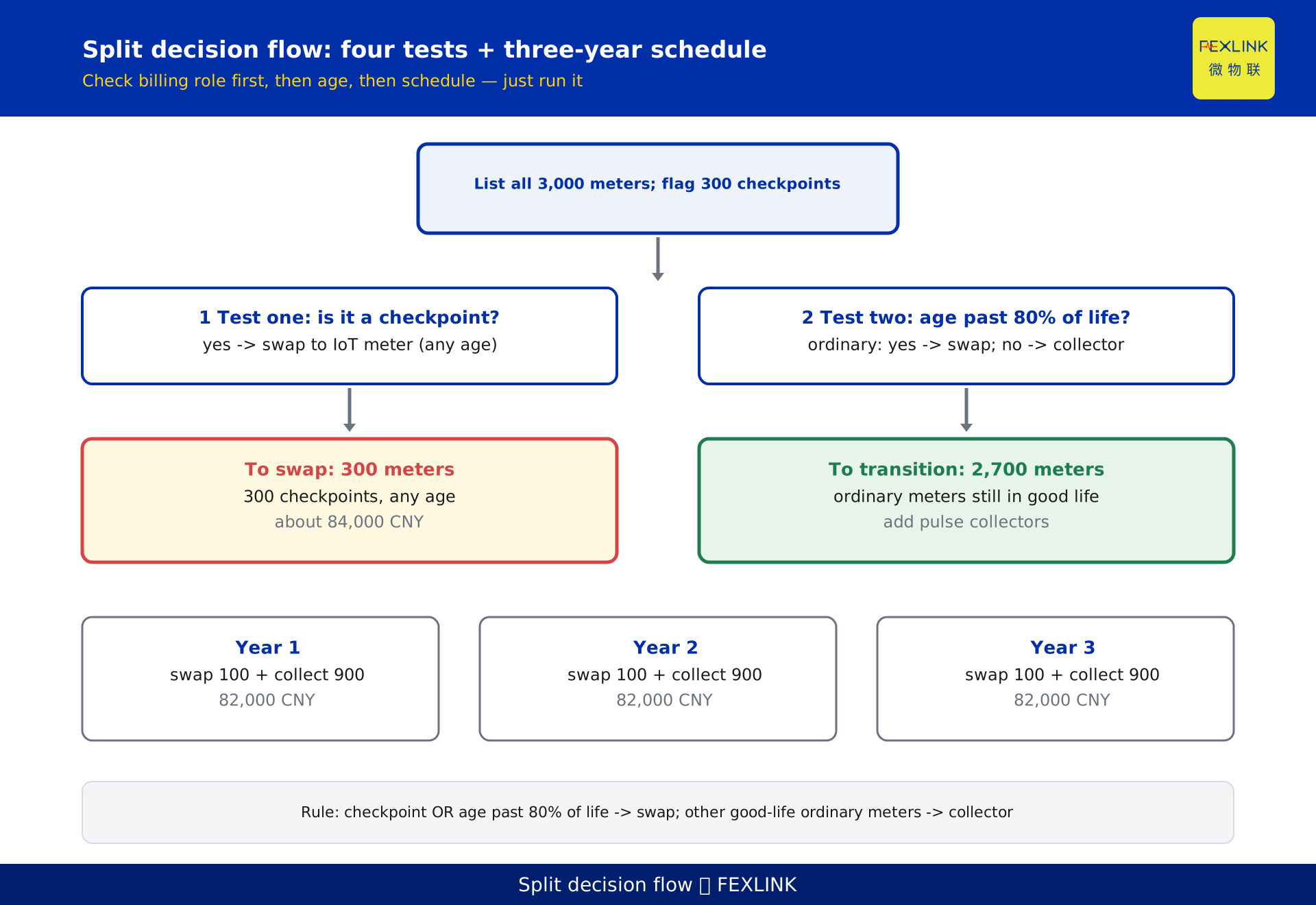
First, look at the billing role. Any meter that enters settlement, bills end users, or joins internal cost allocation carries the highest billing-accuracy demand. Give it the higher-accuracy metering method first—swapping straight to an IoT meter is the safest move.
Second, look at the age. Water meters have a service life and must be replaced at the end of it. If a meter has reached or passed 80% of its service life, do not bother reinforcing it—swap it. Meters still young and well within life take the add-a-collector transition.
Third, look at the program goal. If this retrofit only aims to "see the data first, then govern gradually," fit ordinary meters with collectors to reveal the baseline while swapping the interface meters first. That is the lowest-risk start.
One sentence: high billing-accuracy demand plus old age means swap; internal-only accounting plus young means transition.
5. A three-year rolling plan
With a limited budget, do not try to finish in one year. Concentrate the swaps on the billing interface meters and spread the collectors across the ordinary meters, rolling over three years:
Year one, swap all settlement interface meters first (about 100 meters) and fit collectors to about 900 ordinary meters at the same time, so the platform starts running and the process smooths out.
Year two and year three, push the remaining ordinary meters at the same pace—swap about 100 interface meters and fit about 900 ordinary meters each year. After three years, every interface meter is IoT-based and every ordinary meter carries a collector; automatic reading covers the whole estate.
This keeps annual spending predictable, spreads the work windows, minimizes user impact, and solves the interface meters—the ones that most deserve the money—first.
6. Making it real: collectors and gateways
On the ground, separate the "speaking organ" from the "relay hub."
On the mechanical meter, fit the ESI digital-state monitor (pulse / status-signal collector); it reads the register or pointer motion and outputs pulses or a digital signal. At the zone side, the ESX edge computing gateway gathers the signals scattered across many meters and collectors, performs protocol conversion, and forwards them to the platform.
Upstream, connect the digital electrical intelligent supervision system (same-source water-and-gas acquisition). One acquisition framework covers both water and gas, so there is no need to build a separate system for each. Thus the transition scheme for ordinary meters and the swap scheme for interface meters both flow into one reading platform, under one management caliber.
The products only decide "how to connect," never "which meter to swap"—the split rule is in section 4, the budget in section 7.
7. Cost contrast: a constructed example
The numbers below are constructed to show where the split saves. They represent no real customer or project.
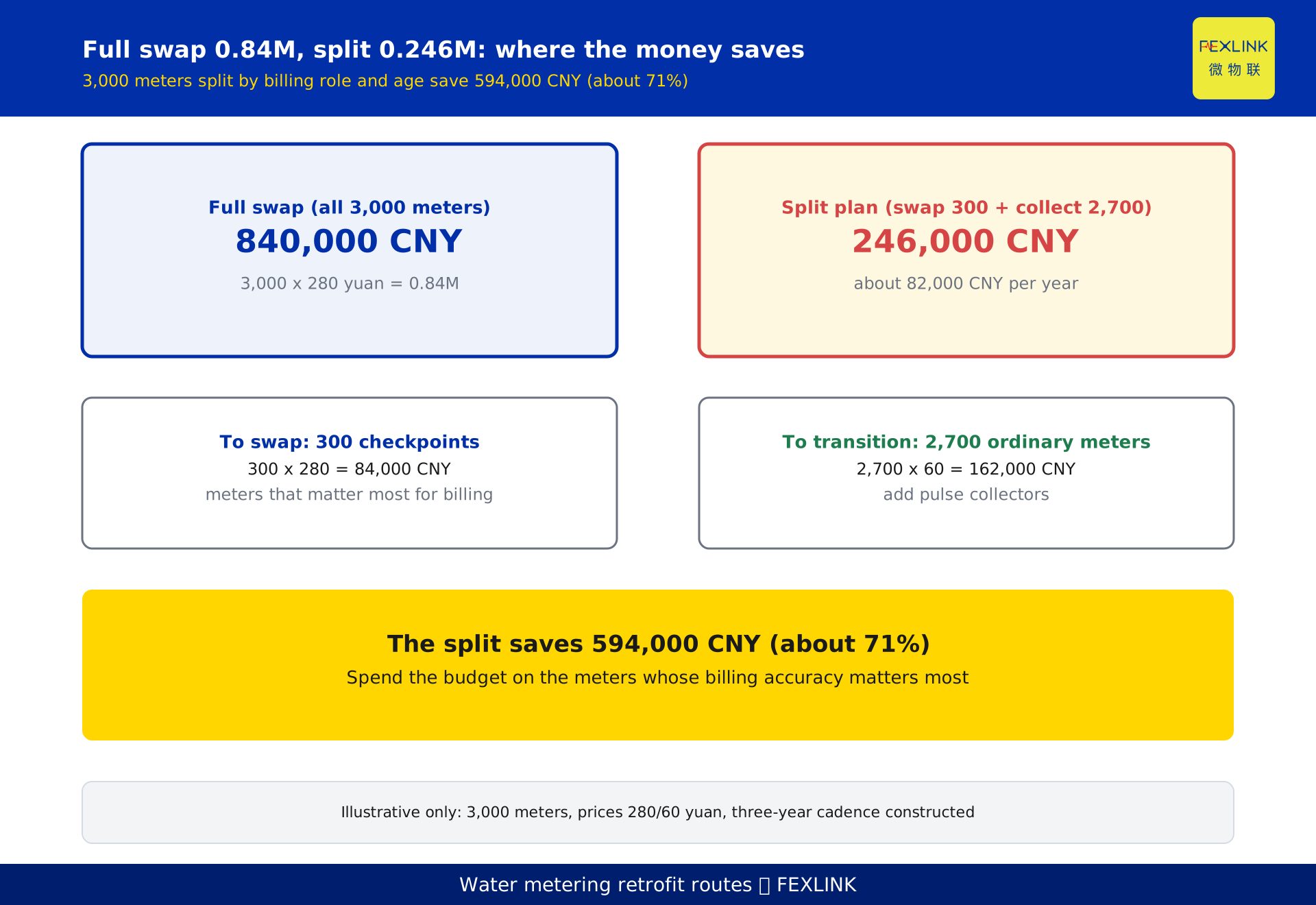
A water utility operates 3,000 mechanical water meters, of which 300 are settlement interface meters (10%) and 2,700 are ordinary metering meters.
A full swap to IoT meters, at 280 yuan per meter, totals 3,000 × 280 = 840,000 yuan.
The split retrofit: swap all 300 interface meters, 300 × 280 = 84,000 yuan; fit collectors to the 2,700 ordinary meters at 60 yuan each, 2,700 × 60 = 162,000 yuan; together 246,000 yuan.
The split saves 840,000 − 246,000 = 594,000 yuan versus the full swap, about 71%. Rolled over three years that is about 82,000 yuan per year—work spread out, impact small.
Note: this is a constructed example to illustrate the arithmetic. Actual unit prices, the age distribution, and shutoff costs vary by project and must be computed from site survey and measured data.
8. Common myths
Myth one: a full swap is the most worry-free. Swapping the ordinary meters too doubles the budget and doubles the water shutoffs, yet many ordinary meters could serve for years more; scrapping them early is waste.
Myth two: collectors are maintenance-free. An add-on collector is not install-and-forget; it depends on the old meter's condition and on periodic re-read calibration. Neglect the upkeep and the error accumulates silently.
Myth three: swap everything first, split later. Once the budget is eaten by ordinary meters, the interface meters that truly need high-accuracy metering have no money left—putting the cart before the horse.
9. Frequently Asked Questions (FAQ)
Q: After a pulse collector is added to a mechanical meter, is the reading accuracy the same as the original meter?
Not necessarily. The collector does not meter; it only converts the old meter's mechanical motion into a signal. The accuracy ceiling is still set by the old meter's condition and the pulse-equivalent configuration, so periodic comparison with manual re-reads is required.
Q: Which meters must be swapped to IoT meters?
Interface meters that enter settlement, bill end users, or join internal cost allocation, and whose age has reached or approached the replacement point, should be swapped first. The meters with the highest billing-accuracy demand deserve the budget most.
Q: How long can an ordinary meter with a collector last?
It depends on the remaining life of the old meter and on the collector's power and wiring upkeep. It is positioned as a transition; when the old meter reaches end of life it should be swapped as part of the retrofit, not used permanently.
Q: The three-year plan is full, but mid-way some batch shows large error. What then?
Pull that batch forward into next year's swap queue, or first re-read and calibrate manually and shorten the comparison cycle—do not let it run carrying the deviation.
Q: Do we need two platforms, one for swapped meters and one for collectors?
No. Both reading types ultimately flow into one acquisition platform (such as the same-source digital supervision system); only the front-end acquisition method differs, while the back-end management caliber is unified.
Scope and limitations
- The route-decision discussion in this article applies to water utilities and system integrators that operate thousands of mechanical water meters and want to move to automatic reading on a controlled budget. A single building or a very small site can scale the logic down proportionally.
- The figures—3,000 meters, 300 interface meters (10%), 2,700 ordinary meters, unit prices of 280 and 60 yuan, total 840,000 yuan, split 246,000 yuan, saving 594,000 yuan (about 71%), and about 82,000 yuan per year over three years—are constructed examples to illustrate the split arithmetic. They represent no real customer, utility, or project. Actual estimates must come from site survey and measured data.
- The "80% of service life" threshold is a decision example given by this article. The actual replacement cycle should follow local metering-management requirements and the real condition of each meter; it does not replace a statutory verification conclusion.
- Descriptions of metering accuracy and on-time reading rate (close to 100%) are qualitative. No standard clause number or error limit is cited. The phrasing that settlement interface meters "should use a higher accuracy class" is an engineering-convention statement and is not a selection basis.
- The functions of the ESI digital-state monitor, the ESX edge computing gateway, and the digital electrical intelligent supervision system are described qualitatively. Specific electrical parameters and communication specifications follow the latest product documentation; this article is not a procurement recommendation.
Frequently Asked Questions
Water Metering Retrofit
A few thousand mechanical water meters heading for automatic reading should not all be swapped at once