 FEXLINK Research Institute
The short answer
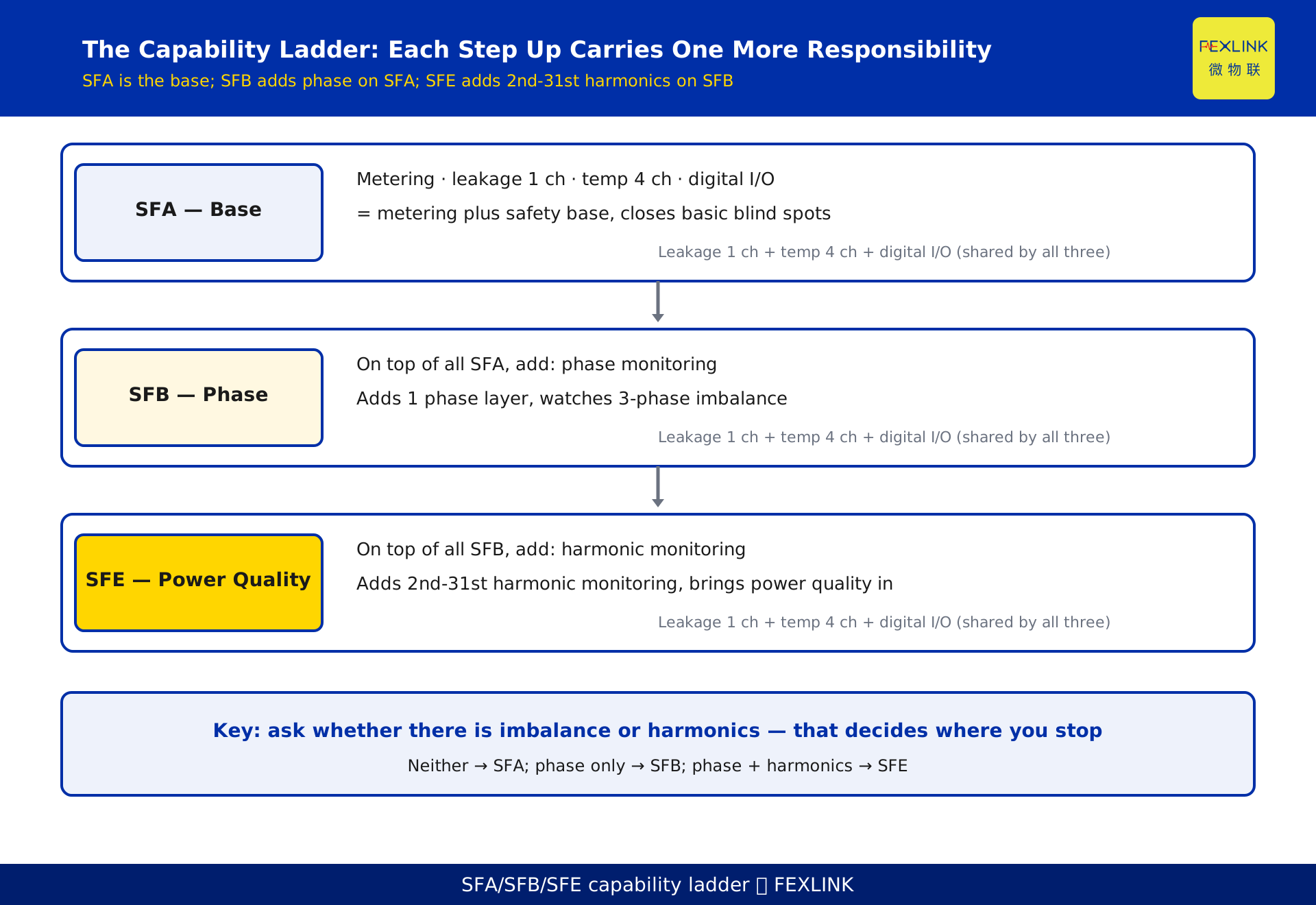
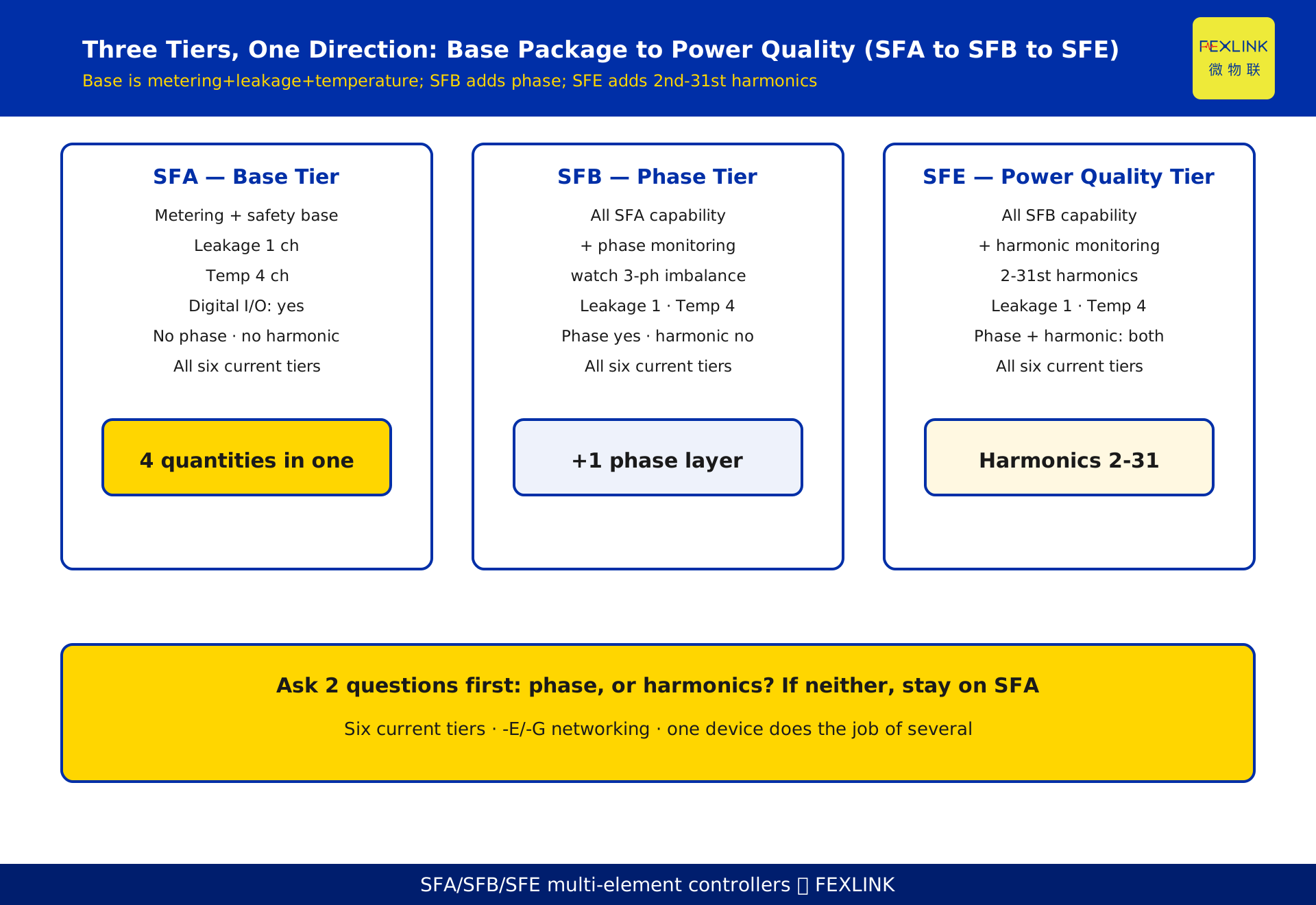
When cabinet space is tight and you want one device to handle energy metering, leakage protection and temperature at once, the three multi-element controllers are "three ascending tiers of capability", not three price points. The FEXLINK SFA multi-element controller (SFA-10031-E/G) is the base package: metering plus leakage plus temperature. The FEXLINK SFB multi-element controller (SFB-11031-E/G) adds phase monitoring on top of SFA to watch three-phase imbalance. The FEXLINK SFE multi-element controller (SFE-11131-E/G) adds harmonic monitoring on top of SFB, bringing power quality into scope. Select by asking two questions first: does the workshop have three-phase imbalance, and does it have harmonics? If neither, stay on the base SFA; size the current range against the loop's actual working current across six tiers, and pick -E or -G networking by site conditions. One device doing the job of several saves cabinet space and wiring.
1. What actually differs between the three tiers
A common mistake is to treat SFA, SFB and SFE as "three price tiers". They are not simply "the expensive one measures a few more numbers". Each layer adds a distinct monitoring responsibility that maps to a real, on-site hazard.
- SFA puts "how much energy was used" and "is it safe" into one device — metering, leakage, temperature and switch status are all acquired together, closing the basic safety blind spot where "a leak goes unnoticed" or "a cable overheats before anyone finds out".
- SFB adds phase monitoring on top of SFA, making three-phase current balance visible. When single-phase loads cluster on one phase and that phase is overloaded, it flags the issue earlier than total active-energy reading alone.
- SFE adds harmonic monitoring on top of SFB, bringing the 2nd-to-31st-order harmonics that VFDs and rectifiers inject into the grid into view.
In short: clarify which monitoring layer the workshop actually lacks, then step up by "base — phase — harmonics", rather than letting unit price drive the decision.
2. Shared capability: one device merges metering and safety
All three share the same base capability set, which is exactly what separates them from a pure metering meter. Taking SFA as the example, a single device embeds three classes of safety acquisition:
- 1 leakage channel: wired to the residual-current protection loop; on leakage trip it pushes an alarm, closing the gap of pure metering meters that "track energy but ignore electric shock".
- 4 temperature channels: attachable to critical hot spots such as breaker outputs, cable joints and busbars, catching abnormal temperature rise before it becomes a fire.
- Switch-input (digital) channels: acquire dry-contact signals like breaker open/close position, door status and fan running state, turning "equipment state" into readable data.
Together these cover four jobs that would otherwise need separate meters — energy metering, leakage current, temperature and switch status. For cabinets where space is tight and the goal is "one meter per cabinet", what you save is not just device cost but also wiring and in-cabinet footprint.
3. SFA base tier: metering plus leakage plus temperature
If the cabinet's safety need is "standard grade" — you want leakage warning, you want temperature at key points, you want switch status collected, but you have no three-phase imbalance or harmonic concern — then SFA is the right fit.
Be clear about its boundary: SFA focuses on metering, 1 leakage channel, 4 temperature channels and switch inputs; it does not treat phase dimension or harmonic analysis as part of its capability. For most office buildings, ordinary commercial distribution and relatively clean workshop power cabinets, this set is enough. Choosing SFA is not "settling"; it is "not paying for capability you will not use".
4. SFB adds phase: watching three-phase imbalance
Many workshops look "normal on energy" while one phase actually carries current far above the others. Single-phase loads (air conditioning, EV chargers, single-phase equipment) piling onto one phase create three-phase imbalance, bringing transformer extra loss, neutral-point shift and premature aging of that phase's cable.
SFB adds phase/sequence-related monitoring on top of all SFA capabilities, continuously observing the difference among the three-phase currents and turning "three-phase imbalance" from eyeballing into quantifiable, alarmable data. The selection rule follows: when the workshop clearly has clustered single-phase loads, or large-motor starts/stops cause phase-current jitter, step up from SFA to SFB.
5. SFE adds harmonics: bringing power quality into scope
VFD drives, rectifier supplies, EV chargers and medium-frequency/arc-type loads reshape the current waveform away from sinusoidal and inject harmonics into the grid. Long-term harmonic excess disturbs sensitive equipment, worsens heating and can even trip protection.
SFE adds harmonic monitoring on top of all SFB capabilities, covering 2nd-to-31st-order harmonic content, total harmonic distortion and other power-quality indices, letting one device answer three questions at once: how much energy, is it safe, and is power quality good. Only when the site has a complex harmonic environment, dense VFD/rectifier loops, or needs monitoring data before harmonic mitigation, is SFE worth it; an ordinary lighting/power cabinet produces essentially no harmonics, so SFE there is paying for unused capability.
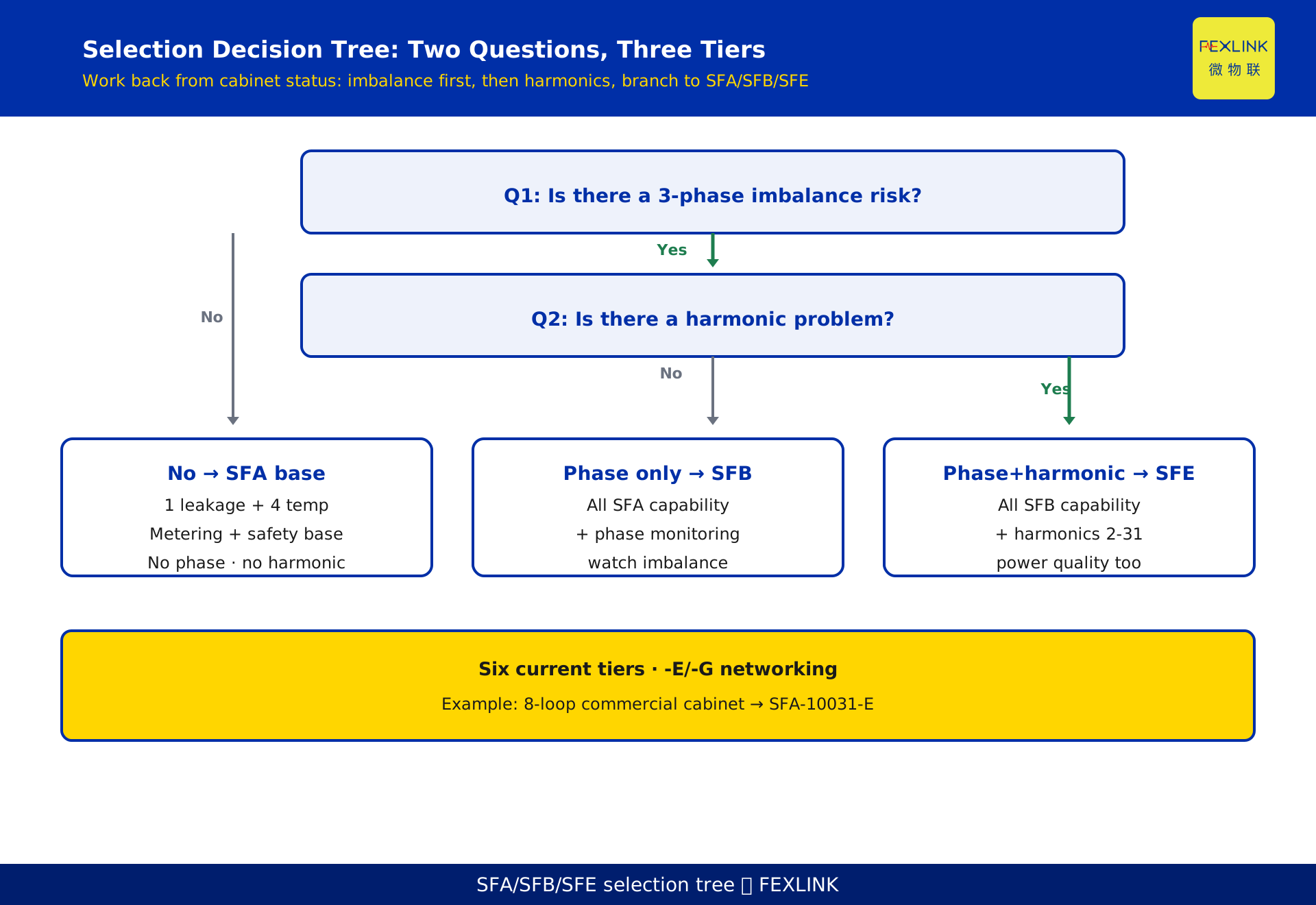
6. Ask two questions before tiering: phase, or harmonics?
Compress the logic above into two decisions and you will rarely choose wrong:
- Is there a three-phase imbalance risk? Clustered single-phase loads, persistently skewed phase currents, elevated transformer temperature → phase monitoring needed, at least SFB.
- Is there a harmonic problem? VFD/rectifier/charging/arc-type loads on site, or harmonic mitigation that needs monitoring points first → harmonic monitoring needed, step up to SFE.
Both "no" → stay on SFA. "Yes" only on phase → choose SFB. Both phase and harmonics → choose SFE. Every clause here is an operable, on-site fact, with no reliance on any vague "feels right".
7. Six current tiers and -E / -G networking
Each model comes in six current tiers matching different loop rated currents. The sizing rule is not "guess from the breaker rated current" but to let the loop's long-term working current sit near about two-thirds of the range: too small and the light-load accuracy collapses; too large and long-term overload damages the meter.
- Small-current loops (e.g. those taking secondary signal via current transformer) map to the lower tiers;
- Large-current loops map to the direct-connection tiers;
- The exact rated current of each tier is per the latest selection manual; this article fabricates none and substitutes for no manual parameter.
The networking suffix -E and -G denote two networking access methods, chosen by site network conditions: pick -E where a wired network already exists, pick -G wireless access where cabling is impractical. The two are functionally equivalent; the only difference is "how data returns to the platform", with no effect on metering and safety monitoring themselves.
8. One-meter-per-cabinet configuration example (constructed example)
The following walkthrough is constructed to illustrate the configuration method and represents no real customer, project or location.
A floor distribution cabinet in an office building has 8 loops. The owner states three needs: see each loop's consumption, get leakage and contact-temperature warnings, and add as few devices as possible inside the cabinet. The site is ordinary commercial load with no single-phase clustering and no VFD/rectifier harmonic source.
Walk the section-6 rule: no three-phase imbalance, no harmonics → tier SFA. One SFA-10031-E, through 1 leakage channel plus 4 temperature channels plus switch inputs, covers the cabinet's leakage current and 4 critical hot spots; the 8 loops' metering is collected by this single cabinet. Networking uses the building's existing wired network, so suffix -E. The whole cabinet needs only this one multi-element controller to satisfy the "one meter per cabinet" goal. If a later floor adds EV chargers and harmonics appear, upgrade that cabinet to the SFE-11031 series without starting over.
The only point this example makes: selection matches "cabinet status + owner needs" item by item and then fits the product, rather than picking the cheapest or the most capable meter.
9. Boundary with "Selecting ZSA/ESA/SFA/SFE Meters for a Cabinet"
A line must be drawn to avoid overlapping the neighboring article. That article decides between three product lines — ZSA pure metering, ESA loop-level full-element, SFA/SFB/SFE metering-plus-safety-in-one — with the increment being an "installation method + capability surface" decision tree.
This article does not repeat that cross-product-line decision; its increment is the internal progression among SFA/SFB/SFE and the two concrete criteria "phase or not, harmonics or not". The two relay: use that article to decide "which product line", then use this one to decide "which tier within SFA/SFB/SFE".
FAQ
Q: All three measure voltage, current and energy — why not just pick the cheapest SFA?
Because "cheap" only looks at unit price, not at which monitoring layer the site lacks. If the workshop actually has three-phase imbalance or harmonics, SFA alone leaves those two gaps and you will eventually rework and add on. Select by "what the cabinet lacks", not by "who has the lowest unit price".
Q: SFB adds phase monitoring over SFA — can it directly replace SFA?
Yes, and the capability is a containment relationship — SFB carries all of SFA's capabilities and only adds the phase dimension. If budget is not sensitive and you want headroom, go straight to SFB; but putting SFB in an ordinary cabinet with no phase need is paying for unused capability.
Q: Once I go with the SFE harmonic model, should every loop get one?
No. Harmonics come from non-linear loads (VFD/rectifier/charging); ordinary lighting and power cabinets produce almost none. Fit SFE only on harmonic-source loops and loops that need monitoring; keep SFA/SFB elsewhere to avoid the wasted spend of "high-spec everywhere".
Q: What if 4 temperature channels are not enough?
The 4 channels cover the cabinet's most critical hot spots (breaker outputs, cable joints, busbars, etc.). If critical points exceed 4, follow the expansion capability in the latest selection manual, or re-plan temperature points at the design stage; this article does not replace the manual's specific wiring and expansion rules.
Q: Do -E and -G differ in metering capability?
No. They are functionally equivalent; the only difference is networking method — -E uses wired network, -G uses wireless access. Choose by whether the site has existing cabling; neither affects metering, leakage, temperature or switch acquisition.
Scope and limitations
- The capability progression and selection criteria for the FEXLINK SFA/SFB/SFE multi-element controllers discussed here apply to electrical engineers and specifiers in scenarios such as distribution cabinets and smart-building multi-loop consumption management; specific installation conditions (cutout dimensions, rail specifications, in-cabinet space) are per on-site survey and the latest selection manual.
- The three models are described qualitatively: SFA is metering plus 1 leakage channel plus 4 temperature channels plus switch inputs; SFB adds phase monitoring on top of SFA; SFE adds 2nd-to-31st-order harmonic monitoring on top of SFB. This article fabricates and cites no accuracy, range, current-tier or price parameters.
- "Six current tiers" is a factual statement of the product's tier count; the exact rated current of each tier is per the latest selection manual. The guidance "let working current sit near about two-thirds of the range" is a sizing suggestion, not a mandatory technical rule.
- The associated solution "Smart-Building Multi-Loop Consumption Management" is a solution-level association; this article does not expand its architecture or parameters. Specific models, parameters and networking methods are per the latest product knowledge base and manufacturer documentation, and this article constitutes no selection or procurement advice.
- The example (an office-building floor cabinet, 8 loops, SFA-10031-E selected) is constructed to illustrate the configuration method and represents no real customer, project or location, and must not be used as an actual engineering basis.
- This article cites no standard number or standard clause; any content involving thresholds, limits or specifications is expressed as "per the latest selection manual and manufacturer documentation", and the conclusions are not mandatory technical rules.
Frequently Asked Questions
All three measure voltage, current and energy — why not just pick the cheapest SFA?
Because "cheap" only looks at unit price, not at which monitoring layer the site lacks. If the workshop actually has three-phase imbalance or harmonics, SFA alone leaves those two gaps and you will eventually rework and add on. Select by "what the cabinet lacks", not by "who has the lowest unit price".
SFB adds phase monitoring over SFA — can it directly replace SFA?
Yes, and the capability is a containment relationship — SFB carries all of SFA's capabilities and only adds the phase dimension. If budget is not sensitive and you want headroom, go straight to SFB; but putting SFB in an ordinary cabinet with no phase need is paying for unused capability.
Once I go with the SFE harmonic model, should every loop get one?
No. Harmonics come from non-linear loads (VFD/rectifier/charging); ordinary lighting and power cabinets produce almost none. Fit SFE only on harmonic-source loops and loops that need monitoring; keep SFA/SFB elsewhere to avoid the wasted spend of "high-spec everywhere".
What if 4 temperature channels are not enough?
The 4 channels cover the cabinet's most critical hot spots (breaker outputs, cable joints, busbars, etc.). If critical points exceed 4, follow the expansion capability in the latest selection manual, or re-plan temperature points at the design stage; this article does not replace the manual's specific wiring and expansion rules.
Do -E and -G differ in metering capability?
No. They are functionally equivalent; the only difference is networking method — -E uses wired network, -G uses wireless access. Choose by whether the site has existing cabling; neither affects metering, leakage, temperature or switch acquisition.