 FEXLINK Research Institute
The short answer
For an aging park that wants tenant-level metering for fine-grained energy billing across hundreds of tenants, the two mistakes to avoid are: ripping out and replacing every meter park-wide in one shot (the budget cannot hold, and the meter type may still be wrong), or building the platform first and discovering the underlying meters are incompatible, forcing a rework. The right approach is a device–edge–cloud layered rollout: fix the settlement scope first, pick one representative building as a pilot, get the full collection chain running and validate three metrics, then replicate at scale only after the pilot is closed. Meter types are tiered, gateways are deployed per power zone, and the platform starts with one electricity meter before expanding to water. Prove you can actually bill, then talk about scale.
1. Inventory before anything else: tenant circuits and existing meters
Do not rush to buy meters. The first step is to understand what you have: how many buildings, how many tenants, how many supply circuits, what meter models already exist, which ones already have communications, and which are still mechanical. The output is a "retrofit scope list" that decides everything downstream — meter selection, gateway placement, and platform integration.
Take an example aging industrial park (figures constructed to illustrate the route, not representing any real customer): 12 buildings, about 200 tenants, supplied through 5 power zones. Today there is a main meter but sub-tenant meters are missing, and roughly 60% of tenants have no remotely readable metering point. The conclusion is blunt — this is not a "replace meters" project, it is a "add metering points + open the communications" project. Start without a clear scope and every building will surface unexpected circuits, blowing both budget and schedule.
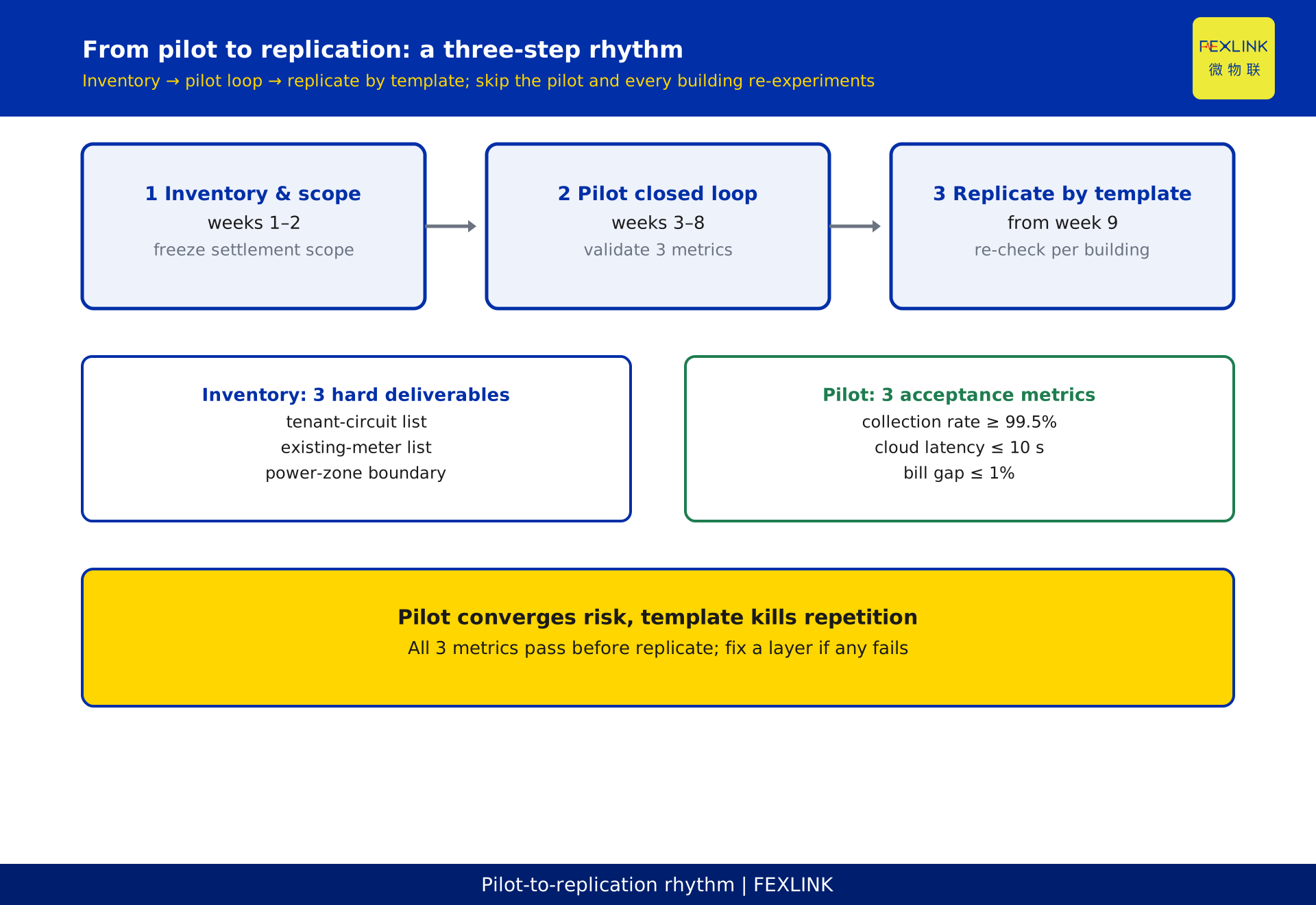
The inventory has three hard deliverables: a tenant-circuit list (which circuit maps to which tenant), an existing-meter list (model / communication interface / remote-readable or not), and the power-zone boundaries (which decide gateway granularity). Until all three are complete, do not enter procurement.
2. Device–edge–cloud: how data flows, how responsibility splits
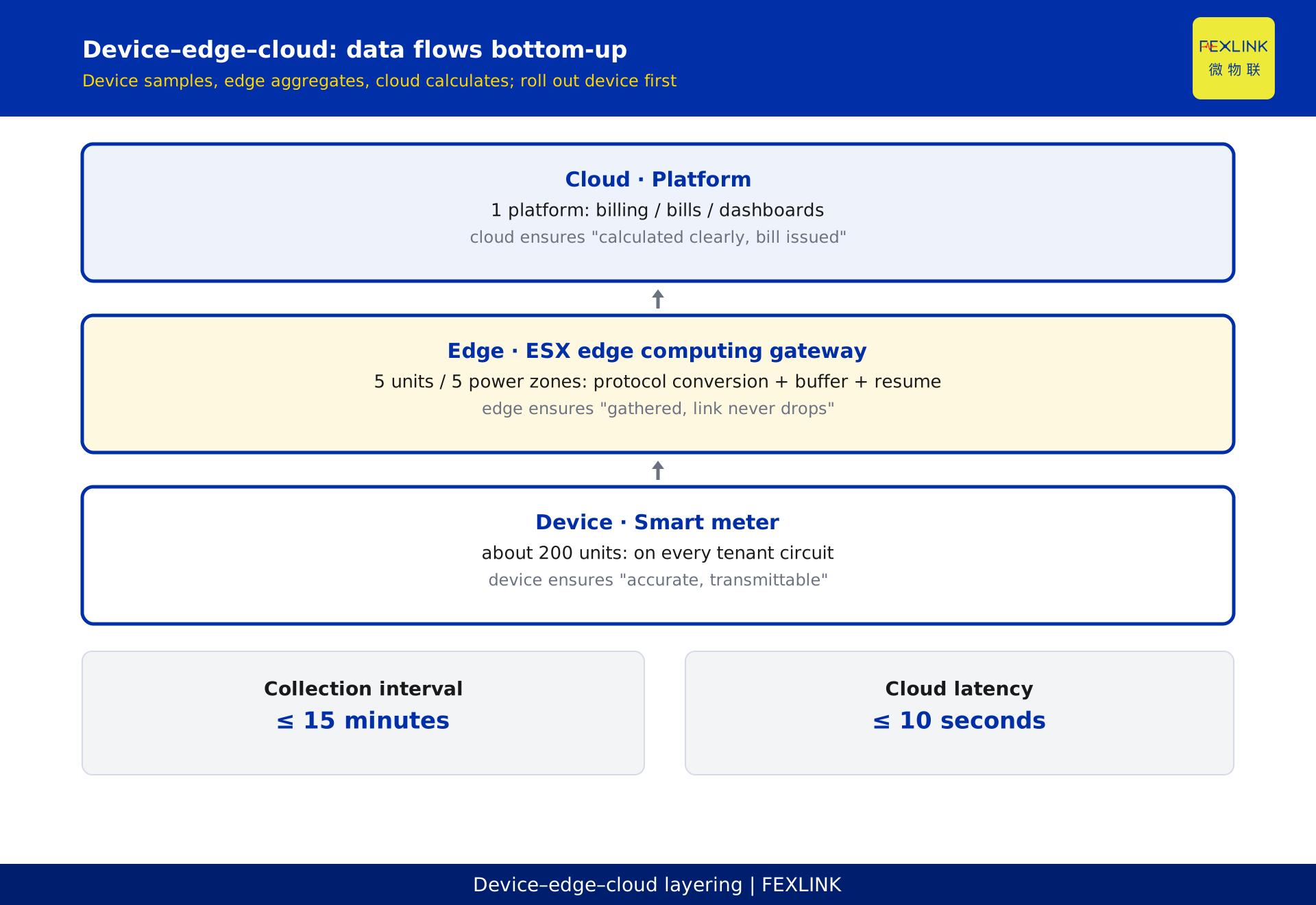
Tenant sub-metering is fundamentally "split the total down to the tenant, aggregate the data up to the cloud." Use a device–edge–cloud layering to decouple, so each layer does exactly one job and replication later stays clean.
- Device (meter): at the very end — one smart meter on each tenant circuit, turning energy into a remotely readable number. The device only cares about "measure accurately, transmit reliably."
- Edge (gateway): one edge computing gateway per power zone, aggregating dozens of meters nearby, doing protocol conversion, resume-on-reconnect, and local buffering. The edge ensures "gather it all, never drop the link."
- Cloud (platform): the platform receives data from every gateway, runs billing settlement, issues bills, and renders dashboards. The cloud ensures "calculate clearly, produce the bill."
Data flows bottom-up: device → edge → cloud. If any layer fails, the layer above gets no clean data. So the rollout order is device first, edge next, cloud last — not the reverse. That is exactly why "platform first, meter type later" derails.
3. Tiered meter types: settlement meters and management meters are not the same
Not every circuit needs the most expensive meter. Split meters into two tiers by purpose and both cost and reliability improve.
Settlement meter: used to charge tenants, must be accurate, tamper-resistant, and legally metrologically qualified; typically fitted at each tenant's main incomer. This is the "money meter," with the strictest selection and acceptance.
Management meter: used for the park's own energy analysis, common-area allocation, and anomaly diagnosis, not facing tenants for billing; a more flexible, lower-cost model is acceptable, fitted at common areas, equipment level, HVAC, and similar circuits.
Back to the example park: 200 tenants, settlement meters at each tenant incomer, about 200 of them; common-area and management circuits supplemented with management meters, several dozen more. The ZSA / ESA smart meter family covers both tiers — the settlement side uses the ESA all-element smart meter (for example ESA-22131-R, 3×400A, 3×220/380V, RS485 Modbus), while the management side can use the lower-cost ZSA series; both speak the same communication protocol, so platform integration is not rewritten.
4. One ESX gateway per power zone
Gateways should not be maximized, nor should the whole park run on a single one. The sensible granularity is "one edge computing gateway per power zone."
The example park has 5 power zones, so deploy 5 ESX edge computing gateways, each aggregating the meters within its zone, typically dozens of meters per gateway. Three benefits follow: first, a small failure domain — one gateway going down affects only one zone; second, short cabling — fiber and network stay inside the switchroom; third, easy replication — each new zone just adds one same-model gateway, the template unchanged.
The ESX edge computing gateway does protocol conversion (turning the meter-side Modbus-style protocols into the cloud protocol), local buffering (data is not lost when the network drops), and resume-on-reconnect. It is the key device of the edge layer; selection should weigh concurrent collection capacity and buffer size, not just interface count.
5. Choosing the pilot building: one building, the whole chain
Before rolling out park-wide, run the entire chain on one building first. The pilot's purpose is not "save the cost of one building" but "expose problems at minimum cost."
Selection criteria: representative tenant mix (commercial, office, common area combined), full circuit-type coverage (main incomer + sub-tenant + common area), and existing meter condition close to the park average. Meet these three and the lessons from one building apply park-wide.
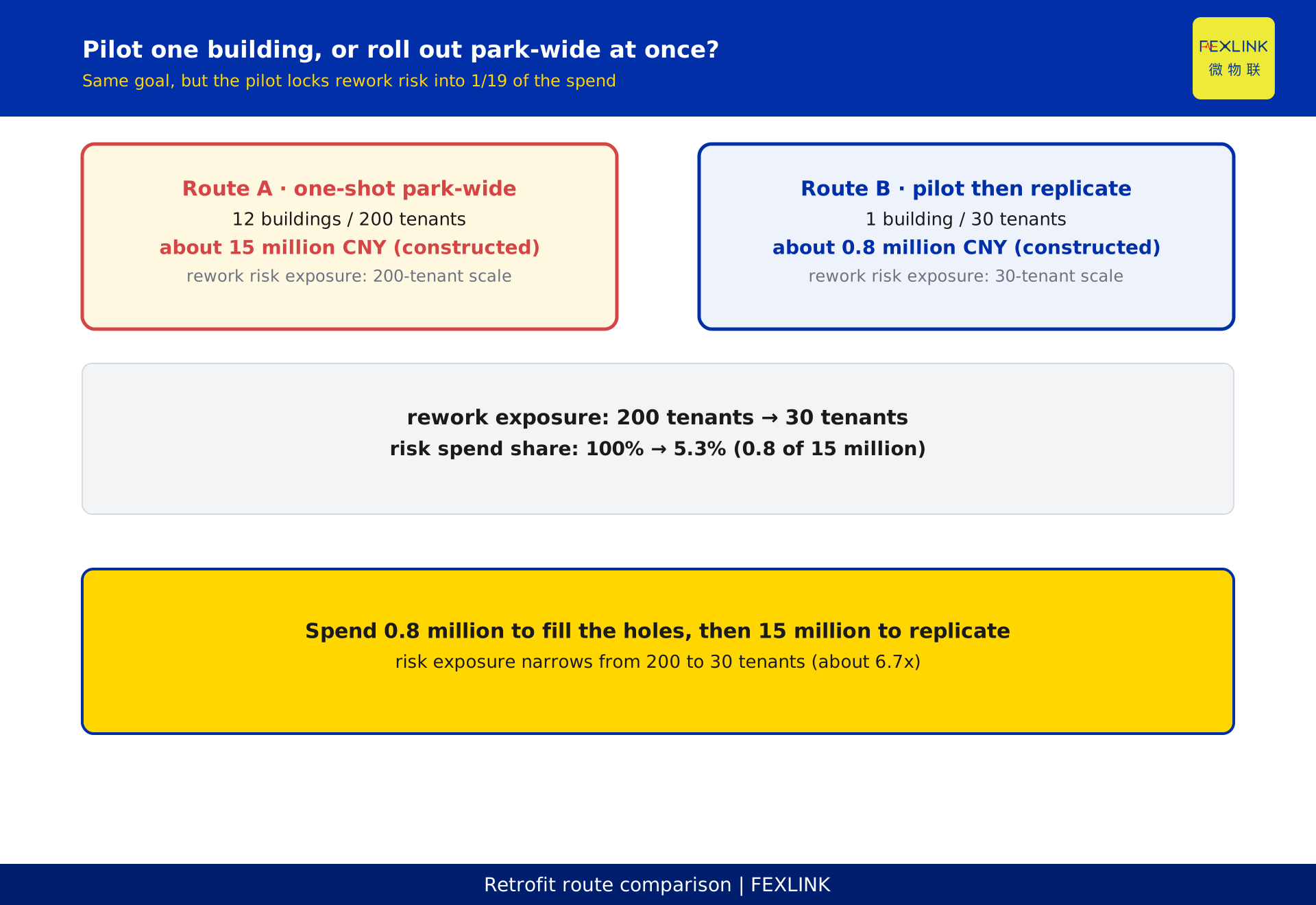
In the example, the pilot is 1 building, about 30 tenants, 1 ESX gateway, about 30 ZSA/ESA smart meters. On budget, the single-building pilot is about 0.8 million CNY (constructed example, covering meters, gateway, installation, and platform integration), against a one-shot park-wide rollout of about 15 million CNY (constructed example). The risk is locked into 1/19 of the spend — wrong meter type, incompatible gateway, or a platform that will not connect are all surfaced and solved within the 0.8 million, not the 15 million.
6. The three pilot acceptance metrics
When the pilot runs, "the lights are on" is not enough. Accept it against three metrics; only when all three pass do you replicate.
- Collection success rate ≥ 99.5%: share of valid data points within one billing cycle; below this the link is unstable and the bill is not trustworthy.
- Cloud latency ≤ 10 seconds: end-to-end delay from meter sampling to platform visibility, which decides whether dashboards are "real time."
- Single-tenant monthly bill discrepancy ≤ 1%: pilot bills compared against manually checked bills; beyond 1% means the scope or algorithm is wrong and cannot be replicated directly.
These three are not "reference values," they are the ticket into replication. Any one failing means going back to fix a device–edge–cloud layer; do not replicate with defects.
7. The pilot-to-replication rhythm in three steps
This section is where this article differs most from the "how to configure first / second / third-level metering" piece: that one is about how metering tiers are configured, this one is about how the retrofit is pushed forward step by step. The increment is exactly the pilot-to-replication rhythm.
- Step 1 — Inventory and freeze scope (weeks 1–2): complete the park-wide retrofit scope list and freeze the settlement scope — which meters bill, on what cycle, under what tariff structure. Without a frozen scope, replicating ten buildings produces ten kinds of bills.
- Step 2 — Pilot closes the loop (weeks 3–8): one building runs device–edge–cloud end to end, validates the three metrics, and produces a reusable deployment template (meter list, gateway deployment diagram, platform integration config).
- Step 3 — Replicate by template (from week 9): using the pilot template as baseline, replicate building by building / zone by zone, re-checking the three metrics after each building, handling anomalous buildings separately without slowing the whole.
The essence is "pilot converges risk, template kills repetition." Skip the pilot and go straight to rollout, and every building becomes a first-time experiment.
8. Platform: one electricity meter first, then water
Do not load "electricity, water, gas, cooling — all at once" onto the platform on day one. Get one electricity meter running first — open the main line of collection, billing, and bill issuance, confirm tenants accept the bills and finance reconciles, then expand to water and other energies.
The reason is practical: the electricity meter is the least disputed, most structured entry point. Get it right and the platform's data model, billing engine, and reconciliation flow are validated by real business. When water arrives, it is just one more metering type and allocation rule; the backbone stays. Reverse it — electricity, water, and gas together — and any one not tuned blocks the whole go-live, stretching the pilot and failing to converge risk.
9. Three common traps
- Trap 1 — Platform before meter type: build the platform first, then find the underlying meters do not support the chosen communication protocol, forcing re-selection and a second installation. The correct order is device → edge → cloud, with meter type fixed during inventory.
- Trap 2 — One-shot park-wide rollout: the budget cannot hold, problems erupt together, and rework cost is counted across the whole park. Fill the holes with one building first.
- Trap 3 — Meters installed but not connected: meters are fitted, data never reaches the cloud, no billing happens — equivalent to no retrofit. The device–edge–cloud layers must close the loop all the way to "bill issued" to count as done.
10. FAQ
Q: An aging park has a messy meter fleet. Can we just replace everything with the top tier?
A: Not recommended. Top-tier everywhere is the highest cost and longest schedule, and many circuits only need management-tier accuracy. Tiered settlement / management configuration controls cost while keeping billing rigorous.
Q: Why must the pilot be a "representative" building? Can't any building do?
A: A random building may have a single circuit type, so its lessons will not replicate to complex buildings and problems surface only at rollout. The representative building must include main incomer + sub-tenant + common area, covering the park's full circuit types.
Q: Can the whole park run on a single gateway?
A: Not advised. A single unit's failure domain is the entire park, and cabling across switchrooms is heavy. One per power zone keeps the failure domain small, cabling short, and replication simple.
Q: Must all three acceptance metrics be met before replication?
A: Yes. Any one of collection success rate, cloud latency, or bill discrepancy failing indicates a defect in some device–edge–cloud layer; replicating with defects amplifies the problem park-wide.
Q: Can the platform take water before electricity?
A: Not advised. The electricity meter is the most structured and least disputed entry, ideal for validating the backbone first; water only adds a metering type, and keeping the backbone untouched is the lowest risk.
Scope and limitations
- The park tenant sub-metering route discussed here applies to multi-tenant scenarios that need per-tenant metering and billing — industrial parks, office clusters, incubators; a single-owner standalone building with no need for tenant metering is out of scope.
- The figures "an aging industrial park with 12 buildings, about 200 tenants, 5 power zones, a pilot of 1 building and 30 tenants, 5 ESX gateways, pilot budget about 0.8 million CNY, park-wide about 15 million CNY" are constructed examples to illustrate the route, not representing any real customer or project; actual retrofit scope, meter counts, gateway numbers, and budget require site survey and metering design.
- The three acceptance metrics (collection success rate ≥ 99.5%, cloud latency ≤ 10 seconds, single-tenant monthly bill discrepancy ≤ 1%) are example criteria; the exact thresholds should be set against the park's network condition, billing cycle, and reconciliation needs, and are not absolute acceptance standards.
- The specific models and parameters of ZSA / ESA smart meters and the ESX edge computing gateway mentioned (such as ESA-22131-R, 3×400A, 3×220/380V, RS485 Modbus) are subject to the latest selection manual and product knowledge base; this article is not a selection or procurement recommendation.
- The related solutions "digital electrical intelligent supervision system" and the "energy-carbon autonomy 4×3×2 framework" are capability-framework descriptions; concrete deployment configurations depend on project scale.
Frequently Asked Questions
Designing Submetering-to-Tenant Retrofit for a Park
For an aging park that wants tenant-level metering for fine-grained energy billing across hundreds of tenants