 FEXLINK Research Institute
The short answer
When a workshop faces excessive harmonics and must add monitoring, the two costliest mistakes are monitoring the wrong loops and over-instrumenting the right ones. Harmonic monitoring belongs only on harmonic-source loops and at the point of common coupling (PCC): loops with non-linear loads — VFDs, rectifiers, EV chargers — need a power-quality monitor, while a plain lighting loop needs only a basic energy meter. The three overpays are top-tier meters on every loop, a cheap model with no event recording, and measuring only without a reserved remedy point. A constructed example (a workshop of 18 circuits) carries the math.
Break the myth: harmonic monitoring is not "a meter on every circuit"
Harmonics are not spread evenly. They originate from non-linear loads — equipment whose current waveform is clipped from a clean sine wave. A drive feeding one motor creates harmonics on that one circuit; a nearby resistive lighting board injects almost none. These two circuit types have completely different monitoring needs.
So the decision starts with the circuit, not the model: a capable meter on the wrong loop misses the harmonics that matter or wastes money. This article answers which loops need a power-quality monitor, which are fine with a basic energy meter, and which three line items you overpay.
Which circuits must be monitored: harmonic-source loops + the PCC
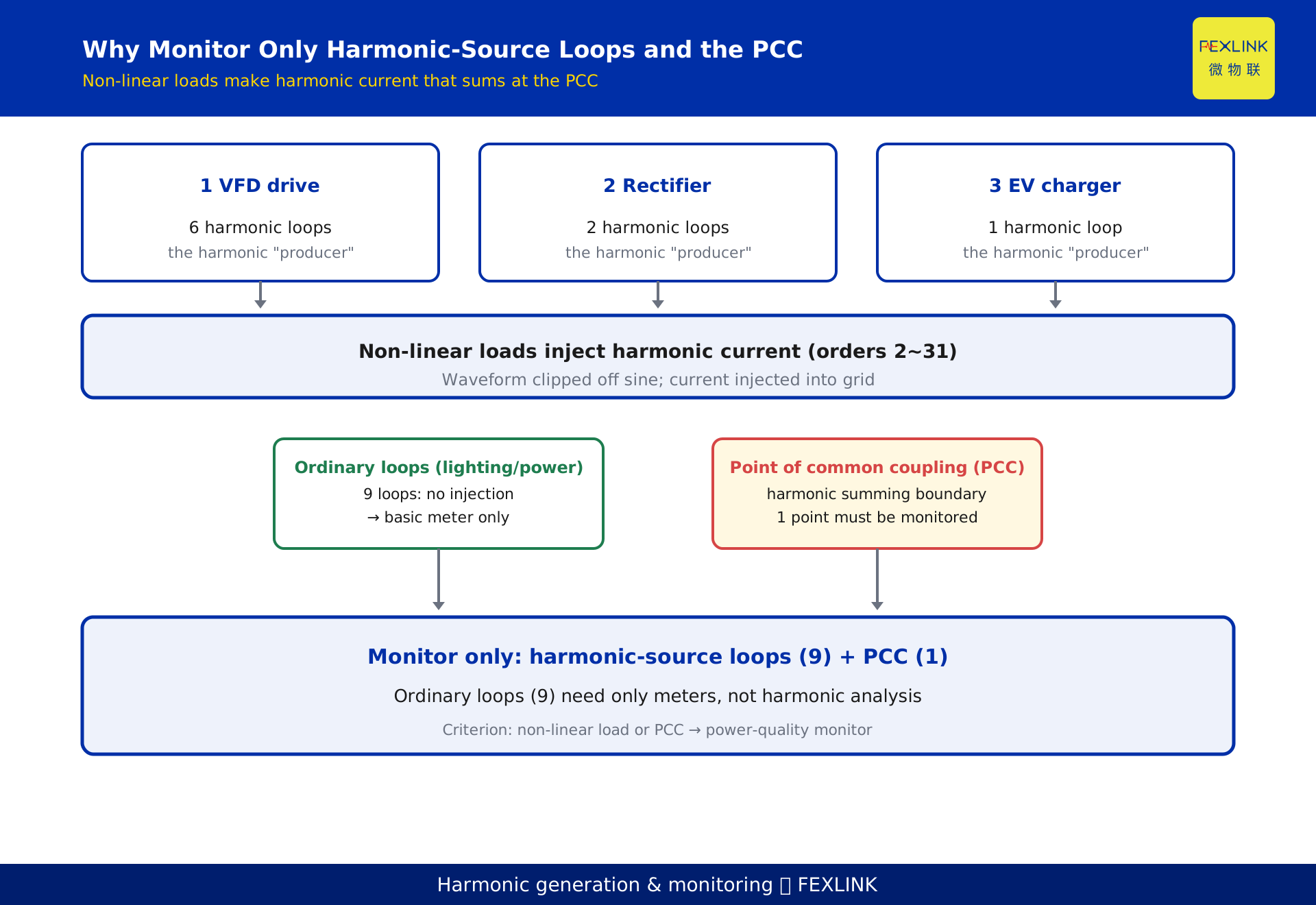
Under GB/T 14549-1993, the assessed object is the harmonic current a user injects at the point of common coupling (PCC). In deployment, only two location types must be monitored:
- Harmonic-source loops: circuits containing variable-frequency drives, rectifiers, EV chargers, or arc-type loads. These loads are the "producers" of harmonics; without monitoring you cannot tell which device is pouring how much harmonic current into the grid. Typical sources are variable-frequency drives, rectifier power supplies, EV chargers, medium-frequency or arc furnaces, and loops dense with LED or switched-mode supplies.
- The point of common coupling (PCC): the user's grid connection point where harmonic currents sum before entering the upstream network; it is the "responsibility boundary" the standard assesses. One monitor at the PCC is mandatory, to judge whether the whole site exceeds limits and where the responsibility lies.
Ordinary lighting, general power, resistive heating and fan-coil loops contribute negligibly and need only a basic energy meter.
A clear selection criterion: if a loop contains VFD/rectifier/charger-type non-linear load, or the loop is the PCC, fit a power-quality monitor; otherwise a basic energy meter suffices. Without this criterion, a quotation tends toward "top-tier everywhere".
How a power-quality monitor differs from a basic energy meter
Both are called "meters", but do very different jobs — and that is where the price gap comes from. A basic energy meter accumulates active/reactive energy; it does not decompose waveform distortion. A power-quality monitor adds harmonic analysis: per GB/T 14549 it outputs THDu/THDi and per-order distortion of orders 2~31 (or higher), plus out-of-limit statistics and event recording.
Three key differences:
- Can it break harmonics down? A basic meter gives only energy; it cannot read "what share of the fundamental is the 5th harmonic". A power-quality monitor produces the per-order spectrum.
- Can it record events? Harmonic harm often strikes during "long out-of-limit periods" or "a specific transient". A power-quality monitor carries event recording (out-of-limit trigger, time window, pre/post waveform buffer); a basic meter does not.
- Can it feed remediation? Monitoring data must return to "which device, which order, by how much"; a basic meter gives no such lead.
In short, a power-quality monitor buys "harmonics visible + events traceable"; a basic meter buys "energy metered". Different goals — do not mix them when paying.
The three overpays, quantified
The following constructed example makes the math clear. It represents no real customer or project.
Imagine a machining workshop with 18 low-voltage distribution circuits. The harmonic-source loops are: variable-frequency drives 6 circuits, rectifier/DC power supplies 2 circuits, EV chargers 1 circuit, totaling 9 circuits that must monitor harmonics; the rest are ordinary lighting and power loops, 9 circuits.
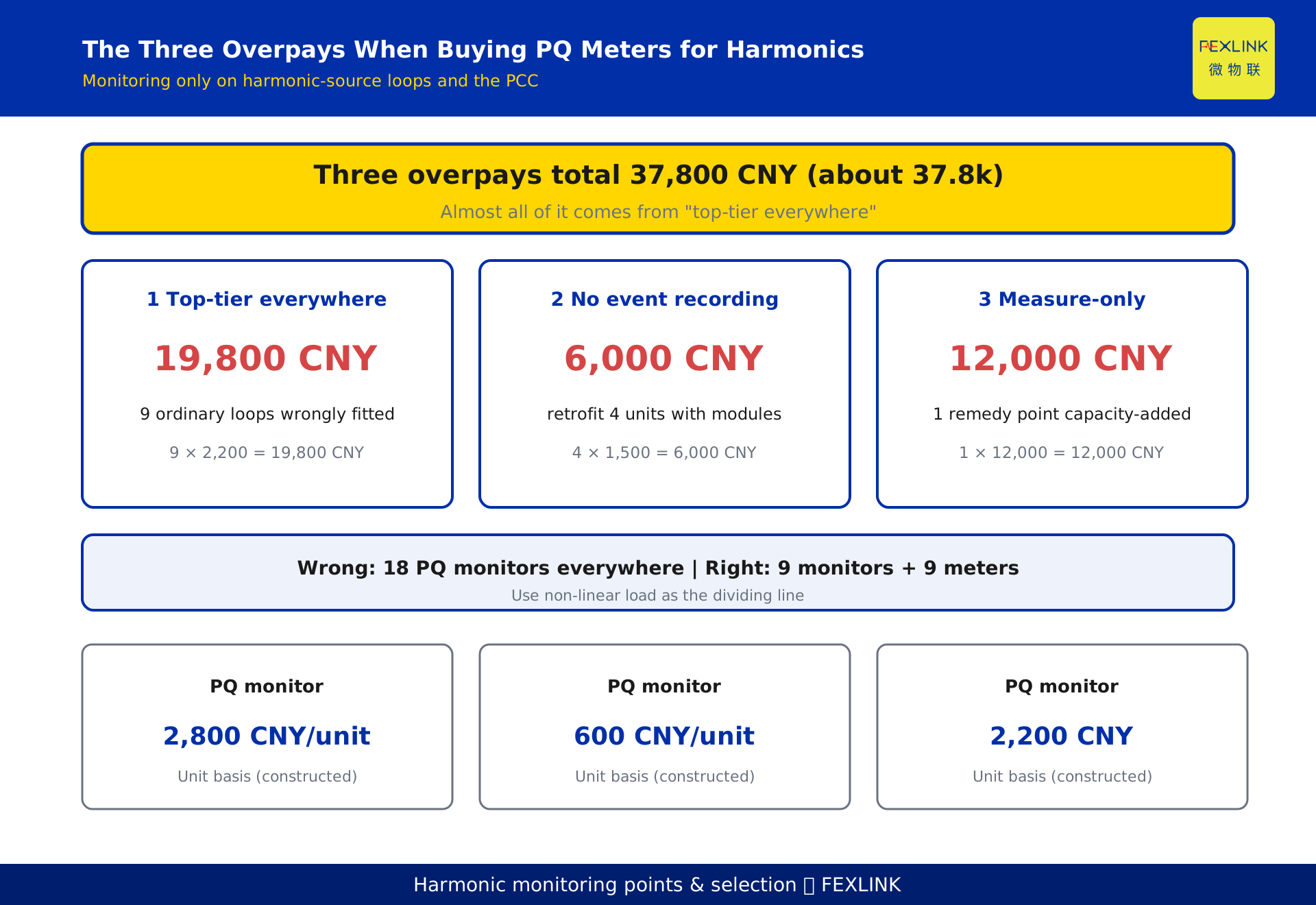
Assume a power-quality monitor costs about 2,800 CNY/unit and a basic energy meter about 600 CNY/unit, a per-unit gap of 2,200 CNY. The wrong approach fits all 18 circuits with power-quality monitors; the right approach fits 9 monitors + 9 basic meters. The wasted money concentrates in three items:
- Overpay 1, top-tier everywhere: 9 ordinary loops wrongly fitted with top-tier meters, wasting 9 × 2,200 = 19,800 CNY.
- Overpay 2, ignoring event recording: an early cheap model with no event recording was chosen to save money; later, when harmonics exceed limits, the responsible time window cannot be shown, so 4 units with event-recording modules are retrofitted at 4 × 1,500 = 6,000 CNY.
- Overpay 3, measure-only: monitoring shows harmonics exceed limits but no remedy/meter-swap point was reserved, so the distribution must be re-designed and one point capacity-added at 12,000 CNY.
The three sum to 37,800 CNY (about 37.8k) — the typical amount over-counted when "measuring harmonics".
Overpay 1: monitoring every circuit at the top tier
This is the easiest wording for a supplier to slip in: since we are checking harmonics, fit a monitor on every circuit so nothing is missed. It sounds safe, but it prices 9 lighting loops at 2,800 CNY that should cost 600 — 2,200 CNY extra per unit, 19,800 CNY sunk into loops needing no harmonic analysis.
The hidden cost is data noise: more loops means longer reports, and the 9 source loops that matter get buried among dozens of tables. More points is not better; more accurate is.
The decision criterion is clear: use the presence of non-linear load as the dividing line — monitors on harmonic-source loops and the PCC, basic meters on ordinary loops. Write this into the technical specification and the "top-tier everywhere" line in the quotation disappears.
Overpay 2: picking a cheap model without event recording
Harmonic problems have a trait: they are often not "always over" but "over in a certain time window" or "over the moment a certain device starts". Without event recording, the meter only gives the instantaneous reading; you never know when the exceedance happened, how long it lasted, or which device's start/stop corresponded. By month-end report, the responsible window has blurred into one blob.
Some quotations use a "basic version" to lower the price but make event recording optional. You appear to save 1,500 CNY per unit; later, when locating the source and writing the remediation report, the data cannot be traced, so you retrofit 4 event-recording modules anyway — 6,000 CNY more and a lost remediation window.
At selection, list "event recording (out-of-limit trigger + time window + pre/post waveform)" as mandatory — it saves more than merely comparing unit prices. The ESE power-quality monitor treats per-order harmonic analysis, THD and event recording as standard capabilities; for loop-level local judgment with control actions, the SFE power-quality multi-element controller pushes the judgment logic down to the distribution loop.
Overpay 3: measure-only, no reserved remedy point
Monitoring produces no compliance; it only tells you "it is over, where, and by how much". Many projects stop at the report. The harmonic source is still on the VFD, the PCC still over limit. Adding a filter, swapping the rectifier stage or adjusting compensation is the next step, but the original design reserved no space for it, so re-drilling, capacity addition and cabinet modification bring a 12,000 CNY rework bill.
This is also where "measure-only" costs the most: monitoring points at the problem yet gives no handle to solve it, so the project repeats the design-construct-acceptance cycle. Planning "monitoring point + remedy reserve" together at deployment is far cheaper than measure-first then retrofit.
How ESE and SFE power-quality models divide the work
The two products are not either/or; they divide by loop hierarchy:
- ESE power-quality monitor: continuous monitoring on harmonic-source loops and the PCC, with standard 2~31 order harmonic analysis, THDu/THDi, three-phase unbalance, voltage deviation, plus out-of-limit event recording and statistics. Suited where you need "the full harmonic picture and traceable events".
- SFE power-quality multi-element controller: beyond power-quality monitoring, it adds temperature and other electrical quantities for integrated measurement and control, suiting occasions that need "monitor + judge + control action" completed locally at the loop level, pushing the remediation criterion down to the distribution loop.
Both fit the power-quality dedicated monitoring solution, forming a "monitor — alarm — locate — remedy" closed loop. Selection order: first use the section-two criterion to fix the loops, then choose ESE or SFE by loop hierarchy, and only then discuss unit price.
Loop-type → configuration lookup table
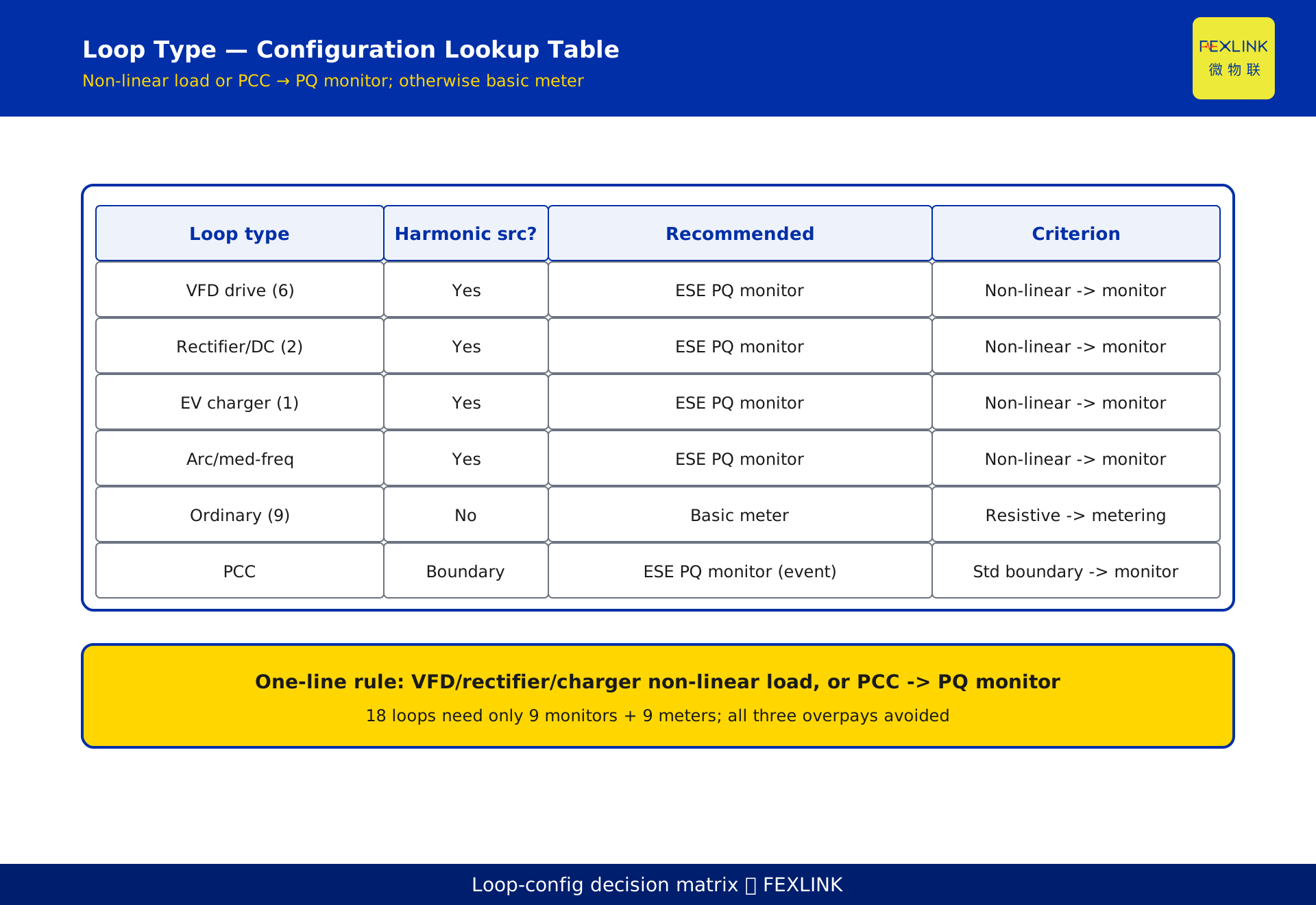
| Loop type | Harmonic source? | Recommended config | Decision criterion |
|---|---|---|---|
| VFD drive (6 circuits) | Yes | ESE power-quality monitor | Non-linear load, monitor mandatory |
| Rectifier/DC supply (2 circuits) | Yes | ESE power-quality monitor | Non-linear load, monitor mandatory |
| EV charger (1 circuit) | Yes | ESE power-quality monitor | Non-linear load, monitor mandatory |
| Arc/medium-frequency equipment | Yes | ESE power-quality monitor | Non-linear load, monitor mandatory |
| Ordinary lighting·power (9 circuits) | No | Basic energy meter | Resistive dominated, only energy metering needed |
| PCC | Responsibility boundary | ESE power-quality monitor (with event recording) | National-standard responsibility boundary, monitor mandatory |
One-line criterion: a loop with VFD/rectifier/charger-type non-linear load, or a loop that is the PCC, gets a power-quality monitor; otherwise a basic energy meter. By this table, the 18 circuits need only 9 monitors + 9 energy meters, avoiding all three overpays at once.
Where this article ends and KD-0467 begins
A line must be drawn to avoid duplicating the neighboring article. KD-0467 is about value interpretation — that THD percentage on the meter, against which GB/T 14549 red line, for how long, and who owns it. This article does not repeat that; its increment is monitoring-point planning and product-configuration decisions: before buying, decide which loops, with which type, and not pay for unused capabilities.
Put differently, KD-0467 answers "once measured and over limit, how do I judge it"; this article answers "before measuring, how do I plan points so I do not overpay". The two hand off: use this article to fix the points and configuration, then use KD-0467 to judge the numbers read.
Frequently asked questions (FAQ)
Q: Can a basic energy meter become a power-quality monitor just by adding a module?
No. Per-order harmonic analysis needs synchronized sampling with phase-lock, FFT decomposition and per-order distortion computation, which a basic meter's metering chip does not perform; event recording also needs independent storage and trigger logic. This is a hardware-architecture difference, not a software upgrade.
Q: The more harmonic-source loops there are, the more we should monitor everywhere, right?
The opposite. More harmonic-source loops means a higher share of ordinary loops too, so deploying by "harmonic-source + PCC" saves even more. The criterion looks only at whether a single loop has a non-linear load, not the total count.
Q: Can we fit only one monitor at the PCC and skip the per-source meters?
You can find the problem but not locate the source. The PCC only says "the whole site is over"; to trace which VFD and which order you still need points on the source loops. With limited budget, prioritize PCC + main source loops over filling everything.
Q: Is event recording truly necessary, or just a sales pitch?
It is a hard requirement for harmonic remediation. Exceedances often occur in specific time windows or at device start/stop; without a time window and pre/post waveform, the remediation report cannot be written and the responsible window cannot be defined. It is the bridge that turns "monitoring" into "remediable", not decoration.
Q: Can ordinary loops use the ESE or SFE power-quality models?
They can, but need not. Ordinary loops have no harmonic-analysis need; fitting SFE/ESE there pays for capabilities you will not use — exactly the first overpay described here. Keep the top-tier meters on harmonic-source loops and the PCC, and leave ordinary loops to energy meters.
Scope and limitations
- The harmonic monitoring-point planning and product configuration discussed here apply to low-voltage distribution scenarios using GB/T 14549-1993 "Power quality — Harmonic in public supply network"; the principle "harmonic-source loops + PCC must be monitored" is a deployment rule, and the specific loop list is subject to on-site load survey.
- The example in this article (a machining workshop of 18 circuits; VFD 6 / rectifier 2 / EV charger 1; unit prices 2,800 / 600 CNY; three overpays 19,800 / 6,000 / 12,000 CNY; total 37,800 CNY) is constructed to illustrate the point and represents no real customer, project or measured data; actual quotations must be based on site survey, the product selection manual and current unit prices.
- The permissible harmonic current values (GB/T 14549 Table 2) require conversion by voltage level and reference short-circuit capacity; this article gives no specific limit figures, and the interpretation method is in KD-0467.
- The specific models, parameters and prices of the ESE power-quality monitor, SFE power-quality multi-element controller and power-quality dedicated monitoring solution are subject to the latest selection manual and product knowledge base; this article constitutes no selection or procurement advice.
- Standard numbers are based on the currently valid edition; after a standard is revised, the related quantitative conclusions must be re-checked.
Frequently Asked Questions
Buying a Power Quality Meter for Harmonics
When a workshop faces excessive harmonics and must add monitoring