 FEXLINK Research Institute
The short answer
For most retrofits of existing electricity meters, the safer order is gateway first, then meters in batches. The key is not meter age but whether each meter has a communication port: RS485 or pulse-output meters stay put and feed the gateway; unported meters that serve billing settlement are replaced first and then connected into the gateway already built. Putting the acquisition channel ahead of the metering body avoids both "meters replaced but no data" and "a channel built for meters that cannot talk". Early real readings prove value and decide which remaining meters get replaced.
1. A Sequencing Problem, Not a Selection Problem
With a limited budget and a few hundred legacy meters, the first question is "which meters, which gateway". What sinks the project is rarely the model but the order: replace every meter first and the new ones are still read by hand; or wire the network everywhere, then find half the old meters have no port and the cabling is useless.
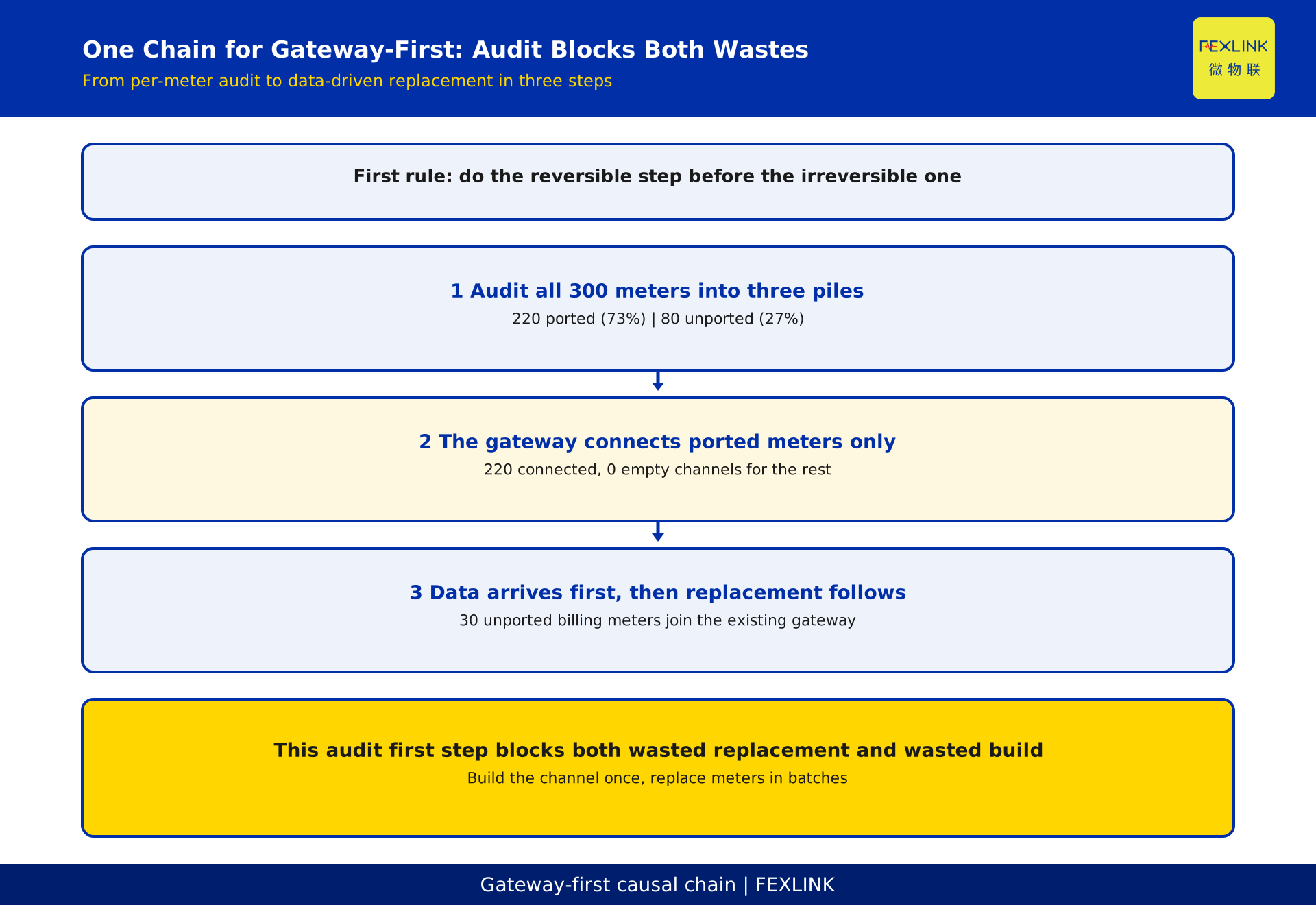
Both wastes share one root: treating the metering body and the acquisition channel as one packaged decision. Replacing a meter touches the body — outage, removal, re-registration, re-checking ratios and wiring — costly and irreversible. Building a channel does not: wire only ported meters, place gateways in the distribution room, cheap and reversible.
So the first rule is: do the reversible step before the irreversible one — a channel in place gives replacement a landing point.
2. The Key: Audit Capability Meter by Meter
The order comes from an audit sheet, not a hunch. Five on-site checks per meter:
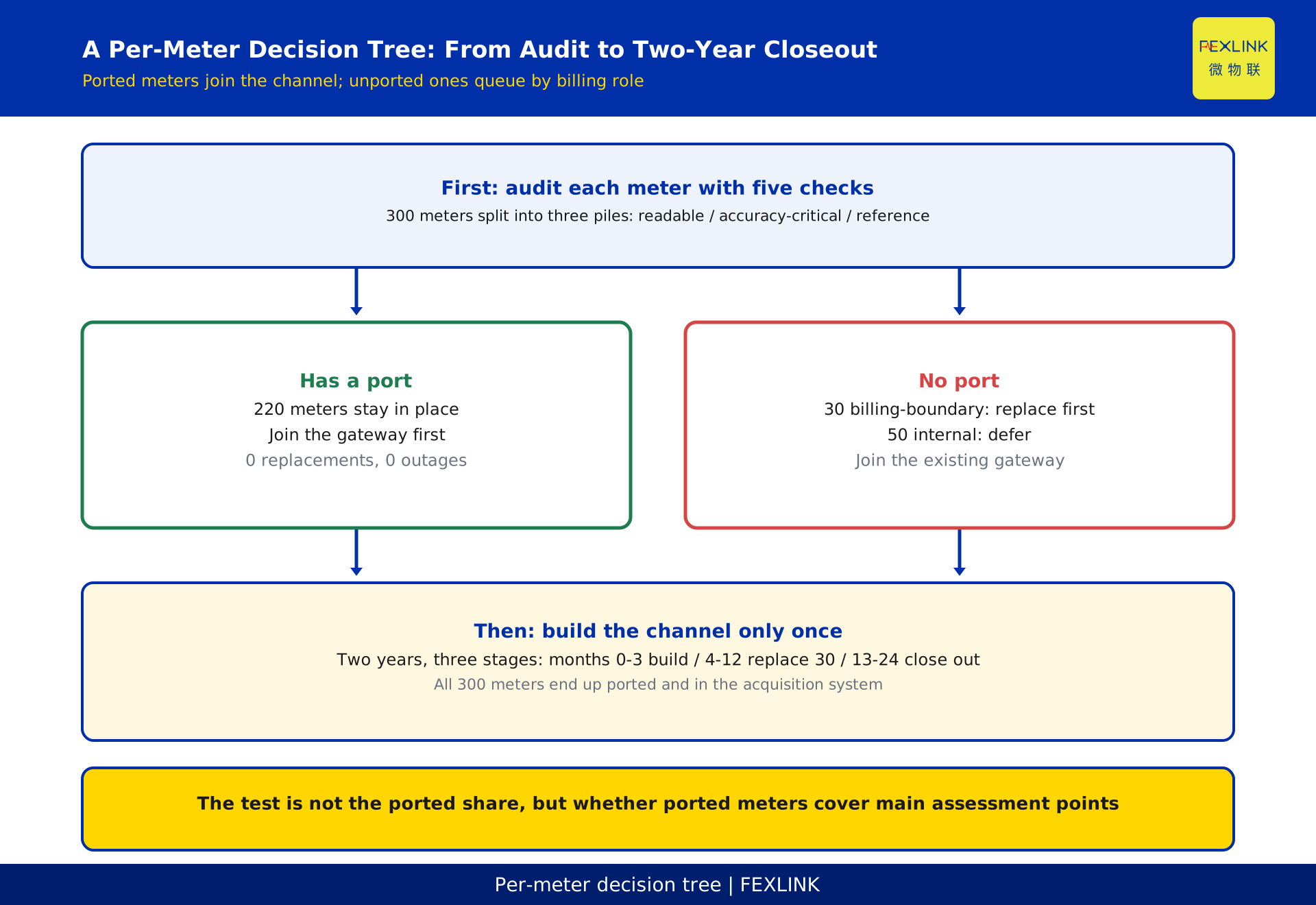
First, is there a port at all — RS485, pulse output, or local display only. Second, is the port already taken, and can it be shared. Third, are power and cabling present; old rooms often have "a port but no wire". Fourth, are the protocol document and point list available, or the port yields no data. Fifth, is the meter for billing settlement, internal assessment, or trend observation.
The audit yields three piles: readable with a port, no port but accuracy mandatory, no port and reference only — the gateway's immediate target, the replacement queue, and those that can wait. It is also the cheapest first step: no meter changed, no outage, yet it blocks both wastes.
3. Gateway First: When It Applies and Where It Stops
When enough meters have ports, building the channel first is usually the better deal: no meter change, no outage, readings reach the platform as soon as the gateway is in.
More importantly, it produces data first. Continuous readings answer "which meter drifts", "which circuit idles at night", "which point deserves replacement first" — otherwise guesswork. The budget is read from data, not an age table.
The boundary is clear. A gateway solves "can the reading get out", not "is the meter accurate". Legacy error, a wrong ratio, ageing wiring do not improve because a gateway is attached; nor does it apply to unported meters — reserving a channel for them is the wasted build above. In one line, gateway first means let ported meters speak and identify the unported ones at the same time.
4. Meter First: When the Order Reverses
Three cases put replacement ahead of the network, or alongside it.
First, unported meters serving billing settlement: they neither transmit nor stop affecting invoices, so disputes are costly; replace them with ported smart meters into the later gateway. Second, meters near replacement age whose accuracy is questioned: they will be replaced anyway, so a transitional channel is uneconomic. Third, sites with almost no ported meters: a very low share covers too few points to prove value, so reverse the order — replace by billing role in batches while building the channel once, connecting each meter as swapped.
Here is an executable criterion: can ported meters cover the main assessment points. If yes, build the network first; if not, replace unported billing meters first. Section 6 uses a 60% ported share as an illustrative threshold; real projects calibrate it themselves.
5. Risk Comparison of the Two Orders
The difference is not total spend, but when money goes out and data arrives.
| Dimension | Meters first, network later | Network first, meters later |
|---|---|---|
| Opening move | Replace all 300 meters, then build the gateway | 3 gateways cover 220 ported meters first |
| Upfront spend (constructed) | 270,000 yuan for meters + 18,000 yuan for gateways | 18,000 yuan for gateways to start |
| When automated data appears | Only after the gateway exists; new meters idle | 220 meters report as soon as the gateway is up |
| Typical waste | New meters with no channel, wasted replacement | Empty channels for unported meters, wasted build |
| What blocks the waste | Nothing; the hole is in the order | The audit identifies ported meters first |
| Basis for later replacement | Meter age and estimates | Real readings already running |
The easiest row to miss is "typical waste". Both routes have one waste, but only network-first blocks it up front — the gateway connects only confirmed ported meters, with no empty channel for the rest. In meters-first the hole sits inside the order; a later gateway only limits damage. Both routes eventually build a channel and replace some meters. Total spend may not differ much; what differs is timing and evidence.
6. A 300-Meter Worked Example
All figures below are constructed; they represent no real customer or project.
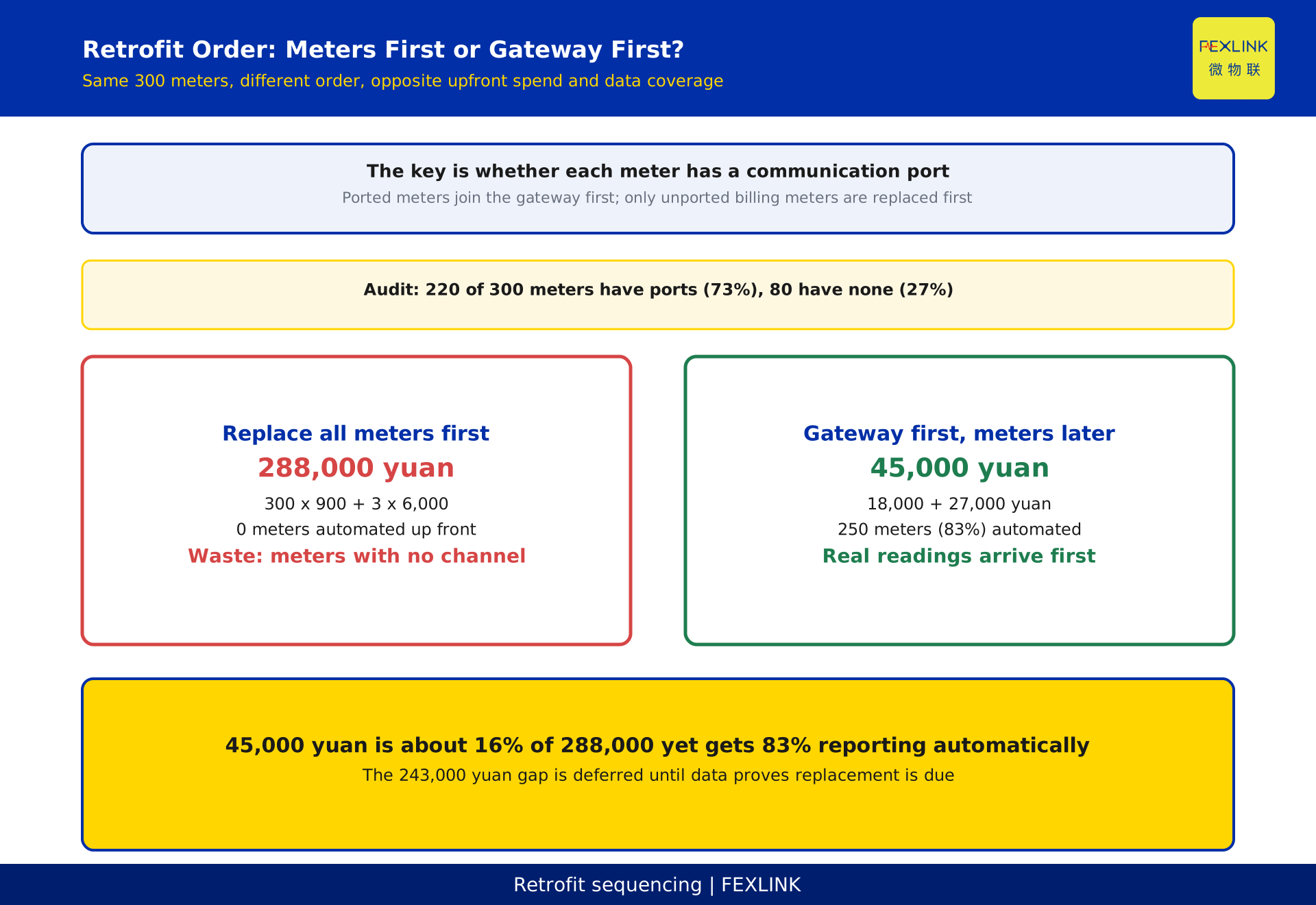
A park has 300 legacy electricity meters. The audit finds 220 with RS485 or pulse output (about 73%) and 80 with no port (about 27%); of those 80, 30 are billing-boundary meters and 50 are internal assessment meters.
By the Section 4 criterion, ported meters cover the main assessment points, so the order is network first. Deploy 3 edge gateways by distribution room and connect the 220 ported meters; the 80 unported meters stay on manual reading, with no empty channel. Constructed unit prices: a smart meter at 900 yuan, an edge gateway at 6,000 yuan.
- Replacing all meters first: 300 x 900 = 270,000 yuan, plus 3 x 6,000 = 18,000 yuan for gateways, 288,000 yuan in total, and every new meter is still read by hand until the gateway exists.
- Network first: spend 18,000 yuan on gateways and 220 meters (73%) are automated immediately.
- Then replace the 30 unported billing-boundary meters with ported smart meters: 30 x 900 = 27,000 yuan, connected straight into the existing gateway. Cumulative 18,000 + 27,000 = 45,000 yuan, with 220 + 30 = 250 meters automated, 83% of the fleet.
- The remaining 50 internal assessment meters wait and are replaced in year two as they age out or budget allows.
Comparison: 45,000 yuan is about 16% of the 288,000 yuan all-at-once route, yet it gets 83% of meters reporting and the readings that decide later replacements. The 288,000 - 45,000 = 243,000 yuan gap is not saved; it is deferred until data proves replacement is due.
Check: 220 + 80 = 300; 220 + 30 = 250; 250 / 300 is about 83%; 45,000 / 288,000 is about 16%; 3 x 6,000 = 18,000; 300 x 900 = 270,000.
7. A Two-Year Rolling Roadmap
Pace it over two years, not one quarter.
Months 0-3: audit and build. Complete the five checks, wire the ported meters, place gateways by distribution room, stabilise readings from the 220 meters, and list the 30 unported billing meters for replacement.
Months 4-12: let data speak and replace the first batch. Run the platform through one full cycle, use readings to check ratios, spot abnormal circuits and verify timeliness, and replace the 30 billing meters into the existing gateway.
Months 13-24: close out. Replace the remaining 50 internal assessment meters in batches by the priority read from the previous stage. In the end all 300 meters have ports and are in the acquisition system, with no channel to rebuild.
All three stages share one trait: build the channel once, replace meters in batches.
8. With the Channel in Place, How the Platform Connects
Separate the "organ that speaks" from the "hub that carries". Ported legacy meters produce readings; the ESX edge computing gateway groups them by distribution room into one upstream channel, aggregating and forwarding without changing the meters. New ZSA/ESA smart meters installed during replacement come with ports, so they join the existing channel directly — no rewiring, no second network.
The Digital Electrical Intelligent Supervision System turns upstream readings into ledgers, curves and alarms. Products here only answer "how to connect"; the criterion is in Section 4, the budget in Section 6.
One boundary: this section covers which comes first, the channel or the body, not which protocol a meter uses, and does not expand on protocol conversion — that belongs to the separate "decide protocol ownership first" topic. The same gateway may carry different protocols on different projects without changing this conclusion.
9. Five Common Traps
Trap one: replace the whole fleet because meters look old. Old does not mean due now; a new meter without a channel is just a costlier manually read meter.
Trap two: read "network first" as reserving an interface for every meter. The gateway connects only confirmed ported meters; no empty channel for the rest.
Trap three: assume data is accurate once the gateway is on. A gateway handles transport, not metrology; legacy error, ratios and wiring still need verification and comparison.
Trap four: treat the ported share as the only criterion. The 60% here is a constructed example; the real test is whether ported meters cover main assessment points. An 80% share covering fringe circuits is worse than a 60% share covering every billing point.
Trap five: treat the routes as either-or for the whole project. The split is per meter: ported meters join the channel first, unported billing meters get replaced first.
FAQ
Q: If old meters have no RS485 port, is replacing the whole fleet the only option?
No. Build the gateway for ported meters first; queue unported meters by billing role, replacing billing-boundary meters first. Choose ported models and connect them into the existing channel.
Q: If I build the gateway first, will it be wasted when meters are replaced later?
Usually not. A gateway is built as a channel, decoupled from meter models; replaced meters simply reconnect and the channel is not rebuilt. The exception is a site-wide medium change, such as bus to wireless — a new design, not a sequencing question.
Q: What share of ported meters justifies building the network first?
The 60% here is a constructed example, not a universal threshold. The test is whether ported meters cover main assessment points and billing boundaries. If yes, build the network first; if not, replace unported billing meters first and bring the channel along.
Q: Once the gateway is powered, is every meter's data accurate?
No. A gateway solves "readings get out", not "the meter is accurate". Legacy error, ratio settings and secondary wiring still require verification and comparison, independent of sequencing.
Q: Can billing-boundary meters stay in place with only the network built first?
Two cases. Ported billing-boundary meters may join the gateway as a transition, but billing accuracy compliance still follows current metering administration requirements. Unported billing-boundary meters should be replaced first, then connected into the existing gateway; long-term manual reading is not recommended.
Scope and limitations
- This article discusses the implementation sequence for automating existing electricity meters in general, aimed at energy managers and project decision makers with several hundred legacy meters and a limited budget. A single building can simplify the audit.
- Boundaries with neighbouring topics are fixed: water meter retrofit splitting by "meter age plus billing role" over a three-year rollout belongs to the water-meter article; protocol ownership and conversion belong to another article. This article covers only the sequencing decision that the acquisition channel precedes the metering body, over a two-year rollout.
- The figures here — 300 meters, 220 ported (73%), 80 unported (27%), 30 billing-boundary, 50 internal assessment, 3 gateways, unit prices of 900 and 6,000 yuan, 270,000 yuan, 18,000 yuan, 27,000 yuan, 45,000 yuan, 288,000 yuan, 16%, 83%, 243,000 yuan, and the two-year three-stage plan — are constructed examples illustrating the sequencing arithmetic, representing no real customer, park or project; actual estimates must come from on-site audit and quotations.
- The "60% ported share" is an illustrative criterion, not a standard or industry threshold. Replacement cycles and billing accuracy compliance follow current local metering administration requirements and actual meter condition; this article does not replace a verification conclusion.
- No standard clause numbers, error limits or protocol parameters are cited. RS485, pulse output and ports are generic engineering interface descriptions; refer to device manuals.
- The ESX edge computing gateway, ZSA/ESA smart meters and Digital Electrical Intelligent Supervision System are described qualitatively only, with no port counts, rates or accuracy figures. Selection follows the latest product documentation; this article is not a purchasing recommendation.
Frequently Asked Questions
If old meters have no RS485 port, is replacing the whole fleet the only option?
No. Build the gateway for ported meters first; queue unported meters by billing role, replacing billing-boundary meters first. Choose ported models and connect them into the existing channel.
If I build the gateway first, will it be wasted when meters are replaced later?
Usually not. A gateway is built as a channel, decoupled from meter models; replaced meters simply reconnect and the channel is not rebuilt. The exception is a site-wide medium change, such as bus to wireless — a new design, not a sequencing question.
What share of ported meters justifies building the network first?
The 60% here is a constructed example, not a universal threshold. The test is whether ported meters cover main assessment points and billing boundaries. If yes, build the network first; if not, replace unported billing meters first and bring the channel along.
Once the gateway is powered, is every meter's data accurate?
No. A gateway solves "readings get out", not "the meter is accurate". Legacy error, ratio settings and secondary wiring still require verification and comparison, independent of sequencing.
Can billing-boundary meters stay in place with only the network built first?
Two cases. Ported billing-boundary meters may join the gateway as a transition, but billing accuracy compliance still follows current metering administration requirements. Unported billing-boundary meters should be replaced first, then connected into the existing gateway; long-term manual reading is not recommended.