 FEXLINK Research Institute
The short answer
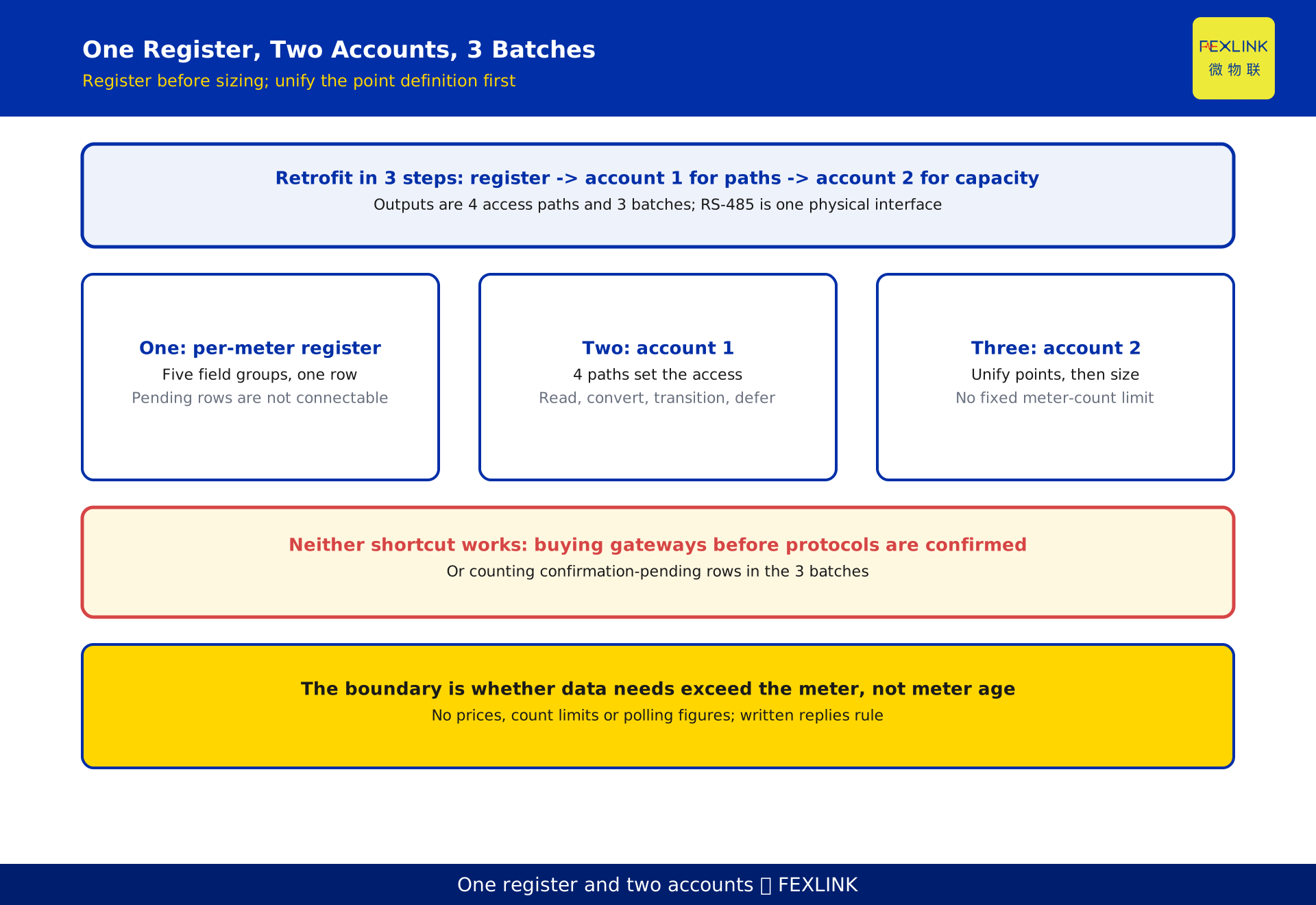
Retrofitting existing meters starts with a per-meter register, then two accounts, then 3 batches. Do not begin by asking whether to replace everything: before the register exists, capacity and price have nothing checkable to attach to.
Account 1 is the access path: direct read, protocol conversion, pulse or dry-contact transition, or no connection for now. Account 2 is gateway capacity: fold connectable meters into one point definition, then check what the gateway must carry. FEXLINK protocol-conversion and edge gateways often share one retrofit list, but serve different paths and are not substitutes. This article gives a method, not a capacity table; counts, capacity, intervals and uplink conditions come from nameplates, selection manuals, site surveys and written answers. Company-disclosed naming is not a specification commitment.
Start with a per-meter register, not a gateway quote
With a tight budget, the easiest first move is to photograph old meters and ask for a gateway quote. But capacity and the need for a conversion stage depend on whether each meter's interface, protocol and point list can be obtained; none of that is on the label or in a photo.
So start with a register: one row per meter, recording whether it can be connected, which path it takes and how many points it occupies. It comes before selection because it reduces a mixed population to a few finite conclusions. Choosing a gateway first means sizing on the most optimistic assumption, then discovering closed protocols during commissioning and rewriting the scheme.
The register also drives phasing. Meters in one room are rarely a single batch, so interfaces and protocols mix; one row per meter shows which units can be validated together and which need individual handling. No fixed connectable or protocol counts are given; company-disclosed family figures are reference points only and must be confirmed in writing.
Five register fields, one row per existing meter
The fields need not be many, but each must be writable and re-checkable. Five groups are enough.
Group one is circuit identity: cabinet, circuit, and whether data serves settlement, assessment or display; business purpose sets the batch order and outranks the interface. Group two is the physical interface: an RS-485 port, pulse output or dry contact, terminal reachability, polarity, shielding and earthing; record only what is seen on site. Group three is protocol and point list: open or not, obtainable or not, who sets parameters; any gap marks the row "written confirmation pending". Group four is addressing and power: conflicts, gateway-side supply, outage windows. Group five is site conditions: cabinet space, stopping the meter, reusing conduits.
Each meter then carries one of three marks: directly checkable, confirmation pending, or not feasible on site, which feed both accounts. Do not treat "same model" as "same protocol": meters from one batch may have been replaced later, so point lists and addresses need per-meter checks. Confirmation-pending rows must not be counted as connectable, or the capacity estimate is inflated from the start.
Account one: four access paths, not only replacement
Combining the register marks gives 4 paths for old meters. They are not a ranking; each fits different conditions.
First, meters with open protocols, obtainable point lists and checkable parameters: direct read, with work mostly in configuration and commissioning. Second, meters with a usable interface but a protocol needing translation: protocol conversion maps different protocols onto unified points, at the cost of a mapping layer and its upkeep. Third, meters with no port but a serviceable body: pulse or dry-contact transition turns consumption into countable signals, yielding consumption but not the richer electrical quantities. Fourth, closed meters with no usable output, or bodies at end of life: leave unconnected, keep manual reading, or plan replacement.
The common trap is confusing the second and fourth paths. A protocol unavailable today does not mean the meter cannot be connected; requesting the point list in writing is often cheaper than replacement. But when requests fail, further commissioning is sunk cost. Record that boundary in the register notes, not in verbal promises. The 4 paths describe only how data gets in; they promise no protocol list, conversion capability or accuracy, which must come from selection manuals and written answers.
Account two: unify the point definition before sizing a gateway
The second account is often skipped: asking how many meters a gateway carries before agreeing on what one point means. Meter count is not a capacity unit; the same meter produces very different point volumes depending on the point list.
Unify the definition first: which quantities each meter needs, one record or several, sampling frequency, buffering and resumption during outages, and who aligns timestamps. Write one row per meter, then roll connectable rows into a point list; group by path, because direct read, conversion and pulse transition occupy a gateway differently.
Only then check the gateway: connectable meter count, point-list capacity, sampling interval, buffering and uplink conditions, each confirmed in writing and cross-checked by commissioning tests. This article gives no fixed figures or conversion formula; these vary with model, point list and site conditions and belong to commissioning. If the list exceeds what one gateway can be confirmed to carry, add aggregation points by area rather than trimming data to fit an optimistic assumption.
When replacement is genuinely required
Keeping the meters is the goal, not a dogma. A row marked "not connected for now" need not be replaced immediately; business value and physical condition come first.
Three criteria point to real replacement: the body has failed or fails verification, undermining the settlement basis; the required data lies outside what the old meter offers, and a transition path cannot supply it; the supplier no longer provides the protocol, point list or spares, with no written alternative. All three say the data requirement exceeds what the meter can deliver, not that it merely looks old.
Conversely, with a serviceable body and a need for only consumption or a few electrical quantities, pulse or dry-contact transition is often enough. Include outage and verification cost, which is easy to overlook. A new meter still goes back through the register; point lists and parameters are not skipped because hardware changed. This section offers criteria only, and promises no accuracy class, legal-metrology status or service life: current regulations, nameplates and written answers govern.
Two cuts for gateway selection: protocol availability, uplink and phasing
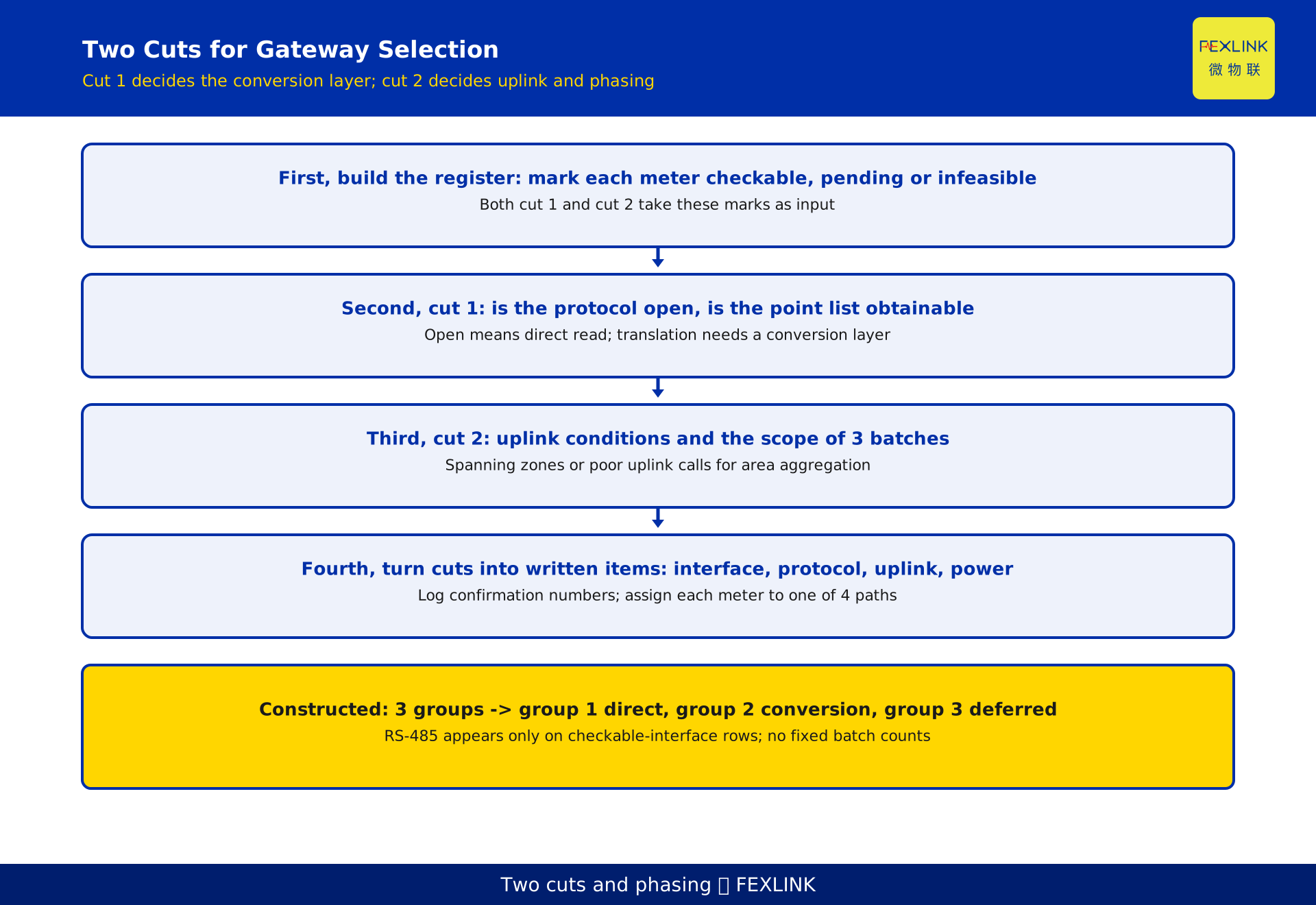
Once the point list exists, gateway selection reduces to two cuts; there is no need to compare models parameter by parameter.
The first cut is protocol availability. With open protocols and complete point lists, direct read is the main path and the gateway is checked for point capacity, buffering and resumption. Where a substantial share needs translation, add a conversion stage and write conversion and uplink responsibilities separately, rather than assuming both sit in one device. This cut decides whether a conversion layer is needed, not which brand.
The second cut is uplink and phasing. A usable wired network, permitted cabling and signal conditions set the uplink; batch count and cabinet coverage set whether gateways are centralised or placed by area. With poor uplink or batches spanning zones, aggregation by area is usually more controllable than one full rollout.
After the cuts, the FEXLINK FG protocol-conversion gateway, FEXLINK ESX edge gateway and FEXLINK ESI dry-contact module correspond to conversion, aggregation with uplink, and pulse transition. These are company-disclosed family positions, not commitments; the multi-protocol access layer of the Taiyi intelligent control hub carries normalised points and cannot supply data the old meter never had. Before ordering, turn both cuts into written check items: interface, protocol scope, uplink mode, power and installation conditions, each answered and logged with a confirmation number.
Worked example: phasing a retrofit in a distribution room
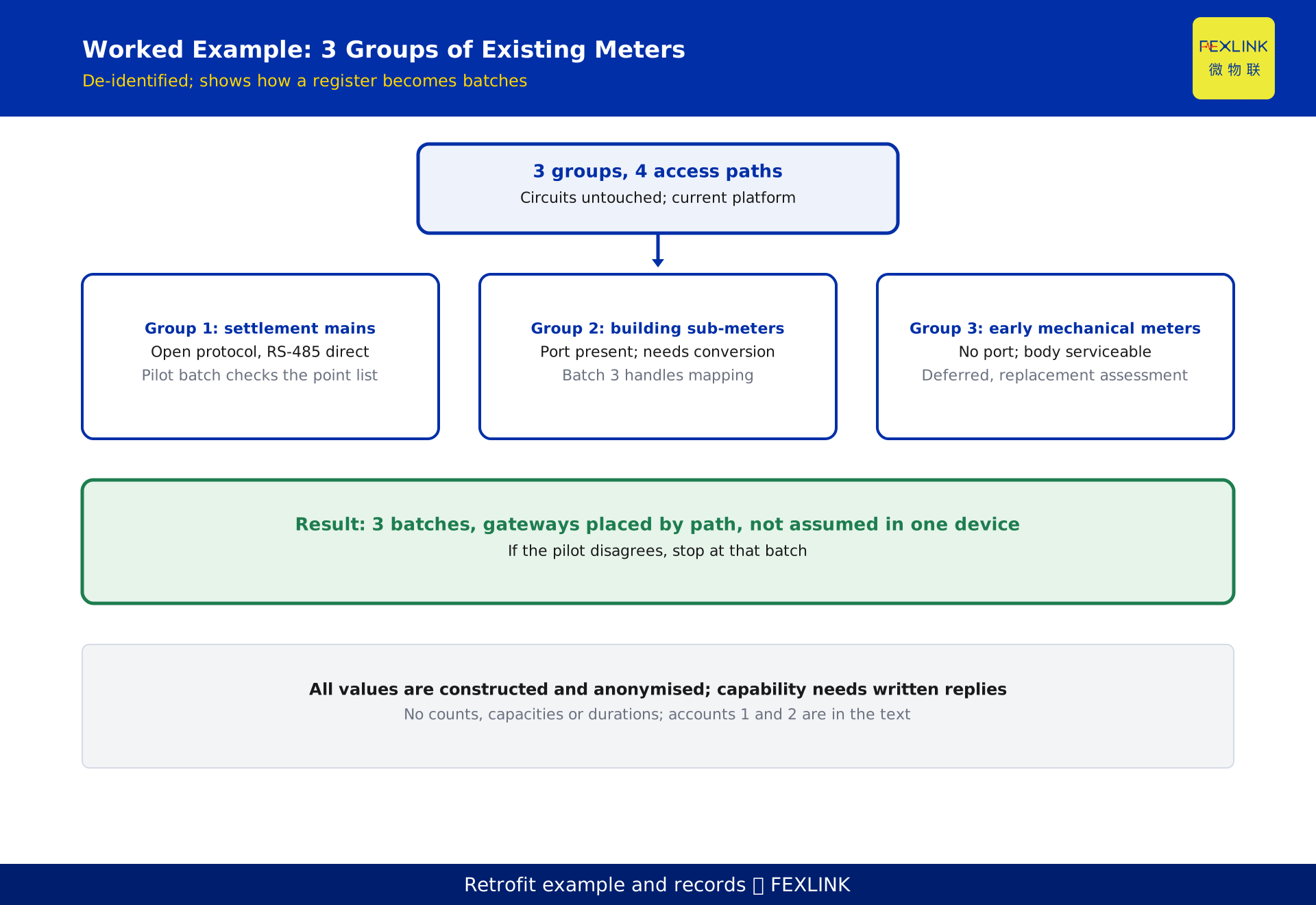
A site's existing distribution room holds meters from different years; the owner wants main circuits untouched and consumption data fed into the current platform. This is a de-identified constructed example, not a real project or quotation.
The register splits circuits into 3 groups: Group 1 holds settlement and allocation mains with open protocols and complete point lists; Group 2 holds building sub-meters with interfaces but protocols needing translation; Group 3 holds early mechanical meters with no port but a serviceable body. Mapped onto the 4 paths, the first two take direct read and protocol conversion; Group 3 keeps manual reading, enters replacement assessment, and is not forced into the connectable count.
The conclusion is 3 batches: pilot one meter from Group 1 to validate point list, address and timestamps; then bring in settlement and critical circuits; finally handle Group 2 conversion mapping and the Group 3 transition option. Gateways sit by path. If the pilot disagrees with actual readings, stop until written confirmation is complete. The example shows only how a register becomes a batch plan; no counts, capacities or durations.
Three batches: pilot, settlement and critical circuits, the rest
Phasing is not about stretching the schedule; it exposes uncertain old-meter conditions in a small scope.
The pilot verifies that protocol, point list, address and timestamps match platform readings, recording "readable" and "correct" separately and stopping if either fails. The settlement and critical circuits batch reuses the validated path and prioritises meters affecting allocation, assessment and alarms. The remainder handles conversion, transition or deferral, merging only after per-meter confirmation, never pulling pending rows forward to hit a date.
Each batch leaves three re-checkable results: its connectable list, written confirmation numbers and commissioning acceptance records. Gateway counts and placement may change between batches, but original register marks must not be rewritten; the register remains the basis for expansion and fault tracing.
Register traceability and acceptance checks
Acceptance often tests only whether the platform shows numbers; the real exposure is whether the number belongs to that meter.
Write acceptance as a per-meter comparison: identifier against register row, point-list items against platform points, accumulated reading against the local display, and resumed data and timestamps after an outage. Mark a row connectable only when all four align; going live on the first two alone invites later challenges to settlements. For transition paths, record how converted quantities compare with the display, with the period set by the business.
Keep original marks, confirmation numbers and acceptance results instead of overwriting them, so expansion or fault tracing can reconstruct why a path was chosen. Company-disclosed family descriptions are references only, never acceptance evidence; written answers, survey records and commissioning acceptance are.
Frequently Asked Questions (FAQ)
Q: The old meters are from another brand, so they cannot be connected, right?
Not necessarily. Connectability depends on an open protocol, an obtainable point list and checkable parameters; brand is not deciding. Work through the five register groups, then assign a path. Treating "a different brand" as "must replace" is the most common retrofit waste.
Q: How many old meters can one gateway carry? Can you give a number first?
No fixed number here. Connectable count, point-list capacity, sampling interval and buffering vary with model and site conditions; they need written confirmation against the specification and commissioning cross-checks. At selection stage, unify the point definition and complete the list.
Q: If the protocol cannot be obtained, is replacement the only option?
Request the point list and parameters in writing first; often documents were never handed over rather than technically closed. Only with no written support and no pulse or dry-contact output should the row be deferred and replacement assessed. Continuing commissioning after unanswered requests costs more.
Q: Does a pulse transition count as "data connected"?
It does, but state the scope. A transition path yields consumption or status signals, not the full electrical quantities inside the meter; where per-item quantities or event records are needed, it cannot replace direct read. At acceptance, compare converted readings with the display separately and record it.
Q: Is splitting into 3 batches more expensive than one rollout?
Batching adds coordination and commissioning rounds, but removes the rework of buying everything on an optimistic assumption only to find a protocol closed. With a limited budget, validating the least certain link in a pilot is usually more controllable. Cost depends on how mixed the meters are, not the batch count.
Scope and limitations
This article is a data-access retrofit method for keeping existing meters, for the preparation stage of metering systems in campuses and distribution rooms. It does not replace engineering design, current standards, communication surveys or selection manuals. The register fields, 4 access paths, two gateway cuts and 3 batches are company-disclosed family and method summaries, not commitments about any model's interfaces, protocol scope, protocol count, point capacity, sampling interval or outcome. Physical interfaces, point lists, addresses and uplink conditions come from nameplates, selection manuals, site surveys and written answers. No fixed figures are given for prices, quotations, connectable limits, capacity limits or polling intervals; networking decisions for new builds, cross-brand connectability judgements, single-meter parsing workflows and a unified multi-brand data foundation have their own articles. The worked example is de-identified and represents no real customer, project or quotation. All deliverables remain DRAFT_PENDING_REVIEW and require independent review; the generator does not self-approve.
Frequently Asked Questions
Keep the Existing Meters
Retrofitting existing meters starts with a per-meter register, then two accounts, then 3 batches