 FEXLINK Research Institute
The short answer
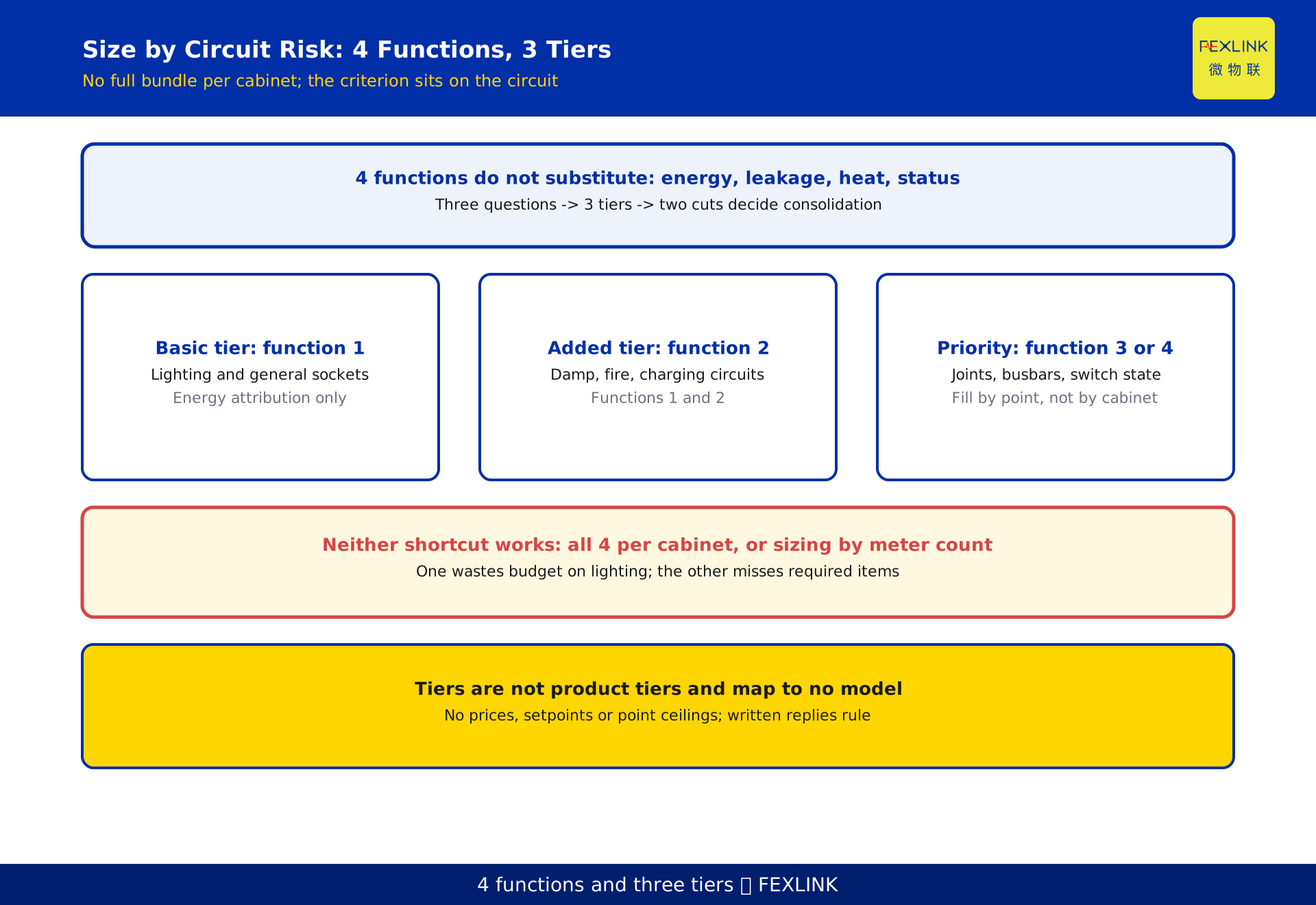
Do not buy a "full bundle" for every cabinet. Size the combination by circuit risk: one ledger row per circuit marks whether the concern is "energy not attributable" or "insulation, heating and status out of sight", set required functions from that, then decide which one device can consolidate. The 4 monitoring functions answer different questions and cannot replace each other. Full coverage everywhere pushes budget onto lighting circuits, while meters alone leave damp, fire-related and charging circuits unmonitored.
The FEXLINK multi-element measuring and control device, FEXLINK electrical fire monitoring device, FEXLINK temperature monitoring controller and FEXLINK status monitor often appear on the same list, yet they belong to different functions rather than interchangeable tiers. This article gives only grading criteria and a configuration table, with no fixed figures for prices, setpoints, limits or point-count ceilings. Ranges, channels, thresholds and installation conditions come from nameplates, selection manuals, site surveys and written manufacturer answers; company-disclosed naming and tiers are family references only, not acceptance evidence.
What the four monitoring functions each answer
The first is circuit-level energy metering: how much was used, when, and to which settlement object, not whether equipment is safe. The second is residual current and insulation monitoring: whether insulation is degrading or an abnormal leakage path exists, for damp, fire-related and charging circuits with heavier consequences; metering cannot yield that conclusion. The third is temperature sensing at critical nodes: whether joints, busbars and cable terminals are overheating, measuring points rather than an average cabinet temperature; high load current does not mean a healthy connection. The fourth is status: whether a breaker or auxiliary contact is closed or open, needing state rather than values.
The common confusion is treating temperature sensing as "add it where current is high" and status as "inferable from power curves". Heating occurs at connection points, not along a circuit; zero power may mean a stop or an upstream trip. Write the table column by column by function, not by ticking device names.
Risk, not cabinet size, decides the combination
Two rules fail: sizing by cabinet, where every circuit gets all 4 functions, and sizing by meter count, where fuller coverage follows more meters. Both treat device count as a proxy for what must be prevented; what decides the combination is the consequence of a circuit failing.
The criteria reduce to three questions: is data used for settlement or assessment, do environment or load amplify insulation and heating consequences, and would losing status visibility affect the response sequence? They point to metering, added safety functions and status capture; answers stack but cannot substitute for one another.
Circuits in one cabinet may differ by a tier, while similar circuits across cabinets often share one combination. Put the criterion on the circuit so the configuration can be reused.
A risk-tiered configuration table
The three answers give three tiers, placed circuit by circuit.
The basic tier covers metering only: ordinary lighting, general sockets and routine power circuits needing energy attribution, keeping only the first of the 4 functions. The added tier supplements metering with residual current: damp locations, fire-related and lithium charging circuits, where insulation degradation outweighs one more function, keeping the first and second; temperature sensing depends on identifiable connection points. The priority tier adds temperature or status: nodes dense with joints, busbars and cable terminals, and circuits whose switch state sets the response sequence, filling the third or fourth by actual point.
Three tiers are not product tiers and do not map to a model; one tier may use one device or several. Each row records circuit ID, tier, required and consolidatable functions, and written-confirmation ID. A row where consolidation still covers all required functions but lacks written support is treated as not consolidated.
Placing residual current and temperature sensing on priority circuits
Residual current monitoring is placed on the circuit, not the cabinet. Damp, fire-related and charging circuits share consequences amplified by environment and load, so the function sits on the measured circuit and shares its metering ID. On the main incoming feeder only an aggregate is visible and a single circuit's degradation is masked; it cannot be inferred from total-meter energy.
Temperature sensing is placed on points, not circuits. Watch joints, busbar laps and cable terminals, which may cluster in one cabinet or spread over several busbar sections; "add temperature sensing to a circuit" is not enough, write "which connection points, carried by which channel". Whether those points can be reached is a site-survey finding, not a configuration-table assumption.
Do not fix setpoints for either. Thresholds, temperature-rise criteria and action definitions vary by site category, regulations and device manuals; this article covers only whether to fit and where. If an item cannot be fitted yet, note the reason and review date instead of deleting a required function.
Status signals and digital input modules
Status answers only closed, open and whether an action occurred; it is the one of the 4 functions with no numeric dimension. It tells the platform, during an incident, which path is already open and which is still live, avoiding a stop being read as a lost link or a trip as zero load.
Status therefore uses digital input acquisition. A FEXLINK status monitor is a role placeholder here; whether auxiliary contacts can be brought out, how normally-open and normally-closed are taken, and who keeps change logs must be checked point by point and confirmed in writing. Do not fold status into the metering point list when counting capacity; the record shapes differ.
Only on circuits whose switch state sets the response sequence is the fourth function required. Ordinary lighting and general socket circuits need not add it to look complete; whether it is required returns to the three questions.
How one multi-element device saves points
A multi-element device collects several required functions of one circuit with a single unit; the FEXLINK multi-element measuring and control device is that role. It saves device count, cabinet space, wiring and duplicated point IDs, not the required functions.
The precondition is checking coverage item by item: which functions the model offers, channels per function, whether ranges and interfaces suit the circuit, and whether residual-current and temperature take-points both land on the monitored object. If any item cannot be confirmed, treat it as uncovered and return it to a separate device; never assume all 4 functions from one multi-element claim. Coverage is settled by selection manuals and written answers.
Also see what cannot be saved: required functions of different circuits cannot stand in for each other because they share one device, and points across cabinets cannot be forced together. Consolidation holds only within one circuit, one take-point condition and one written-confirmation ID; the ledger records the carrying device.
Two cuts in selection: required functions first, then consolidation
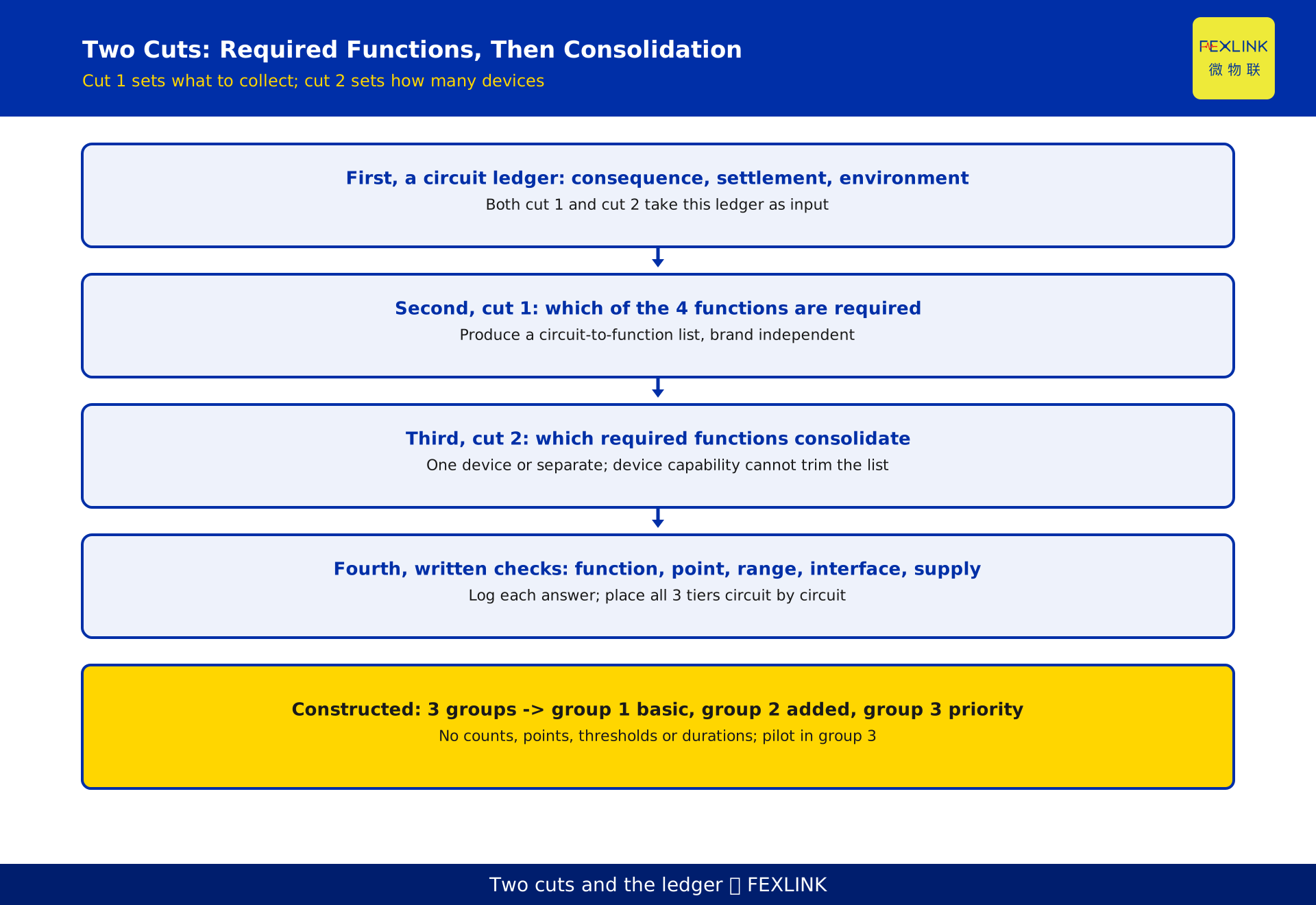
Once the ledger exists, selection reduces to two cuts, with no need to compare parameters model by model.
Cut 1 fixes required functions: for each circuit, write which of the 4 functions are required, judged by consequence rather than position or meter count, producing a list. This cut decides what to collect, independent of brand, model and tier. Choosing equipment before the list exists orders against the most optimistic assumption, and commissioning then reveals a function with no channel.
Cut 2 fixes consolidation: see which required functions in one circuit or cabinet qualify, then decide whether one multi-element device carries them or they stay separate. This cut decides how many devices; its input must be the Cut 1 list, and device capability must not trim required functions.
After both cuts, the FEXLINK electrical fire monitoring device, temperature monitoring controller and status monitor correspond to residual current, temperature and status roles as company-disclosed family placements; the Electrical hazard early-warning system receives normalized circuit data and does not fill in uncaptured functions. Before ordering, turn both conclusions into written check items: function, take-point position, channel range, interface and supply, each with a written answer in the ledger.
Worked example: configuring a park's distribution cabinets
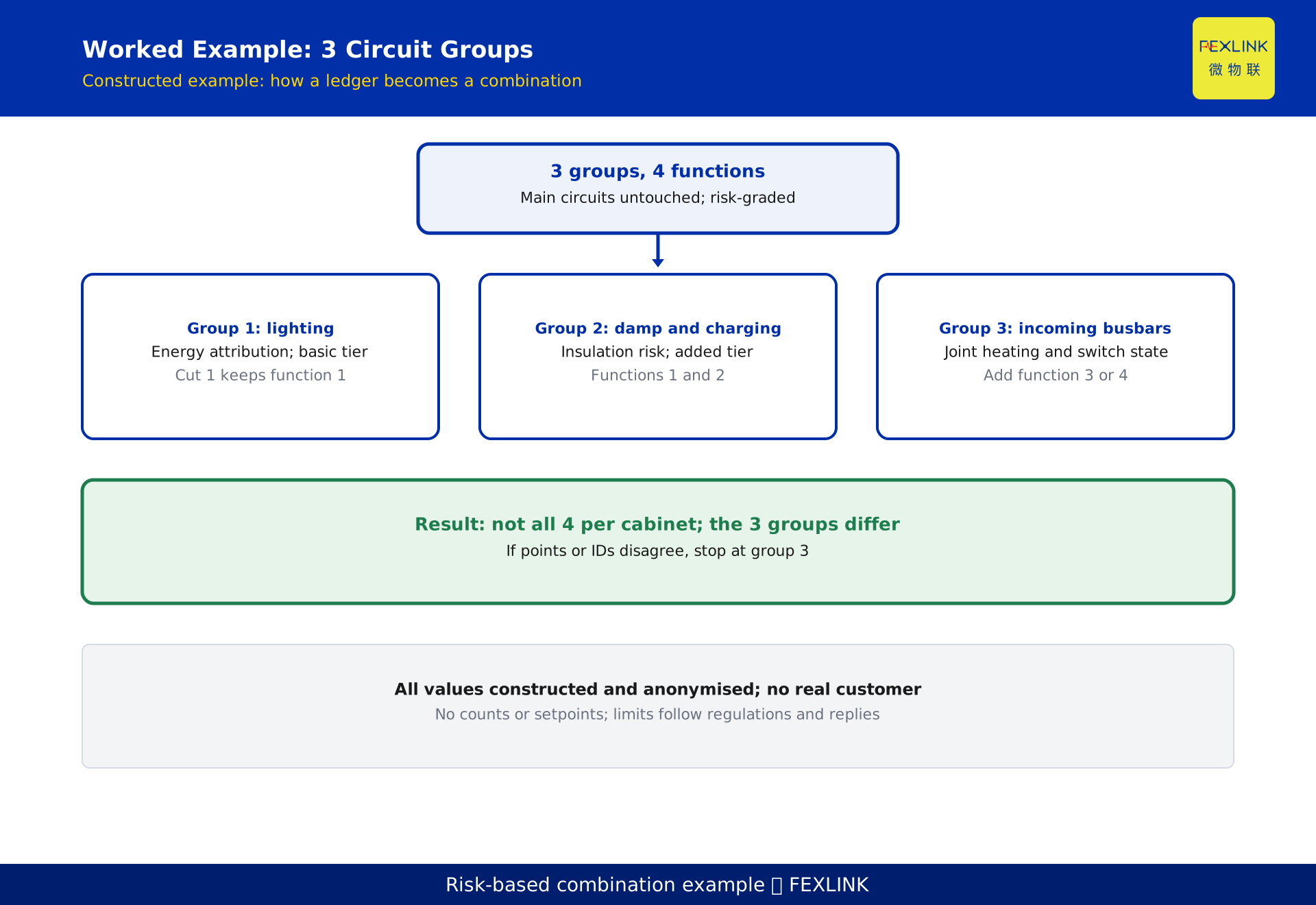
A park is retrofitting a batch of distribution cabinets, leaving main circuits untouched and fitting monitoring by risk. This is a desensitized constructed example, not a real project or quotation.
The ledger splits circuits into 3 groups by consequence. Group 1, ordinary lighting and general sockets, needs energy attribution only and takes the basic tier. Group 2, damp areas and charging circuits, has heavier insulation-degradation consequences and takes the added tier. Group 3, an incoming cabinet dense with busbar laps and cable terminals, needs connection-point heating and switch state, taking the priority tier. After both cuts, Group 1 keeps metering, Group 2 adds residual current, Group 3 adds temperature and status; items consolidated within one cabinet are carried by one device.
The conclusion is not that every cabinet gets all 4 functions, but that the 3 groups differ, with functions only on circuits judged to require them. Pilot first in Group 3 to verify take-point positions, ID alignment and status changes; if any fails, stop there. The example only shows how a ledger becomes a combination, giving no figures for unit counts, points, thresholds or schedule.
Where the savings stop, and the configuration ledger
State the boundary of savings: duplicate devices, redundant points, cabinet space, supply wiring and the alignment cost of two numbering systems are saved, not the required functions, and not a downgraded priority tier. Spreading all 4 functions across lighting circuits adds channels and points that change neither the metering conclusion nor the consequence grade. Conversely, cutting residual current from a damp circuit removes a required function and leaves a safety blind spot. Whether it costs more depends on risk distribution, not on function count.
Each ledger row keeps four columns: circuit ID and location, risk tier and criterion, required and consolidatable functions among the 4, and carrying device plus written-confirmation ID; attach take-point positions, survey findings and commissioning records. Update by appending rather than overwriting, so it remains the basis for expansion and troubleshooting.
Acceptance often checks only whether data appears, while the risk is whether it comes from that circuit's function. Compare cumulative readings with local displays, residual current with the measured circuit ID, temperature with the surveyed point, and status changes with actual states, marking a row connectable only when they match. Written answers, survey records and commissioning acceptance are the review evidence.
Frequently Asked Questions (FAQ)
Q: The cabinet already has meters, so must leakage and temperature sensing be added everywhere?
Not necessarily. Apply the three consequence questions first: ordinary lighting and general socket circuits usually keep metering only, damp, fire-related and charging circuits make residual current required, and temperature sensing depends on identifiable connection points. Justification is the function being required, not spare space.
Q: A multi-element device replaces several units, so should every circuit use one?
No. It saves devices and points for required functions consolidated within one circuit, subject to coverage checks. The basic tier has only metering as a required function and nothing to consolidate, so a multi-element device saves nothing; points across cabinets should not be forced onto one unit either.
Q: Would adding residual current monitoring to ordinary lighting circuits be safer?
It does not change that circuit's risk criterion, yet adds channels, points and checking effort. Safety comes from fitting the function on circuits with heavier consequences and aligning it with the circuit ID, not from covering the whole cabinet. If a lighting circuit's consequences grow, re-grade it.
Q: Where should temperature sensors go, by cabinet or by joint?
On identifiable connection points: joints, busbar laps and cable terminals, written as which points carried by which channel, not as a circuit-level note. Whether those points can be reached is a site-survey finding; thresholds and temperature-rise criteria are confirmed in writing.
Q: Can status be derived from metering data?
No. Zero power may mean either a stop or an upstream trip, and the platform cannot tell them apart from a metering curve. Status uses digital input acquisition, is required only where switch state sets the response sequence, and should not be folded into the metering point list.
Scope and limitations
This article is a combination-selection method for fitting monitoring functions by risk on low-voltage distribution circuits, for campus, building and cabinet retrofit preparation. It does not replace engineering design, current standards, site surveys or selection manuals. The 4 functions, three tiers, two cuts and the configuration ledger are company-disclosed family and method summaries, not commitments about any model's coverage, channel count, range, threshold, accuracy or outcome. No fixed figures are given for prices, quotations, alarm setpoints, temperature limits, residual current settings, point-count ceilings or sampling intervals; no standard clause numbers or fixed error limits are cited, and any limit follows the current effective version, nameplates, selection manuals, site surveys and written manufacturer answers. This article does not cover multi-parameter correlation criteria, bus-mounted networking, single-meter parsing workflows or unified data-platform architecture; those have separate articles. The worked example is desensitized and constructed, not a real customer or project. All deliverables remain DRAFT_PENDING_REVIEW and require independent review; the generator does not self-approve.
Frequently Asked Questions
Should You Bundle Metering, Leakage
Do not buy a "full bundle" for every cabinet