 FEXLINK Research Institute
The short answer
When meters on a site come from several manufacturers and each speaks its own protocol, you do not need to write a bespoke integration for every brand. The workable approach is to place a protocol-conversion gateway at the edge that translates each brand's protocol into a standard Modbus/TCP or MQTT uplink, then let a multi-protocol access layer on the platform side build a unified model — a unified point model. Adding a new brand then means loading one protocol driver and filling one point-mapping table, with no change to the analytics applications above. The whole point is to trap the "protocol difference" at the edge rather than let it seep into the platform and the business systems.
1. First see the problem: where the fragmentation actually lives
On a mixed-brand meter site the pain is not "can't read the data" but "every brand reads a different way". Take active power inside one meter: manufacturer A exposes it at address 0x0201 under DL/T 645, manufacturer B at Modbus holding register 40001, manufacturer C under IEC 62056 OBIS code 1.0.1.7.0.255. The physical quantity is identical, yet the point address, data format, byte order and baud rate are all different.
The result: every time you onboard a brand, the platform needs a fresh parser, a fresh storage schema and a fresh screen. A site with 5 brands and 300 meters spanning 4 communication protocols — DL/T 645, Modbus, IEC 62056 and CJ/T 188 — ends up with 5 parallel logic stacks on the platform. Add one more brand and you rewrite the stack; a firmware update from one vendor that changes a telegram forces all 5 stacks back to rework. Maintenance cost does not grow linearly — it compounds.
2. How the unified data backbone is layered
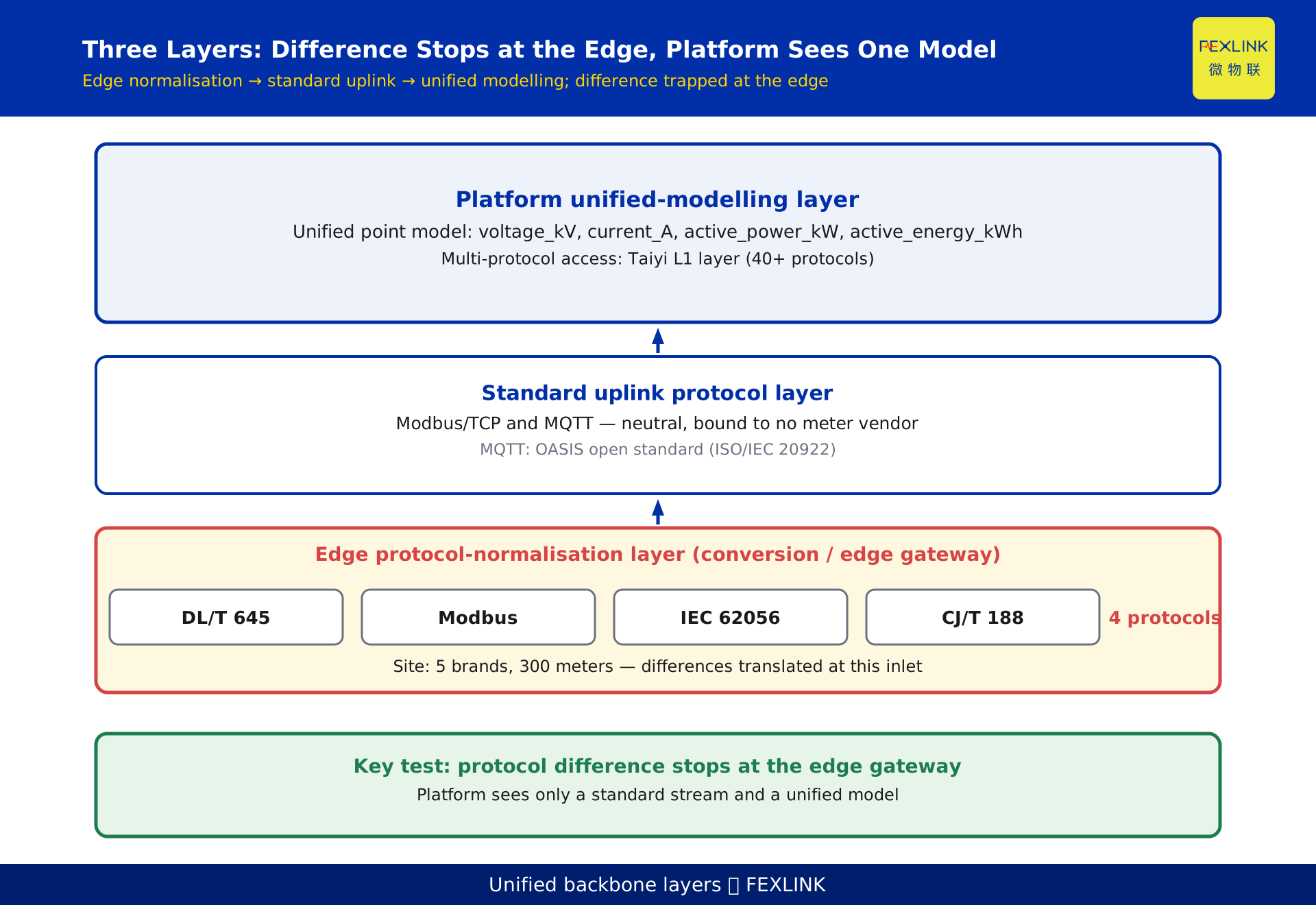
To peel the protocol difference away from the platform you use three layers.
Edge protocol-normalisation layer. A protocol-conversion gateway (or an edge gateway) sits close to the meters, collects against each vendor's private protocol, and translates different telegrams into internally unified physical quantities. This layer is where the differences converge.
Standard uplink protocol layer. Above the gateway, no private formats travel any more — everything goes over Modbus/TCP or MQTT. MQTT is an open standard messaging protocol published by OASIS (ISO/IEC 20922) whose publish/subscribe model is lightweight and well suited to edge-to-platform uplink; Modbus/TCP is a long-standing de-facto standard in industry. Both are "neutral" protocols; the platform is bound to no meter vendor.
Platform unified-modelling layer. A multi-protocol access layer on the platform maps the incoming stream onto a unified point model — voltage, current, active power and active energy carry unified names and units (kV, A, kW, kWh), and the platform no longer cares which vendor's telegram they came from.
The boundary is the crux: protocol difference stops at the edge gateway, and the platform sees only a standard stream and a unified model.
3. What the protocol gateway actually translates at the edge
A protocol-conversion gateway is not a dumb "pass-through"; at the edge it does four jobs.
Protocol recognition and telegram parsing. Per the vendor protocol it breaks binary or text telegrams into fields, handling address offsets, data formats (BCD, IEEE754 float, integer) and byte order (big-endian or little-endian).
Unit and dimension consolidation. It normalises the differing units and scaling factors that vendors apply to "the same energy" — for example converting a 0.01 kWh minimum resolution uniformly into kWh.
Time alignment. It stamps every reading with a time tag and harmonises the sampling cadence, avoiding the time skew caused by brands reporting on different periods.
Exception fallback. On communication timeout, checksum error or out-of-range value it flags per a unified rule, rather than pouring dirty data into the platform as-is.
In product terms, edge devices such as the FG-0221-ER protocol-conversion gateway, the ESX edge gateway and the CW gateway turn those four jobs into configurable capability: what meter to connect and which protocol to use is set as a driver on the gateway side, not coded on the platform side.
4. How to design the unified point model
The unified point model solves the "same name, different meaning; same meaning, different name" problem. Three principles guide the design.
Centre on the physical quantity, not the vendor. The model's first-class citizen is "active power of a certain circuit", not "a certain register of a certain vendor". Vendor differences are pushed down into a mapping table and never enter the model body.
Unified names and units. Agree on a fixed field set — voltage_kV, current_A, active_power_kW, active_energy_kWh, power_factor and so on — with fixed units. Downstream applications read by this field set and never need to know who is upstream.
Separate the mapping table from the model. The correspondence from each vendor's points to the unified fields lives in an independent mapping table (driver configuration). Adding a brand equals adding one mapping table — the model and the applications stay untouched.
Done this way, "energy" inside the platform has exactly one meaning and one unit, so analysis, billing and benchmarking stay natively consistent instead of producing "two energies" after a vendor change.
5. Why the cost of onboarding a new brand falls
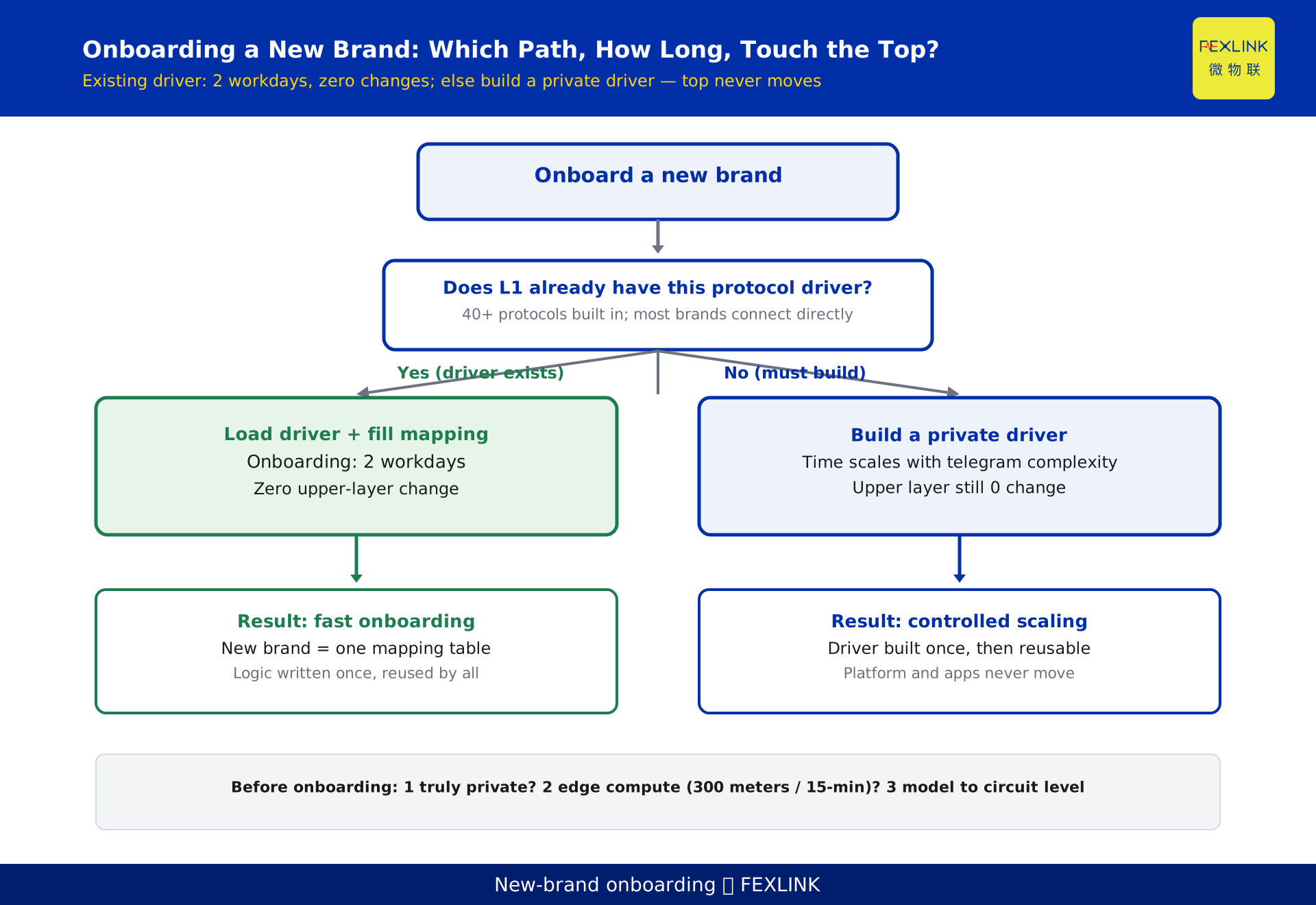
Once the difference is trapped at the edge, the cost structure changes. The platform no longer writes a parser per brand; onboarding a new brand collapses into two steps — load (or build) one protocol driver at the edge gateway, then fill one point-mapping table. Analytics, dashboards, alarms and billing all reuse the existing unified model, and the code-change amount is zero.
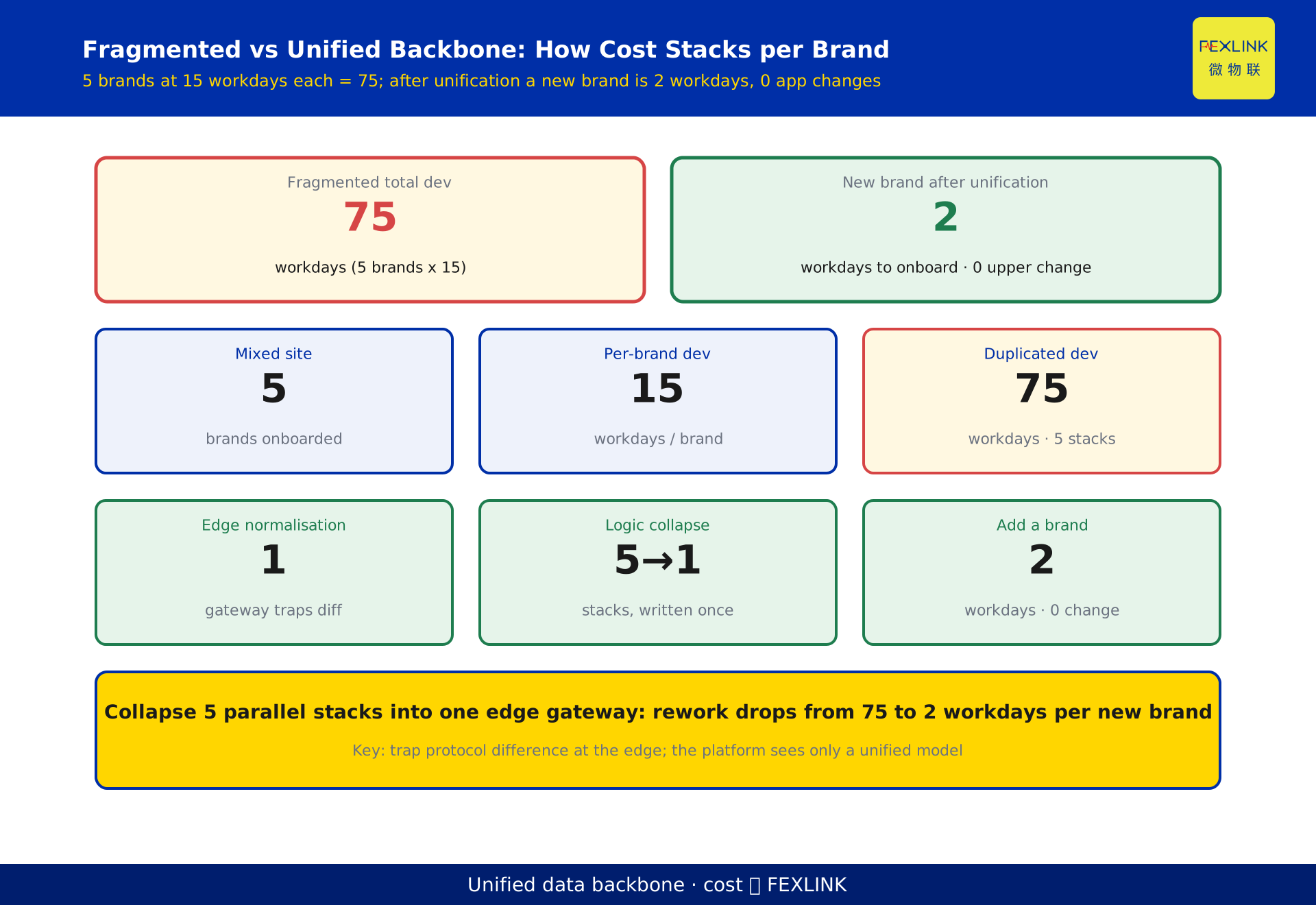
Consider a campus (the following is a constructed scenario, not a real customer): on site there are 5 brands and 300 meters; before the retrofit each brand's independent development averaged 15 workdays, so 5 brands accumulated roughly 75 workdays of duplicated work. After building the unified data backbone, adding a 6th brand drops to 2 workdays, with zero change to the platform's upper-layer applications. The drop comes from "pushing the difference to the edge, writing the logic only once".
6. A worked scenario (constructed): 5 brands, 300 meters
The figures below are constructed to illustrate the architecture and represent no real project or customer.
A campus power-distribution and energy-monitoring site mixes 300 smart meters from 5 brands across 4 protocol families — DL/T 645, Modbus, IEC 62056 and CJ/T 188. Before the retrofit the platform maintained a separate collection, parsing and storage logic for each brand; averaging 15 workdays of development per brand, the 5 parallel stacks added up to roughly 75 workdays of effort, and any single vendor's firmware change triggered rework across all stacks.
After adopting edge protocol-normalisation plus platform unified modelling: an FG-0221-ER protocol-conversion gateway and an ESX edge gateway are deployed near the meters, translating the 4 protocol families uniformly into an MQTT uplink; on the platform side the Taiyi central-control system L1 access layer (already supporting 40+ protocols) performs unified point modelling. When a 6th brand is added on site, only one protocol driver is added at the edge and one mapping table filled in; onboarding takes 2 workdays with zero code change on the platform's upper layer.
7. Three judgements when landing the project
Judgement one: is the protocol truly "private"? Meters that can speak standard Modbus/TCP or IEC 62056 should go straight onto the standard protocol, with the gateway doing only light adaptation; only genuinely private, non-standard telegrams need a dedicated driver. Do not write a driver for every meter by default, and do not expect one driver to swallow every vendor.
Judgement two: is there enough edge compute? Protocol normalisation happens at the edge, so the gateway must sustain concurrent collection and parsing. 300 meters with a sampling interval of 15 minutes or finer is a medium scale, within reach of a single gateway or a gateway cluster; beyond that, assess the gateway's processing and uplink bandwidth.
Judgement three: at what grain should the model sit? The unified point model is best pushed down to "circuit level" — one unified point per incoming feeder of each major energy-using device. Too coarse (only the main meter) cannot locate problems; too fine (down to the socket) only grows the maintenance surface.
8. Where the products fit
On the edge, the FG-0221-ER protocol-conversion gateway carries the protocol normalisation: it parses each brand's private telegram and consolidates units, then uplinks uniformly over MQTT; where more edge compute is needed, the ESX edge gateway or the CW gateway takes over collection, buffering and forwarding.
On the platform side, the "Taiyi central-control system L1 access layer" already has built-in support for 40+ protocols; it maps the incoming standard stream onto the unified point model and hands it to the upper-layer "data production system" for cleansing, storage and external service. Upper-layer applications (dashboards, alarms, energy-carbon accounting) recognise only the unified model, never the brand.
9. Common traps
Trap one: treating the gateway as a pass-through. Doing only protocol forwarding at the edge without consolidating units and byte order lets dirty differences flow straight into the platform, leaving the unified model hollow. Consolidation must finish at the edge.
Trap two: scattering mapping tables inside code. Hard-coding point mappings into application code means onboarding a brand requires digging through several codebases. Mappings must be externalised as driver configuration so that "adding a brand adds no code".
Trap three: normalising but not validating. After unification, skipping data-quality checks (out-of-range, jumps, missing points) lets errors get "legalised" inside the unified model. The edge gateway should keep its anomaly-flagging ability, and the platform side needs a quality gate too.
10. FAQ
Q: How does a unified data backbone differ from collecting straight to the cloud?
The difference is which layer digests the difference. Collecting straight to the cloud ships each brand's private telegram up unchanged and parses it separately there, so the platform stays fragmented. The unified backbone normalises the difference at the edge, and the platform faces only a standard stream and a unified model — which makes later expansion cheaper.
Q: Can old meters with no standard protocol enter the unified backbone?
Yes. As long as the vendor can supply a communication description or private-protocol document, a corresponding driver can be developed at the edge gateway to normalise it. A genuinely non-communicating legacy meter can be treated as an "offline meter" with manual entry or phased replacement, which does not block building the unified model.
Q: After unified modelling, can the vendor's original configuration tools still be used?
Yes. The unified model lives on the platform side, while the vendor's configuration and commissioning tools live on the device side; the two do not conflict. After the edge gateway finishes normalisation, the device's own operations and maintenance can still use the original vendor tools — the platform simply no longer depends on them.
Q: Roughly how long does adding a new brand take?
It depends on whether a ready protocol driver exists. In this article's constructed scenario, once the unified backbone exists, adding a 6th brand takes about 2 workdays (load driver plus fill mapping table). If a private driver must be written from scratch, time grows with telegram complexity, but the platform's upper layer always stays unchanged.
Q: Will the unified point model get "locked in" by any one meter vendor?
No — avoiding lock-in is precisely why the model is built this way. The model centres on physical quantities and externalises mapping tables, so changing brand means changing only the mapping table while the platform and applications stay put. What must truly be avoided is writing a vendor's private fields directly into the model body.
Scope and limitations
- The "unified data backbone" discussed here applies to sites where meters from multiple brands and protocols are mixed, with the goal of trapping protocol difference at the edge and unified modelling on the platform. Single-brand or already-unified sites gain little and need not force the pattern.
- DL/T 645, Modbus, IEC 62056/COSEM and CJ/T 188 are industry-common protocols; MQTT is an open standard published by OASIS (ISO/IEC 20922). Specific versions and fields follow each vendor's documentation and the current standards.
- "The Taiyi central-control system L1 access layer supports 40+ protocols" is a product-capability disclosure offered as a reference for architectural feasibility, not a selection commitment; the actually supported protocol list follows the product manual.
- In the worked scenario, the 5 brands, 300 meters, 4 protocol families, 15 workdays per brand, 75 cumulative workdays and 2 workdays for a new brand are all constructed to illustrate the architecture and represent no real customer or project; actual onboarding effort requires site survey and protocol-document review.
- The specific interfaces, compute and load capacity of the FG-0221-ER protocol-conversion gateway, the ESX edge gateway and the CW gateway follow the latest selection manual and product knowledge base; this article is not a procurement recommendation.
- A sampling interval of 15 minutes or finer is a general recommendation; the actual sampling frequency should follow the monitored object and analysis needs, and is not a fixed rule.
Frequently Asked Questions
Mixed-Brand Meter Sites
When meters on a site come from several manufacturers and each speaks its own protocol, you do not need to write a bespoke integration for every brand