 FEXLINK Research Institute
The short answer
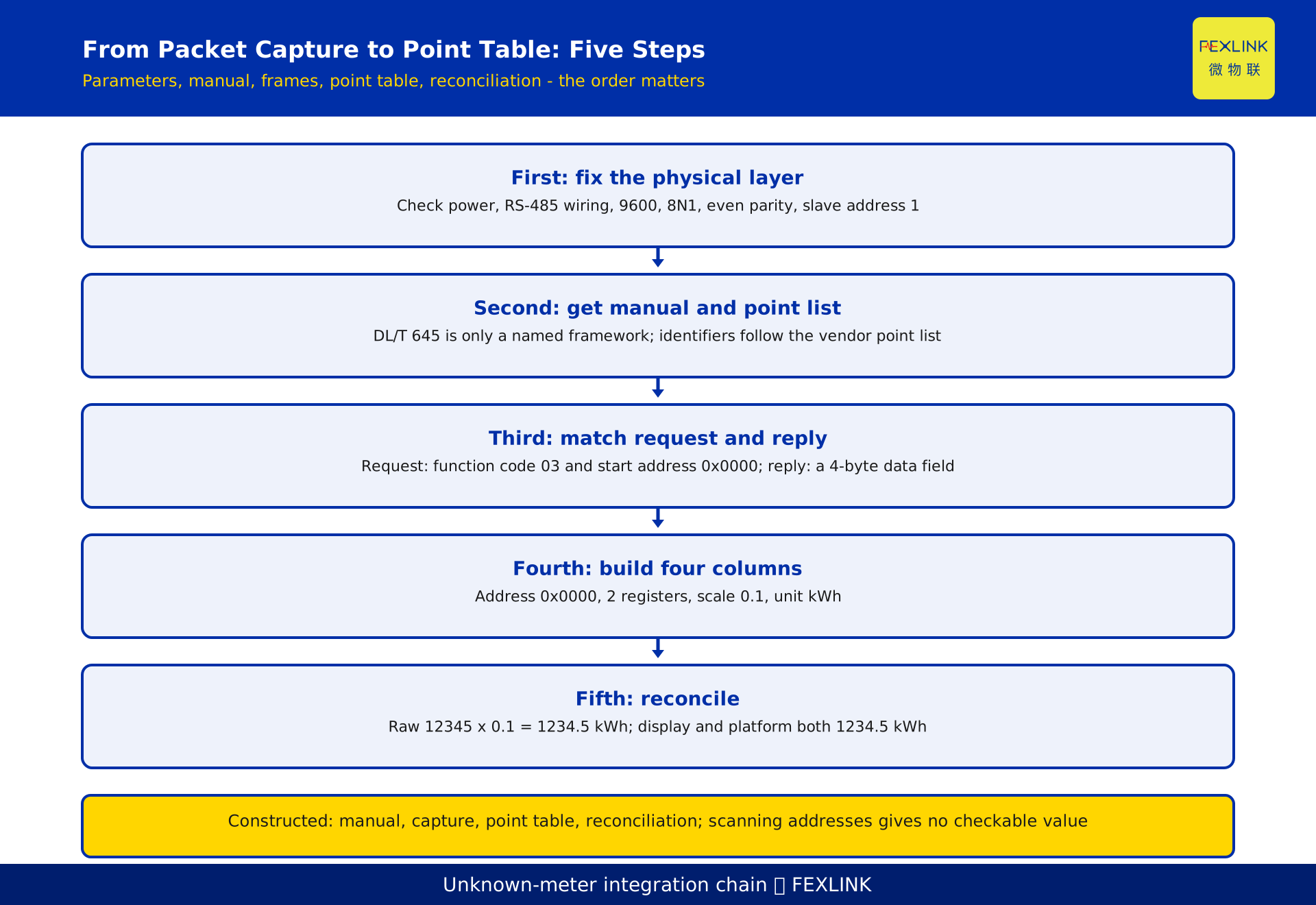
Reading an unfamiliar electricity meter into a platform is not a matter of guessing register addresses. It is a standard workflow: fix the physical layer and serial parameters, obtain that meter's communication protocol manual and point list, capture traffic and compare request with reply, write address, quantity, scale and unit into a point table, and finally reconcile the platform value against the meter display. What decides success is holding the vendor manual, which says where each quantity sits, in which byte order, and by what scale it is multiplied. A blind scan may return a number, yet nothing proves it is the right quantity.
1. Fix three things first: power, wiring, serial parameters
When an unknown meter refuses to answer, the physical layer is usually misaligned. Bring three things to a recordable state first.
Power and interface. Confirm from the nameplate whether the port needs external power and whether it is RS-485, optical or Ethernet. On a bus also check termination and polarity: swapping A and B is a common fault.
Wiring and topology. Daisy-chain the bus, avoid star branches, ground the shield at one point, and keep every address unique.
Serial parameters. Slave address, baud rate, data bits, parity and stop bits must match the meter settings. The constructed example uses slave address 1, 9600, 8N1 and even parity; real values follow the meter settings and vendor manual. Wrong parameters usually produce no reply, so clear this layer first.
2. Get the manual before trial reads: protocol and point list are the entry point
The registry names DL/T 645 as the related standard, a common framework for meter communication in China. A standard name only says which protocol family the device speaks; it cannot replace the protocol manual and point list for the specific meter. Data identifiers and register layouts differ between brands, and extensions are vendor-defined.
The proper entry point is two documents: the communication protocol manual (frame structure, address field, function or control code, checksum, data-identifier encoding) and the point list (address, data type, scale, unit, byte order for each quantity). With both, parsing is table lookup; without them, trial reads become brute force. One rule: if a supplier cannot supply them, register an integration risk instead of scanning blindly. DL/T 645 is cited only as a named framework, with no version year, no clause numbers and no data-identifier table.
3. Capture the master-slave exchange: matching request and reply frames
These protocols are mostly master-slave half duplex: one request frame, one reply frame, nothing pushed spontaneously. Capturing traffic means recording that exchange field by field.
On the request side check the slave address, the class of function or control code, and the start address and length. On the reply side check that the same meter answers, the function code corresponds, and data-field length and checksum are self-consistent. Only then is the exchange valid.
Constructed example: the master sends a read-holding-register class command (example function code 03) to slave address 1, reading 2 registers from start address 0x0000, and the reply returns a 4-byte data field. 03, 0x0000, 2 and 4 are constructed; real frame structure and checksum follow that meter's manual. If the reply carries an exception marker, look up its meaning. Capture splits "cannot read" into three cases: never sent, no reply, or a mismatched reply.
4. Four columns of a point table: address, quantity, scale, unit
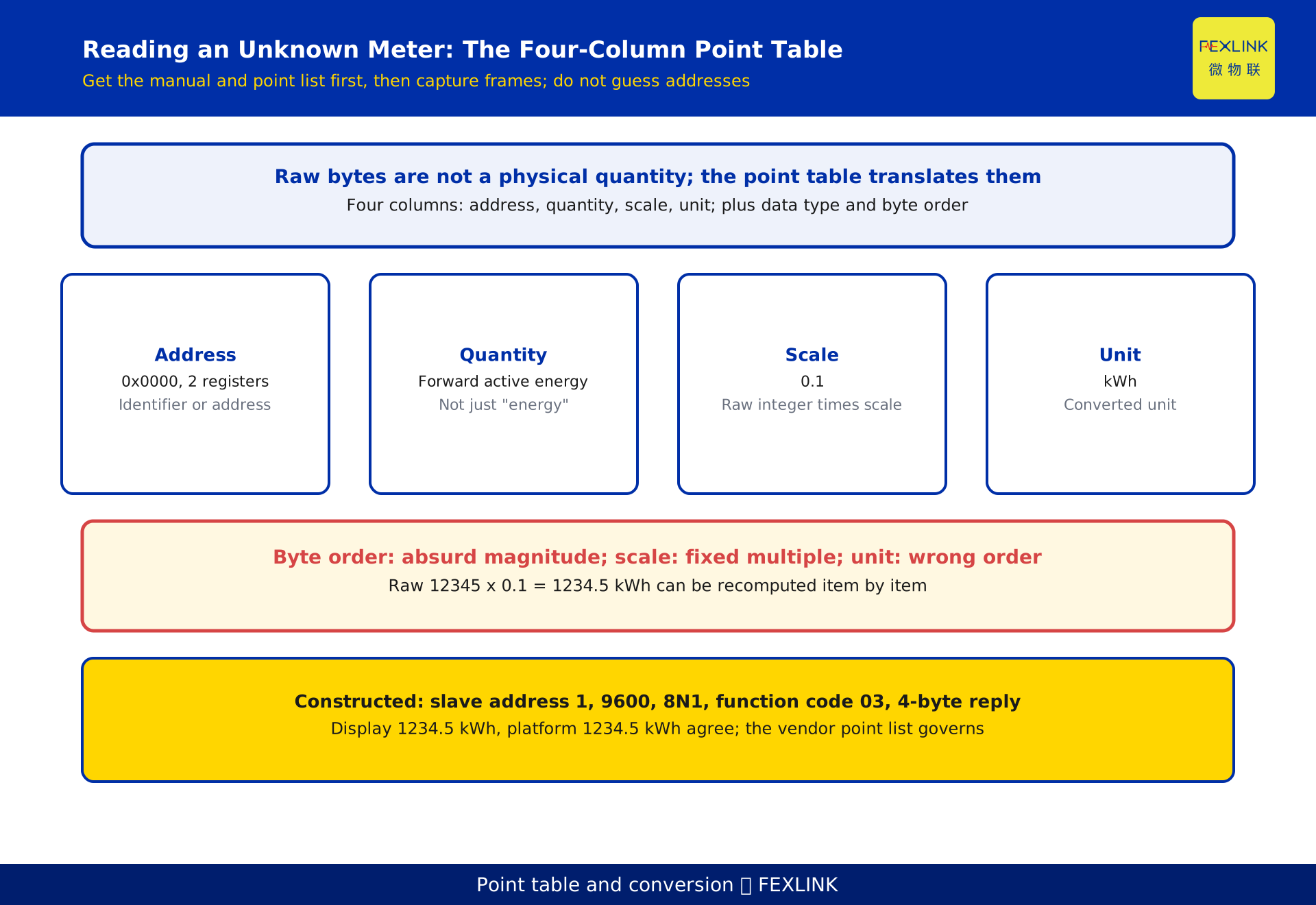
A point table translates raw bytes into a named quantity and needs at least four columns.
Address: data identifier or register start address plus the register count; multi-byte quantities must state whether they span consecutive registers. Quantity: what the value actually is - forward active total energy, voltage, current, power - not a vague word like "energy". Scale: the raw integer times the scale is the engineering value; record the sign and decimal-place rule too. Unit: kWh, V, A, kW and so on, with whether it applies after scaling.
Add two columns: data type and byte order. The same bytes read high-byte-first or low-byte-first can differ by orders of magnitude; this is the most common point-table error and the one most easily mistaken for a broken meter. The constructed example maps 2 registers at 0x0000 to forward active total energy, unsigned integer, scale 0.1, unit kWh. A point table must be printable and reusable, not buried as constants in a debug script.
5. Engineering-value conversion and byte order
The platform needs an engineering value: raw bytes assembled into an integer per byte order, multiplied by the scale, then stored with its unit. Each step can introduce a distinctive deviation.
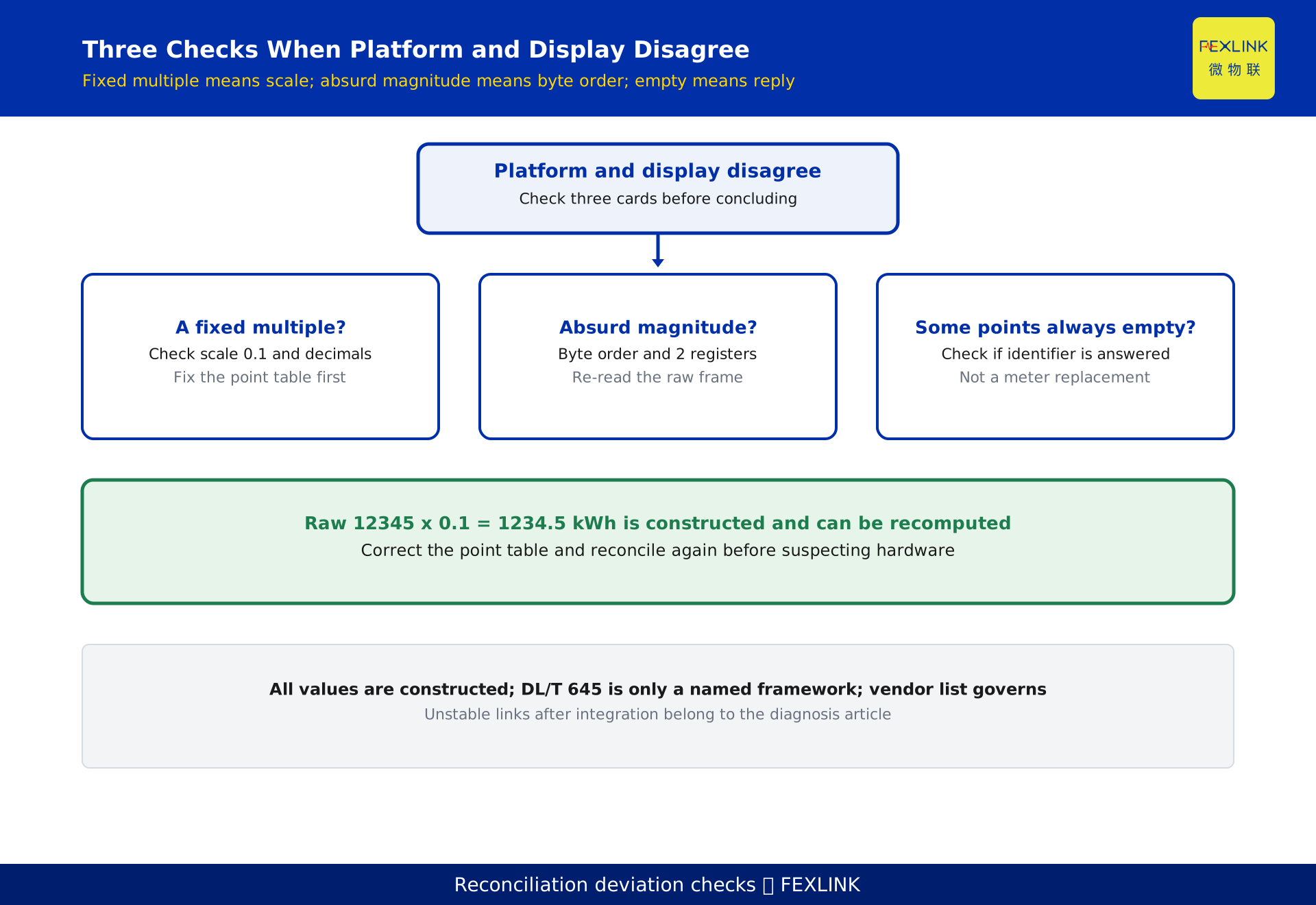
Wrong byte order gives an absurdly large or near-zero number; a wrong scale gives a stable fixed multiple; a wrong unit leaves the number right but the magnitude incompatible with billing; reading a signed value as unsigned turns a negative into a large positive. All are recomputable systematic deviations, so commissioning needs no guesswork.
Constructed example: the reply data field assembles into raw value 12345, the point-list scale is 0.1, so the engineering value is 12345 x 0.1 = 1234.5 kWh, recomputable term by term. If the platform magnitude is clearly too large or too small, check scale and decimal places rather than replacing the meter. Keep four traceable items: raw frame in hexadecimal, assembled integer, scale used, final engineering value.
6. Commissioning reconciliation: platform value against meter display
A finished point table does not prove the integration is correct. Close with a consistency check: at the same instant read the display cumulative value and the platform value, point by point. The constructed example takes a display reading of 1234.5 kWh and a platform reading of 1234.5 kWh; a match passes that point.
Check three layers: is a single point right (value and unit), are all points present (voltage, current and power), is the trend sane (read again after one interval). One point alone misses cases like energy matching while the power sign is inverted.
One decision rule: a fixed multiple points to the scale; an order-of-magnitude gap points to byte order; points never returning a value mean going back to the captured frame; if every point is intermittent, this is a stability diagnosis covered elsewhere. Record time, both readings and point-table version.
7. Worked example: from unknown meter to a platform value
The following is constructed and represents no real customer or project.
A campus retrofit adds an unfamiliar three-phase meter to an existing energy platform. Step one: confirm the RS-485 interface and power, daisy-chain onto the bus, set slave address 1, and use 9600, 8N1 and even parity (constructed example values). Step two: obtain the protocol manual and point list, confirm the exchange under the DL/T 645 protocol family. Step three: capture traffic - request and reply appear in pairs, with address, function code, length and checksum aligned. Step four: build the four columns - 2 registers from address 0x0000, quantity forward active total energy, scale 0.1, unit kWh - plus data type and byte order. Step five: reconciliation - display 1234.5 kWh and platform 1234.5 kWh agree; raw value 12345 converts through 12345 x 0.1 = 1234.5.
The point is the order, not the address: manual, capture, point table, reconciliation. Even if 12345 appears, nothing proves it is forward active total energy.
8. Where the hardware sits: the gateway in the chain
In hardware, the gateway turns protocol exchanges into engineering values the platform can store. The FG-0221-ER protocol conversion gateway sits at the conversion link: it issues requests from the point-table configuration, parses replies, applies scale and unit conversion, and sends standardised data upstream. The ESX-0223-GR edge gateway handles parallel connection of many meters and edge buffering. The L1 access layer of the Taiyi intelligent control hub (40+ protocol parsing) carries unified multi-protocol access and point-table management.
The boundary matters: a gateway only reads, converts and forwards data per the manual. It does not change the meter's metrological accuracy, nor does it fill in a missing vendor point list. Enter address, data type, byte order, scale and unit point by point, trial-read one point before enabling the batch; model numbers and customisable options follow the latest product knowledge base and selection manual. This is not a selection or procurement recommendation.
9. Boundary with the stability-diagnosis article
This article covers getting a new meter from zero to one: fixing the physical layer and protocol, capturing traffic, building the point table and reconciling values. Its increment is replacing lucky address guessing with a checkable parsing chain. The stability-diagnosis article covers a meter already integrated but intermittent.
The line is sharp: this article handles "never read a value", the diagnosis article handles "read values, but unreliably". If all points turn intermittent, hand over rather than keep editing the point table - a wrong table does not work one moment and fail the next.
FAQ
Q: Without the vendor manual and point list, can I scan addresses to read the meter?
Not advisable, and correctness cannot be guaranteed. A scan may find an address that answers, but which quantity those bytes represent, their byte order, scale and unit cannot be judged without the manual; recording voltage as energy is more dangerous than reading nothing. Register "supplier has not provided a point list" as an integration risk and push to close it. All example frames and addresses here are constructed, not a generic point table.
Q: Serial parameters are all correct, so why is there no reply at all?
Exclude in three layers. Physical: are A and B swapped, is termination and shield grounding right, is the bus a star branch. Addressing: does the slave address match the meter settings, is there a duplicate on the bus. Command: do the request function code, start address and checksum follow the protocol. If capture shows only master requests and no slave reply, the fault is almost always in the first two layers. Do not keep editing the point table before the physical layer is confirmed.
Q: Is DL/T 645 the same thing as a fixed point table?
No. DL/T 645 is an industry standard framework defining general rules such as frame structure and data identifiers. Which identifier holds a quantity, its scale and its byte order still follow the vendor protocol manual and point list for that model. This article cites the standard only as a named framework, with no version year, no clause numbers and no data-identifier table.
Q: Platform and display differ by a fixed multiple - is the meter broken?
Usually not. A fixed multiple almost always points to scale, decimal places or unit conversion in the point table, while byte-order errors show an absurd magnitude. Revisit section 5 and recompute the four items: raw frame in hexadecimal, assembled integer, scale used and final engineering value. The constructed example 12345 x 0.1 = 1234.5 kWh is exactly that checkable relation. Correct the point table and reconcile again before suspecting hardware.
Q: Once the point table passes one reconciliation, is there nothing left to worry about?
No. Meter firmware upgrades, model changes, scale adjustments or point-table version changes can invalidate a correct mapping. Keep the point table under version control, and for every change retain three records: the four columns before and after, the trial-read raw frame, and the reconciliation result. Rerun reconciliation after any firmware or model change. The three-layer check in section 6 should be a fixed routine.
Scope and limitations
- This article covers first-time integration of an unfamiliar meter, applying to master-slave exchanges that read by data identifier or register address. Diagnosis of an unstable link, meter selection and parameter interpretation are outside its scope.
- The values "slave address 1", "9600, 8N1, even parity", "example function code 03", "2 registers from start address 0x0000", "4-byte reply", "raw value 12345", "scale 0.1", "12345 x 0.1 = 1234.5 kWh", and "display 1234.5 kWh, platform 1234.5 kWh" are constructed examples. They represent no real customer or project and are not a generic point table; actual values follow the meter nameplate, vendor protocol manual and point list.
- The registry lists DL/T 645 as the related standard, cited only as a named framework. No version year, no clause numbers, no data-identifier table, no invented frame values and no default communication rate appear. The coefficient fact base has no match for this article's keywords, so no coefficient is introduced from it.
- The functional roles attributed to the FG-0221-ER protocol conversion gateway, the ESX-0223-GR edge gateway and the L1 access layer of the Taiyi intelligent control hub (40+ protocol parsing) follow the latest product knowledge base and selection manual. Supported protocol range and interface counts are customisable options; this is not a selection or procurement recommendation.
- The boundary with the stability-diagnosis article is in section 9: this article handles "never read a value", that article handles "read values, but unreliably".
- All constructed examples are labelled. Other workflow descriptions derive from public general references on master-slave communication, frame checks and engineering-value conversion, and from vendor disclosures about the gateway products. Every deliverable remains DRAFT_PENDING_REVIEW and requires independent review; the generator does not self-approve.
Frequently Asked Questions
Without the vendor manual and point list, can I scan addresses to read the meter?
Not advisable, and correctness cannot be guaranteed. A scan may find an address that answers, but which quantity those bytes represent, their byte order, scale and unit cannot be judged without the manual; recording voltage as energy is more dangerous than reading nothing. Register "supplier has not provided a point list" as an integration risk and push to close it. All example frames and addresses here are constructed, not a generic point table.
Serial parameters are all correct, so why is there no reply at all?
Exclude in three layers. Physical: are A and B swapped, is termination and shield grounding right, is the bus a star branch. Addressing: does the slave address match the meter settings, is there a duplicate on the bus. Command: do the request function code, start address and checksum follow the protocol. If capture shows only master requests and no slave reply, the fault is almost always in the first two layers. Do not keep editing the point table before the physical layer is confirmed.
Is DL/T 645 the same thing as a fixed point table?
No. DL/T 645 is an industry standard framework defining general rules such as frame structure and data identifiers. Which identifier holds a quantity, its scale and its byte order still follow the vendor protocol manual and point list for that model. This article cites the standard only as a named framework, with no version year, no clause numbers and no data-identifier table.
Platform and display differ by a fixed multiple - is the meter broken?
Usually not. A fixed multiple almost always points to scale, decimal places or unit conversion in the point table, while byte-order errors show an absurd magnitude. Revisit section 5 and recompute the four items: raw frame in hexadecimal, assembled integer, scale used and final engineering value. The constructed example 12345 x 0.1 = 1234.5 kWh is exactly that checkable relation. Correct the point table and reconcile again before suspecting hardware.
Once the point table passes one reconciliation, is there nothing left to worry about?
No. Meter firmware upgrades, model changes, scale adjustments or point-table version changes can invalidate a correct mapping. Keep the point table under version control, and for every change retain three records: the four columns before and after, the trial-read raw frame, and the reconciliation result. Rerun reconciliation after any firmware or model change. The three-layer check in section 6 should be a fixed routine.