 FEXLINK Research Institute
The short answer
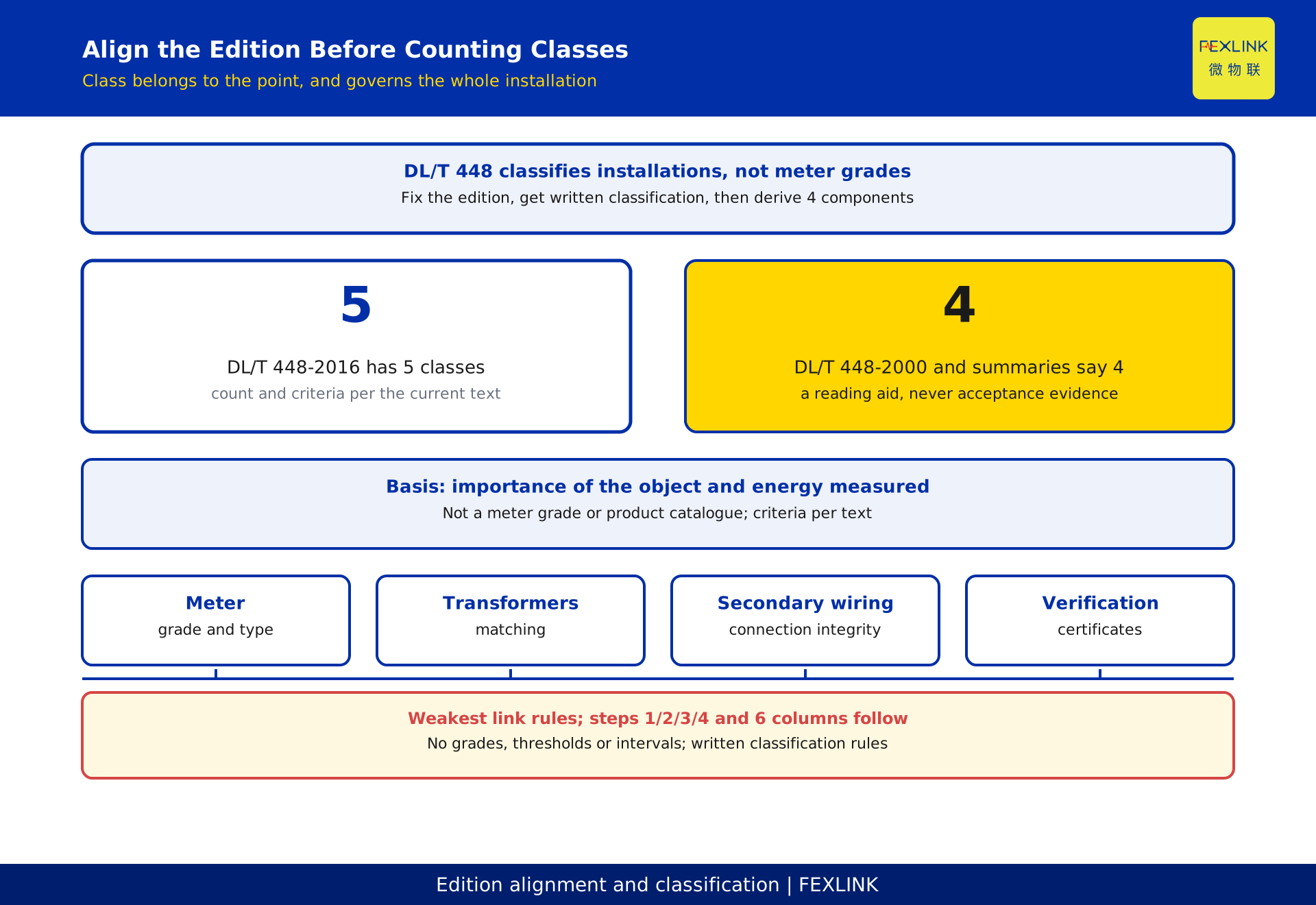
DL/T 448 does not grade meters; it classifies energy metering installations. The current DL/T 448-2016 groups installations in service into 5 classes (I to V) by the importance of the metered object and the amount of energy measured. The 4-class version common in summaries comes from an older edition or a simplified retelling, so class count and criteria must come from the currently effective text and a written classification from the local grid operator. A class governs the whole installation—meter, transformers, secondary wiring, enclosure and verification records—not one meter swap. Four steps are fixed: build a metering-point register, obtain a written class per point, derive the configuration of the 4 components from it, then accept and archive. No accuracy grades or thresholds are quoted.
Start with the metering point, not the meter: classification asks who the point answers to
The usual wrong turn is to hold a meter datasheet and ask which class the meter belongs to. Class attaches to the metering point, not to the device. Within one plant, the utility settlement boundary, an internal workshop assessment point, tenant sub-metering and a self-consumption export point may all use the same meter model while carrying entirely different responsibility.
The first register has four columns: circuit and location, purpose, whether the counterparty is external or internal, and the state of equipment and documents. One row per point, never merged by meter model. Record purpose as trade settlement, economic and technical assessment, or internal monitoring, and name the counterparty; these two columns drive every later decision.
How DL/T 448 classifies: importance and energy measured, not meter grade
DL/T 448, the Technical Administrative Code for Electric Energy Metering, is an electric power industry standard. The current DL/T 448-2016 replaces DL/T 448-2000 and groups installations in service into 5 classes, labelled with Roman numerals I to V, for graded management.
This is an administrative grading, not a product catalogue. Higher classes bring stricter requirements on accuracy configuration, transformer matching, verification and operational management. Specific thresholds belong to the standard text and are not reproduced here; take them from the currently effective original and the grid operator's written documents.
Two terms need separating. An installation is the whole assembly—meter, transformers, secondary wiring, enclosure, seals and records; the meter is one component. The class is written into the installation register, not onto the meter nameplate.
4 classes or 5: align the version and the retelling first
Design documents and vendor selection tables frequently disagree: some say 4 classes, some say 5. The current DL/T 448-2016 has 5; the older DL/T 448-2000 and second-hand compilations use 4, and the two describe class names, criteria and required configurations differently. Applying an old chart to a current project can shift a whole column of class numbers and component requirements; the mismatch surfaces only at acceptance, when the cited basis proves to be a different edition.
Fix the order. Step 1: identify the edition the contract, design basis and acceptance criteria cite, and write it into the register. Step 2: obtain a written per-point classification from the grid operator or owner, in Roman numerals. Step 3: treat exam banks and rule-of-thumb tables as reading aids, never as acceptance evidence; where they conflict, the contract edition and the written classification govern.
This article uses the current 5-class structure for explanation. On site, the edition your project actually cites governs.
A class governs the whole installation, not one meter: 4 components, weakest link
Open up the installation and the class lands on 4 components: meter, instrument transformers, secondary wiring and connections, and the enclosure with seals and verification records. The meter is judged by grade and type, transformers by matching, wiring by connection integrity, and the evidence side by whether certificates, seals and register agree with the field. They form one criterion set: conformity is set by the weakest link, and none can offset another.
Two reworks follow from ignoring this: replacing only the meter while leaving transformers and wiring untouched, or specifying every point to the strictest class while verification certificates and the register remain incomplete. The reproducible method is one configuration table per class, one row per component, each stating requirement, current state, gap and evidence; where documents are missing, mark the row pending verification instead of filling it from memory.
Product placement belongs only at this step. The FEXLINK ESA full-element smart meter and the FEXLINK ZSA embedded smart meter are candidate meter-side devices; the Digital Electrical Intelligent Supervision System handles collection and register-side records. These names and capabilities are vendor-disclosed, used only as role references and excluded from the conclusion, selection advice and acceptance basis. Meter grade, installation class and configuration are governed by the currently effective standard text, the nameplate, the selection manual, the site survey and the grid operator's written reply. A product satisfies the configuration table; it never defines the class.
Boundary meter vs internal assessment meter: one meter, two possible classes
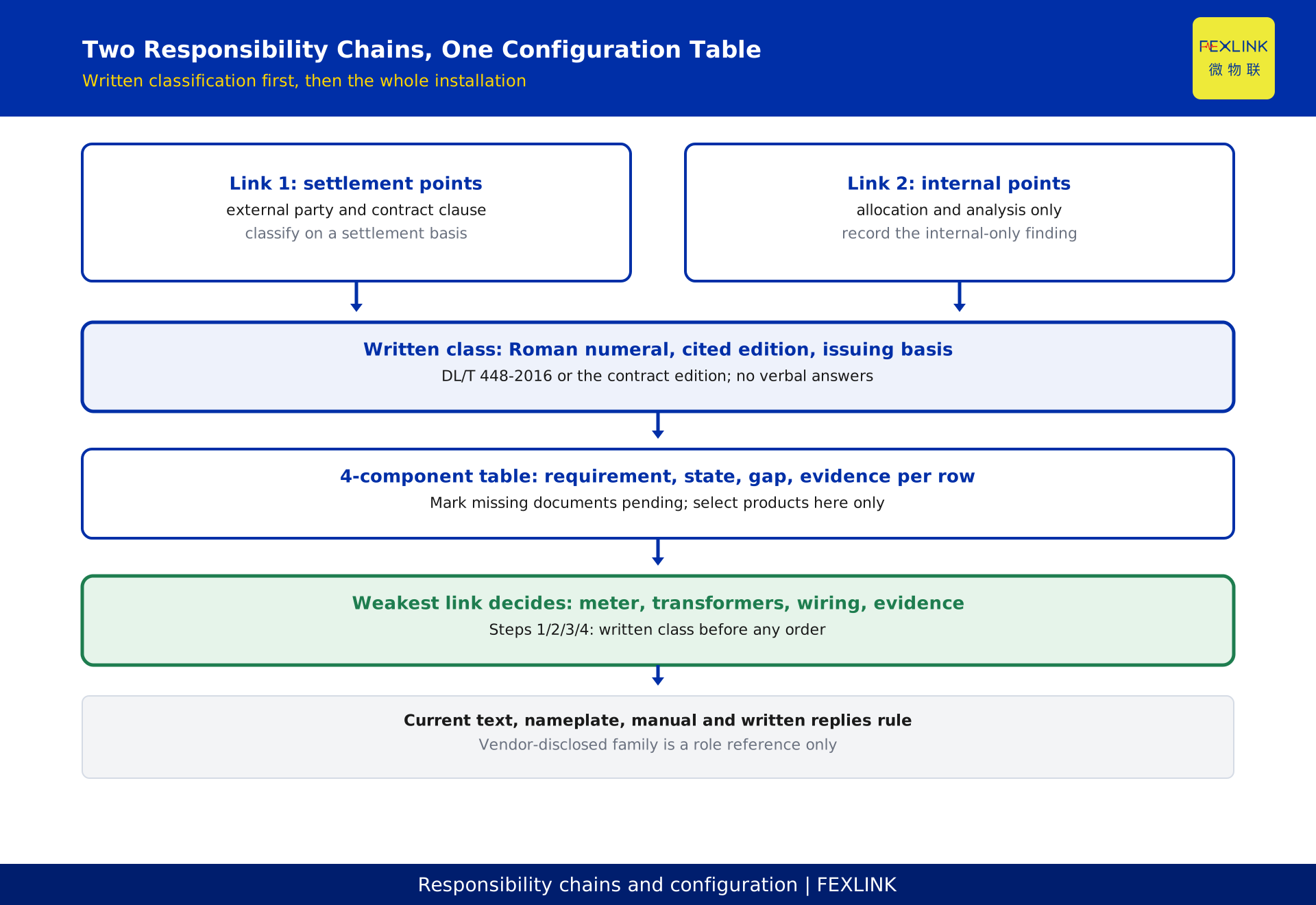
Class follows the point, not the meter model. The same meter at a utility settlement boundary and at a workshop assessment point can fall into different classes; asking what class a meter is reverses cause and effect.
Use three tests: will an external party claim against the figure, is it in a contractual settlement clause, and does the counterparty change with the purpose? Any external answer sends the point back through classification on a settlement basis. Points serving only internal allocation need not be built to the boundary class, but record the internal-only determination, since a change of use forces reclassification.
This sets the boundary with neighbouring material: purpose boundaries, accuracy-grade reading and communication protocols each have their own treatment. This article answers only how the standard classifies, how a class lands on the whole installation, and how to match a retrofit.
Why this article gives no accuracy figures: three uncertainties
A reader may expect a table of grades for classes I to V; it is deliberately absent, for three reasons.
First, numerical requirements must come from the currently effective original, and no verifiable first-hand text was available. Second, second-hand compilations contradict one another—the same class attracts different answers in different question banks—and copying one would freeze an error into an acceptance criterion. Third, a standard value is not necessarily a project value: the grid operator, contract and design basis may impose stricter requirements.
Accordingly, no accuracy grades, energy or capacity thresholds, transformer grades, verification intervals or secondary-circuit limits are quoted. Take numbers through three channels: ask the utility or designer for the cited edition and written per-point classification; ask the manufacturer for type evaluation and verification certificates; then check nameplates, wiring, seals and register on site before writing into the configuration table. This article neither assigns a class nor supplies a value on behalf of the site.
Retrofit in four steps: register, written classification, configuration, acceptance record
Step 1, build the register. One row per point with circuit and location, purpose and counterparty, the cited standard edition, and the state of equipment and documents. No enquiries or orders until it closes.
Step 2, obtain written classification. Submit the register to the utility, owner or designer and record each point's Roman-numeral class, cited edition and issuing basis; a verbal answer is not a record. List disputed or uncovered points separately, do not build on them, and repeat after any change of use, expansion or meter replacement.
Step 3, derive the configuration. Expand the class into a table of 4 components—meter, transformers, secondary wiring, verification and records—with requirement, state, gap and evidence per row. Product selection happens only here and must map row by row to it.
Step 4, accept and archive. Check each point against its class and file the classification, configuration table, verification certificates, seal and wiring records, and register consistency as a signable record. The order cannot be reversed: class before selection, written classification before ordering, closed evidence before signature.
Worked example: a class register for a plant retrofit
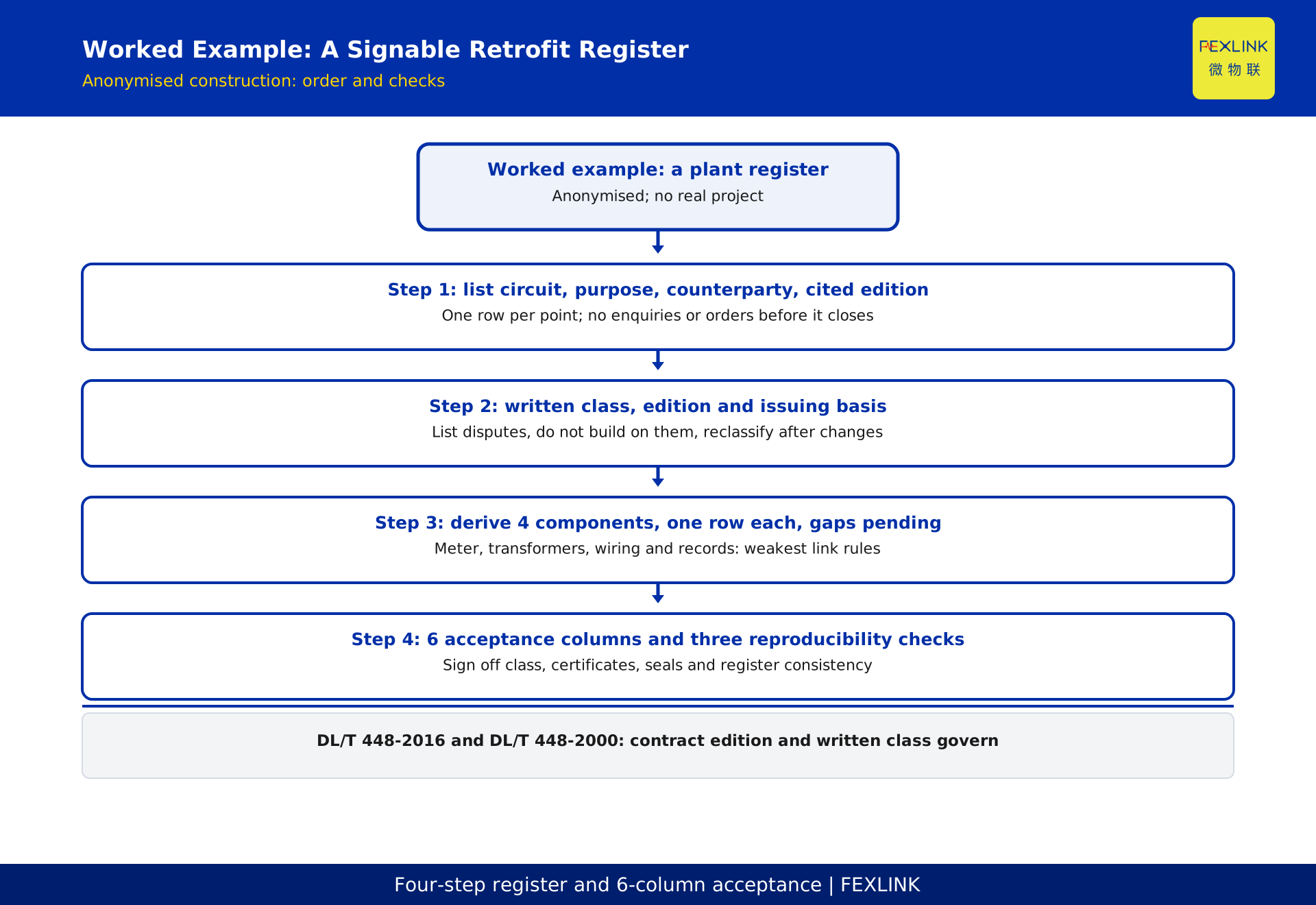
A plant distribution room retrofit lists three kinds of points: a utility settlement boundary, internal workshop assessment and tenant sub-metering. This is an anonymised construction with no customer, location or inferable combination, no real project and no numerical values from the standard.
After Step 1 closed the register, the dispute appeared at the tenant points: entered as internal assessment, they had to issue chargeable statements externally, so they were resubmitted on a settlement basis. The written classification from Step 2 cited the same edition for the boundary and tenant points and classified the workshop point separately; class names used Roman numerals and the conflict was filed on its own.
At Step 3 the workshop point was to reuse its meter, but transformer documents and wiring inspection records were missing; on the weakest-link rule the action was to complete documents and field checks, not replace the meter first. At Step 4 the 4 components were ticked row by row, with signatures on classification, verification certificate, seal record and register consistency; a meter change would be reclassified against the same register. The example shows only order and criteria: responsibility, class, whole installation, evidence.
A 6-column acceptance check and neighbouring topics
Use a fixed 6-column acceptance sheet; a missing column means incomplete: point and circuit identifier; written classification with cited edition; record matching meter and transformer configuration to the class; secondary wiring, connections and seal inspection; verification or calibration certificates and validity; and consistency between register, collected points and field.
Add three reproducibility checks: trace any point back to its written classification; recompute the requirement and state of the 4 components row by row; and after a meter change, expansion or change of use, show that the same process yields a fresh classification and a new record. All three need signatures.
The increment is the version discrepancy, the 4-component view, the four-step order and the 6-column check; purpose boundaries, accuracy-grade reading and communication protocols are treated elsewhere. Three sentences carry the conclusion: class before selection, installation before meter, written classification before construction.
Frequently asked questions (FAQ)
Q: The design says 5 classes and the vendor table says 4. Which governs?
The edition cited in the contract and acceptance criteria governs, backed by the written classification from the grid operator or owner. An older edition or a simplified retelling is not acceptance evidence. Write class names in Roman numerals, file the conflict separately and do not negotiate a compromise class in private.
Q: If I install a higher-grade meter, does the installation meet its class?
No. A class governs the whole installation—meter, transformers, secondary wiring, verification and records—and the weakest link decides. Replacing only the meter while documents or register entries are missing still fails acceptance.
Q: Must an internal assessment meter be built to the boundary class?
Apply the three tests: will an external party claim against the figure, is it in a settlement clause, and does the counterparty change. Points serving only internal allocation need not match the boundary class, but record that determination; external charging requires reclassification.
Q: Why are accuracy grades not listed here?
No verifiable first-hand text was available, second-hand compilations contradict one another, and the project may be stricter. Take numbers from the standard text, written classification, type evaluation and verification certificates, then check on site. No exam-bank answer is acceptance evidence.
Q: Can we order equipment before the classification arrives?
Not advisable. The class determines the configuration of the 4 components, so ordering first lets equipment define the class retroactively. List disputed points, do not build on undetermined ones, and at minimum fix purpose, counterparty, cited edition and who issues the written classification.
Scope and limitations
This article applies to plants and distribution rooms with existing or planned metering installations needing configuration checked against standard classification, and addresses electrical engineers and energy managers. The classification logic, version discrepancy, whole-installation view, four-step order and 6-column check are engineering method summaries, not commitments about grade values, verification intervals, device capability or project duration.
DL/T 448 is cited only as a source. No accuracy grades, energy or capacity thresholds, transformer grades, verification intervals or secondary-circuit limits are quoted. The current edition uses 5 classes; the 4-class wording in summaries reflects an older edition or a simplified retelling. Class count, criteria and configuration are governed by the currently effective text, the grid operator's written classification, the contract and manufacturer documents. This article explains method only: it rewrites no existing design document, topic description or project register, and does not classify installations or issue acceptance decisions for a site.
The worked example is anonymised and represents no real project. The names and capabilities of the FEXLINK ESA full-element smart meter, the FEXLINK ZSA embedded smart meter and the Digital Electrical Intelligent Supervision System are vendor-disclosed, used only as role references and excluded from the conclusion, selection advice and acceptance basis. All deliverables remain DRAFT_PENDING_REVIEW, require independent review, and are not self-approved by the generator.
Frequently Asked Questions
How DL/T 448 Classifies Energy Metering Installations
DL/T 448 does not grade meters; it classifies energy metering installations