 FEXLINK Research Institute
The short answer
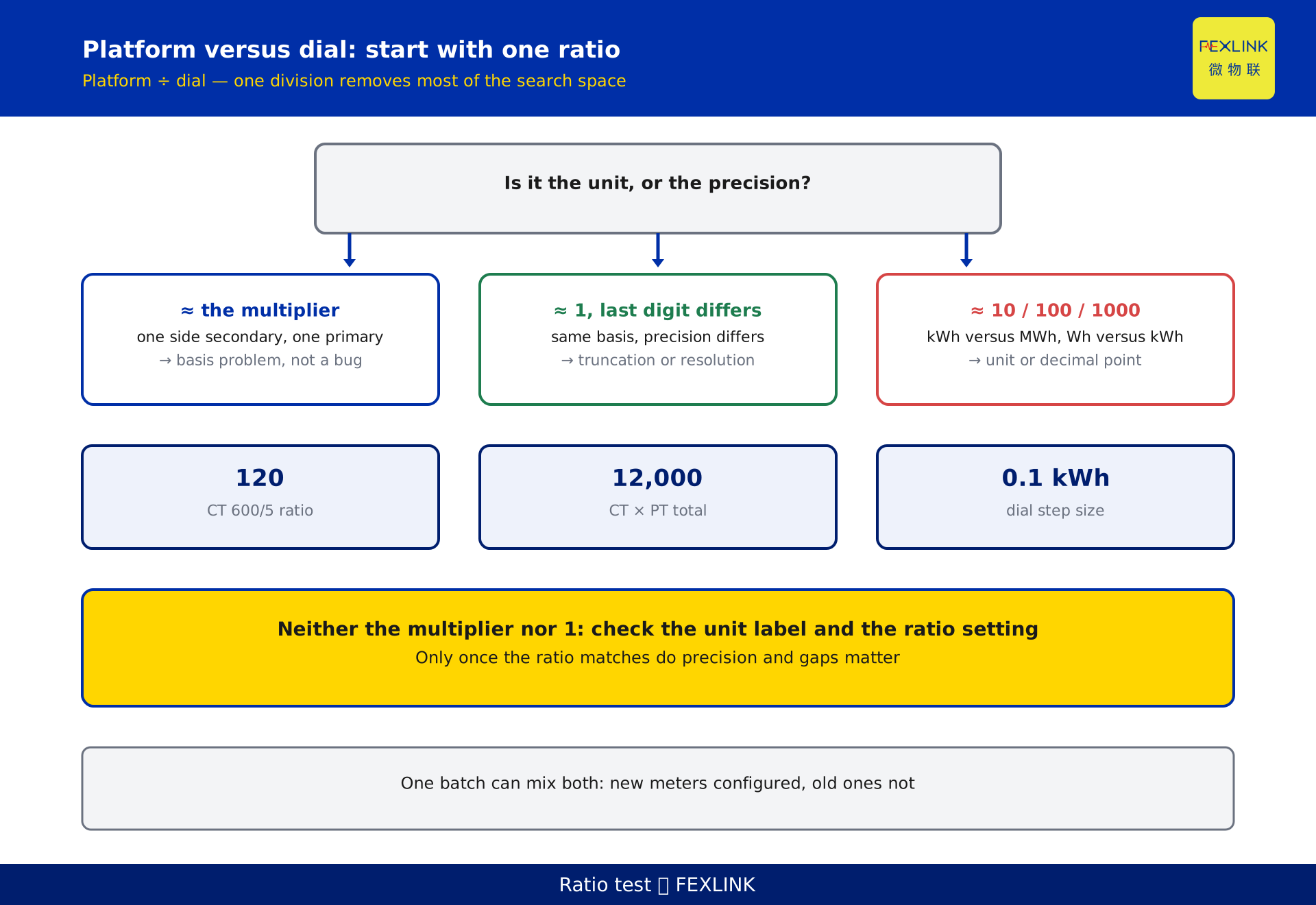
When the platform's kWh differs slightly from the meter dial, do not start by suspecting the acquisition code. Compute one ratio first: platform value ÷ dial value. If that ratio is about the CT/PT multiplier (120, 8000 and so on), it is a unit problem — one side reads the secondary, the other the primary. If the ratio is about 1 and only the last digit differs, it is a precision problem — decimal truncation or insufficient resolution.
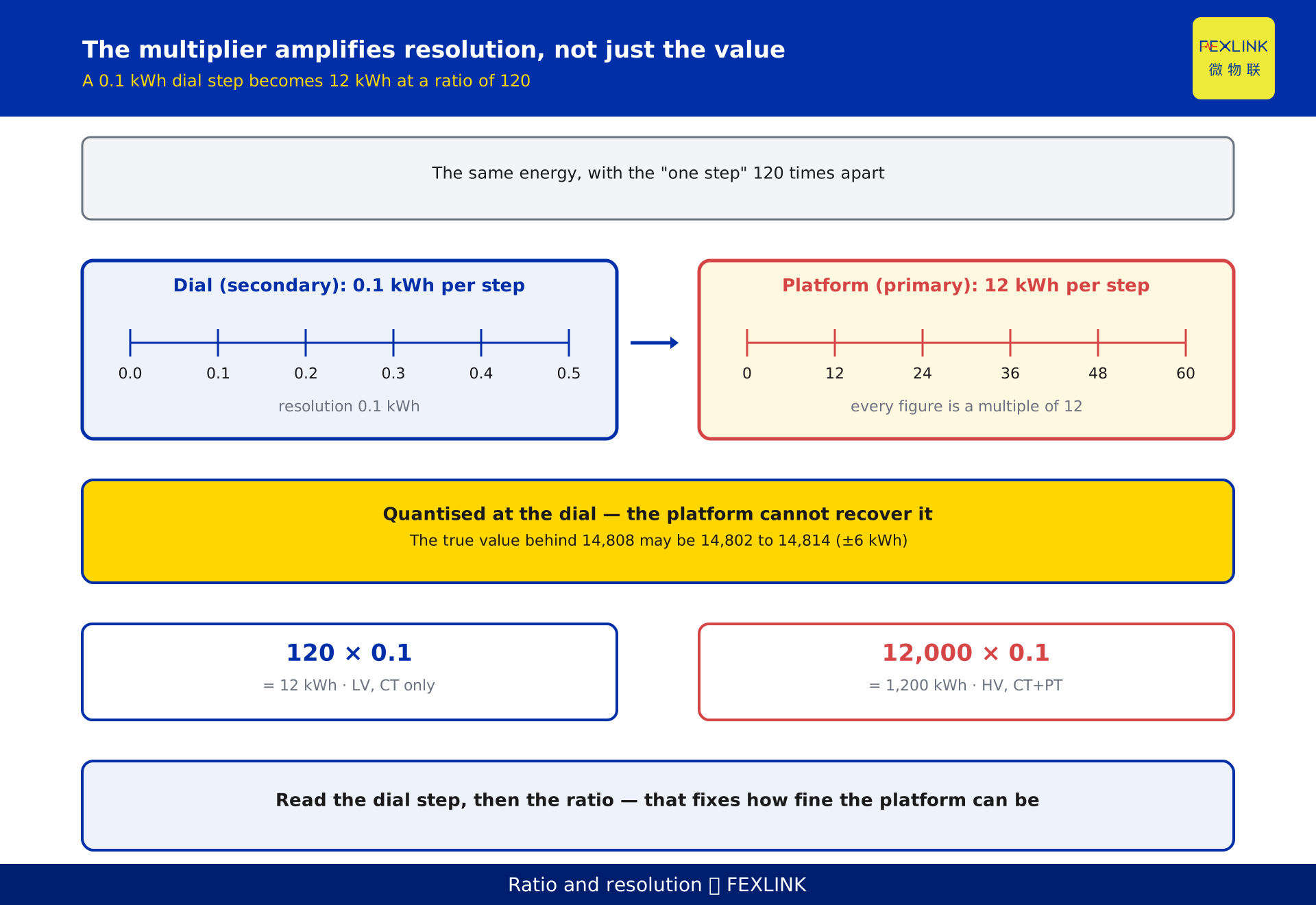
The two behave completely differently. A multiplier mismatch is an order-of-magnitude error and shows up the moment you divide. A precision difference looks tiny but gets amplified by the multiplier: with a dial step of 0.1 kWh and a ratio of 120, one "tick" on the platform is 12 kWh. No number on that platform can be finer than 12 kWh.
More important: computing energy by difference (end index minus start index) keeps the error bounded and non-accumulating; accumulating per-interval increments lets it grow with the number of samples. On the same data the two methods can differ by whole percentage points — and that is usually what "the platform drifts further every month" really means.
1. One ratio tells you unit or precision
When an audit does not reconcile, the first move is a division, not a code review.
- Ratio ≈ the multiplier (120, 8000, 12000): the platform is primary, the dial is secondary. Not a bug — a configuration convention nobody wrote down.
- Ratio ≈ 1, last digit differs: same basis, precision differs — dial resolution, storage precision or display truncation.
- Ratio ≈ 10, 100, 1000: unit conversion (kWh versus MWh, Wh versus kWh), or a misplaced decimal point.
One division removes half the search space. Many teams skip it, hunt for "missing samples" for days, and only then discover the two numbers were never on the same side.
2. Which side does the dial show
The meter measures secondary voltage and current — the small signals after CT and PT. What the dial shows depends on whether a ratio is configured inside the meter:
- Ratio configured: the dial shows primary energy directly, e.g. 14,807.6 kWh. The platform only forwards it, so any difference is precision.
- No ratio configured: the dial shows the secondary total, e.g. 123.4 kWh. The platform must multiply by the ratio, so the difference can come from the multiplier, from precision, or both.
Both deployments are common, and one batch can contain both — especially in retrofit projects: new meters configured, old ones not, the platform applying one rule to all, so half reconcile and half are off by 120×.
The quick test is magnitude: if a feeder uses ten thousand-odd kWh a month but the dial has advanced only a hundred-odd, it is showing the secondary.
A second test uses the same month's data: dial increment × nameplate ratio against the platform total. Agreement within a step or two means the ratio is right and only precision remains; a gap equal to the ratio itself means one side converts and the other does not; a clean factor of ten or a hundred points at a unit label. For a mixed batch the fix is a register column recording, per meter, whether the dial reads primary or secondary — everything downstream keys off it.
3. Where the multiplier comes from
The multiplier is a product of two ratios:
total multiplier = CT ratio × PT ratio
- CT 600/5 A → ratio 120
- PT 10 kV/100 V → ratio 100
- total = 120 × 100 = 12,000
LV feeders usually have no PT, so the multiplier is just the CT ratio, e.g. 120. HV metering has both, and multipliers run into the tens of thousands.
One easily missed point: the multiplier applies to energy, not to power. Power × multiplier gives primary power, and integrating that over time gives energy — equivalent. But multiply once at power and again at energy and you are off by a whole multiplier. That double conversion produces exactly the same symptom as a wrong ratio, and only the ratio test tells them apart.
4. The multiplier amplifies resolution, not just the number
This is the sentence to remember: the multiplier scales the dial's quantisation step along with the value.
Dial step 0.1 kWh, ratio 120:
- one dial tick = 12 kWh on the primary side
- every platform figure is a multiple of 12
- the quantisation error against the true value is at most ±6 kWh (half a step)
So when the platform shows 14,808 kWh, the true value may lie between 14,802 and 14,814. That is not insufficient precision — the information was quantised at the dial and cannot be recovered downstream.
HV metering makes it obvious: at a total multiplier of 12,000, a 0.1 kWh step corresponds to 1,200 kWh on the primary. That one decimal digit is worth 1,200 kWh — which is why HV metering cares so much about dial decimals and cannot tolerate a dial that reads only whole numbers.
5. Truncation versus rounding
Two ways to handle decimals, with very different consequences.
Rounding: error bounded by half a unit, random in direction, cancelling over time.
Truncation (floor, drop the tail): error accumulates in one direction; every figure is a little low and never comes back.
Take 14,807.6 kWh:
- Integer, rounded → 14,808, off by +0.4 kWh.
- Integer, truncated → 14,807, off by −0.6 kWh.
- MWh to one decimal, rounded → 14.8 MWh, off by −7.6 kWh.
- MWh to one decimal, truncated → 14.8 MWh, off by −7.6 kWh.
Once, a few kWh hardly matters. But apply that truncation at every sample and then sum — the character changes. That is the next section.
6. Difference versus accumulation
Same index data, two algorithms:
Difference: energy = (end index − start index) × multiplier. Error comes only from the two endpoints — bounded, independent of the number of intervals.
Accumulation: energy = Σ(interval increment × multiplier), with a rounding step in every interval. Error grows with the number of intervals.
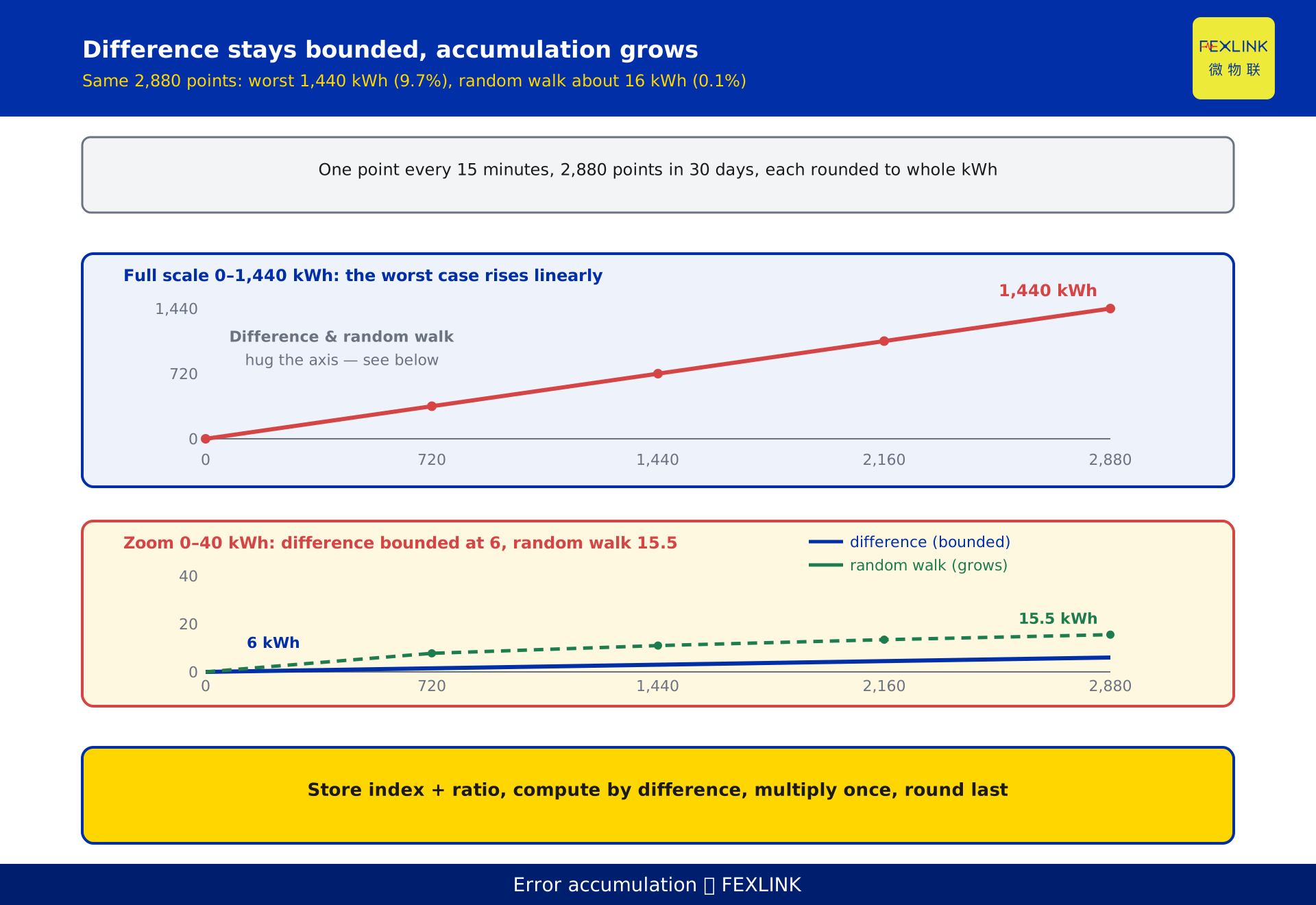
Numbers. A feeder uses about 14,808 kWh a month; the platform samples every 15 minutes, 96 points a day, 2,880 points in 30 days. Round each point to whole kWh:
- worst case per point ±0.5 kWh
- worst case total 2,880 × 0.5 = 1,440 kWh, about 9.7% of the month
- random walk (closer to reality) about ±16 kWh, about 0.1%
Worst and typical differ by two orders of magnitude, yet the conclusion is the same: accumulation feeds the error, difference does not. Store the index and the multiplier; compute energy by difference, rather than storing per-interval energy and summing.
The trap has a second layer: even a platform that stores per-interval energy correctly can reintroduce the error at reporting time, summing 2,880 rounded values and then rounding the monthly total again. Round once, at the last step, and keep the unrounded value in the database. There is also a diagnostic asymmetry — difference-based energy is self-checking, since closing minus opening must equal the sum of the platform's own increments, whereas an accumulated total carries no identity that reveals whether it is right.
7. A worked example: the 0.4 between 14,808 and 14,807.6
Constructed to illustrate the conversion; no real customer.
A 0.4 kV feeder, CT 600/5 A (ratio 120), no PT, no ratio configured in the meter, dial step 0.1 kWh. Opening index 0123.4, closing 0246.8.
- Secondary increment = 246.8 − 123.4 = 123.4 kWh
- Primary energy = 123.4 × 120 = 14,808 kWh
- Platform shows 14,808; the dial, if configured and shown to one decimal, reads 14,807.6
A 0.4 kWh difference, 0.0027% — entirely normal, the inevitable result of dial resolution plus display digits, not a fault.
Now suppose the platform shows 14,760 kWh, 48 kWh low (0.32%). That needs investigation: 48 ÷ 12 = 4, exactly four quantisation steps. The likeliest explanation is that the platform rounded the secondary index to 123 kWh before multiplying by 120, discarding that 0.4.
Which brings us to the shape of the deviation.
8. The shape of the deviation
A deviation has a size and a shape, and the shape points at the cause.
- Constant (about −48 kWh every month): fixed truncation or fixed rounding; change the algorithm.
- Proportional to the multiplier: a basis problem — one side multiplied, the other did not.
- Linear growth (5, then 10, then 15): accumulation-type error, or the platform adding twice.
- Step change (a large gap one day, then stable): meter swap, ratio change, configuration change, or an index overflow.
- Random jitter: missing samples, clock skew, or backfill that scrambled the timestamps.
Plot deviation against time first. Once the shape is visible the cause is usually decided — far faster than reading code line by line.
Step changes deserve a specific check, since they are the one shape that can silently break a history: if the jump matches a meter swap, the likely fault is a missing closing index, the platform reading the reset as a negative increment. The month after looks normal, which is what makes it invisible.
9. How to correct it
Three practices, in priority order.
One: store the raw index, not the converted energy. Keep index, multiplier and timestamp as columns; compute energy at query or display time. Then a rule change can be recomputed instead of leaving history frozen.
Two: multiply in exactly one place. Either the meter or the platform, never both. Before changing configuration, establish which deployment you have.
Three: compute by difference, not by accumulation. Unless there is a real reason (index rollover, for example), difference is always the safer choice; if you must accumulate, use a high-precision type, keep enough decimals, and round only at the end.
In product terms, the ESX edge computing gateway caches raw indices with timestamps locally and backfills by index value after an outage rather than re-processing per-interval energy; the ESA full-parameter smart meter supports configuring the ratio from the site nameplate, so conversion happens in one place only. Configuration items and accuracy follow the latest selection manual.
FAQ
Q: The platform is tens of kWh below the dial — are samples missing?
Divide first. Ratio ≈ 1 with only the last digit differing usually means truncation or resolution, not missing data; ratio ≈ the multiplier means a basis problem; only random jitter that maps to a specific period suggests missing samples.
Q: The dial reads 123.4 and the platform 14,808 — a hundredfold gap. Is that wrong?
No — different bases. 123.4 is secondary; multiply by 120 and you get 14,808 exactly. Record "dial reads secondary" in the asset register, or every audit will re-open the question.
Q: How far off is a wrong multiplier?
Energy scales with the ratio. With a real 600/5 CT configured as 300/5, the multiplier is halved and the reading is half the truth — an order-of-magnitude error, not a precision issue, visible from one division.
Q: Why is the gap larger when displaying in MWh?
Because the display step grows. Whole kWh means one unit per step; MWh to one decimal means 100 kWh per step. Same number, different unit, 100× the quantisation error.
Q: Rounding or truncation — which is safer?
Rounding is bounded, random in direction and cancels over time; truncation accumulates one way. Summing amplifies the difference, so prefer rounding over truncation, and difference over accumulation.
Q: After a meter swap, how do the historical totals join up?
Record the closing index of the old meter and the opening index of the new one, convert each segment with its own multiplier and add them. Record only the new opening index and the history breaks — silently.
Scope and limitations
- This article covers primary/secondary energy conversion, multiplier amplification and decimal truncation as a predictable deviation, for AC metering through CT/PT and downstream platform processing. Direct-connected meters without transformers have no multiplier stage.
- No specific standard clauses are cited; CT/PT accuracy classes, ratio configuration and verification follow the relevant metering regulations, which are a different matter from the conversion and truncation deviations discussed here, and cannot substitute for them.
- The 120, 12,000, 14,808 kWh, 123.4 kWh, 0.4 kWh and 2,880-point figures are set for easy verification and represent no real customer or project; actual multipliers and resolutions are governed by the nameplate, the meter manual and the platform configuration.
- The "worst case 1,440 kWh, random walk about ±16 kWh" figures in Section 6 are order-of-magnitude estimates under a uniform error model, used only to show accumulation; actual error depends on the rounding rule and the data distribution and must be verified against measurements.
- Descriptions of the ESX edge computing gateway and the ESA full-parameter smart meter are subject to the latest selection manual and product knowledge base; this article is not a selection or procurement recommendation.
Frequently Asked Questions
The platform is tens of kWh below the dial — are samples missing?
Divide first. Ratio ≈ 1 with only the last digit differing usually means truncation or resolution, not missing data; ratio ≈ the multiplier means a basis problem; only random jitter that maps to a specific period suggests missing samples.
The dial reads 123.4 and the platform 14,808 — a hundredfold gap. Is that wrong?
No — different bases. 123.4 is secondary; multiply by 120 and you get 14,808 exactly. Record "dial reads secondary" in the asset register, or every audit will re-open the question.
How far off is a wrong multiplier?
Energy scales with the ratio. With a real 600/5 CT configured as 300/5, the multiplier is halved and the reading is half the truth — an order-of-magnitude error, not a precision issue, visible from one division.
Why is the gap larger when displaying in MWh?
Because the display step grows. Whole kWh means one unit per step; MWh to one decimal means 100 kWh per step. Same number, different unit, 100× the quantisation error.
Rounding or truncation — which is safer?
Rounding is bounded, random in direction and cancels over time; truncation accumulates one way. Summing amplifies the difference, so prefer rounding over truncation, and difference over accumulation.
After a meter swap, how do the historical totals join up?
Record the closing index of the old meter and the opening index of the new one, convert each segment with its own multiplier and add them. Record only the new opening index and the history breaks — silently.