 FEXLINK Research Institute
The short answer
DL/T 448 does not classify metering by meter price. It sorts electric energy metering installations into Classes I through V by billing capacity plus purpose: the higher the class (Class I strictest), the tighter the accuracy, with revenue points, large customers and grid-export points at the top. The first job for any meter is to be placed into its class, then look up the accuracy and instrument-transformer requirement that class demands. Do that and your retrofit procurement list gains a regulatory footing; at acceptance you can explain why one meter is 0.2S and another is 2.0.
Note: the Class I–V thresholds and accuracy grades below are taken from DL/T 448-2016 Tables 1 and 2; defer to the currently effective edition. This article covers classification and the look-up method only, not accuracy error limits — those belong to GB/T 17215 / IEC 62053 (see KD-0455). Unlike KD-0455, which explains what the accuracy numbers mean, the added value here is the Class I–V look-up procedure.
1. What does DL/T 448 actually classify by?
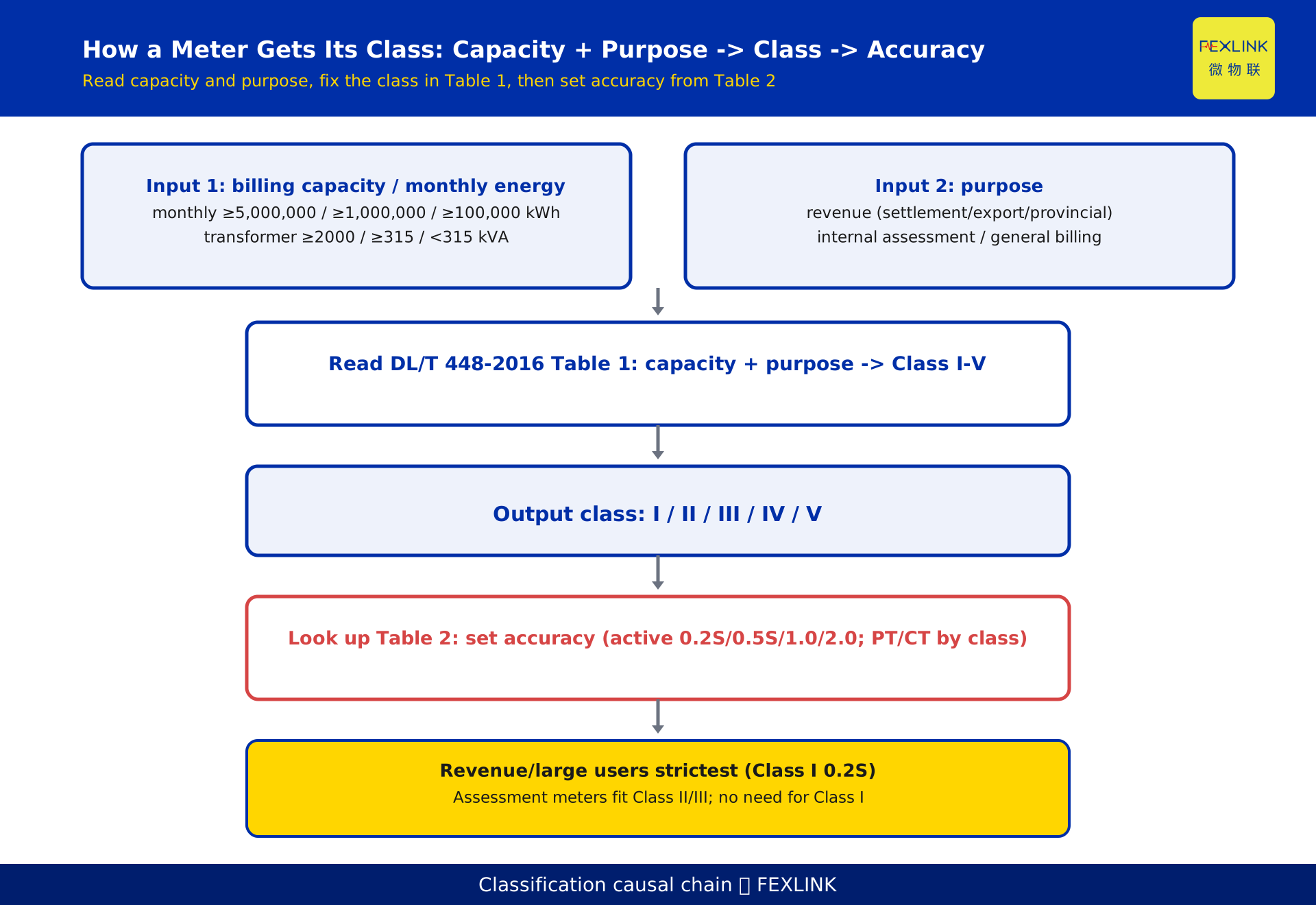
The first mistake many metering engineers make is to open the procurement list and pick the most accurate meter. DL/T 448 works the other way round: fix the class first, then the accuracy. A class is decided by two pieces of a puzzle — the billing capacity (monthly energy or transformer capacity) and the purpose of the meter (does it settle with the grid, export energy, or assess internally).
In other words, the same 0.2S meter is Class I at a provincial revenue point but often only Class II or III on an internal assessment circuit; a 2.0 direct-connected single-phase meter is correctly Class V. Class first, accuracy second — never the reverse.
This is also the line between this article and KD-0455 (accuracy-class concepts): KD-0455 explains what 0.2S and 0.5S mean; this article explains which class your meter falls into and how to choose accuracy from it. The class must exist before accuracy is meaningful.
2. The Class I–V landscape: from revenue points to single-phase
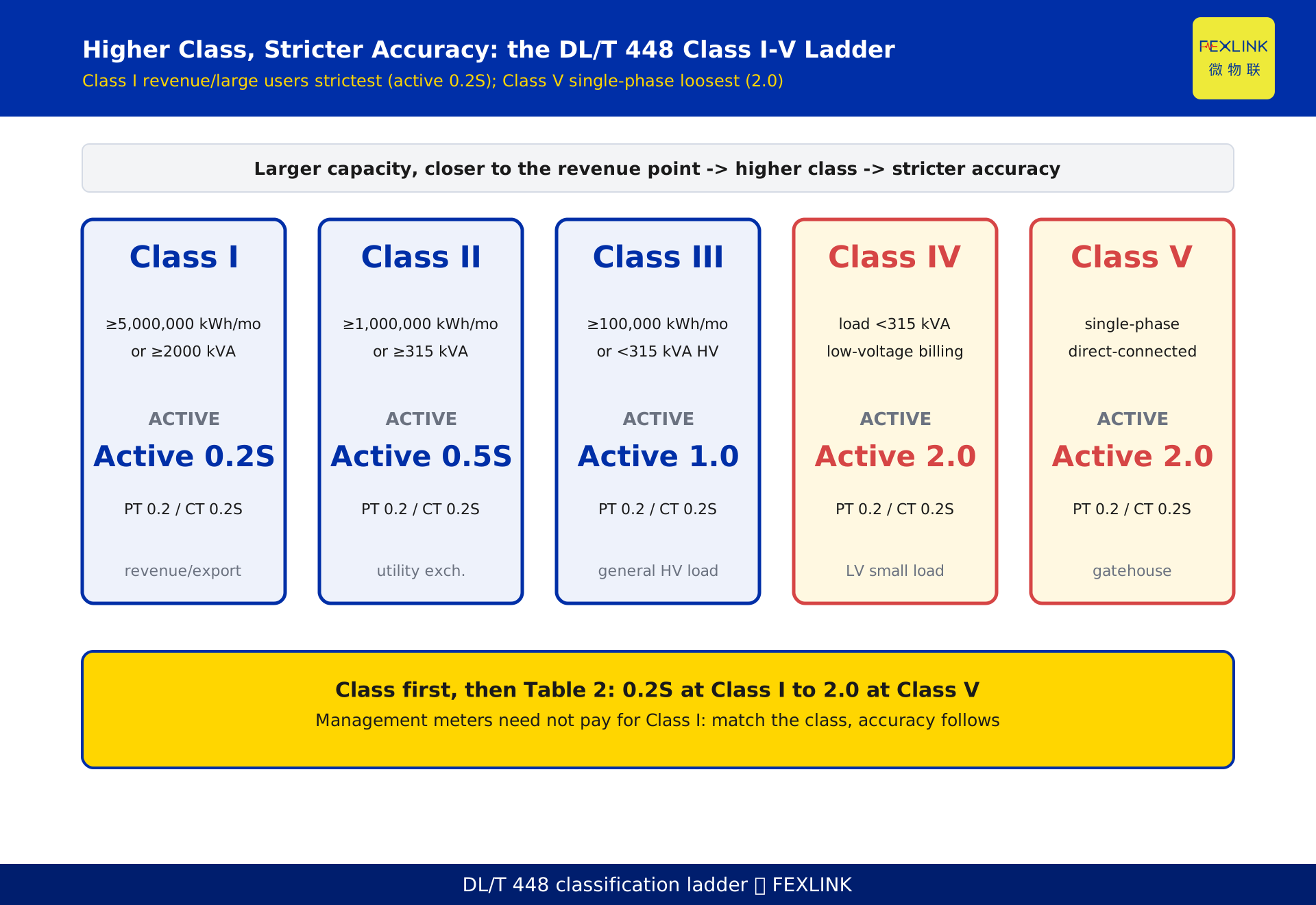
On the 2016 edition, the five classes are divided as follows (defer to the current DL/T 448 Table 1):
- Class I: monthly average energy ≥ 5,000,000 kWh, or high-voltage billing customers with transformer capacity ≥ 2000 kVA; also generators ≥ 200 MW, generation enterprise grid-export energy, inter-utility exchange points, provincial revenue points, and similar.
- Class II: monthly average energy ≥ 1,000,000 kWh, or high-voltage billing customers with transformer capacity ≥ 315 kVA; generators of 100–200 MW, inter-utility exchange points, and similar.
- Class III: monthly average energy ≥ 100,000 kWh, or high-voltage billing customers and loads with transformer capacity < 315 kVA; generators below 100 MW.
- Class IV: billing customers with load capacity < 315 kVA (generally low-voltage billing).
- Class V: single-phase billing customers (direct-connected, no instrument transformers).
In short: the larger the capacity and the closer to the settlement point, the higher the class — Class I is provincial gateways and large users, Class V is the gatehouse single-phase meter.
3. What accuracy each class gets: the Table 1 / Table 2 basis
Once the class is fixed, accuracy is not a guess — read it from the DL/T 448 Table 2 assignment (2016 edition, for reference):
| Class | Active | Reactive | VT (PT) | CT |
|---|---|---|---|---|
| I | 0.2S | 2.0 | 0.2 | 0.2S |
| II | 0.5S | 2.0 | 0.2 | 0.2S |
| III | 1.0 | 2.0 | 0.5 | 0.5S |
| IV | 2.0 | 3.0 | 0.5 | 0.5S |
| V | 2.0 | 2.0 | direct | direct |
A detail easy to miss: Classes I and II demand active 0.2S / 0.5S, while Classes IV and V need only 2.0 — a full order of magnitude apart. Forcing a 0.2S meter onto a Class IV low-voltage load is over-spec and wasteful.
4. Revenue meter vs assessment meter: same meter, different class
"Revenue meter" and "assessment meter" are often used interchangeably, but under DL/T 448 they usually land in different classes.
- Revenue meter: the point that settles with the utility, exports generation, or is a provincial revenue gateway. It normally sits in Class I, active 0.2S, because its data flow into trade settlement where a small error is real money. Generators ≥ 200 MW and inter-utility points are also Class I.
- Internal assessment meter: metering between shops or processes for benchmarking. It is usually high-voltage billing and, by capacity, lands in Class II or III, where active 0.5S or 1.0 is enough; there is no need to chase Class I 0.2S.
The key conclusion: an assessment meter, however important, rarely needs Class I. Treating internal assessment meters as revenue meters is the most common source of waste discussed next.
5. Common misconfiguration: buying management meters to Class I spec
Three misconfigurations show up most often in the field:
- Management assessment meters bought to Class I. Meters used for shop benchmarking or process accounting should be Class II/III (0.5S / 1.0) but are uniformly specified as 0.2S revenue meters — several times the unit price, with accuracy the acceptance test never uses.
- Low-voltage small loads forced to high accuracy. A Class IV point with load < 315 kVA should be active 2.0, yet a 0.5S meter is specified; the transformer, meter and wiring are all upgraded, but the code never required it.
- Meter and transformer grade mismatch. The meter is 0.2S but the CT is 0.5S, so the chain's accuracy is dragged down — wasted specification. Meter and transformers must align to the same Table 2 grade.
One hard rule: first ask which class the meter maps to, then specify accuracy by that class's Table 2 — never buy the most expensive first. Order before the class is set and misconfiguration is almost certain.
6. A plant look-up example
This constructed example illustrates the look-up method (no real customer or project). A plant has five meters to classify:
- Revenue total meter: settles with the grid, monthly energy 6,000,000 kWh, transformer 2500 kVA → hits Class I (monthly ≥ 5,000,000 and capacity ≥ 2000 kVA), active 0.2S.
- Internal shop assessment meter (high-voltage billing): monthly 1,200,000 kWh, capacity 400 kVA → hits Class II (monthly ≥ 1,000,000), active 0.5S.
- General high-voltage feeder metering: monthly 150,000 kWh, capacity 200 kVA (high-voltage, < 315 kVA) → hits Class III, active 1.0.
- Low-voltage power billing load: load capacity 250 kVA (< 315 kVA) → hits Class IV, active 2.0.
- Gatehouse single-phase supply: direct-connected → hits Class V, active 2.0, direct-connected with no transformers.
Only one of these five meters is Class I. Under the habit of buying management meters to Class I too, the other four would all be wrongly specified as 0.2S — the transformer-and-meter price gap alone is sizable waste, while at acceptance they should have been Class II/III/IV/V.
7. Look-up checklist: assign every meter to a class
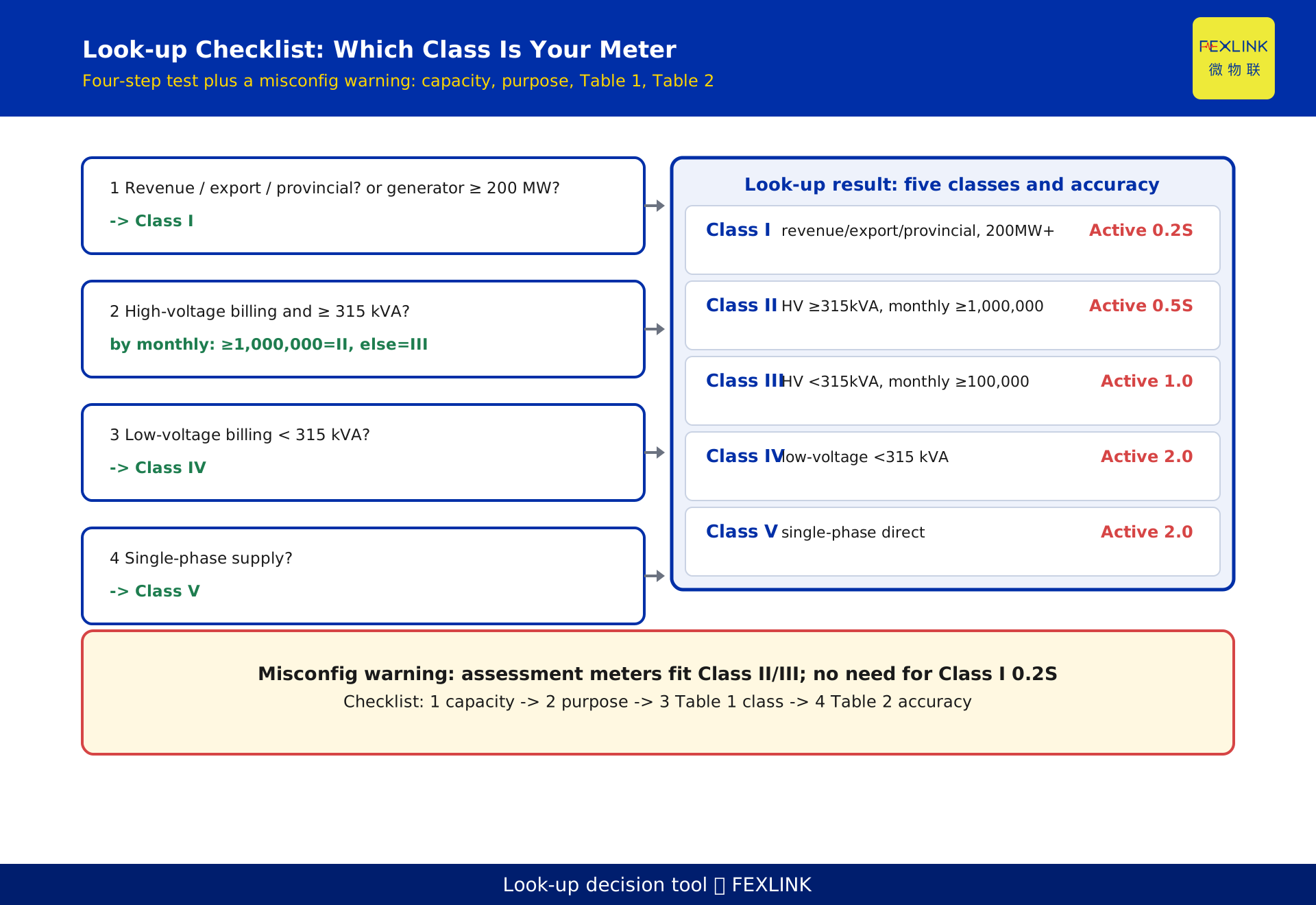
Compress the logic above into a checklist you can run on every meter, in four steps:
- Set capacity: read the monthly average energy (in kWh) or transformer/load capacity (kVA) and find the band it falls into.
- Set purpose: is it a settlement gateway / grid export / provincial, an internal assessment, a general billing load, or a single-phase direct connection?
- Use Table 1 to fix the class: capacity + purpose map to Class I–V; record the class.
- Use Table 2 to set accuracy: take the active/reactive accuracy and PT/CT grade for that class, and order meter and transformers to match.
Put those four steps into a table and the retrofit list stops being a pile of meters on a procurement sheet and becomes every meter tagged with its class, accuracy and transformers. At acceptance, asked why this one is 0.2S, you answer directly: it is a Class I revenue point, per DL/T 448 Table 2.
8. How products land: ZSA / ESA smart meters
Classification answers what accuracy to fit; landing it depends on meters at both ends feeding data back. The ZSA embedded multi-function smart meter (embedded multi-function smart meter) is compact, fits inside switchgear or at the equipment end, and suits Class III/IV equipment-level and circuit-level points. The ESA all-element smart meter (circuit-level smart meter) covers circuit metering and data upload and serves Class I/II revenue points and key circuits. Both solve the same problem: returning every class of meter's readings to the system automatically and continuously instead of manual reading and after-the-fact classification.
Once data returns to the system it feeds the Digital Electrical Intelligent Supervision System for aggregation, benchmarking and alarm from Class I–V meters. Selection follows the product manual; this article explains only the classification and look-up logic, not a procurement recommendation.
9. Three things most easily missed at handover
Classification done and meters installed, the handover moment is where three things most often slip and directly stall acceptance:
- Class omitted from the handover list: only the equipment ledger is handed over, without each meter's DL/T 448 class and accuracy basis, so the receiver cannot verify and the next retrofit repeats the chaotic buying.
- Ratio and in-meter setting inconsistent: the CT ratio 0.2S does not match the meter setting, so readings are off by a factor and this fault does not alarm — it silently biases every conclusion.
- Management meters also set to Class I: at handover, assessment and general billing meters are passed on as Class I 0.2S, which is over-spec and plants the "excess accuracy, high maintenance cost" trap for later operation.
The handover package should carry a four-way "meter — class — accuracy — transformer" sheet so every meter can be traced back to its DL/T 448 class basis.
FAQ
Q: Is my revenue total meter Class I or Class II?
It depends on whether it carries the settlement master account. If it settles with the utility, exports generation, is a provincial revenue gateway, or matches a generator ≥ 200 MW or an inter-utility exchange point, it is Class I (active 0.2S). If it only benchmarks two internal accounting units on high-voltage billing, it normally lands in Class II or III. The yardstick is purpose + capacity, not where the meter is mounted.
Q: Is higher accuracy always safer for a management assessment meter?
No. Assessment meters are mostly Class II (0.5S) or Class III (1.0); fitting them to the Table 2 grade is enough. Chasing Class I 0.2S exceeds the code and raises cost — a textbook misconfiguration. Good enough accuracy matters more than highest.
Q: Does a direct-connected single-phase meter (Class V) still need instrument transformers?
No. Class V is a single-phase billing customer; on the 2016 edition it is direct-connected with no voltage or current transformers, active accuracy 2.0. Forcing transformers in only adds failure points and cost for no reason.
Q: Same transformer — why is the revenue point a different class from the internal assessment?
Because DL/T 448 classifies on both capacity and purpose. The revenue point sits in trade settlement and is Class I; internal assessment is in-house benchmarking, usually Class II/III on high-voltage billing. Purpose decides where the meter sits in the settlement chain and thus the class; capacity only decides II or III.
Q: The standard was revised — which edition of Tables 1/2 should I use?
Use the currently effective edition. The thresholds here are DL/T 448-2016 Tables 1/2 values for reference. For real projects check your applicable edition; if thresholds shifted, follow the latest, but fix the class first then read accuracy stays unchanged.
Scope and limitations
- This article covers the DL/T 448 Class I–V classification system and look-up method for electric energy metering, applicable to enterprise metering that settles with the grid, exports energy, assesses internally, or bills generally; plain residential supply not classified this way is out of scope.
- The Class I–V thresholds (monthly ≥ 5,000,000 / 1,000,000 / 100,000 kWh; capacity ≥ 2000 / ≥ 315 / < 315 kVA; generators ≥ 200 MW, etc.) and accuracy grades (active 0.2S/0.5S/1.0/2.0, reactive 2.0/3.0, PT 0.2/0.5, CT 0.2S/0.5S) are taken from DL/T 448-2016 Tables 1 and 2 as the 2016-edition values for reference; defer to the currently effective edition, and re-verify quantitative conclusions after any revision.
- This article covers classification and look-up only and does not address accuracy error limits (those belong to GB/T 17215 / IEC 62053, see KD-0455); the meaning of the accuracy numbers themselves should follow KD-0455.
- The plant example in Section 6 (6,000,000 kWh / 2500 kVA / 1,200,000 kWh / 400 kVA / 150,000 kWh / 200 kVA / 250 kVA and the five-meter look-up results) is constructed to illustrate the method and represents no real customer or project.
- References to the ZSA embedded multi-function smart meter and ESA all-element smart meter are qualitative (embedded / circuit-level metering and data upload) and contain no current, voltage, accuracy or communication-rate specifications; specific selection follows the product manual, and this article is not a procurement recommendation.
- The related "Digital Electrical Intelligent Supervision System" is mentioned only to show where the data loop is hosted, with no technical detail or metric elaborated.
Frequently Asked Questions
Is my revenue total meter Class I or Class II?
It depends on whether it carries the settlement master account. If it settles with the utility, exports generation, is a provincial revenue gateway, or matches a generator ≥ 200 MW or an inter-utility exchange point, it is Class I (active 0.2S). If it only benchmarks two internal accounting units on high-voltage billing, it normally lands in Class II or III. The yardstick is purpose + capacity, not where the meter is mounted.
Is higher accuracy always safer for a management assessment meter?
No. Assessment meters are mostly Class II (0.5S) or Class III (1.0); fitting them to the Table 2 grade is enough. Chasing Class I 0.2S exceeds the code and raises cost — a textbook misconfiguration. Good enough accuracy matters more than highest.
Does a direct-connected single-phase meter (Class V) still need instrument transformers?
No. Class V is a single-phase billing customer; on the 2016 edition it is direct-connected with no voltage or current transformers, active accuracy 2.0. Forcing transformers in only adds failure points and cost for no reason.
Same transformer — why is the revenue point a different class from the internal assessment?
Because DL/T 448 classifies on both capacity and purpose. The revenue point sits in trade settlement and is Class I; internal assessment is in-house benchmarking, usually Class II/III on high-voltage billing. Purpose decides where the meter sits in the settlement chain and thus the class; capacity only decides II or III.
The standard was revised — which edition of Tables 1/2 should I use?
Use the currently effective edition. The thresholds here are DL/T 448-2016 Tables 1/2 values for reference. For real projects check your applicable edition; if thresholds shifted, follow the latest, but fix the class first then read accuracy stays unchanged.