 FEXLINK Research Institute
The short answer
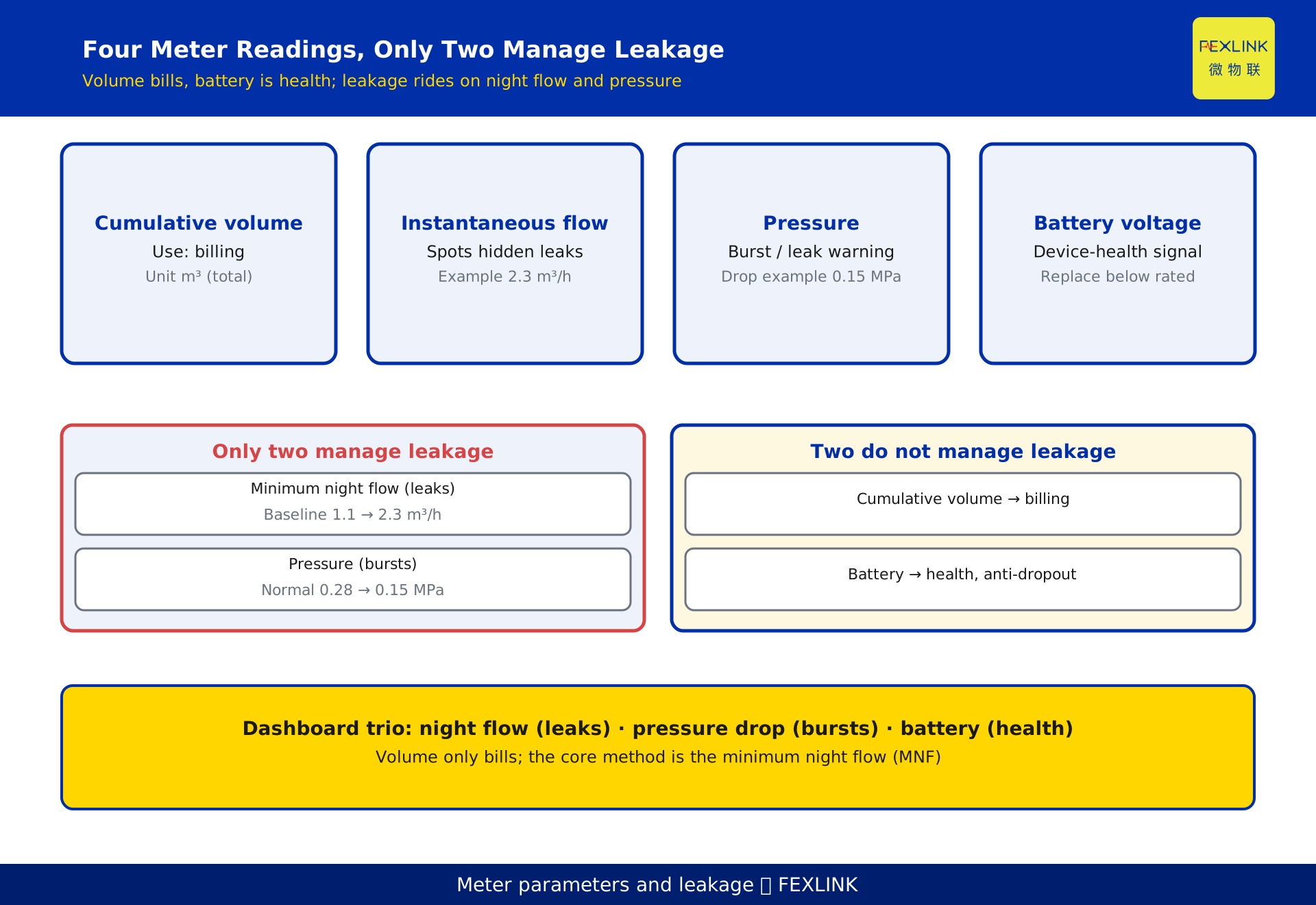
A smart water meter reports more than cumulative volume: it also shows instantaneous flow, pressure and battery voltage. Only two of these truly serve leakage management — minimum night flow catches hidden leaks, and pressure drops warn of pipe bursts. Cumulative volume is a billing figure, and battery voltage is a device-health figure; neither judges leakage directly. Operations teams should shift the dashboard from "cumulative reading only" to a trio of minimum night flow, pressure change and battery voltage, with the minimum night flow method at the analytical core.
1. What numbers actually appear on a smart water meter
A smart water meter — or the acquisition terminal that forwards its data — typically shows four classes of reading on its screen or in the device detail page of a water utility platform:
- Cumulative volume: total water used since installation or the last reset, in cubic metres (m³).
- Instantaneous flow / velocity: how much water is moving through the pipe at this moment, usually in m³/h.
- Pressure: the supply pressure inside the pipe, usually in megapascals (MPa) or metres of head.
- Battery voltage: the remaining voltage of the meter's supply battery, in volts (V).
Many property and utility operators read the screen like a totaliser — noting only cumulative volume for billing and skipping past the other three. That turns a terminal capable of warning of bursts and detecting hidden leaks into the cheapest possible mechanical meter. The sections below explain what each number is actually for.
2. Cumulative volume: for billing, not leakage
Cumulative volume is the legal basis for supply-contract settlement and tiered tariffs. Its value sits on the finance side: reconciliation, billing and cost allocation.
It is, however, almost insensitive to leakage. A slow, hidden leak may add only a few dozen cubic metres a month to the cumulative total, easily lost inside normal consumption swings. In other words, cumulative volume answers "how much to charge", not "is the network leaking silently". Pinning leak detection on the cumulative reading is the first misconception this article corrects.
3. Instantaneous flow: the real entry point for leakage control
Instantaneous flow is the true entry point for leakage management. It shows "how much water is moving right now", and leakage is fundamentally "water moving when it should not" — a broken pipe, an imperfectly closed valve, a permanently open hydrant all keep instantaneous flow non-zero when nobody is drawing water.
This is where the distinction from the companion article on diagnosing erratic water-meter readings matters. That article is about troubleshooting abnormal readings — communications, metering, installation. This article does not repeat that troubleshooting logic; it explains what each displayed parameter is for. Its incremental contribution is the minimum night flow method developed next.
4. The minimum night flow (MNF) method
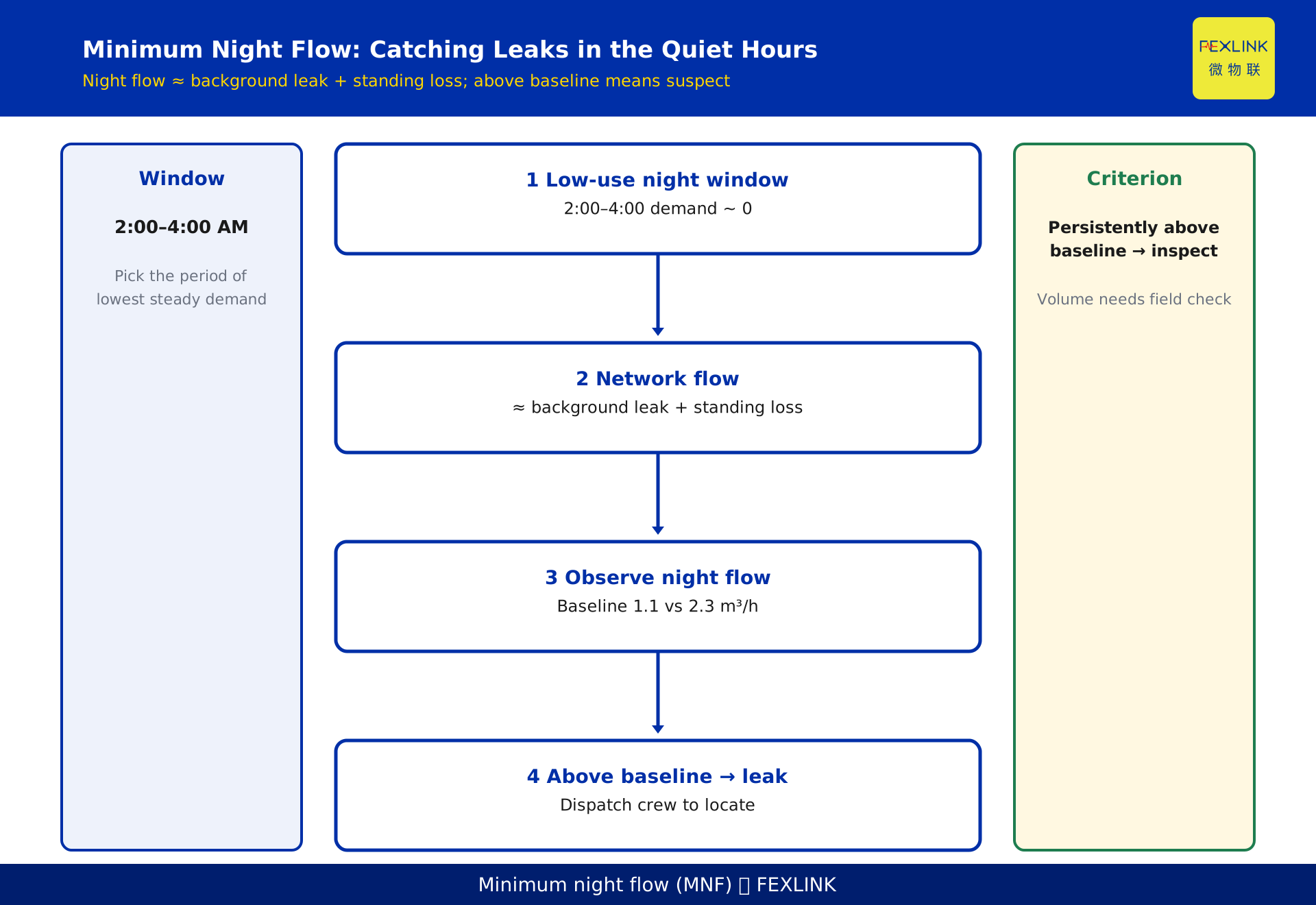
The industry-standard way to find hidden leaks in a DMA (district metered area) is the minimum night flow (MNF) method. The logic is plain.
During the low-consumption window at night (typically 2:00–4:00), most consumers are asleep and legitimate demand approaches zero. The flow still measured in the network then comes mainly from two sources — background leakage (normal minor seepage) and standing losses (valves not fully shut, hydrants left open, and so on). That "minimum flow" is the district's baseline.
If the night flow observed over several consecutive days stays persistently above this historical baseline, a new hidden-leak suspicion is raised and leak detection should be scheduled. Note: this article explains the method only; it gives no specific leakage-rate percentage, because the true leakage volume must be reconciled on site against pipe diameter, pressure and material.
5. A worked example: why a district's night flow alarmed
The following figures are constructed to illustrate the method and represent no real customer or project.
A water utility district is defined as one DMA, with a historical minimum night flow baseline of about 1.1 m³/h. Operators sampled 2:00–4:00 every night for a week and found the district's minimum night flow holding steady near 2.3 m³/h — roughly double the baseline. Under the minimum night flow method this already constitutes a hidden-leak warning, and a crew should be dispatched with acoustic and correlation equipment to locate the leak.
This example makes two points. First, a hidden leak need not move the cumulative volume dramatically, but it lifts the "should-be-quiet" night flow. Second, the judgement is "persistently above baseline", not some fixed threshold — baselines differ by district and pipe age.
6. Pressure: event warning for bursts and leaks
Pressure is the other leakage-relevant parameter, complementary to night flow. Under normal supply the network pressure fluctuates within a relatively stable band; when a burst or a large leak occurs, local pressure drops sharply.
In practice the sharp pressure drop is used as the burst-event trigger: a monitoring point falling from a normal 0.28 MPa suddenly to around 0.15 MPa often means a downstream break or major water loss. The value of pressure warning is speed — it signals the event before the leak grows or the road collapses, and combined with GIS pipe locations it narrows the search quickly. Pressure alone does not tell you how much is leaking, but it tells you "something happened".
7. Battery voltage: a device-health signal, not a leakage signal
Battery voltage is often misread as "a water parameter". It is in fact a device-health / supply-status signal. Smart meters are mostly battery-powered, and a steadily falling voltage means the meter is about to go offline or lose data.
The rule: when battery voltage falls below the manufacturer's rated threshold, replace the battery to prevent the device dropping off and interrupting acquisition. It must be stressed that rated voltage and replacement thresholds differ by model — no single fixed voltage value may be treated as a universal cutoff; the specific threshold follows that model's selection manual or manufacturer note. Battery voltage governs "is the data still there", not "is the network leaking".
8. What to put on the operations dashboard
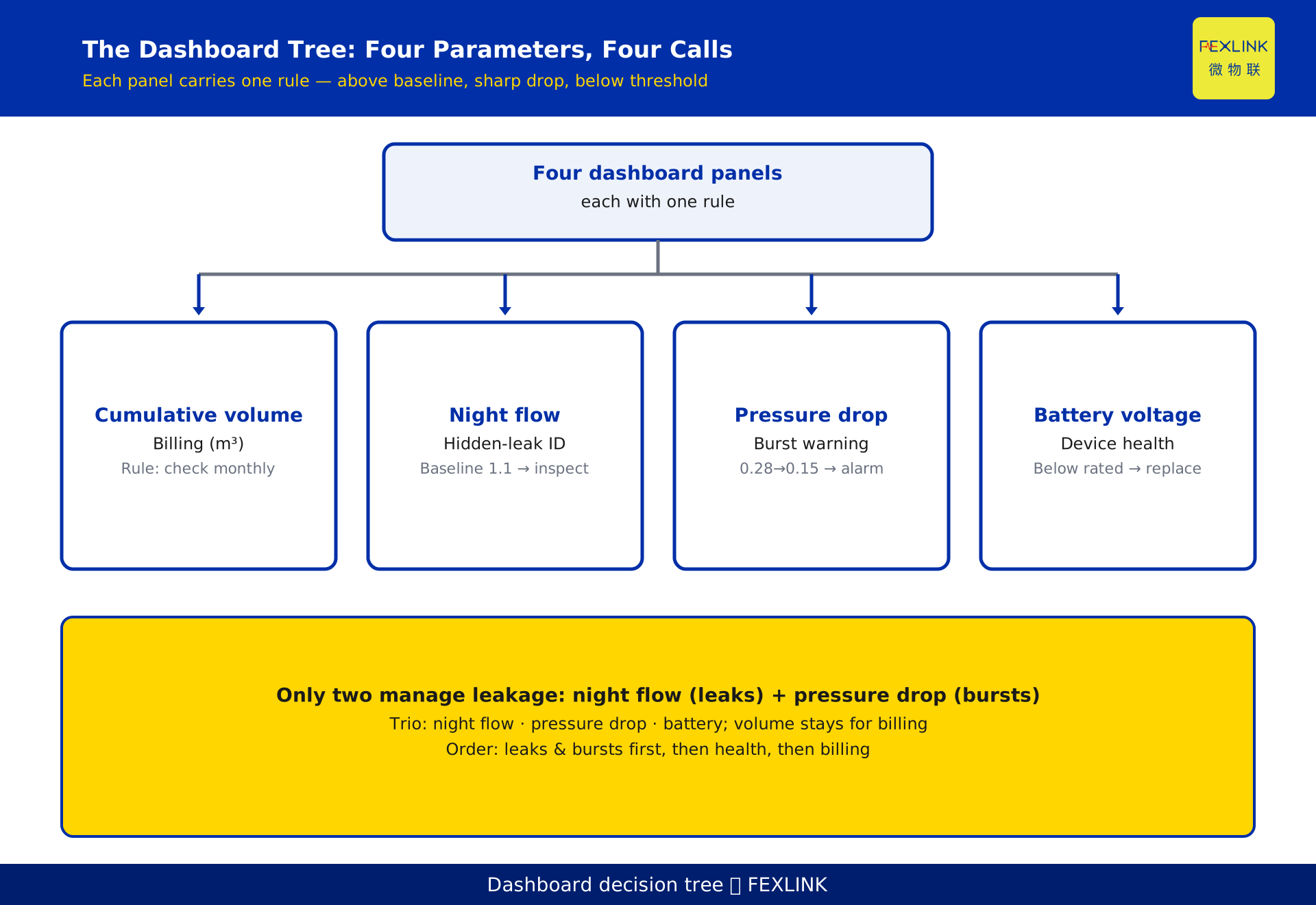
Translated into daily operations, the dashboard should not show only one big cumulative number. At minimum it should carry four panels:
- Cumulative volume — for billing and settlement; check monthly, investigate only on anomalous jumps.
- Minimum night flow — for hidden-leak detection; criterion: persistently above baseline triggers inspection.
- Pressure change — for burst warning; criterion: a sharp drop triggers an alarm, verify on site immediately.
- Battery voltage — for device health; criterion: below the manufacturer's rated threshold, replace, to avoid dropout.
One clear decision rule for operators: first thing each morning, check whether night flow is above baseline, then whether pressure shows a drop alarm, then confirm battery voltage is not below the replacement threshold. Only when all three are normal should you turn to cumulative volume for billing. Reverse the order and the real leakage signals get missed.
9. How the products fit in
Running this logic needs both endpoint acquisition and local computation.
The ESX edge computing gateway performs "water-and-gas co-sourced acquisition and edge computing": it gathers data from water meters, pressure gauges and similar instruments at one edge node and computes locally — for example the minimum night flow and its baseline comparison — without sending all raw data back to the centre, cutting bandwidth and latency.
The ESI digital-status monitor performs "device-state monitoring": it can watch digital signals such as the meter's low-battery alarm and valve open/closed state, bringing "is the device still alive" onto the same dashboard. Together they upgrade the four panels from "an operator scanning screens daily" to "the system judging automatically and pushing exceptions".
10. FAQ
Q: Can cumulative volume be used to find leaks at all?
Cumulative volume is a billing figure and insensitive to slow hidden leaks. On its own it only shows a total anomaly and cannot reveal a leak that "keeps running when it should be quiet". Real hidden-leak detection relies on the minimum night flow method, not the cumulative reading.
Q: Does the MNF method have to be measured at 2:00–4:00?
The 2:00–4:00 window is the common industry low-consumption slot, but the core is "pick the period of lowest, most stable legitimate demand", not rigidly those two hours. The specific window can follow the district's routine, as long as the baseline stays comparable.
Q: Does a small pressure dip mean I should go to site?
Not necessarily. Occasional small fluctuations are normal operation. What demands response is the "sharp drop" — pressure falling clearly outside its normal band in a short time, usually a burst or large leak — which should be verified immediately rather than waiting for the daily report.
Q: Below what battery voltage must I replace?
There is no single fixed value. Rated voltage and replacement thresholds differ by meter model and should follow that model's selection manual or manufacturer note. The principle is "replace below the manufacturer's rated threshold", not waiting until the meter dies and drops out.
Q: How does this differ from the companion article on diagnosing erratic water-meter readings?
That article handles "how to troubleshoot communications, metering and installation when readings are abnormal". This article does not repeat that troubleshooting; it explains what each displayed parameter is for and adds the minimum night flow method as the leakage-detection increment. The two are complementary: one treats "wrong numbers", the other "unused numbers".
Scope and limitations
- The business uses of the four displayed parameters — cumulative volume, instantaneous flow, pressure and battery voltage — apply to property and utility operations using IoT smart water meters and their acquisition terminals. Legacy mechanical meters without instantaneous and pressure reporting can use cumulative volume only.
- The minimum night flow (MNF) method is an industry-common DMA hidden-leak practice and a methodological summary; the true leakage volume requires on-site reconciliation against pipe diameter, pressure and material, and this article gives no specific leakage-rate percentage.
- The example figures (a district's night-flow baseline 1.1 m³/h, observed 2.3 m³/h; normal pressure 0.28 MPa, sharp drop 0.15 MPa) are constructed to illustrate the method, represent no real customer, project or district, and must not be used as an engineering basis.
- Battery replacement thresholds vary by meter model; this article gives, and should give, no fixed voltage cutoff. Specific values follow the latest selection manual and manufacturer note.
- The functional roles of the ESX edge computing gateway and the ESI digital-status monitor (water-and-gas co-sourced acquisition, edge computing, device-state monitoring) are product-capability descriptions; specific models, interfaces and electrical specifications follow the latest product knowledge base, and this article is not a selection or procurement recommendation.
- This article cites no standard number or clause; wherever thresholds or limits appear they are expressed as "follow the manufacturer / selection manual", and the conclusions are not mandatory technical provisions.
Frequently Asked Questions
Flow Rate, Pressure
A smart water meter reports more than cumulative volume: it also shows instantaneous flow, pressure and battery voltage