 FEXLINK Research Institute
The short answer
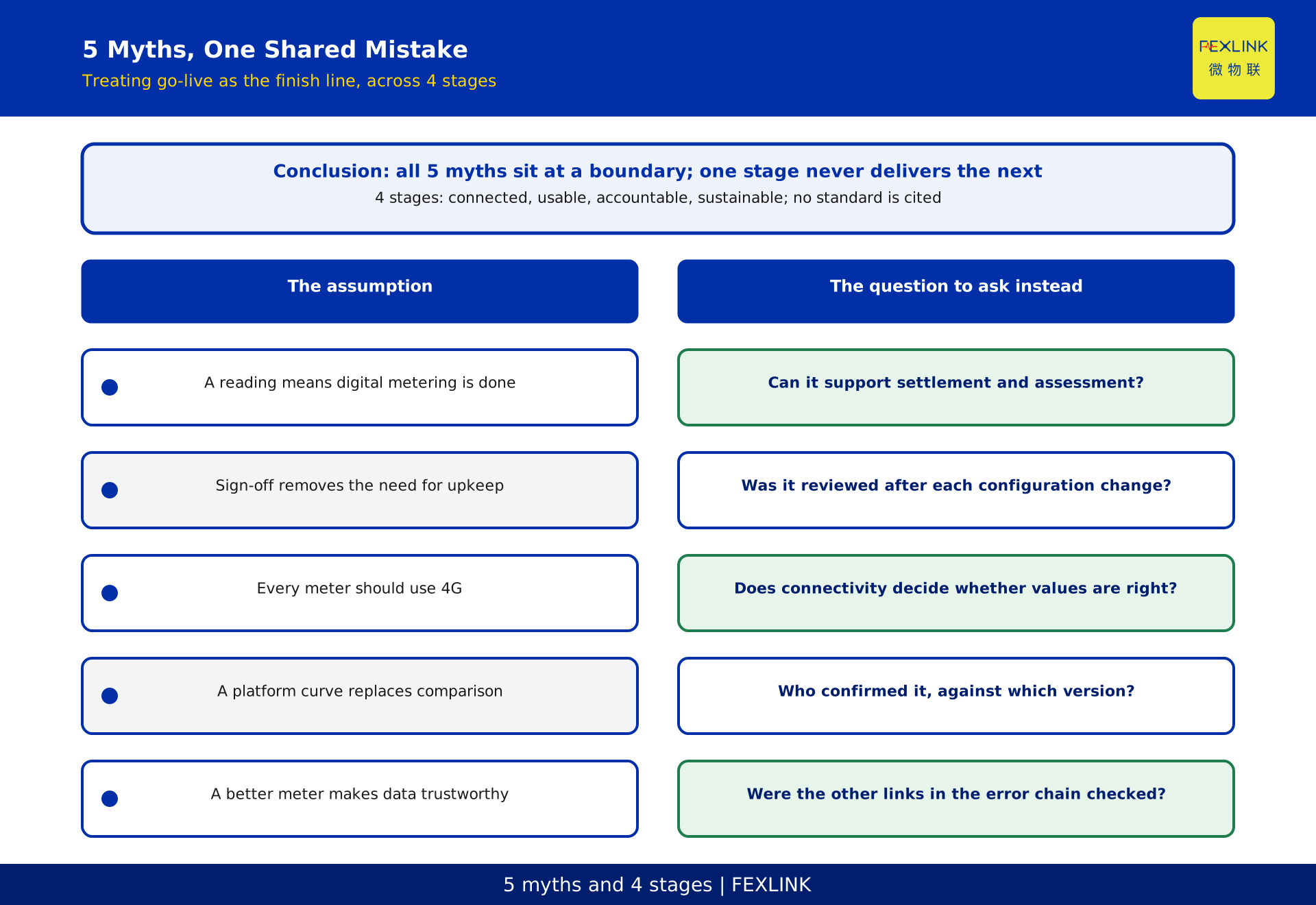
Getting readings out of the meters proves the link works; it does not prove that digital metering is finished. Teams new to automatic meter reading tend to fall into 5 assumptions: that a visible reading is usable data, that sign-off means no maintenance, that the networking choice decides success, that a platform curve is proof of delivery, and that meter accuracy equals system trustworthiness.
All 5 assumptions share one mistake: they treat go-live as the finish line. A more reliable frame is a 4-stage state chain: connected, usable, accountable and sustainable. Passing an earlier stage never automatically delivers a later one. The right posture is to put verification, reconciliation and change-triggered review into a closed loop before talking about scaling up to more meters and more sites.
What follows is a management-side judgement frame plus a way to leave records.
One. Turn digital metering from a delivery into a 4-stage state chain
The usual closing scene is familiar: meters installed, gateway online, a curve on the platform, a sign-off meeting, and the project is declared digital. Months later, when energy performance is reviewed, one circuit turns out to be unusable for accounting, and nobody can say which configuration version was used to confirm it.
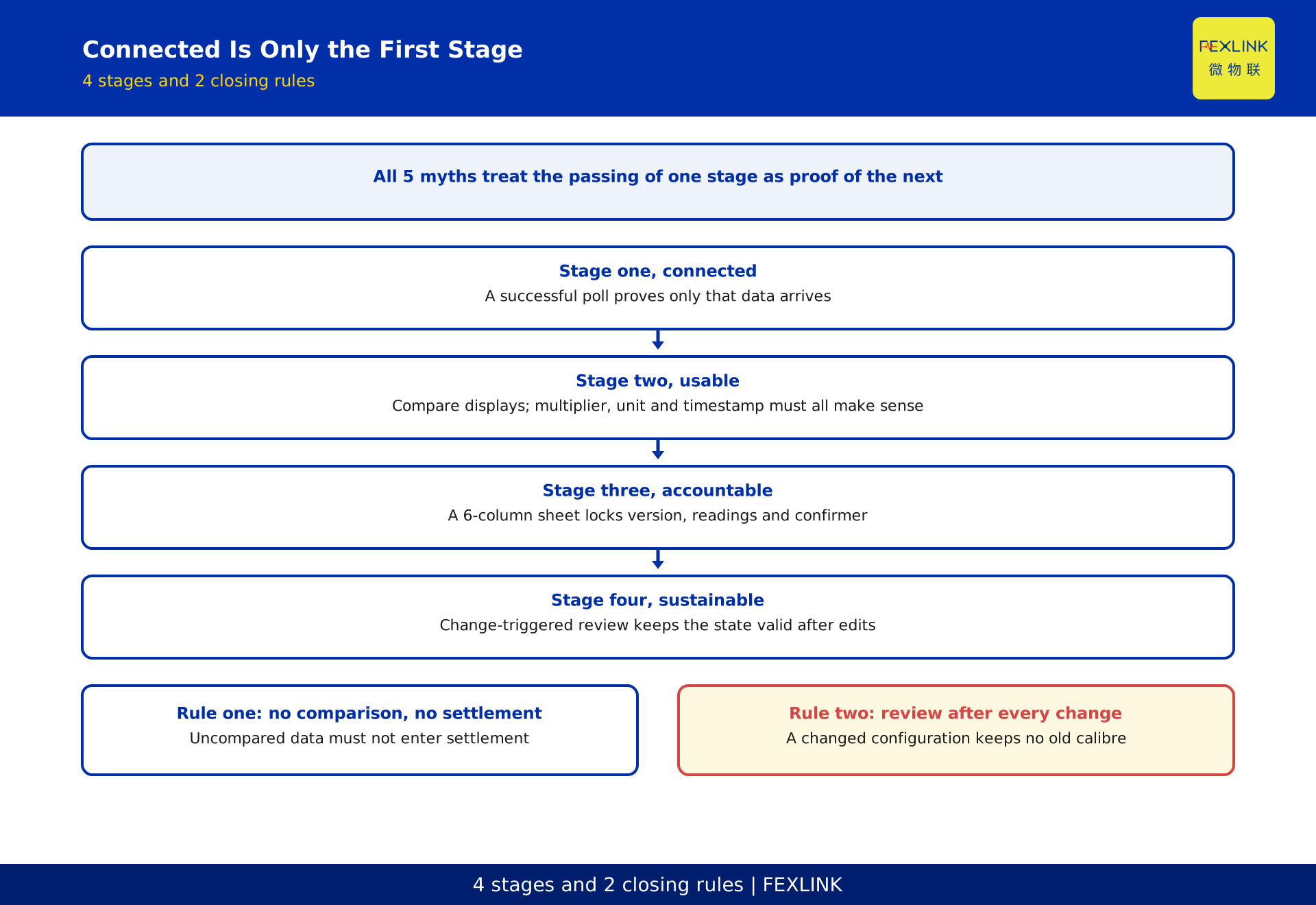
The root cause is confusing a project delivery with a data state. Rewrite the state as 4 stages. Connected means every meter can be read and the link is stable. Usable means the reading makes sense in quantity, multiplier, timestamp and ownership. Accountable means each critical reading has a confirmer, a configuration version and a retrievable record. Sustainable means the project can return to the earlier stages after a meter swap, a configuration change or a platform upgrade.
The 4 stages cannot be collapsed into one acceptance test. Connected is a technical question, usable a verification question, accountable a responsibility question, sustainable an operations question. Each of the 5 misconceptions below sits exactly at a boundary between stages: it treats the passing of one stage as proof of the next.
Two. Misconception one: collected data already means digital metering
"There is a curve" is the phrase that most reliably lowers everyone's guard. A curve proves the meter answers, the gateway forwards and the platform stores. It does not prove which circuit the number belongs to, whether the multiplier was applied, or whether the reading timestamp matches the accounting period.
The way to measure the gap is not to stare at the curve again but to ask three things: can this meter's reading be compared with its local display, one meter at a time; does the cumulative value only rise across a complete cycle with no isolated jumps; and when a report is missing, is the gap left visible or filled in. If any answer is missing, the state remains connected and cannot advance to usable.
Treating collection as completion defers the cost. Leave an observation window in the go-live schedule and close it with records rather than a screenshot.
Three. Misconception two: sign-off means no maintenance
Automatic reading removes the site visit and the manual entry. It does not remove the fact that configurations change. Meter replacement, a changed transformer ratio, a revised point list, gateway firmware, a new platform template, a switched uplink: any of these can quietly push an aligned mapping out of alignment again, usually without raising an alarm.
That is what makes the drift dangerous. Polling continues, the curve keeps refreshing, and from a certain day one column sits a step off or belongs to a different circuit. By the time monthly reconciliation notices, a whole stretch of history is in question.
The right posture is not "signed off, therefore finished" but "review attached to change". Whenever meters, multipliers, point lists or platform configuration change, keep a comparison record from before and after and state who confirms that the 4 stages still hold. With no change, sample checks still belong in the routine, rotating across circuits and focusing on cumulative continuity and configuration versions.
Four. Misconception three: every meter should be on 4G
A common instinct on a new site is that direct 4G on every meter is simplest: no cabling, no bus to manage. But the networking choice settles whether data arrives, not whether it arrives correct.
Most sites end up mixed: concentrated groups feed an uplink through a gateway, isolated points report on their own, and the decision rests on cabling cost, power availability and long-term access.
The point is narrower: do not turn the networking choice into the variable that decides whether digitalisation succeeded. Even with every meter steadily online, a missing mapping, multiplier, timestamp or sign-off keeps the state at connected. Connectivity is necessary, never sufficient; treating it as sufficient is exactly how the later stages get skipped at acceptance.
Five. Misconception four: a platform curve removes the need to compare meters
A curve is a display view; a ledger is a responsibility view. They are not interchangeable. The curve answers what the trend roughly looked like. The ledger answers who confirmed this number, when, against which configuration version, and how a discrepancy was handled. A dispute needs the second answer, and the second answer is not produced automatically.
Many teams treat meter comparison as something done only after trouble appears, so they keep platform data but no site comparison records. When a discrepancy finally arrives, there are no start and end readings and no version stamp, and nobody can tell whether the meter changed, the configuration changed, or the accounting period changed. The ledger is then rebuilt from memory.
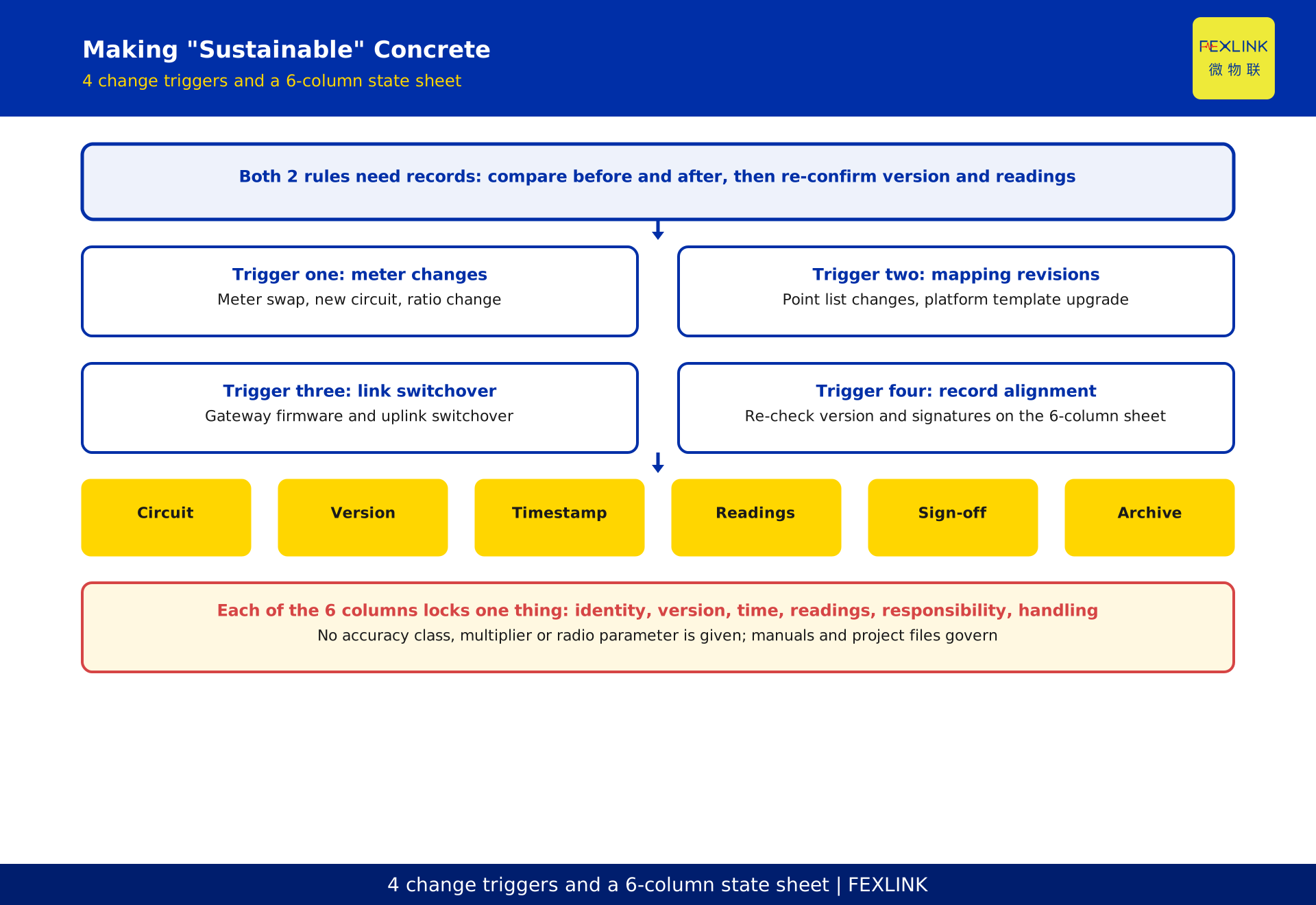
The minimum workable step is a 6-column state confirmation sheet for every critical circuit: circuit and meter identifier, point list and configuration version, comparison timestamp, start and end readings, confirmer and reviewer, discrepancy handling and archive location, signed row by row.
Six. Misconception five: a more accurate meter makes the data trustworthy
Meter accuracy is necessary, not sufficient. The error chain also includes transformer and multiplier settings, point mapping, engineering-value and unit conversion, timestamp alignment, gap and fill handling, and the platform's configuration version. If any link is wrong, the number reaching the report is wrong no matter how good the meter is.
A purchasing view often equates "more expensive, higher class" with "more trustworthy", confusing a device's performance with a system's data quality. An accuracy class describes the meter's own measurement capability under stated load and conditions; it constrains neither downstream configuration nor the accounting calibre. Choosing accuracy by purpose is reasonable, but after procurement the project still has to confirm all 4 stages.
This differs from device-side corrective commonplaces such as "pulses are not energy" or "price is not accuracy".
Seven. Why all 5 misconceptions fail at the same point
Put the 5 together and the pattern is clear. The first mistakes connected for usable. The second mistakes a moment of usable for lasting sustainable. The third mistakes a link condition for a guarantee across all 4 stages. The fourth builds a display view but never the accountable chain of responsibility. The fifth mistakes the performance of one link for the performance of the whole error chain.
The shared mechanism is a visibility mismatch. Link status is visible in real time, so it is easily taken for the state of everything. Ownership, calibre, responsibility and change history, which actually decide whether data can be used, are invisible in normal operation and surface only during a dispute. The acceptance meeting therefore always sees green lights, and the problem always arrives months later.
Reverse the mechanism and the right posture appears: give the invisible stages visible evidence, namely comparison records, configuration versions, named confirmers and change-triggered reviews. Evidence is not bureaucracy; it turns "can this number be used" into an answerable question instead of a collective act of recall. Digital metering then stops being a one-off delivery and becomes a state that can be maintained.
Eight. Criteria for the 4 stages and 2 closing rules
Each stage needs a criterion that can be judged on the spot. Connected: every row of the point list can be read individually, with no gaps and no wrong replies across a complete observation window. Usable: meter-by-meter comparison against the local display agrees, and multiplier, unit, direction and reading timestamp make sense. Accountable: each critical circuit has a 6-column confirmation sheet carrying the version, start and end readings, confirmer and discrepancy handling. Sustainable: change-triggered review exists and sample records can be retrieved.
There are only 2 closing rules: data that has not been compared must not enter settlement or performance assessment; a configuration that has not been reviewed after a change must not be assumed to keep the old calibre. The second stops silent drift after sign-off.
Give the criteria stage by stage. A screenshot or one full polling round cannot cover all 4 stages, and the criteria should not be turned into a one-time acceptance form either. Connected and usable can be frozen inside the go-live window; accountable and sustainable have to keep producing records through routine governance.
Nine. A change-triggered review list and the 6-column sheet
The cheapest way to make sustainable concrete is a short trigger list: meter replacement or a new circuit, transformer ratio changes, a revised point list or mapping, a platform template or calibre upgrade, gateway firmware and uplink switchover. When one of these occurs, keep a comparison before and after, and re-confirm the configuration version and start and end readings on the state sheet.
Define the 6-column sheet as circuit and meter identifier, point list and configuration version, comparison timestamp, start and end readings, confirmer and reviewer, discrepancy handling and archive location. The first two columns lock identity and version, the middle two lock comparison and responsibility, the last locks what went wrong. It does not conflict with a commissioning ledger: that is a one-time per-meter sign-off at handover, while this is a continuing state record after every change, and the version stamps in both must be traceable to each other.
An anonymised site: a park reviewing energy use half a year after go-live found one building's cumulative value a step off from a certain week onward. Rather than editing a platform coefficient first, the team opened the state sheet and found a gateway template upgrade in that week; the comparison record showed the multiplier column had been reset. They re-checked it against the manual, kept the record, and archived the handling calibre for the affected interval. What solved it was the paper trail, not a fresh commissioning pass.
Frequently asked questions (FAQ)
Q: The platform already draws curves and reports. Why is that not digital metering yet?
A curve proves the link works and the platform can store and plot. Whether the data can support settlement and assessment depends on ownership, multiplier, timestamp and sign-off records, none of which a curve shows.
Q: We compared every meter at acceptance. Do we still need periodic comparison?
Yes. Meter swaps, ratio changes, point list revisions and platform upgrades can push an aligned configuration out of alignment again, often without an alarm. Attaching review to changes is cheaper than rerunning everything on a fixed schedule.
Q: Is the simplest network always best, for instance connecting every meter directly?
Networking decides whether data arrives, not whether it is correct. Concentrated and scattered points differ in cabling cost, power and long-term access. This article gives no selection advice and no communication parameters.
Q: If the accuracy class is higher, can we do less verification?
No. An accuracy class describes the meter's own measurement capability, while the error chain also includes multiplier, mapping, unit, timestamp, gap filling and configuration version. A fault in any link distorts the stored data. No class values are listed here.
Q: How is a 6-column state sheet different from a commissioning ledger?
A commissioning ledger is a one-time per-meter sign-off at handover; a state sheet continues the record after every change. The first proves it was right at that moment, the second proves it stayed right. Version stamps in both should cross-reference.
Scope and limitations
This article applies to campus and building projects that have just deployed or are about to deploy automatic meter reading, and to energy managers and owners new to such systems, assuming meters, gateways and platform are already connected. It offers a management-side judgement frame and a record-keeping method, not a field commissioning manual.
It excludes single-meter protocol parsing, cabling and construction, layered data validation frameworks, discrepancy diagnosis and networking selection; each has its own dedicated article. No standard numbers or clause numbers are cited and no conformity judgement is made. No accuracy class values, multiplier values, communication parameters, polling cycle lengths or sampling ratios are given; device manuals, project point lists and design documents govern. Gateways, platforms and control systems appear only as roles along the meter-to-gateway-to-platform chain, and product names are neither a selection recommendation nor an acceptance basis. All comparisons require on-site verification and records should be signed and archived by suitably qualified personnel; the anonymised site is a flow example, and where project documents differ, those documents prevail.
Frequently Asked Questions
"Collected Data Means Digital Metering
Getting readings out of the meters proves the link works; it does not prove that digital metering is finished