 FEXLINK Research Institute
The short answer
Meters from another vendor are on site, and in most cases they can stay. Whether their data reaches your platform depends not on brand but on a port an external device can read, plus an available protocol and point list. With both, a gateway brings them in; with no port, no gateway will invent data.
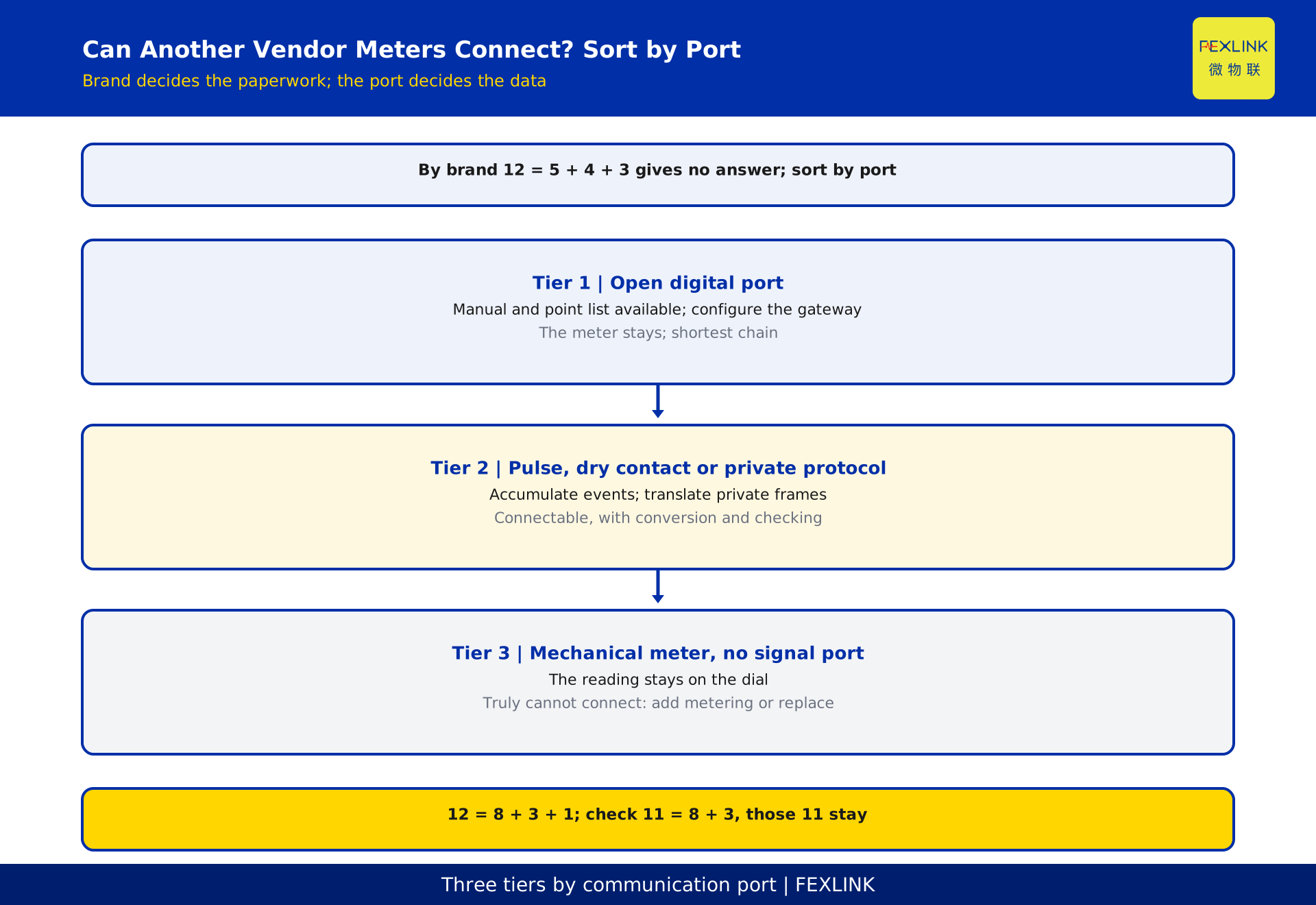
This article gives one checkable rule: sort installed meters into three tiers by communication port, choose a path per tier, and only then discuss replacement. Grouping by brand is wrong; grouping by port is right. One brand may contain both directly readable and pulse-only meters, while two brands can share a bus if both expose the same digital port. Only one tier truly cannot connect: a mechanical meter with no external signal port. Elsewhere replacement is a choice about new functions or metering compliance, not a precondition for integration.
1. Ask the right question: port and protocol, not brand
"The device is from another supplier, so it cannot be connected" merges two matters. Brand decides who writes the factory point list; integration decides whether an external device can extract a reading under an agreed rule. One is commercial, the other technical, with no necessary link.
When a multi-brand distribution room joins a platform, the complaint that "everyone speaks a different language" rarely comes from the vendors. It comes from different port forms, different protocols and point lists never reduced to one written convention. Using brand as the axis groups a directly readable meter with a pulse-only meter from the same supplier, and splits two meters from different suppliers that expose the same digital port. Either mistake turns configuration into a replacement budget.
So change the first question: ask whether a readable port exists, what protocol it speaks, what sits in each register position, and whether any of it is in writing. With answers, only configuration remains; without them, discuss touching the meter.
2. Three tiers, sorted by port rather than brand
Sorting installed meters by connectability makes the conclusion stable.
Tier 1 has an open digital communication port: an accessible bus port, an obtainable protocol manual and point list, and a device that can poll each meter under an agreed rule. These meters stay; a gateway configured from the point list brings them in.
Tier 2 has only a pulse or dry-contact output, or a private protocol needing conversion. Data leaves as a count event or a private frame, not a database-ready engineering value. One more layer is needed: a collector totals the events, or a gateway translates the private protocol into recognised data points. It connects, at the cost of extra conversion and checking.
Tier 3 is a purely mechanical meter, or one with a display and buttons but no external signal port. The reading exists only on the dial. This is the only tier that truly cannot connect: add separate metering or replace the meter.
The only boundary: can data leave the case and be interpreted? Brand and price are not part of the test.
3. Connecting Tier 1: with the port and the paperwork, the meter stays
This tier is easiest, but not unprepared. Three documents must be secured: the protocol, an address and parameter register for every device on the bus, and that model's point list. The protocol decides the request, the register whom to ask and at what rate, and the point list how returned words become engineering values.
With all three, the gateway polls each meter and maps register contents into platform fields without turning a screw. With one missing, the site guesses addresses and scaling factors.
The common misreading is that a shared protocol implies a shared point list. A protocol specifies how to ask and answer, not what sits in each position; two models with the same port often use different scaling or byte order. Preparation lands on the point list, not the brand or a replacement list.
4. Connecting Tier 2: turn events into counts, then counts into values
A pulse or dry contact reports that something happened once, not a reading. A collector records each transition as a timestamped event, and the platform converts and accumulates them using that meter's factor from the nameplate and vendor documentation. The total must not roll back after power loss, restart or a collector swap; only then is there a usable energy series.
With a private protocol the port and frames exist, but the frame structure has no published basis. Either the gateway translates from vendor documentation, or another device converts the frames into standard data points. Without documentation the only option is capturing frames and reading by trial, which belongs to a parsing workflow rather than this judgement.
The cost is clear: one more device, conversion and register. Far below replacing the population, it must appear in the quotation and schedule.
5. Why Tier 3 cannot connect: the data never leaves
Three things are routinely mistaken for ports: a display, a card or keypad, and remote or local control. A display moves the dial onto another medium; a keypad or card is person-to-meter interaction; a control action travels from the system to the meter, opposite to data return. All three can coexist with a genuine port, but none proves data gets out.
For this tier, adding a gateway, changing the platform or tuning parameters produces no readings. Two routes remain: add separate metering on the circuit, or replace the meter with one that has a signal port. The first leaves the original alone; the second also settles metering and integration. Choosing between them belongs to a retrofit plan, not a connectability judgement.
Close with one action: if no external signal port appears on the case, wiring or manual, record Tier 3 and stop assigning gateway points.
6. Three paths: direct read, protocol conversion, pulse collection
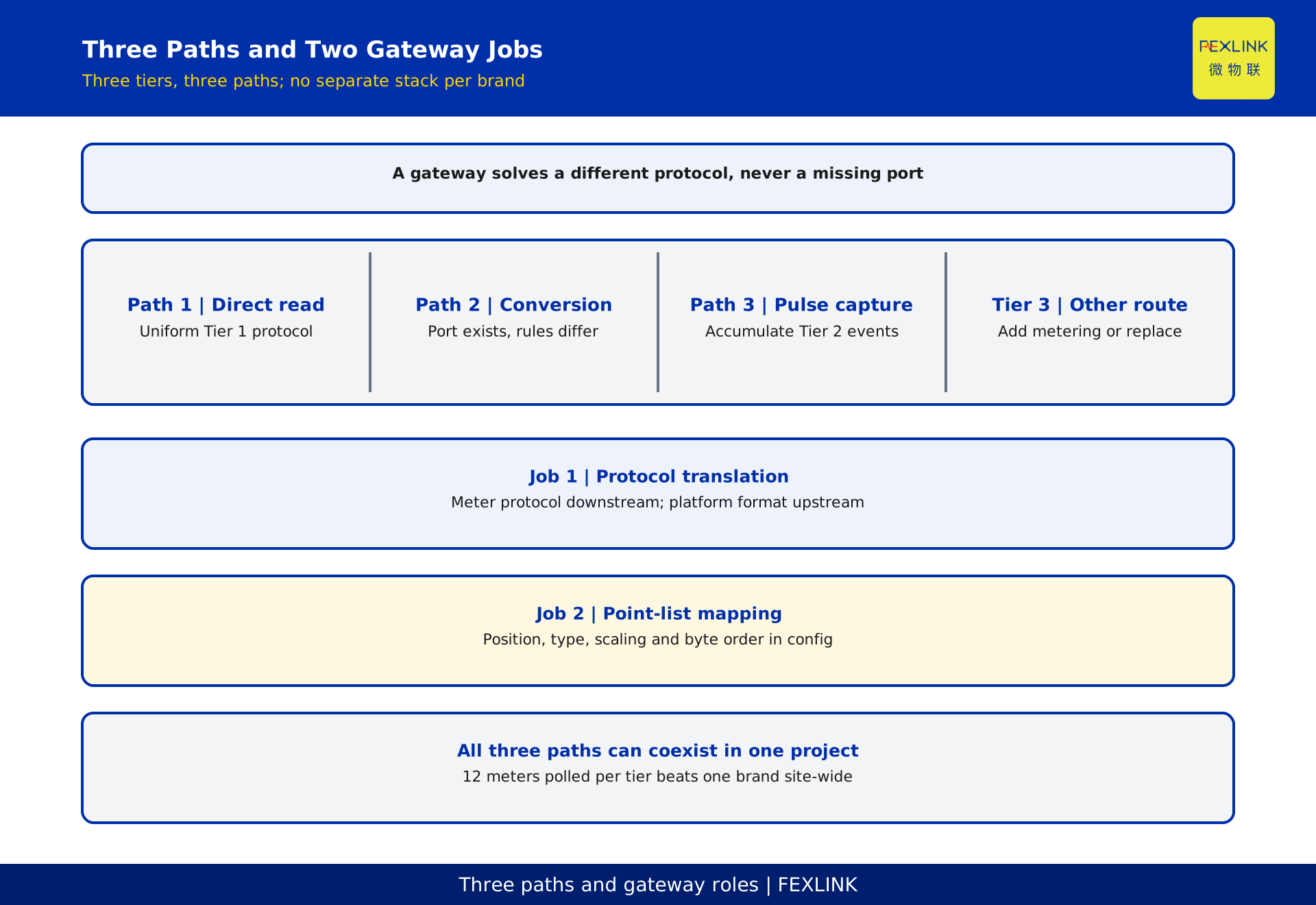
The three tiers map to three paths, with no need to build one stack per brand.
The first is direct reading over a digital port. The meter speaks a protocol the platform can parse, and the gateway polls from the point list and forwards the result. This shortest chain suits Tier 1 meters with a uniform protocol.
The second is protocol conversion. When protocols differ, the gateway reads each device in its own protocol downstream and emits a unified data model upstream. It solves "different languages", not "no port"; point lists still need checking device by device.
The third is pulse collection: an event accumulated into a value by a collector before reaching the platform, suiting Tier 2 meters with only a dry contact.
All three paths can coexist in one project; a gateway serving several bus segments and a few pulse inputs is normal. Writing them side by side beats requiring one brand site-wide.
7. What the gateway does: protocol translation and point-list mapping
Calling a gateway a translator covers only half the job.
The first half is protocol translation: downstream it exchanges frames in a protocol the meter understands, upstream it delivers the format the platform expects. Each side keeps its own rules; neither meter firmware nor a per-model platform parser is needed.
The second half is point-list mapping: configuring which position of which meter is interpreted with which type, scaling and byte order, so returned words become engineering values with units. This almost always consumes the time in multi-vendor projects, because protocols can be unified while point lists stay device-specific.
Separating the two separates responsibility. Translation is covered by gateway capability; mapping requires written evidence from that meter. Without a point list, the strongest gateway reads only numbers; with a point list but an unsupported protocol, the gap is device capability, not the meter. Gateway selection and sizing belong to a neighbouring article; this one stops at who must supply what.
8. When replacement is genuinely required
Separating integration from replacement leaves four reasons to touch a meter.
The first is Tier 3: no external signal port where automatic reporting is required. The second is metering compliance: an expired calibration period, unsuitable accuracy, or a settlement-boundary meter with specific requirements; unrelated to connectability. The third is a functional gap: remote control, demand, sub-metering or load profiles the meter never produces, since a gateway cannot invent measurements. The fourth is missing paperwork: neither manual nor point list obtainable, and separate metering infeasible, so replacement beats open-ended trial reading.
Outside those four, replacing a population because "it is not ours" turns a commercial question into a technical conclusion. A device-by-device survey often shrinks the replacement count to a handful.
9. Worked example and a four-column register
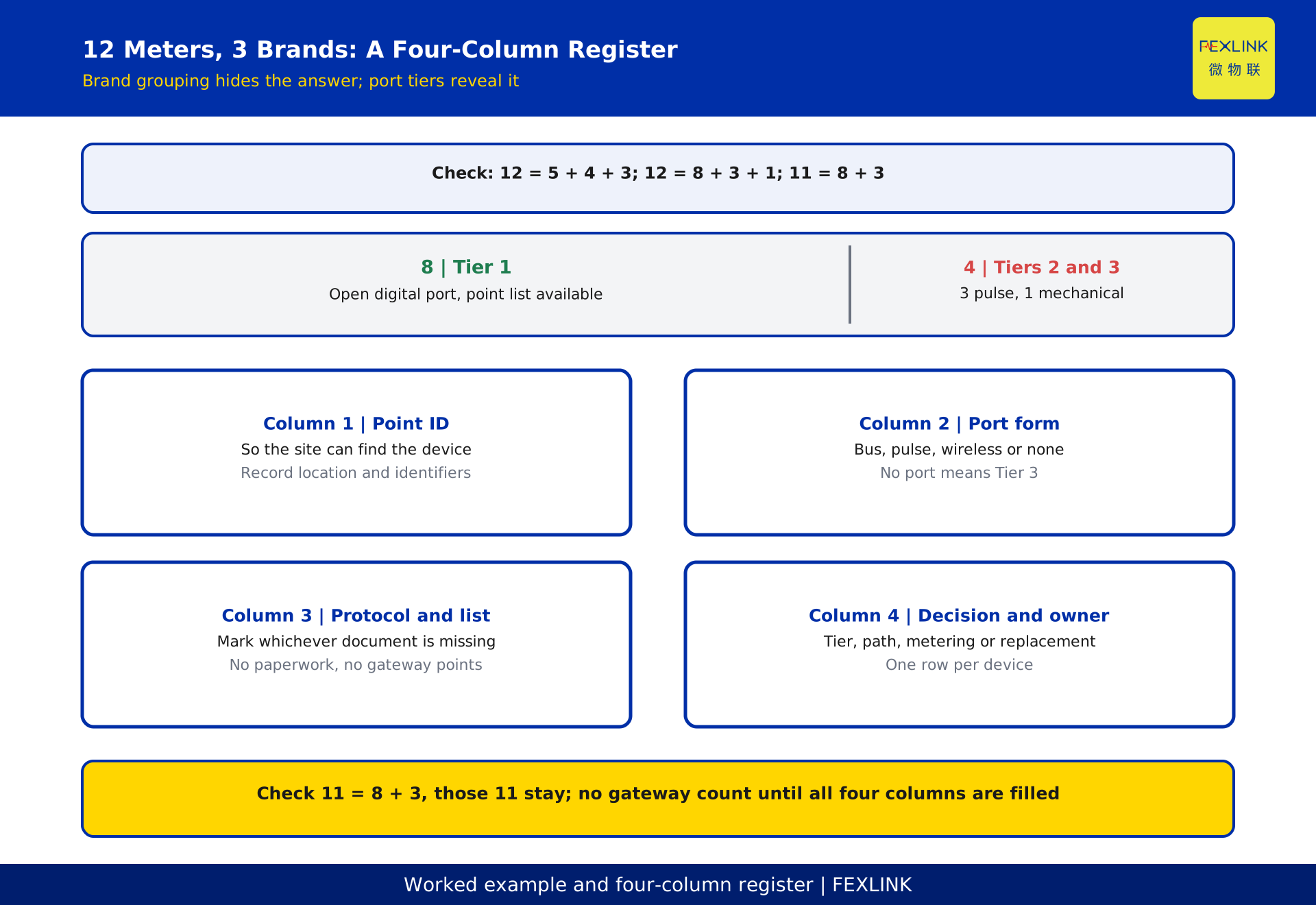
A distribution room had 12 installed meters from 3 brands, and the owner wanted all of them on a self-hosted platform. The first proposal replaced the entire population. Grouping by brand gave 12 = 5 + 4 + 3, which says nothing about connectability. Regrouping by communication port gave 12 = 8 + 3 + 1: 8 in Tier 1 with an open digital port and an available point list, 3 in Tier 2 with only a passive pulse contact, and 1 in Tier 3, a purely mechanical meter.
Check the arithmetic: 11 = 8 + 3, and those 11 needed no replacement; only 1 meter had to be addressed. Brand and tier cross: of the largest brand's 5 meters, some are Tier 1 and some Tier 2, so grouping by brand lumps unlike cases together.
On the first day, 2 of the Tier 1 meters stayed offline. Neither was faulty: 2 agreements were missing, namely that model's point list, which had not shipped with the goods, and the address and rate entries for those two devices in the communication register. Once supplied, all 8 replied; the 3 Tier 2 meters came in through collector conversion; the 1 Tier 3 meter produced data through separate metering without replacing the original. The criterion throughout was the port, the protocol and the point list, not who built the meter.
Put that judgement on one sheet, four columns and one row per device. Column 1 records the point and identifying information. Column 2 records the port form: bus, pulse or dry contact, wireless, or an explicit "none". Column 3 records protocol and point-list availability, marking whichever is missing. Column 4 records the tier, path, whether separate metering or replacement is needed, and who owns it. Until all four are filled, do not quote a gateway count. The register turns "apparently connectable" into which device, by which route, on whose evidence. All figures are constructed, anonymised examples with no customer, location, project name or pricing.
Frequently asked questions (FAQ)
Q: Does a meter from another supplier always keep its protocol closed?
Not necessarily. Openness depends on the model and contract, not ownership: many meters carry a standard digital port and ship with protocol documentation and a point list, though one supplier may ship models with different conventions. Check the port and paperwork first.
Q: Once a protocol-conversion gateway is installed, can any meter be connected?
No. A gateway translates frames that already exist; a meter without a port produces none. Tier 3 needs separate metering or replacement first. A gateway solves "a port exists but the protocol differs", never "there is no port".
Q: Does a pulse meter count as connectable?
Yes, with one more stage. A pulse supplies only a count event, so a collector must accumulate it, apply the conversion factor, and hold the total through power loss and restart. That places it in Tier 2, with different costs from Tier 1.
Q: Can different brands share one point list?
Not by rule of thumb. Protocols can be unified, but a point list is device-specific: position, type, scaling and byte order must be checked against that model's manual. The mapping method belongs to a neighbouring article.
Q: When is a full replacement actually justified?
When most meters are Tier 3, metering compliance has expired, the project needs data the originals never produce, or protocols and point lists are broadly unavailable and separate metering impossible. Replacing a population merely because the platform never recognised the badge is usually unfounded; survey first.
Scope and limitations
This article is a conceptual judgement about multi-vendor integration: three tiers by communication port, three paths, the split between protocol translation and point-list mapping, four cases requiring replacement, and a four-column survey register. Gateway selection and sizing, frame capture for an unfamiliar meter, cross-brand point-list mapping, post-integration fault diagnosis, and the distinction between DL/T 645 and other protocols each belong to a neighbouring article.
No standard clause numbers, fixed baud settings, address ceilings, termination resistances, point-count capacities, pulse factors or gateway device limits are given; engineering values come from device manuals, vendor point lists, contracts and current project documents, and configurable options follow the latest selection guide. This is not a selection or purchasing recommendation. The figures of 12 meters, 3 brands, 12 = 5 + 4 + 3, 12 = 8 + 3 + 1, 11 = 8 + 3 and 2 missing agreements are constructed, anonymised examples. This article is DRAFT_PENDING_REVIEW and requires independent review before publication; the generator does not self-approve.
Frequently Asked Questions
You Already Have Other Brands of Meters
Meters from another vendor are on site, and in most cases they can stay