 FEXLINK Research Institute
The short answer
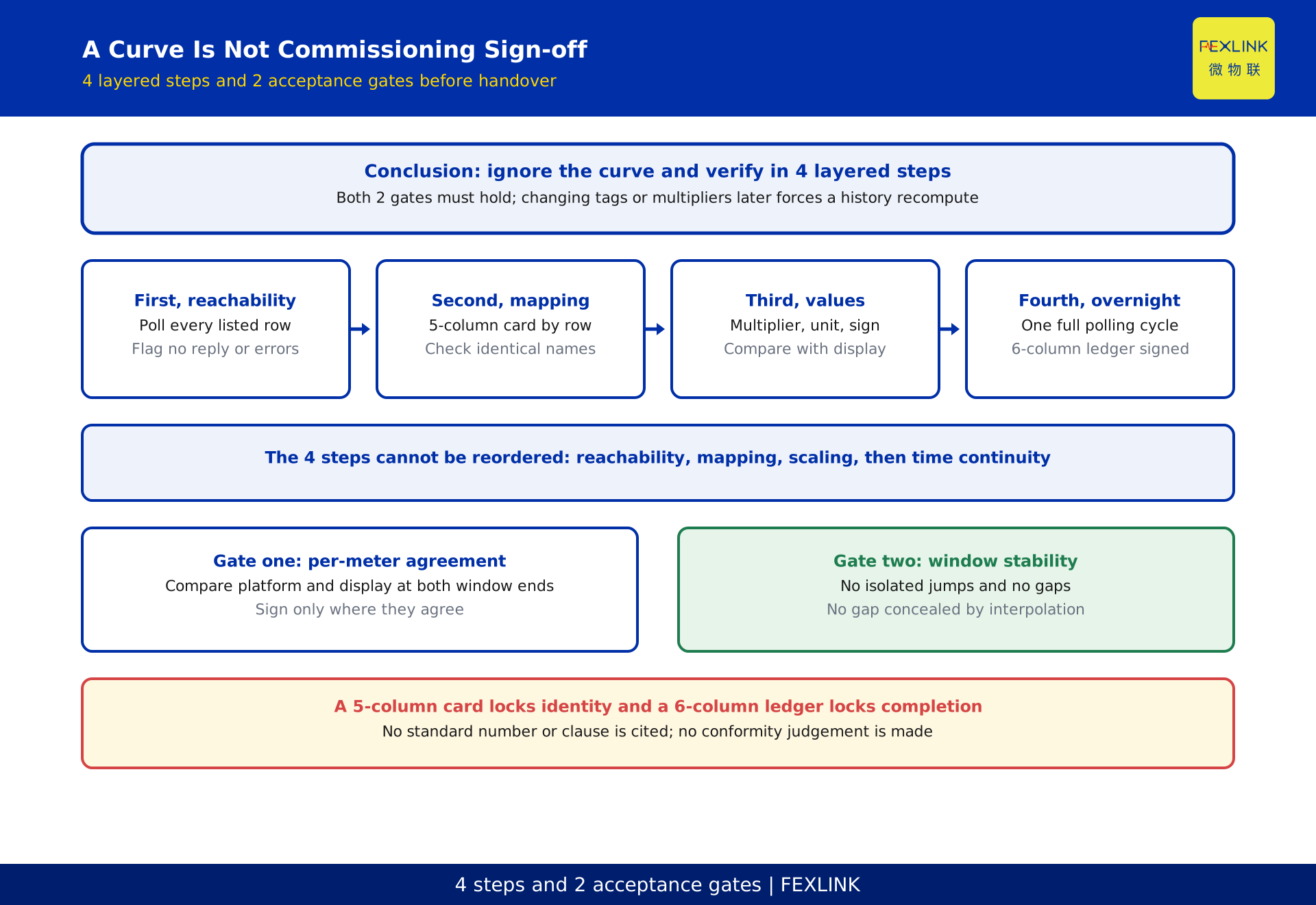
Powering up the meters and the gateway, then seeing a curve on the platform, does not mean commissioning is complete. Bring a batch online in 4 ordered steps: confirm the gateway can poll every meter, align the register point list with platform tags row by row, verify engineering values, units, multipliers and direction, then observe a full polling cycle overnight.
There are 2 acceptance gates. Platform readings must match the meter display unit by unit, and the curve must show no isolated jumps and no gaps across one complete polling cycle. Only when both hold should the batch be handed to operations.
The expensive failure is not "no data" but "wrong data that looks plausible". A mapping error can attach one circuit's energy to another; a missed multiplier or an inverted direction still produces a clean, alarm-free curve.
What follows is a commissioning sequence you can execute and sign off, delivering a 5-column mapping check card and a 6-column acceptance ledger.
One. Turn "the platform has data" into 4 commissioning steps
The usual site routine is short: power the gateway, scan addresses, see a curve, paste a screenshot into the project chat, and call the job done. Weeks later, during energy reconciliation, someone notices that a few meters read a whole scale off, or that a circuit is quietly reporting another meter's energy.
The root cause is treating "data exists" as "data is right".
The 4 steps cannot be reordered. Reachability sits at the physical and addressing layer, point mapping at the semantic layer, engineering-value checks at the numeric layer, and overnight observation at the time layer. Skipping ahead means every later step pays for an earlier one, and the bill grows with the number of meters already connected.
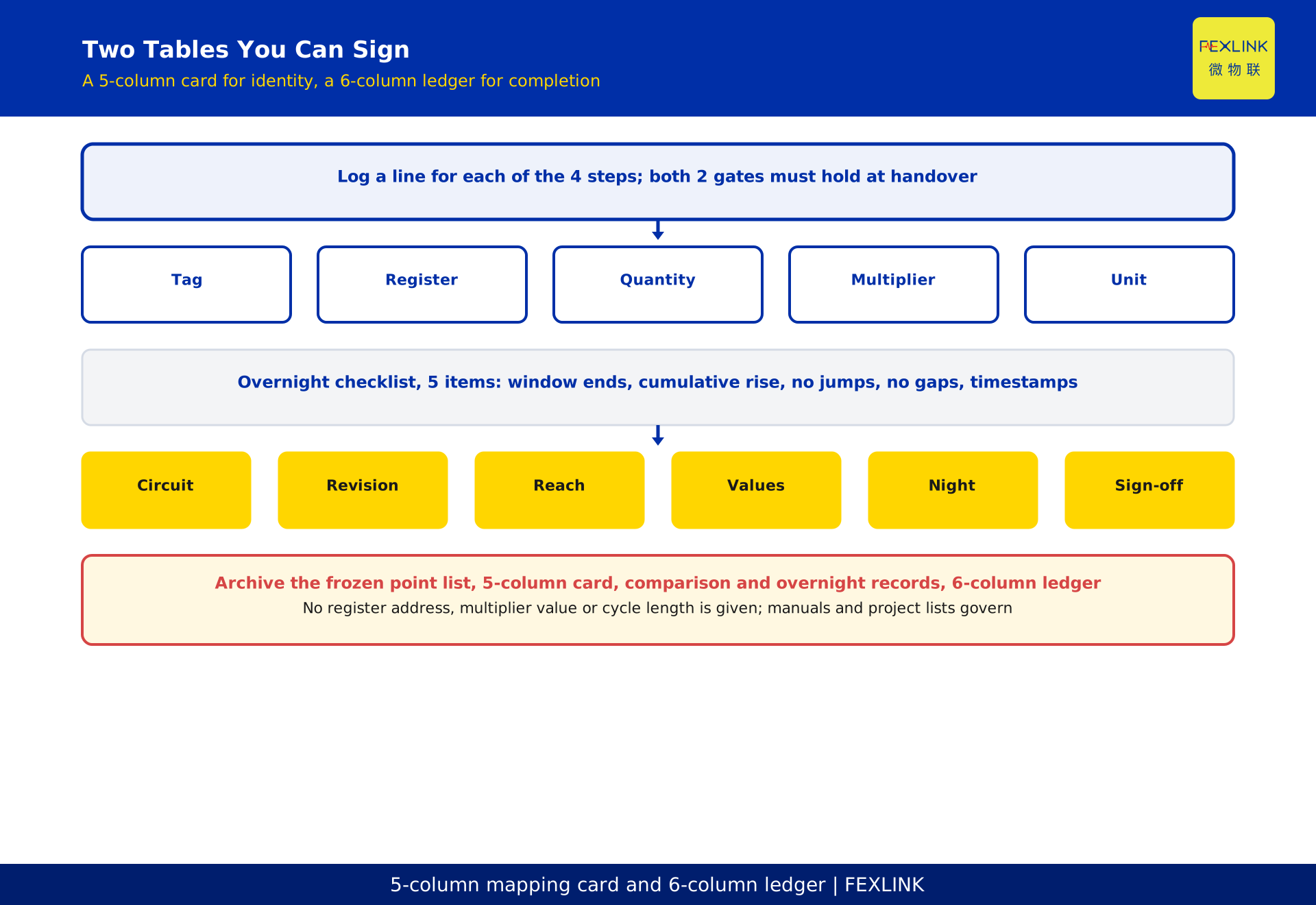
Each step is three things: the action, a pass criterion judged on the spot, and a record line. "It's tuned" then becomes several lines anyone can audit. Two artefacts are produced: a 5-column mapping check card filled in tag by tag during commissioning, and a 6-column acceptance ledger signed meter by meter at handover.
Two. Step one, reachability: prove the gateway can poll every meter
Walk the point list delivered by the installation team and poll every row. Record each response in one of three states: valid reply, no reply, or wrong reply. Skip nothing.
When a row gives no reply, go back to the physical link and the address: terminations, address conflicts, and whether parameters match the site parameter card. Do not delete the row in the platform or substitute an address to route around it. That hides an installation defect inside a configuration, and it returns as intermittent gaps overnight.
The pass criterion: every row can be polled individually, and one full sweep produces neither a no-reply nor a wrong-reply result. Record the point-list revision, per-row results and the disposition of any exception. This step verifies reachability only; it does not re-pull cable or re-assign addresses. If reachability fails, work returns to the installation workstream, so acceptance responsibility stays clear.
Three. Step two, point mapping: align registers, quantities and tags
Fill the 5-column mapping check card row by row: tag name, register address, quantity, multiplier, unit.
Insist on row-by-row alignment rather than a bulk import followed by a spot check. A bulk import typically shifts somewhere in the middle, after which an entire column is offset, and a spot check rarely lands on the affected rows.
Watch for identical names with different meanings. Different meter models may place "total active energy" and "forward active energy" at different registers, and a legacy platform template may carry older naming. A matching label is not a matching quantity.
The pass criterion: pick any tag, and the platform value must make dimensional sense against the raw register value; every card row has a source and a reviewer. Record the card revision and source manual revision. Frame structure, byte order and protocol trial reads belong to the single-meter parsing workstream.
Four. Step three, engineering values: multiplier, unit and direction together
Between a raw register value and a platform engineering value sit 4 things: multiplier, unit, direction and decimal scaling.
Check the multiplier against both the instrument transformer ratio on site and the platform configuration, and be explicit about where the ratio is applied. If the meter already applies it and the platform applies it again, every reading is scaled up; if neither does, every reading is scaled down. Both are obvious in a display comparison and invisible without one.
Direction must match how the circuit is wired. Reversing import and export may stay invisible on a pure load circuit for a long time and surface immediately where export or generation exists; record the decision rather than leaving it embedded in a configuration field.
The pass criterion: compare platform value against the meter display on site, meter by meter, and sign only where they agree. Log the object, timestamp and person, plus multiplier source, unit conversion, direction confirmation and per-meter results. This article covers getting it right the first time; working backwards from an existing reconciliation gap is a separate workstream.
Five. Why "reachable" is not the same as "correct"
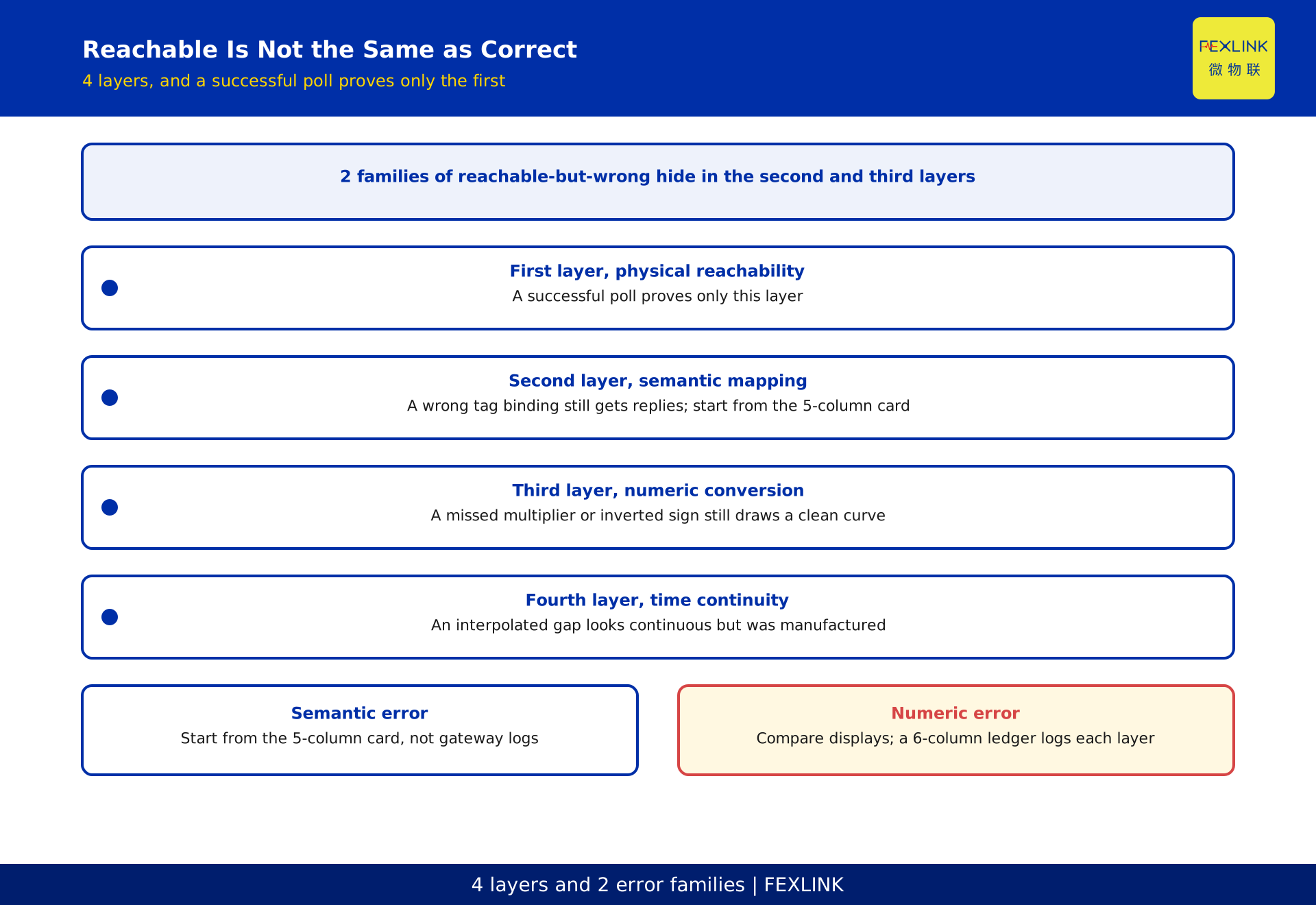
Split the online path into 4 layers: physical reachability, semantic mapping, numeric conversion and time continuity. A successful poll proves only the first. Mapping errors, missed multipliers and inverted direction all occur in the second and third layers, which are entirely transparent to the communication layer: frames still get replies, the gateway still parses values, the platform still stores them and still draws a curve. No communication alarm is raised.
That is why "reachable but wrong" never arrives as a fault. It surfaces weeks later in reconciliation, billing or a year-on-year report as "roughly right, but something feels off".
The fourth layer is subtler. If a meter misses one report and the platform interpolates a point, the curve looks continuous even though that segment was manufactured rather than collected.
This gives 2 families of "reachable but wrong": semantic errors, where a tag is bound to the wrong circuit or quantity, and numeric errors, where one of multiplier, unit, direction or decimal scaling is wrong. Both leave the communication layer green; they differ only in where diagnosis should start. Commission layer by layer, give each layer its own pass criterion, and never let the fact that a curve exists stand in for all 4 layers.
Six. Step four, overnight observation: what to watch across one full polling cycle
The first three steps are instantaneous checks. They prove the system was right at that moment.
The observation checklist has 5 items: compare platform value with the meter display at both ends of the window; cumulative quantities only increase, with meter replacement or reset logged as explicit exceptions; instantaneous curves show no isolated jumps; data has no gaps and no gap is concealed by interpolation; and report timestamps line up with scheduled platform jobs.
Gaps and interpolation must be recorded separately. A gap is a fact; interpolation is a handling choice. Smoothing a gap away deletes the link or reporting problem from the record and strips the ledger of traceability.
The pass criterion: all 5 items are logged across one cycle with no unexplained anomaly. Where an anomaly occurs, log the disposition and observe another full cycle. Record the window boundaries, each result, anomalies and dispositions, and the reviewer.
Seven. Acceptance: 2 gates and a 6-column ledger
The first gate is per-meter agreement: platform reading and meter display are compared at both ends of the observation window and must agree meter by meter. The second is stability across the window: no isolated jumps, no gaps, and no gap concealed by interpolation over one complete polling cycle. Both must hold.
These 2 gates sit on a 6-column acceptance ledger: circuit and meter ID, point-list and mapping-card revision, reachability result, engineering-value check result, overnight observation result, and reviewer with signature. The first two columns lock identity and revision, the middle two lock the first three steps, and the last two lock the night and the accountability. Drop any column and a later investigation loses a piece of the picture.
Archive the frozen point list, the 5-column mapping card, per-meter comparison records, overnight observation records and the 6-column ledger together. After a meter swap, an extension or a platform upgrade, the same revision baseline can be reused instead of re-reading every meter on site. Passing acceptance means this batch can be handed to operations; it does not mean long-term data quality is closed, since meter swaps, ratio changes and communication degradation still require periodic comparison.
Eight. The 2 most common "reachable but wrong" cases
The first family is semantic error: a tag bound to the wrong circuit or quantity. The symptom is a normal curve at a plausible magnitude whose ownership is simply wrong, invisible on any single curve. Start from the 5-column mapping card, tracing each row back to register and meter ID, not from gateway logs.
The second family is numeric error: one of multiplier, unit, direction or decimal scaling is wrong. The symptom is a whole-scale offset or an inverted sign.
Both families keep the communication layer green and both survive an address sweep; they differ only in where diagnosis begins. Start in the wrong place and you will read gateway logs for a long time to no effect. The same remediation rule applies: fix configuration first, then repeat observation.
Nine. An anonymised site: commissioning a batch of meters
A park added a batch of meters to an existing platform.
In the first step, two spare rows returned no reply. They were confirmed as meters not yet installed, recorded with that status, excluded from this acceptance scope, and not deleted from the platform.
In the third step, one meter's platform value was a whole scale off because the ratio had been applied both in the meter and again on the platform; the configuration was corrected and the comparison repeated. Overnight observation then showed one isolated jump, traced back to an instantaneous quantity wired into a cumulative tag. After correction, a further full cycle showed no unexplained anomaly.
This is a process illustration showing how layered acceptance and record keeping help locate problems.
Frequently asked questions (FAQ)
Q: The platform already draws a curve. Do we still need to compare every meter?
Yes. A curve proves the channel works and the platform can store and render data, not that tags are bound correctly or multipliers were applied.
Q: Can we bulk-import the mapping and spot-check a few rows?
Not advisable. Bulk-import offsets usually land in the middle rows, which a spot check tends to miss.
Q: Why must overnight observation cover one complete polling cycle?
Because the first three steps are instantaneous. Scheduled jobs, report timestamps, cumulative behaviour across cycle boundaries and interpolated points only appear over a full cycle.
Q: If a gap appears, does filling it with platform interpolation count as a pass?
No. A gap is a fact; interpolation is a handling choice, and the two must be logged separately. Smoothing a gap away conceals a link or reporting problem and removes traceability from the 6-column ledger.
Q: After acceptance, is periodic comparison still necessary?
It is. This acceptance covers one batch within the commissioning window.
Scope and limitations
This article applies to bringing a batch of meters online after bus installation is complete, on new-build or retrofit projects, and is written for field commissioning engineers and system integrators. It assumes the installation team has handed over a usable point list and a reachable bus.
It excludes bus wiring, addressing and termination; frame decoding and protocol trial reads for a single unfamiliar meter; diagnosis of an existing reconciliation gap; and the long-term data-quality framework and maintenance regime. Each has its own treatment and is not repeated here.
No standard number or clause is cited, and no conformity judgement is made. No concrete register address, multiplier value, communication parameter or polling-cycle length is given; device manuals, the project point list and design documents govern throughout. Gateways, platforms and supervisory systems appear only as link roles, and product model names do not constitute selection advice or acceptance criteria.
All comparisons and observations require on-site verification, and the ledger must be signed and archived by appropriately qualified commissioning personnel. The anonymised site is a process illustration representing no actual project's performance, schedule or fault rate. Where device manuals or project documents differ from this text, those documents take precedence.
Frequently Asked Questions
Bringing Meters Online
Powering up the meters and the gateway, then seeing a curve on the platform, does not mean commissioning is complete