 FEXLINK Research Institute
The short answer
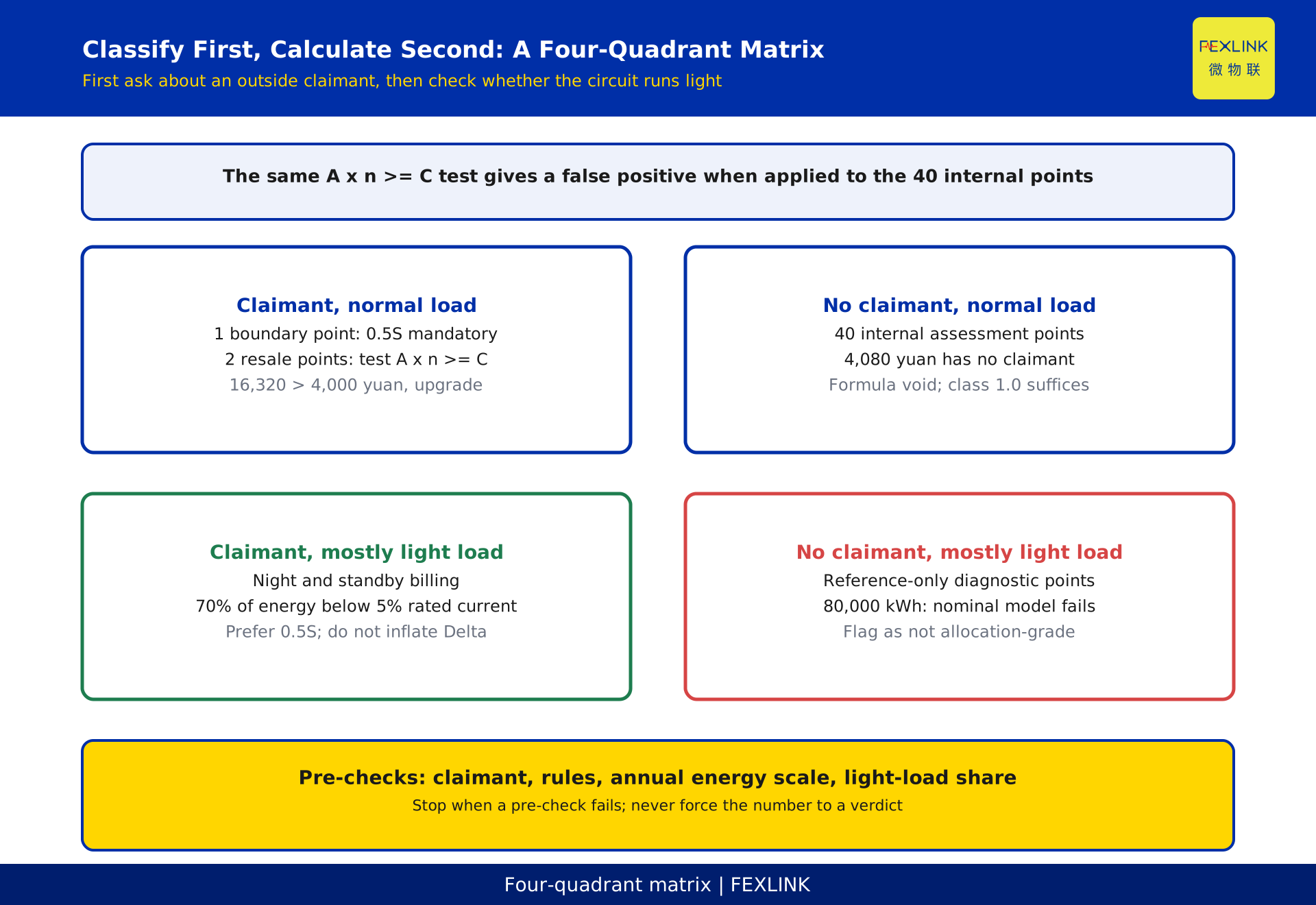
Compliance comes before economics: a billing boundary meter takes its class from the current DL/T 448. Only points where rules allow judgment reach the arithmetic. The test is not "how much more accurate is 0.5S" but "can an outside party claim a discrepancy". With a counterparty, annual dispute exposure = annual billed energy × price × nominal band gap; without one, the formula does not apply and class 1.0 suffices.
Then make the premium comparable: annual exposure × comparison period ≥ price difference + added cost. The 0.5 percentage points are an upper bound on the disputed amount, not savings; direction can reverse — over-registration means a refund, under-registration a back charge.
In short: compliance sets the floor, the counterparty sets applicability, magnitude sets the verdict.
1. Three separate ledgers, not one formula
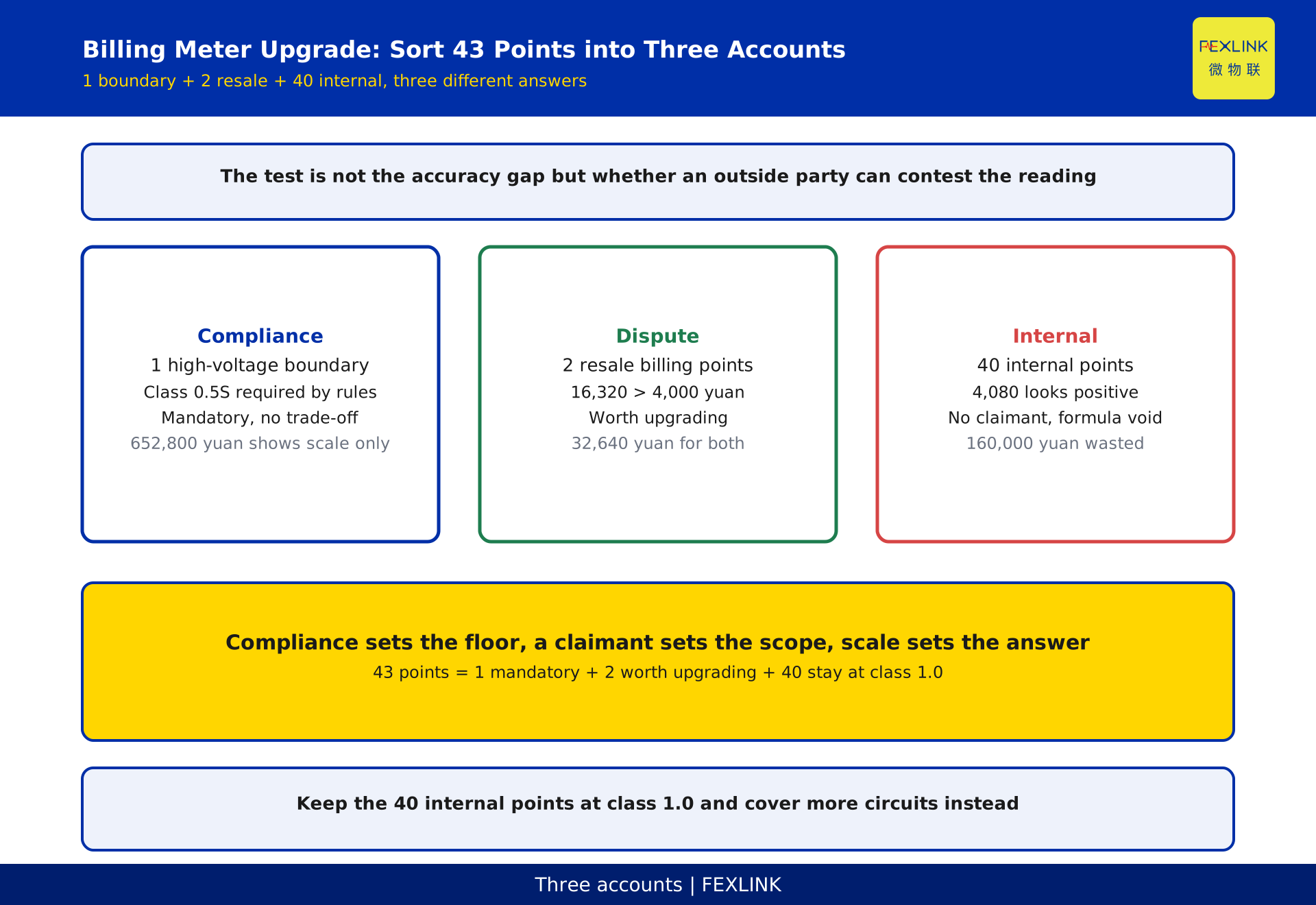
"0.5S costs more; is it worth it" bundles three questions. The compliance ledger asks which class current rules and the supply contract require; if 0.5S is required, it stays required. The dispute ledger asks what an outside party — utility, tenant, resale customer — could claim at worst on rechecking. That is what the formula measures. The internal ledger covers readings used only in internal reports, where an error costs a reworked analysis, not an energy charge.
Separated, the question narrows to: where class 1.0 is permitted and a counterparty exists, can reduced exposure cover the premium? Most confusion comes from pushing internal points into the dispute ledger and then upgrading dozens of meters.
2. What the two classes differ in: band, light load, standard ownership
Band. Class 1.0 and 0.5S denote permitted error bands under reference conditions, roughly ±1% and ±0.5%, a nominal gap of 0.5 percentage points — a worst-case boundary, not typical error.
Light load. The S class earns its cost by holding accuracy at low current, not by the half point at full load: S classes guarantee down to about 1% of rated current, non-S classes start near 5%. On a circuit running light most of the year, the non-S reading may leave its guaranteed range, so 0.5 percentage points understates the difference.
Standard ownership is where mistakes cluster. Class 0.5S belongs to IEC 62053-22:2020 (second edition, current, covering 0.1S, 0.2S and 0.5S), applying only to type tests of transformer-operated static AC active-energy meters; classes 1 and 2 belong to IEC 62053-21. The two are not in one document, so no error table reads across them. Whether an installed meter passes follows verification results, not a type-test limit table.
The 0.5 percentage points serve only as a simplified nominal band gap for magnitude work. Load-point limits follow the current standard text; this article cites no clause numbers or class tables.
3. The exposure formula: four inputs, one test, one conversion
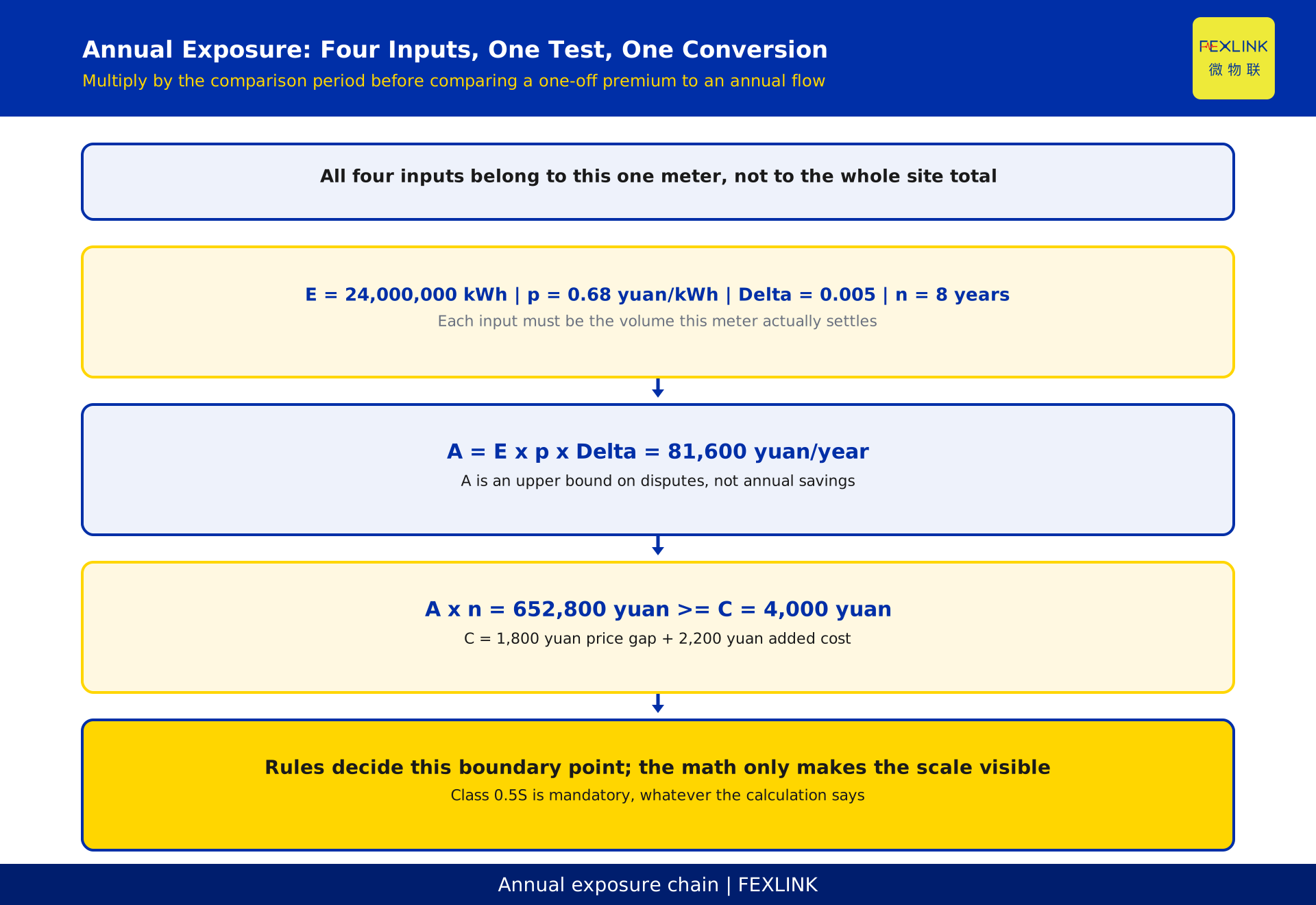
All four inputs belong to this meter. Annual billed energy E (kWh/year) is what this reading settles, not site totals or capacity estimates. Settlement price p (yuan/kWh) is the average price for that energy, not one tariff band. Nominal band gap Δ is 0.5 percentage points, written 0.005. Comparison period n (years) is expected service life; state it explicitly.
Annual dispute exposure A = E × p × Δ Test: A × n ≥ C, where C = price difference + added cost
A premium is one-off while A recurs yearly, so comparing them assumes a one-year payback; multiply by n. C covers verification, sealing, transformer matching, data retention and re-registering assets. If transformer accuracy or secondary voltage drop already fails, replace the transformer too. A real dispute adds evidence and rechecking effort, but do not invent coefficients; when A × n is close to C, note them as a qualitative reason to upgrade.
Two points are firm. A is an upper bound: the band runs both ways, so the outcome may be a back charge or a refund. The formula holds only with an outside counterparty; an internal point yields a figure with nobody to claim it.
4. When 0.5S is mandatory: compliance first, no arithmetic
- Boundary and trade settlement points: assign class, verification and sealing under the current DL/T 448-2016 and the supply contract. It is the current recommended power-industry standard, issued 2016-12-05, effective 2017-05-01, replacing the 2000 edition. No cost result may downgrade these; the formula only makes the budget visible.
- Resale and tenancy points: readings enter another party's invoice, with clear counterparty and high cost of proof.
- Large-energy points with a high light-load share: staying in band is a requirement, see section 7.
- Points whose contract names a class: the agreement overrides arithmetic.
Compliance is a threshold, not a variable; applying "worth it" below it turns a mandatory point into a false saving.
5. When class 1.0 is enough: no counterparty, formula does not apply
- Internal assessment, sub-metering and diagnostic points: readings only enter internal reports, where comparable periods and trends beat extra decimals.
- Sub-meters covered by an upstream settlement meter: they allocate cost and locate anomalies; settlement still uses the upstream meter, and bias is visible through reconciliation.
- Short-term monitoring: n is small, so A × n rarely covers C.
For internal points, spend on covering more circuits: at equal budget, extra feeders usually beat replacing one class 1.0 meter with 0.5S. A uniform high class is least economic on the ledger.
6. A 43-point worked example
All figures below are constructed to illustrate the method, representing no real customer, project or quotation.
A site has 43 metering points: 1 high-voltage boundary, 2 resale settlement and 40 internal assessment points. Inputs: 0.68 yuan/kWh; band gap 0.5 percentage points; price difference 1,800 yuan per meter; verification, sealing and matching 2,200 yuan per point, so C = 4,000 yuan; n = 8 years.
- A, boundary: annual billed energy 24,000,000 kWh. A = 24,000,000 × 0.68 × 0.005 = 81,600 yuan/year; A × n = 652,800 yuan, far above 4,000 yuan. But compliance decides: 0.5S or better is required, and arithmetic only shows scale. Verdict: mandatory, independent of the result.
- B, resale (single): annual billed energy 600,000 kWh. A = 600,000 × 0.68 × 0.005 = 2,040 yuan/year; A × n = 16,320 yuan > 4,000 yuan. Verdict: worth upgrading if rules allow judgment; both points total 32,640 yuan.
- C, internal (single): annual energy 150,000 kWh. Forcing the formula gives A = 150,000 × 0.68 × 0.005 = 510 yuan/year; A × n = 4,080 yuan > 4,000 yuan, apparently "just worth it". Invalid calculation: the reading never enters an external invoice, so 4,080 yuan has no claimant. Verdict: class 1.0 suffices; all 40 points stay. Upgrading on the false result spends 40 × 4,000 = 160,000 yuan on unused margin.
Three verdicts: set by compliance, justified by arithmetic, outside the formula. Decision quality depends on sorting the point into the right column first.
7. Light-load correction: the nominal gap understates the S class
A reversal: a night and standby settlement point has annual energy of 80,000 kWh. Nominal arithmetic gives A = 80,000 × 0.68 × 0.005 = 272 yuan/year; A × n = 2,176 yuan < 4,000 yuan, so the verdict would be "not worth it".
But about 70% of its energy occurs below 5% of rated current, where a non-S class leaves its nominal band — precisely where the S class earns its value. Do not enlarge 0.005 to force the answer; take the point out of the nominal formula: if it settles, prefer 0.5S; if indicative only, mark light-load readings as reference and exclude them from allocation.
Add a pre-check: what share of annual energy occurs at light load? If high, the nominal formula fails and a qualitative S-class judgment replaces it; do not fabricate a larger Δ.
8. Do not let the rest of the metering chain eat the upgrade
DL/T 448 governs the whole metering device — meter, instrument transformers, secondary circuit, connections — while IEC 62053-22:2020 governs only the meter's type tests. A 0.5S meter narrows one link. Transformer error, secondary voltage drop, contact resistance, a wrong multiplier, reversed phase sequence: any can exceed 0.5 percentage points.
Audit at device level first: transformer accuracy, secondary voltage drop, ratios and multipliers against the asset register, wiring polarity, verification and sealing. If the dominant error sits in the transformer or secondary circuit, money spent on the meter buys nothing.
Products only cover "stable, traceable readings": the ZSA-22243-R and ESA all-element smart meters read and record per circuit, and the digital electrical supervision platform turns readings into ledgers and reconciliation evidence. They do not choose the class or replace verification. Models, ranges, accuracy specifications and interfaces follow the latest selection manual.
9. Five recurring mistakes
One, judging an installed meter by type-test limits: field acceptance follows verification. Two, one error table for both classes: 0.5S and class 1.0 sit in different standard parts, and the nominal gap supports magnitudes only. Three, comparing a one-off premium with one year of exposure: missing n and added cost. Four, internal points in the dispute formula: a figure with no claimant, the commonest error. Five, calling A annual savings: the band is two-sided and A is a ceiling.
FAQ
Q: How much more accurate is 0.5S than class 1.0, and can I say it saves 0.5% of the bill each year?
No. The 0.5 percentage points are the gap between nominal permitted bands, used only as Δ. The band is a two-sided worst-case boundary, neither typical error nor a saving; "annual savings" treats a ceiling as an expected value.
Q: An internal point looks "worth it" in the formula. Should it also get 0.5S?
No. Exposure assumes an outside party can recheck the reading and claim a difference. An internal point has no counterparty, so the figure has no claimant; spend that budget on covering more circuits.
Q: A settlement point looks uneconomic. Can I fit class 1.0 and save the money?
No. Class assignment at boundary and trade settlement points is a compliance requirement under the current DL/T 448-2016 and the supply contract; the formula only checks budget scale. Economics applies only where rules allow judgment.
Q: Why can a light-load circuit not use the nominal band gap directly?
Below about 5% of rated current a non-S class leaves its nominal guaranteed range, so the real gap exceeds 0.5 percentage points. Take the point out of the formula and judge the S class qualitatively; do not enlarge Δ.
Q: I upgraded to 0.5S. Why do total and sub-meters still disagree?
The meter is one link. Transformer error, secondary voltage drop, wrong multipliers, wiring polarity, sealing and verification all contribute and may exceed half a point. Find the dominant device-level error source first.
Scope and limitations
- Distinct from KD-0455, which explains the class numbers 0.5S / 0.5 / 1.0 and the single "annual cost of the class gap" calculation. This is an economic decision: the increment is the compliance / dispute / internal split, comparison-period conversion, counterparty pre-check, light-load correction and device-level error audit. Use-based classification belongs to KD-0451.
- Standards: DL/T 448-2016, the technical management code for electric energy metering devices, is the current recommended power-industry standard (issued 2016-12-05, effective 2017-05-01, replacing DL/T 448-2000). IEC 62053-22:2020 is the current second edition, covering 0.1S / 0.2S / 0.5S, applying only to type tests of transformer-operated static AC active-energy meters. Classes 1 and 2 fall under IEC 62053-21; confirm editions against the official catalogue. No clause numbers, class tables or load-point limits are reproduced.
- ±1% / ±0.5% are nominal permitted bands under reference conditions; about 1% and 5% of rated current are common reference points for S versus non-S light-load onset. The 0.5 percentage points are a simplification, not a standard-defined per-load-point difference. Actual error and pass/fail follow the current standard text and verification results; do not use them for quotations, verification or dispute evidence.
- Every figure in sections 6 and 7 is constructed to illustrate the method and represents no real customer, site, project or quotation; anonymised: 43 points (1 boundary / 2 resale / 40 internal), 0.68 yuan/kWh, 0.5 percentage points, 1,800 yuan, 2,200 yuan, C = 4,000 yuan, 8 years, annual energy 24,000,000 / 600,000 / 150,000 / 80,000 kWh, annual exposure 81,600 / 2,040 / 510 / 272 yuan, A × n of 652,800 / 16,320 / 4,080 / 2,176 yuan, 32,640 yuan, 160,000 yuan, 70%. Real studies need site billed energy, settlement price, quotations and verification records.
- This does not replace a compliance decision. Required class, verification interval, sealing and retention follow the current DL/T 448, the supply contract and local rules; contract terms take precedence.
- The ZSA-22243-R, ESA all-element smart meters and digital electrical supervision platform are described qualitatively only; models, ranges, accuracy specifications and interfaces follow the latest selection manual. Not a procurement recommendation.
- Status is DRAFT_PENDING_REVIEW. An independent reviewer must confirm D10 before this can support publication; the generator must not self-approve.
Frequently Asked Questions
How much more accurate is 0.5S than class 1.0, and can I say it saves 0.5% of the bill each year?
No. The 0.5 percentage points are the gap between nominal permitted bands, used only as Δ. The band is a two-sided worst-case boundary, neither typical error nor a saving; "annual savings" treats a ceiling as an expected value.
An internal point looks "worth it" in the formula. Should it also get 0.5S?
No. Exposure assumes an outside party can recheck the reading and claim a difference. An internal point has no counterparty, so the figure has no claimant; spend that budget on covering more circuits.
A settlement point looks uneconomic. Can I fit class 1.0 and save the money?
No. Class assignment at boundary and trade settlement points is a compliance requirement under the current DL/T 448-2016 and the supply contract; the formula only checks budget scale. Economics applies only where rules allow judgment.
Why can a light-load circuit not use the nominal band gap directly?
Below about 5% of rated current a non-S class leaves its nominal guaranteed range, so the real gap exceeds 0.5 percentage points. Take the point out of the formula and judge the S class qualitatively; do not enlarge Δ.
I upgraded to 0.5S. Why do total and sub-meters still disagree?
The meter is one link. Transformer error, secondary voltage drop, wrong multipliers, wiring polarity, sealing and verification all contribute and may exceed half a point. Find the dominant device-level error source first.