 FEXLINK Research Institute
The short answer
The first step in harmonic mitigation is not buying a filter — it is placing the monitors correctly. If you start retrofitting before you know who is emitting the harmonics, how much, and who is suffering, the money is spent but the problem may not be solved, and resonance can even make the distortion worse. Do three-point monitoring first — at the harmonic source circuit, at the point of common coupling (PCC), and at the sensitive-equipment side — and use the data to draw the power-flow path and the liability boundary. Only then decide whether to act at the source, the branch, or the common point. Never sign a filter proposal that is not backed by monitoring data.
Why monitor before you act
The hard part of harmonics is not eliminating them but locating them. Every nonlinear load in a plant — variable-frequency drives, rectifier supplies, arc equipment, LED drivers — injects harmonic current into the grid, but each source differs in magnitude, order, and phase. Quoting a filter just because "the power-factor penalty arrived" or "the line is unstable" is like prescribing medicine without taking the temperature.
Skipping monitoring creates at least three traps. First, wrong location: a filter mounted on the common bus helps little if the dominant harmonics come from one VFD feeder, so the budget lands where it contributes least. Second, resonance: a passive filter is an LC circuit, and if its tuning coincides with a system-impedance resonance frequency it amplifies that order, worsening the THD — the classic "the more I fix, the worse it gets" case. Third, no acceptance baseline: without pre-retrofit measurements, nobody can prove how much was reduced or whether the limit was met, and the vendor closes the job with "it is installed."
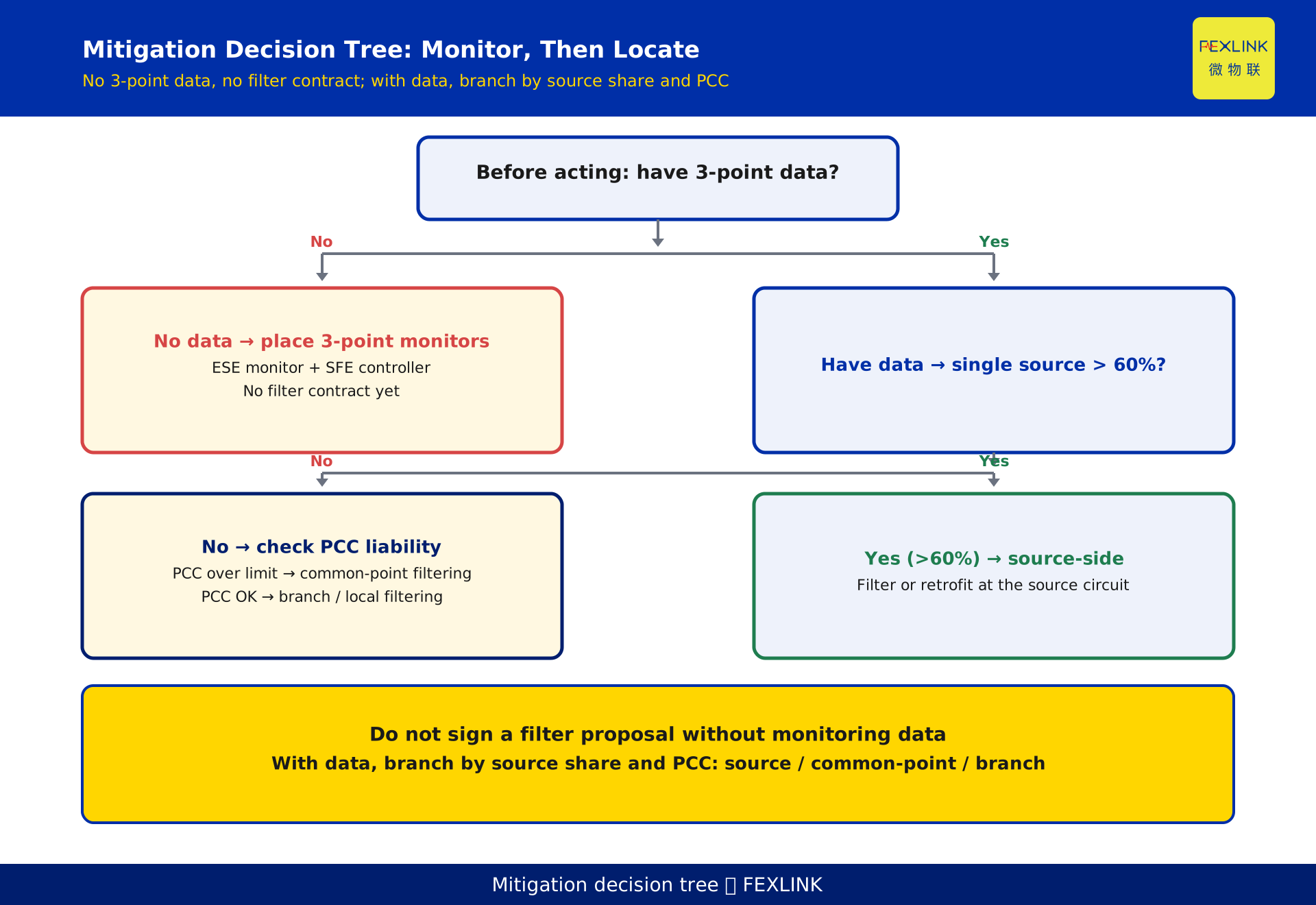
So the core conclusion is blunt: three-point monitoring must precede any retrofit, and the data must draw the flow path and liability boundary before anyone decides where and how to act. A filter proposal without monitoring data should not be signed.
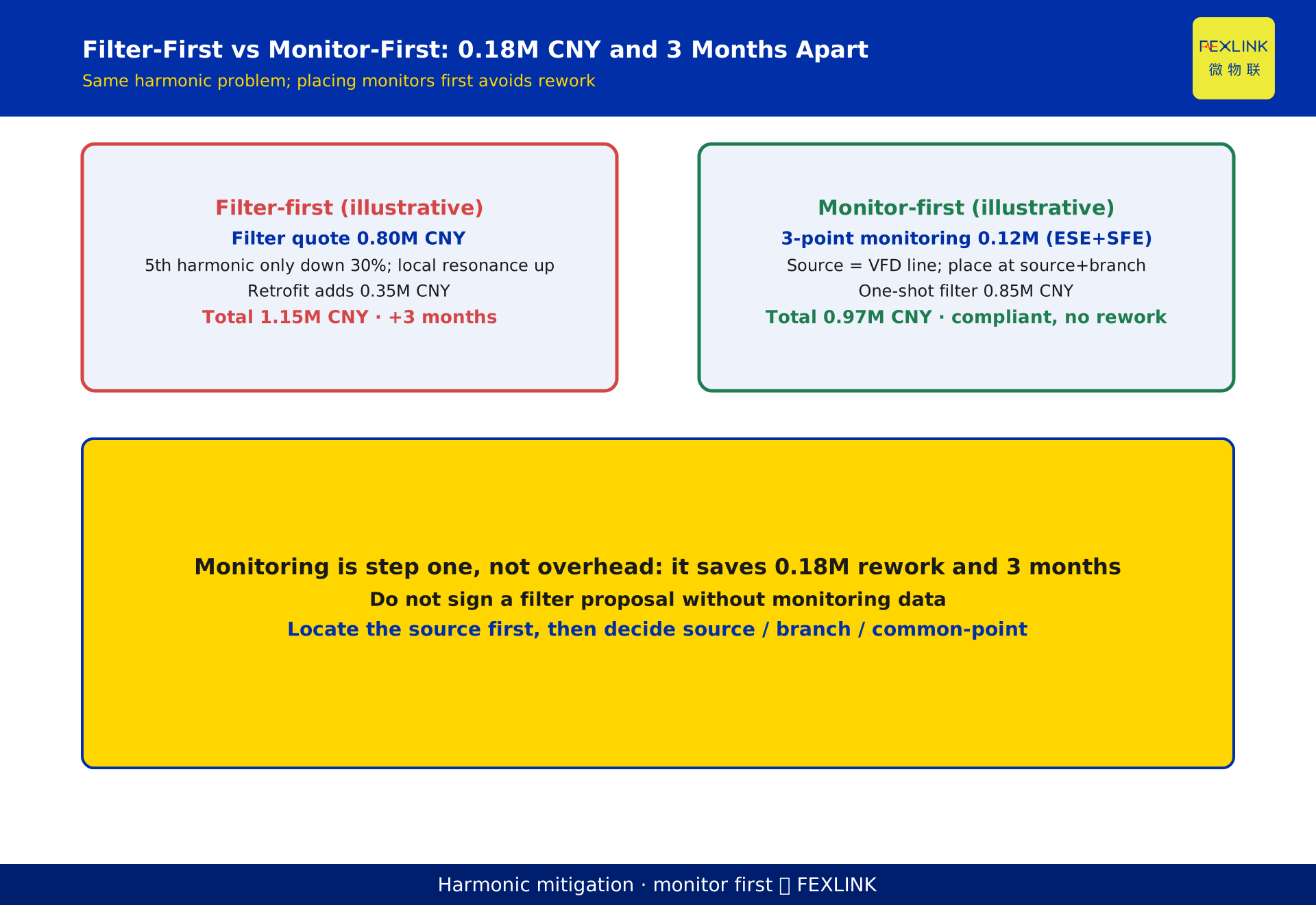
A constructed example (figures are illustrative, not a real project): a plant that skips monitoring buys a filter quoted at 0.80M CNY; after retrofit the 5th harmonic drops only 30% and local resonance pushes THD back up, so a second retrofit adds 0.35M CNY — total 1.15M CNY and three extra months. The same plant that monitors first spends 0.12M CNY on three-point monitoring, locates the source at a VFD line, places the fix at source plus branch, and closes the filter in one shot at 0.85M CNY — total 0.97M CNY, compliant, no rework. Monitoring alone saves about 0.18M CNY and three months.
The three-point method: what each point sees
Three-point monitoring places one monitor at each of three locations so the chain from generation to propagation to victim can be reconstructed.
Point one, the harmonic source circuit. Mount it at the incoming side of a major nonlinear load, for example below the feeder breaker of a VFD line. It answers "who emits, and how much": measure the harmonic current spectrum (per-order content) and the current total harmonic distortion, THD. This step locates the source and its dominant orders, which decides which circuit the retrofit should target.
Point two, the point of common coupling, PCC. Mount it at the boundary between the customer and the utility, for example on the 10 kV incoming bus. It answers "where is the liability": measure the per-order harmonic current injected into the system and the voltage THD, and compare against the per-order harmonic current limits given by GB/T 14549-1993 to judge whether the plant's injection exceeds the allowance. The PCC is the legal node for allocating responsibility and the basis for any discussion with the utility.
Point three, the sensitive-equipment side. Mount it upstream of the most affected equipment — a PLC cabinet, a precision test bench, a metering supply. It answers "who suffers": measure voltage THD, voltage sags, and short interruptions. This step confirms that distortion has reached the end and created real risk, which sets the priority order.
In practice the ESE power-quality monitor can take the current-spectrum and THD readings at the source circuit and the PCC, while the SFE power-quality meter/controller performs the edge measurement of voltage distortion and sags at the sensitive side and the branches; both feeds flow into the power-quality monitoring program with Tianyan engine harmonic analysis for centralized comparison. Together the three points answer three questions: where the harmonics come from, who is liable, and who is hurt.
How the data sets liability and placement
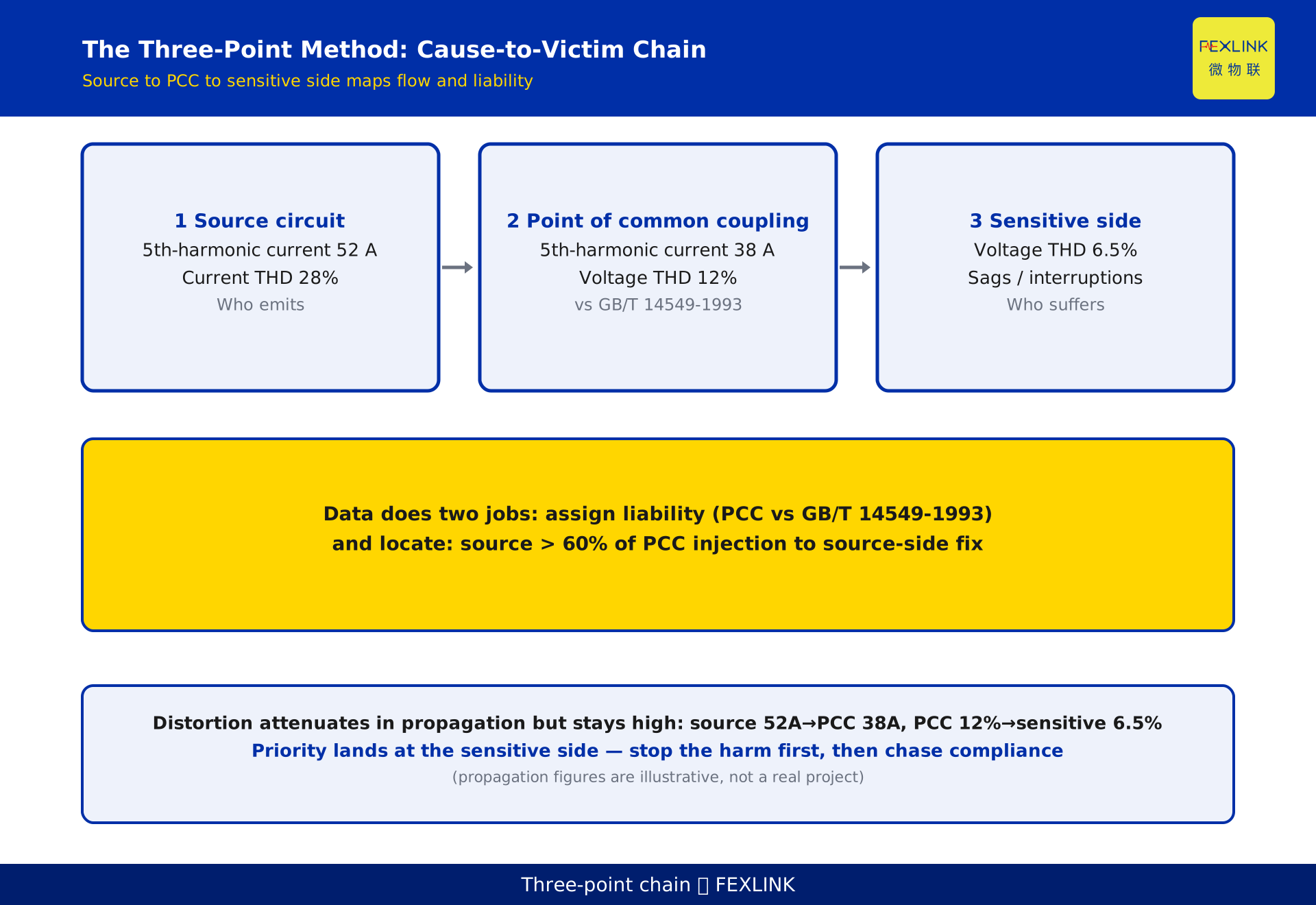
The three points are not three isolated numbers; they form a causal chain: source → PCC → sensitive side. That chain quantifies responsibility and locates the fix.
In the constructed example, the source circuit reads 5th-harmonic current 52 A and current THD 28%; the PCC reads 5th-harmonic current 38 A and voltage THD 12%; the sensitive side reads voltage THD 6.5%. From source to PCC the 5th harmonic falls from 52 A to 38 A, meaning part is absorbed by the system and other loads; from PCC to the sensitive side the voltage THD falls from 12% to 6.5%, meaning distortion attenuates in propagation but stays high.
The liability boundary is set at the PCC: compare each measured harmonic order at the PCC with the allowance in GB/T 14549-1993; whichever order exceeds defines the responsible load class. Placement is set by share: if one circuit contributes more than 60% of the PCC injection, it is the dominant source and source-side mitigation comes first; if many sources are scattered and none stands out, common-point mitigation is better; if the PCC already complies but the sensitive side still violates, branch or local mitigation at the equipment front is the answer.
In one sentence: data turns "probably that device" into "precisely which order, which circuit, and whether it is your responsibility."
Common mitigation options and where they fit
No single technique fits all; the choice follows the position and spectrum the three points reveal.
Passive filters (LC tuned) target specific orders such as 5th and 7th, are cheap and efficient, and suit a single large source with a concentrated spectrum. But they are the source of resonance risk, so system impedance must be checked against the tuning using monitoring data before installation.
Active filters (APF) inject opposing harmonic current in real time, handle many orders at once, suit multi-source and complex spectra, and rarely cause resonance. The cost is higher, so they are usually placed at the PCC or a critical bus segment.
Source retrofit modifies the emitting equipment itself — phase shifting, series reactors, better drive algorithms — to cut emission at the root. It suits a clearly dominant source whose share exceeds 60%.
Branch or local mitigation adds an isolation transformer or filter in front of the sensitive equipment to protect the end device. It suits the case where the PCC already complies but the end still suffers.
Note that "fits" for any of these presupposes that the three points have already given position and spectrum. Without data, every "fits" is a guess.
Before-and-after verification design
Retrofitting ends only when the same three-point setup proves the result. Design three comparison lines: first, how far the source-circuit 5th-harmonic current falls from 52 A; second, whether each PCC harmonic order drops within the GB/T 14549-1993 allowance; third, whether the sensitive-side voltage THD improves materially from 6.5%. All three must improve for the retrofit to count as effective.
Verification rules: use the same monitoring points, the same instruments, and the same operating window, so a "different meter, different condition" cannot make numbers incomparable; the baseline comes from pre-retrofit three-point data and the report-period data from the same conditions after retrofit; the pass criterion is not "the filter is installed" but "PCC harmonics comply and end-voltage THD no longer threatens equipment."
If any order rises after retrofit, check resonance immediately: a passive filter may be resonating with system impedance at that order, and adding more of the same type is the wrong move — reselect the point using monitoring data.
Where this differs from "harmonic-meter selection pitfalls"
KD-0472 covers "how to avoid pitfalls when buying a harmonic meter" — the selection stage: accuracy class, sampling window, order range, communication interface. This article does not repeat that; it covers the monitoring-front design of a mitigation project. Before you decide which meter to buy, and long before you decide which filter to buy, settle the method: where the points go, what they measure, and how the data assigns responsibility and placement.
The increment is the three-point method and the liability boundary. The three points are a causal-chain layout of source–common-point–sensitive-side; the liability boundary compares PCC measurements order by order against GB/T 14549-1993 to assign "whose fault." Meter selection is downstream of this — once the points are right, go to KD-0472 to pick the meter, not the other way around.
FAQ
Q: The boss already asked the vendor for a filter quote — should we still monitor first?
Yes. A vendor quote without three-point data gives you no way to judge where it goes, which order it targets, or whether it will comply, let alone verify it. Spend a little first on monitoring, then decide whether to sign; it is far safer than going straight to hardware.
Q: Is one harmonic meter at the incoming side enough?
No. The incoming side (PCC) only shows total injection and the liability boundary; it cannot reveal which circuit the harmonics come from or which equipment is hurt. The source-circuit and sensitive-side points are irreplaceable for locating and assigning responsibility.
Q: What are the GB/T 14549-1993 limits, and can I put them in the contract?
The standard gives per-order harmonic current allowances at the PCC; the exact values follow the current edition of the standard, which this article does not list. The contract may state "acceptance is based on the per-order harmonic current allowances in the current edition of GB/T 14549-1993," but the numeric limits should be quoted from the standard text itself.
Q: Why does a passive filter sometimes make things worse?
A passive filter is an LC circuit; if its resonance frequency coincides with a system-impedance resonance at some order, it amplifies that order and THD rises. Impedance must be checked with monitoring data before installation — which is exactly why monitoring comes first.
Q: Should monitoring points stay after retrofit?
Recommended. Harmonic loads change as lines are rebalanced and equipment is added or removed; ongoing PCC and sensitive-side monitoring keeps catching new exceedances and resonance risks — a routine safeguard beyond acceptance.
Scope and limitations
- The three-point method and the placement logic discussed here apply to industrial and commercial distribution systems that contain nonlinear loads and show harmonic distortion or power-factor penalties; purely resistive systems without nonlinear loads generally do not need this process.
- All monitoring figures in this article (source 5th-harmonic 52 A, current THD 28%; PCC 5th-harmonic 38 A, voltage THD 12%; sensitive-side voltage THD 6.5%; costs 1.15M / 0.97M / save 0.18M CNY; single-source share 60%) are constructed to illustrate the method and represent no real customer or project; actual values depend on site survey and measurement.
- The rule "single source above 60% of injection → source-side mitigation" is an illustrative empirical threshold, not a mandatory standard; the actual threshold should follow the real spectrum and system conditions.
- GB/T 14549-1993 provides per-order harmonic current allowances at the PCC; the exact allowances follow the current edition of the standard, and this article lists no specific limit numbers.
- The specific models, parameters, and functions of the ESE power-quality monitor, the SFE power-quality meter/controller, and the Tianyan engine harmonic analysis follow the latest product documentation and selection manuals; this article is not a selection or procurement recommendation.
- Standard numbers cited follow the currently valid editions; quantitative conclusions must be rechecked after a standard is revised.
Frequently Asked Questions
The boss already asked the vendor for a filter quote — should we still monitor first?
Yes. A vendor quote without three-point data gives you no way to judge where it goes, which order it targets, or whether it will comply, let alone verify it. Spend a little first on monitoring, then decide whether to sign; it is far safer than going straight to hardware.
Is one harmonic meter at the incoming side enough?
No. The incoming side (PCC) only shows total injection and the liability boundary; it cannot reveal which circuit the harmonics come from or which equipment is hurt. The source-circuit and sensitive-side points are irreplaceable for locating and assigning responsibility.
What are the GB/T 14549-1993 limits, and can I put them in the contract?
The standard gives per-order harmonic current allowances at the PCC; the exact values follow the current edition of the standard, which this article does not list. The contract may state "acceptance is based on the per-order harmonic current allowances in the current edition of GB/T 14549-1993," but the numeric limits should be quoted from the standard text itself.
Why does a passive filter sometimes make things worse?
A passive filter is an LC circuit; if its resonance frequency coincides with a system-impedance resonance at some order, it amplifies that order and THD rises. Impedance must be checked with monitoring data before installation — which is exactly why monitoring comes first.
Should monitoring points stay after retrofit?
Recommended. Harmonic loads change as lines are rebalanced and equipment is added or removed; ongoing PCC and sensitive-side monitoring keeps catching new exceedances and resonance risks — a routine safeguard beyond acceptance.