 FEXLINK Research Institute
The short answer
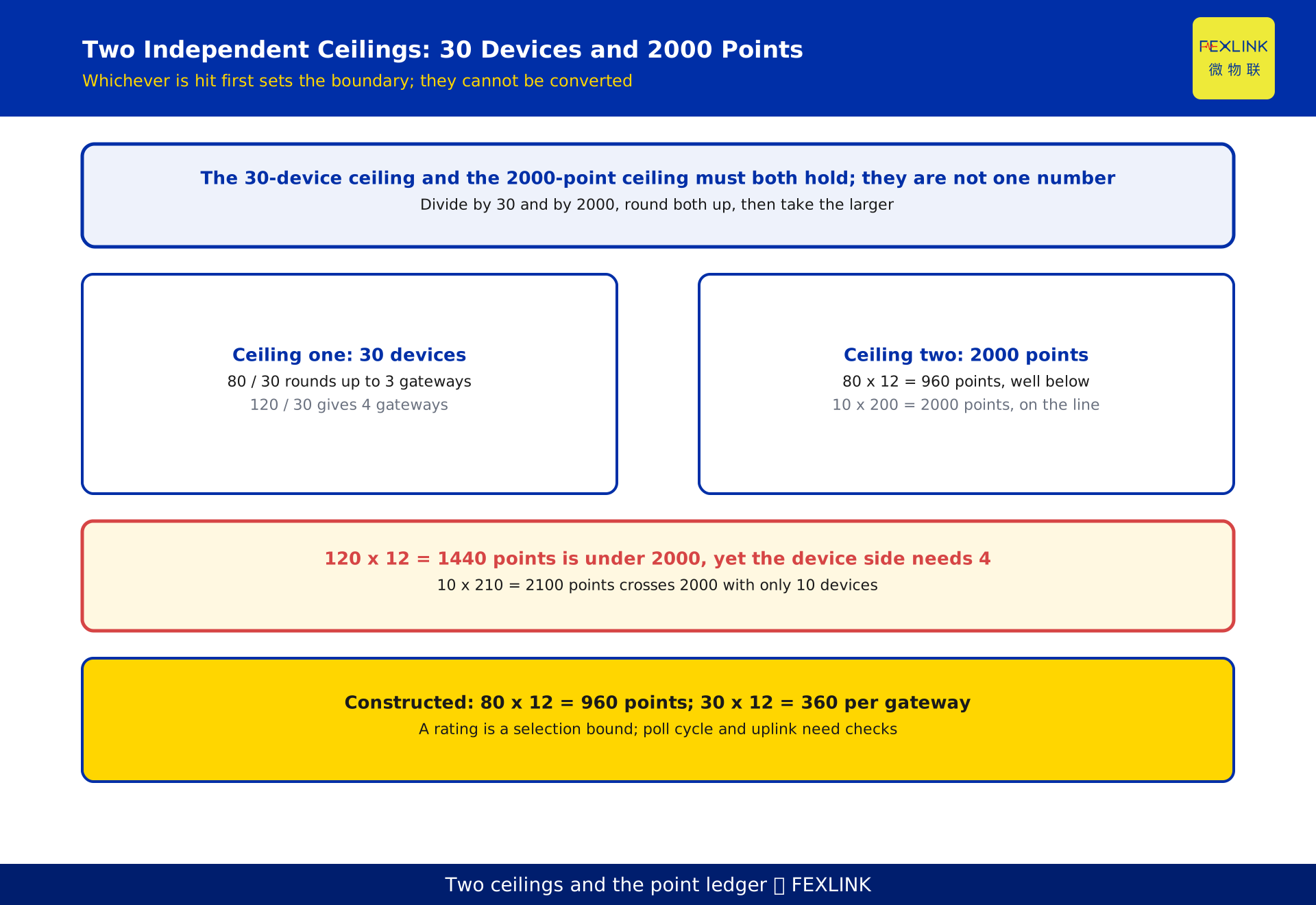
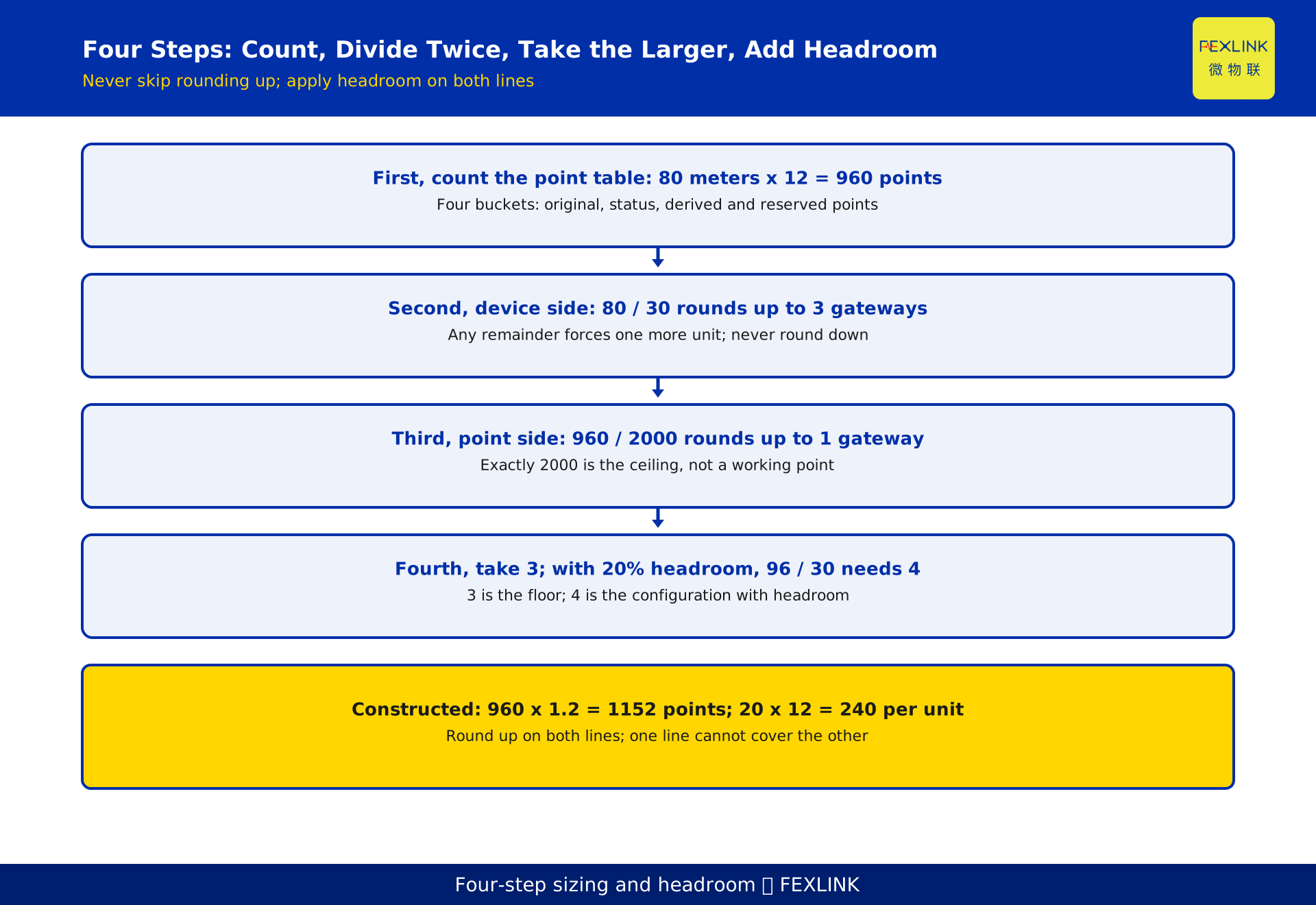
"30 devices / 2000 data points" is two independent ceilings, not one capacity figure: at most 30 devices and at most 2000 collected points, and whichever is hit first sets the boundary. Count each device's points from its point table, multiply devices by points per device, then divide by 30 and by 2000, round both up, take the larger and add headroom. For 80 meters at 12 points each, 960 points stay far below 2000 while 80 devices exceed 30: the floor is 3 gateways and, with 20% headroom, the configuration is 4. "A dozen-odd points" is only a rough magnitude, not a specification; the point table comes first.
1. Two separate ceilings, not one capacity number
Reading the rating as a single number is the common starting error. Device count is the number of slaves the gateway polls; point count is the number of measurements it collects, buffers and forwards. They have different dimensions and constraints, so listing them together means both must be satisfied, not that one converts into the other.
This gives two opposite failures: simple meters hit the device ceiling first, feature-rich meters the point ceiling first. Watching one alone leads to the same complaint: nothing exceeded its limit, so why will it not connect?
Even with room on both ceilings, poll cycle, uplink bandwidth, buffering and processing load may bottleneck earlier. A rating is a selection upper bound, not a performance guarantee; this article only computes the ledger, while verification belongs to commissioning.
2. What counts as one data point
The unit is not one meter, one telegram or one register: one measurement the platform can name, read and store independently counts as one data point. Three-phase voltages and currents, active and reactive power, power factor, frequency, and cumulative active and reactive energy each count separately.
Registers and points do not map one to one: a floating-point value may occupy 2 registers yet count as 1 point, one request may return a dozen points, and one status bit still counts as 1 point. Derived daily totals, maxima and alarm flags stored separately each take 1 point.
So telegrams times registers is not a ledger. Start from the point table: after address, dimension, multiplier and unit are aligned, count the reported quantities row by row. Recovering that four-column table from telegrams is covered elsewhere.
3. Points per meter: count the point table, not a rule of thumb
"Roughly a dozen points per meter" is a usable first estimate but not a specification. For one model, adding per-phase values, demand and event logs to cumulative energy can change the count several times over, and multiplying by the meter count scales that error.
Count in three passes: original measurement points row by row; status and event points such as online state, self-check, switch position and alarm words; then platform-derived points stored or plotted independently. Their sum is the per-device count, labelled with the point-table version and polling interval.
The examples here take 12 points per meter as a labelled assumption, only to make the arithmetic reproducible; it is not a measured count or a selection basis. Real projects use that model's point table and platform configuration.
4. Four buckets in the point ledger
A ledger with four columns is easier to audit than a single total.
Column one is original points: voltage, current, power and energy. Column two is status points: online state, self-check, switch position and alarm words. Column three is derived points: daily totals, peaks and differences. Column four is reserved points for meters, points or items added later.
A source and an owner per column let a dispute be traced to the column left out. Omissions cluster in columns two and three: wiring focuses on the meter reading, then go-live reveals that status, alarms and daily-total curves occupy points too. The reserved column states a convention and a review date, not a promised value.
5. The sizing arithmetic
The conventions reduce to: total points = devices times points per device; device-side gateways = devices / 30 rounded up; point-side gateways = total points / 2000 rounded up; gateway count = the larger, rechecked against headroom.
Headroom is chosen for the project stage; the examples take 20%, a multiplier of 1.2. Apply it to both lines: 80 times 1.2 gives 96 device-equivalents and 960 times 1.2 gives 1152 points. Headroom on points but not devices is a half-measure.
Never skip rounding up: 80 divided by 30 is not a whole number and must not drop to 2; any remainder forces one more gateway. Likewise a total exactly equal to 2000 is the ceiling itself, not a sustainable operating point.
6. Constructed example: 80 meters, 3 gateways minimum
A park has 80 meters across three distribution rooms; the point table gives 12 points per meter, the four-column ledger is checked, and the case is anonymised.
Total points: 80 times 12 = 960. Device side: 80 divided by 30 rounds up to 3 gateways. Point side: 960 divided by 2000 rounds up to 1 gateway. Taking the tighter of the two ceilings gives a theoretical minimum of 3. Split across 3 gateways, each carries at most 30 meters and 30 times 12 = 360 points, still far from 2000, which shows the binding constraint here is the device side, not the point side.
Now apply 20% headroom: device-equivalents 80 times 1.2 = 96, and 96 divided by 30 rounds up to 4 gateways; points 960 times 1.2 = 1152, still well below 2000 per gateway. Across 4 gateways each carries about 80 divided by 4 = 20 meters and 20 times 12 = 240 points. The reported figure is 4, not 3: 3 is the theoretical floor and 4 is the configuration with headroom.
The record states the point-count source, point-table version, headroom factor, and per-zone device and point totals. Adding meters later only means rerunning these lines.
7. Two counterexamples
First: 120 meters at 12 points give 120 times 12 = 1440 points, below 2000. Points alone suggest one gateway is plenty, yet 120 divided by 30 needs 4. Under the point limit does not mean the configuration works.
Second: only 10 devices, but 200 points each give 10 times 200 = 2000, exactly on the ceiling; at 210 points each the 2100 total crosses 2000. The device side, 10 against 30, has ample room. Under the device limit does not mean it works either.
Both cases say the same: multiplying meters by an approximate point count and comparing with 2000 is not enough. Divide on both lines, round up on both, take the larger; headroom on one line cannot cover the other.
8. One gateway, several gateways, or an expansion unit
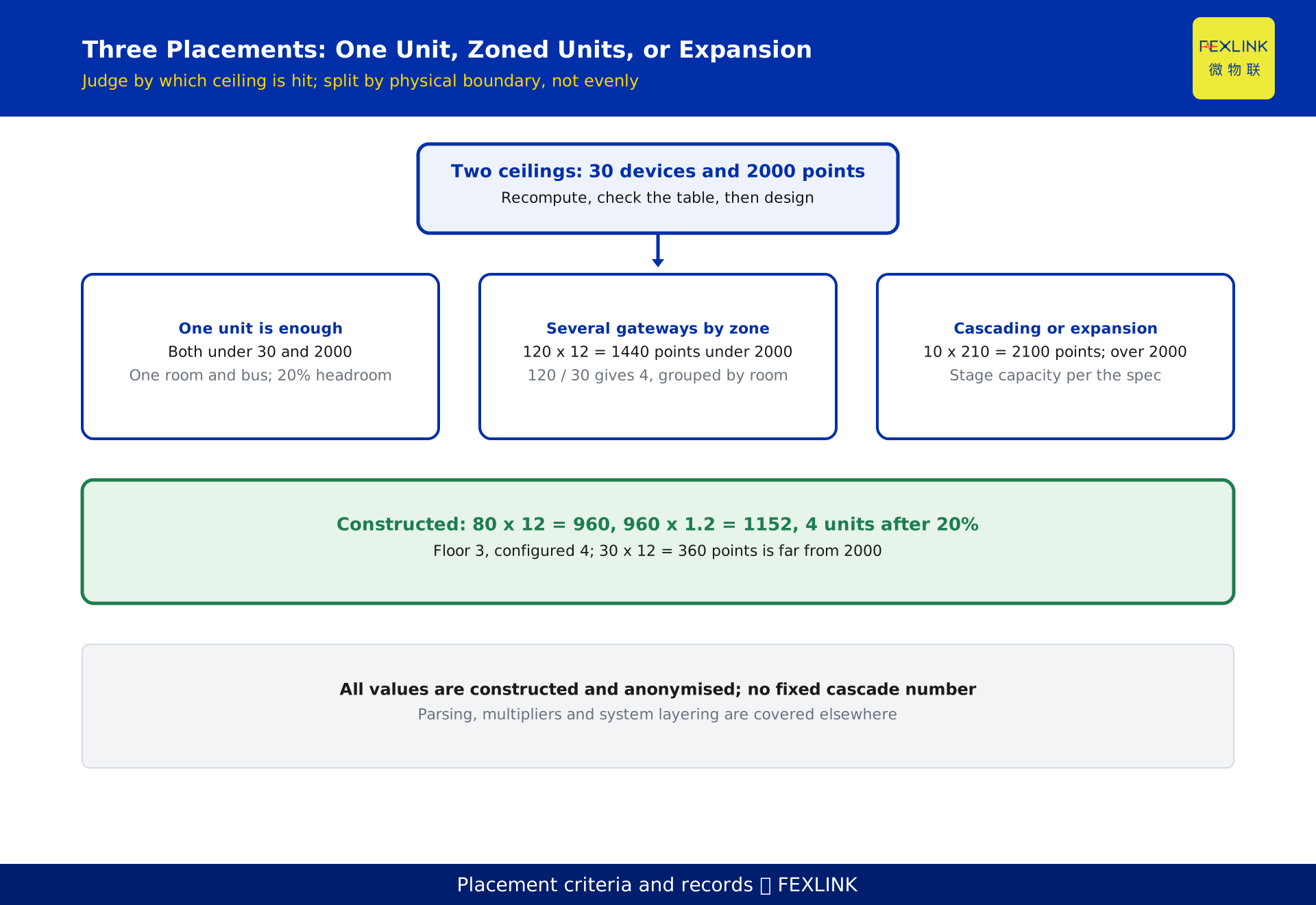
One gateway: devices and points are both clearly below 30 and 2000, the devices sit in one room on one bus, and headroom still fits one unit. A second gateway is then only cost.
Several gateways: if either ceiling is breached, split by physical boundaries - room, bus, floor - with one gateway per group, not an even division of the total. Recompute per-gateway totals to confirm none hits a ceiling.
Cascading or an expansion unit: where the manufacturer offers it for that model, load can be split across stages. Whether it is supported, how many devices and points each stage adds, and how the poll cycle changes belong to that model specification. No fixed number or capability claim is made here; put those three questions on the vendor checklist and fix the configuration only after a written answer.
All three need the same record: zone list, per-gateway totals, headroom factor, point-table version and reviewer. Architecture layering, uplink design and cloud grouping belong to system-level planning, covered elsewhere; this article only sizes one point of capacity.
9. Where this article stops
The increment is one reproducible calculation: what a point is, how many points a device takes, how each ceiling is divided, how headroom is added, and where the load goes when a ceiling is exceeded.
Recovering a point table from telegrams and aligning address, dimension, multiplier and unit belongs to parsing an unfamiliar device; nameplate multiplier conversion and accuracy-class reading have their own articles; layering a park with several hundred meters belongs to whole-system design. None enter this calculation, and no sibling article numbers appear in the body.
The boundary keeps the ledger auditable: when devices will not connect, recompute capacity, then check the point table, then review the architecture, rather than collapsing all three into one claim that the gateway cannot handle it.
Frequently asked questions (FAQ)
Q: Does "30 devices / 2000 points" mean 2000 divided by 30 meters?
No. The ceilings have different dimensions and cannot convert into each other. The device side compares with the number of slaves, the point side with the number of measurements; divide both, round up, take the larger.
Q: How many points does one smart meter actually take?
There is no universal number. Count the point table in three passes - original measurements, status and alarms, derived values - since a dozen-odd is only a magnitude. The 12 points per meter here is an anonymised assumption, not any model specification.
Q: If total points are exactly 2000, can I report one gateway?
Not advisable. 2000 is the ceiling itself, not an operating point with headroom; with 20% headroom, 960 points correspond to 1152 points, while 2000 points leaves no room to grow. The device side must also satisfy 30 at the same time.
Q: Why add gateways when the point total is under the limit?
Because the device count can hit its ceiling first. 120 meters times 12 points = 1440 points, under 2000, yet 120 divided by 30 needs 4 gateways. When meters are spread across several distribution rooms, physical zoning also pushes the design toward multiple gateways.
Q: How far can cascading actually extend?
No number is given here. Whether cascading is supported, the capacity of each stage and the polling behaviour after extension must come from a written answer in that model specification. Put it on the selection checklist rather than inferring it from marketing material.
Scope and limitations
- This data-interpretation article covers the point ledger behind "30 devices / 2000 data points": two ceilings, line-by-line counting, separate rounding and a headroom recheck. Device parsing, meter multiplier, accuracy classes and whole-system layering are covered elsewhere.
- No standard is cited. Terminology checks confirmed that maximum connected slaves and maximum collected points are parallel ceilings, and that bus node count differs from gateway device count. Those checks only fix names: no edition years, clause numbers, parameter comparisons or vendor claims appear here. The verified coefficient baseline has zero hits for gateway, point count, data point, telemetry, 2000, cascading and collection point; no coefficient is introduced.
- The 30 devices and 2000 points come from the master-data nameplate wording and serve only as example inputs. 12 points per meter, 80 / 120 / 10 devices, 200 / 210 points per device, 20% headroom and all derived values such as 960, 360, 1152, 96, 240, 1440 and 2100 are constructed, anonymised examples for illustrating the arithmetic, with no customer, place or project name. They represent no real client, park, project, quotation or product specification. Actual capacity follows that model specification, the manufacturer point table and the platform configuration, and must not be used for quotation, acceptance or dispute evidence.
- A nameplate capacity is a selection bound, not a performance guarantee; poll cycle, uplink bandwidth, buffering and processing need commissioning checks. Cascading support and per-stage reach are deliberately left without fixed numbers.
- Gateway interfaces, protocols and capacities are customisable options. Refer to the latest selection manual and product knowledge base; this is not purchasing advice. All deliverables remain DRAFT_PENDING_REVIEW and require independent review; the generator does not self-approve.
Frequently Asked Questions
Is "30 Devices / 2000 Points" Enough
"30 devices / 2000 data points" is two independent ceilings, not one capacity figure: at most 30 devices and at most 2000 collected points