 FEXLINK Research Institute
Direct answer
When a cold storage door opens, warm humid air rushes in and meets the cold body and pipes, turning into water and then ice. At the same time, low temperature hardens the cable jacket and shrinks the terminals, quietly raising the contact stress at the joints. None of this means a device has failed; it is what low temperature and the cold-hot boundary do to the distribution.
The answer is not to fit thicker cables or just add air conditioning to the switch room. It is to put the focus back on the cold-hot boundary: watch the temperature and leakage current of cold storage distribution, especially where cables pass through the panel, through the wall and through the busy doorways, and then talk about how insulation and heat tracing work together.
The digital electrical intelligent supervision system is registered by name only, with no dimensions, tiers or elements expanded. This article writes no year, clause number, limit, allowable value or conformance judgement. Associated products are registered by name only, with zero parameters and selection advice; the whole article carries zero measured data, zero limits, zero ratios, zero amounts and zero effect commitments.
I. Translating "cold storage loves electrical faults" into observable quantities
What arrives on site is often "the panel keeps tripping", "the line runs hot", "the terminal burned" or "the insulation is mysteriously low". These are consequences, not alignable objects. The first step is to translate them into quantities that can be pointed to on a drawing and aligned in a record: temperature, surface condensation and leakage current.
Opening with "replace the cable" or "add air conditioning" treats an environmental and structural problem as a device problem. This article gives only observation positions and a recording order, with no magnitude, duration, frequency or pass boundary.
II. What low temperature does to cables and terminals
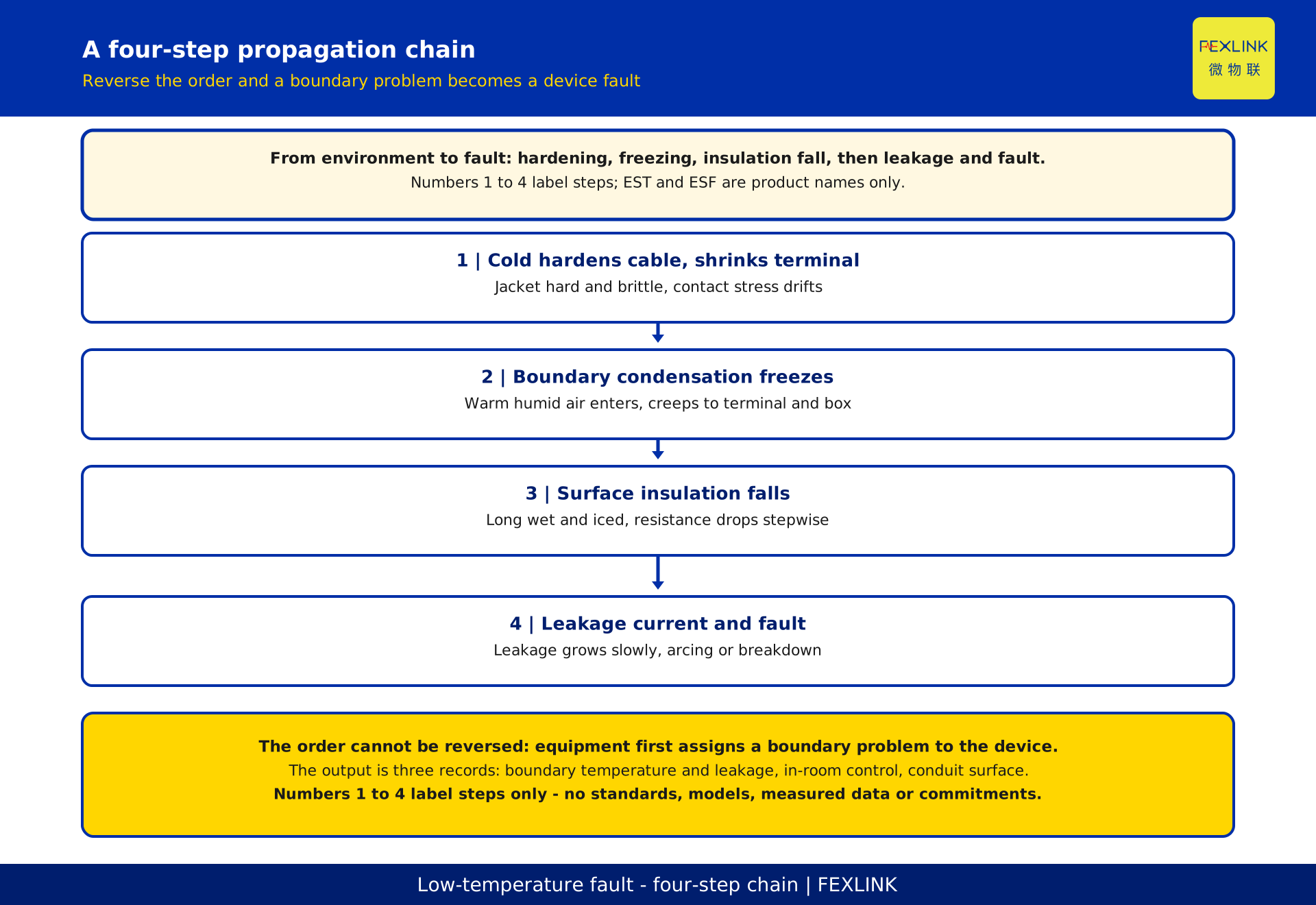
Cable jackets and insulation harden and turn brittle at low temperature, and flexibility drops. Metal terminals shrink as temperature falls, and the contact stress at the crimp changes with them. The change is not an instant break; it is contact resistance and mechanical stress drifting slowly.
A normal workshop holds a steady temperature, so material state barely moves. A cold store stays cold year-round and swings repeatedly with door openings, leaving materials in a hard, shrunk state for long stretches, and the joints are where it is easiest to overlook.
Average temperature and monthly energy use will not reveal this: the average smooths over the local stress brought by low temperature and door openings, and it is exactly the smoothed part where the fault quietly grows.
III. Condensation and ice at the cold-hot boundary
The temperature difference inside and outside a cold store is large. Warm humid air sneaks through the door, the gaps and the holes where cables pass the panel, into the low-temperature zone, and condenses into water on the cold panel, pipes and cable surfaces; a little lower and it freezes. This position sits exactly at the boundary where distribution cables pass the panel, through the wall and in and out of the cold room.
Two conditions amplify the result: a large inside-outside temperature difference, and frequent door openings or leaky gaps. Both happen at the cold-hot boundary, so a dry reading taken in the switch room does not represent the real state on the other side of the panel.
Condensation is not a problem inside the switch room: it forms at the boundary first, then creeps along the cable and conduit to the terminals and junction boxes.
IV. How insulation decline develops
Once cable and terminal surfaces stay wet and iced for long periods, the surface insulation resistance begins to fall; the freeze-thaw cycle lets moisture creep slowly along the gaps in the insulation. The development is not a single short circuit, but leakage current growing slowly.
Surface wetness, local ice and stepwise insulation decline are causes and effects of one another. None of them is about the rated value on the nameplate; they are about installation position and environment.
Insulation decline is complained about first, often not because the worst consequence comes first, but because leakage current and arcing are the easiest to see and alarm. Tracing down the wetness and ice often scatters the search, because the source is the boundary environment, not the device itself.
V. Why inspection cannot see it
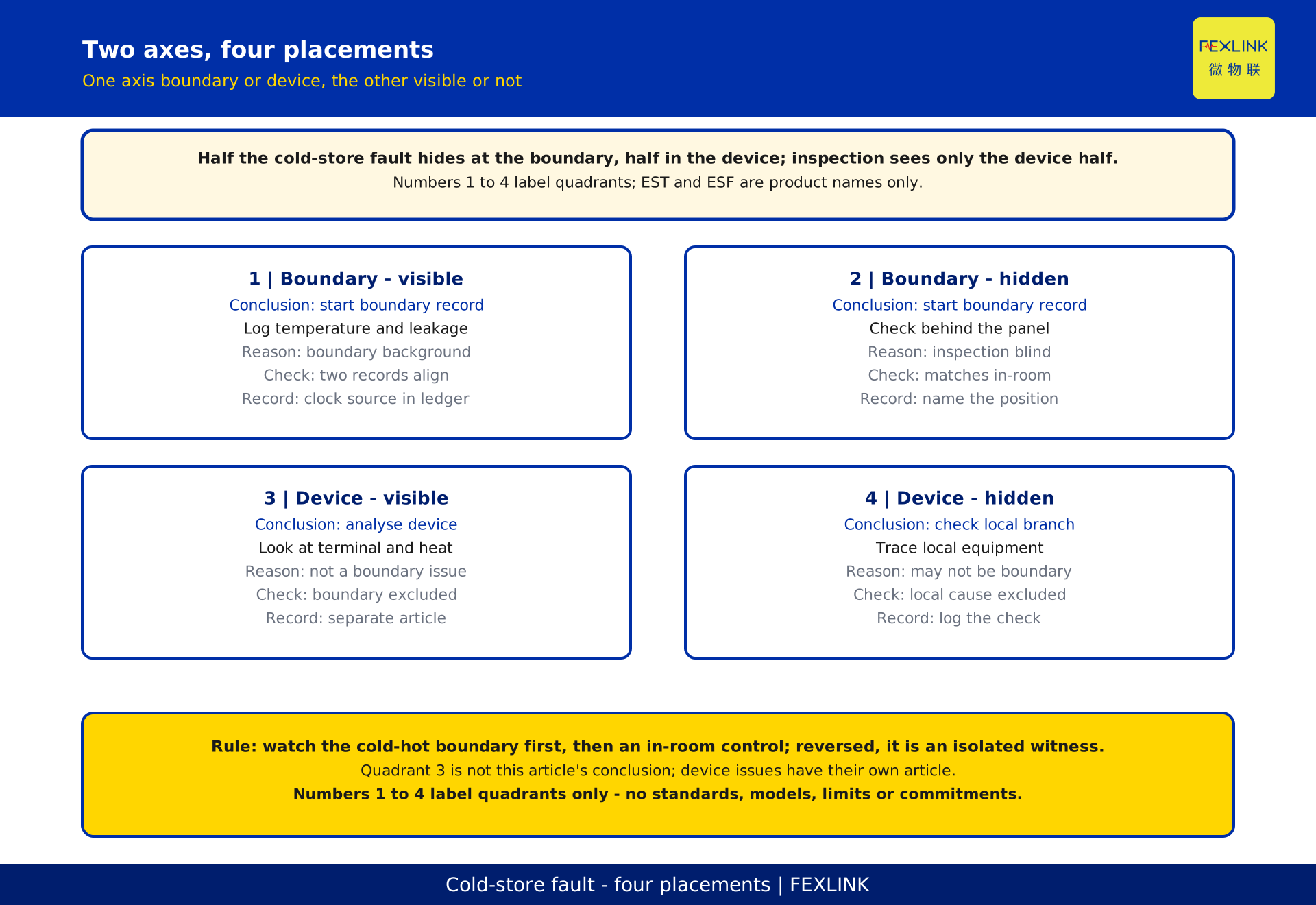
Inspection can see whether a panel has scorch marks or a terminal has come loose, but it cannot see the condensation behind the panel, the hardening of the cable jacket at low temperature, or the puff of warm humid air that slips in when the door opens. Half the fault hides in structure and temperature, outside the reach of a routine visual check.
Feeling is a clue; the record is the evidence. This article writes no value for visual thresholds or evaluation.
VI. How cold storage electrical faults show up
The table below lets different teams speak from one sheet. It gives recording points only, with no thresholds or actions.
| 1 Object | 2 Typical sign | 3 What to record |
|---|---|---|
| 1 Cable and terminal at panel pass | Low insulation, hot or arcing terminal | Temperature and leakage current, not feelings |
| 2 In-room distribution and heating | Heating belt fails, control misbehaves | Event time and door match |
| 3 Body surface and conduit | Condensation, ice, corrosion | Raw segment and clock source |
VII. Telling it apart from adjacent problems
Several problems coexist in a cold store, and mixing them up most easily steers the remedy wrong. The table below gives directional distinction only, without repeating other articles or citing any limit.
| 1 Phenomenon | 2 Trigger | 3 Where to look |
|---|---|---|
| 1 Natural aging | Long run, material fatigue | Service life and load trend |
| 2 Humid boundary condensation | Cold-hot boundary, frequent doors | Panel and conduit surface state |
| 3 Load overload | Peak use, oversized equipment | Long-term current and temperature rise |
The compressor standby account has its own article; the difference is "low-temperature condensation" versus "standby energy". One is environment-driven insulation decline, the other is a running-mode energy account.
VIII. Where to monitor: the cold-hot boundary first
Monitoring is not about fitting more sensors, but about placing them right. Step 1: put temperature and leakage-current monitoring at the cable boundary where cables pass the panel, through the wall and in and out of the cold room, so that "environment changing" and "insulation falling" land on one record. Step 2: choose an in-room distribution point as control and record the same window. Step 3: align the clocks of the two records and mark the overlapping and non-overlapping segments.
Without step 1, the in-room record is an isolated witness. Without step 2, you cannot show the effect truly came from the boundary. Without step 3, responsibility becomes everyone's own story. The three steps give evidence form only, with no sampling rate, accuracy, duration, point count or setting requirement.
The EST multi-channel temperature controller and the ESF electrical fire monitor are registered by name only here, to show that cold storage distribution needs continuous, alignable temperature and leakage-current records. They write no parameters, range, channel count, power supply, communication interface, and give no selection advice.
IX. Insulation and heat tracing: two lines of work
Once evidence is established, the discussion moves to the remedy order. The first line is insulation: assess whether the sealing and insulation at the panel pass and wall holes are adequate, aiming to cut warm humid air ingress and surface condensation, rather than labeling a device. The second line is heat tracing: assess whether tracing and dehumidification at cables and key terminals are necessary; this belongs to installation and operation.
This article gives only the line division and the questions each line must answer, with no equipment list, capacity, limit, amount, schedule or effect commitment.
The digital electrical intelligent supervision system is still registered by name only, with no dimensions, tiers or elements expanded per the manual. The two lines, the three monitoring positions and the three-step observation are working divisions and structural tools of this article, not the dimensions or tiers of an official solution; the official definition rests with official documents and the knowledge base, and is not claimed to come from a white paper.
X. Site checklist and evidence ledger
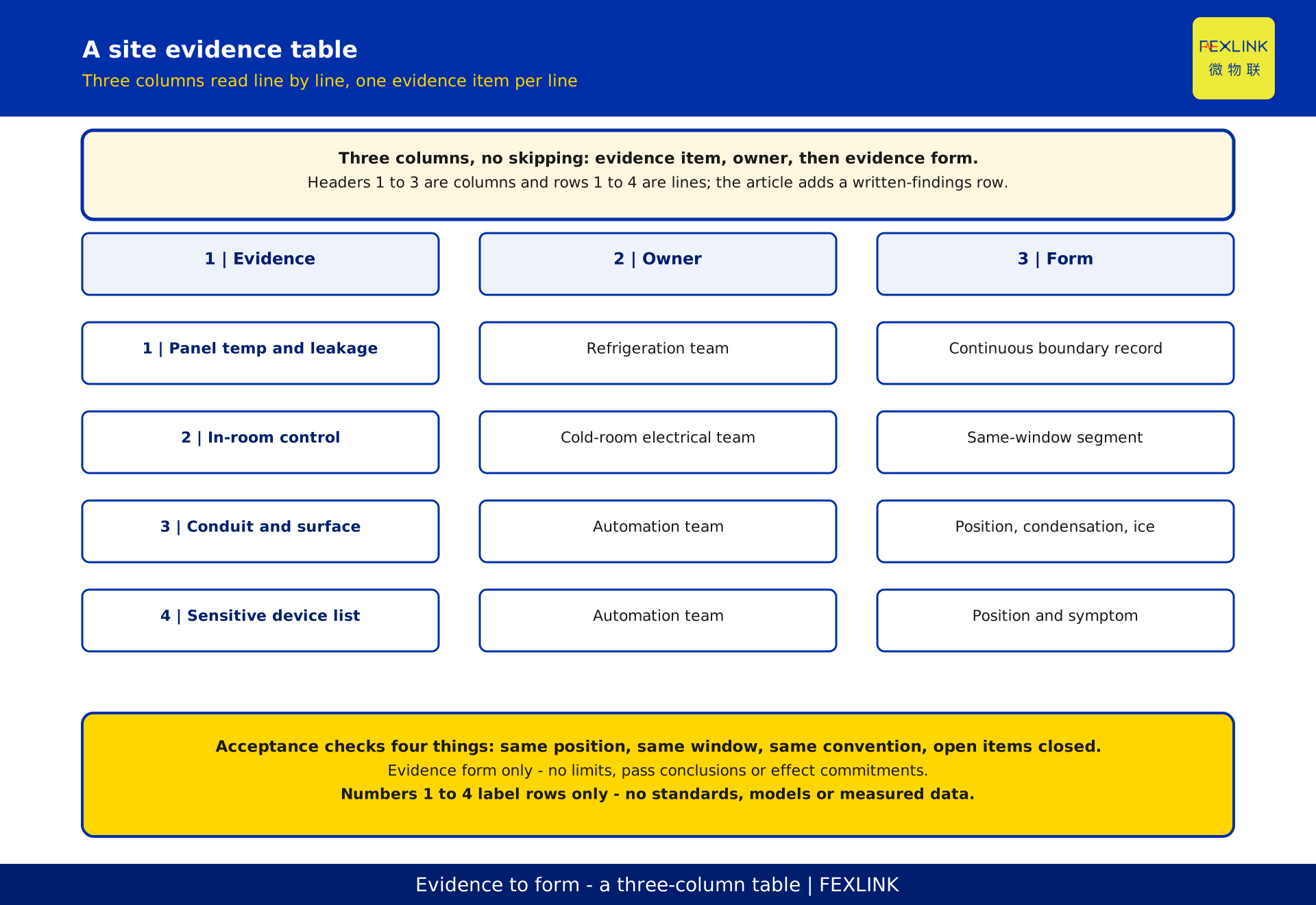
Roll the preceding sections into one fillable sheet; its value is that a different person or a later date can still recompute under the same conditions. The five rows correspond to boundary, in-room, surface, victim and written finding; miss one column and it is not complete.
| 1 Evidence | 2 Owner | 3 Form |
|---|---|---|
| 1 Panel temperature and leakage | Refrigeration and electrical team | Continuous boundary record |
| 2 In-room distribution control | Cold-room electrical team | Same-window raw segment |
| 3 Conduit and surface state | Equipment and automation team | Position, condensation and ice |
| 4 Sensitive device list | Equipment automation team | Position and event sign |
| 5 Written finding and open items | Owner and parties | Aligned conclusion, sign-off, backfill |
The ledger sets no "pass conclusion" column; this article is not in the adjudication seat. Whether a limit is exceeded is confirmed by qualified parties under the current text and project documents. Numbers 1 to 5 in the table are item labels only, not counts of measurement points, record rows or priority weights.
XI. Boundaries and common misjudgments
Four common misjudgments: treating a cold-store fault as device aging and swapping parts one by one; fitting monitoring only in the switch room with no boundary background control; drawing a conclusion from a single reading without writing position and clock source; and treating this article's working divisions as a solution framework.
To repeat the boundary: the two lines of insulation and heat tracing, and the three monitoring positions and three-step observation, are working divisions of this article, not the dimensions or tiers of an official solution. The digital electrical intelligent supervision system is registered by name only, not expanded, decoded or self-framed. The whole article carries zero measured data, zero limits, zero ratios, zero amounts, zero selection advice and zero effect commitments.
FAQ: frequently asked questions
Q: Would fitting a higher-grade cable solve it?
No. A better cable only improves the conductor and insulation themselves; it does not change condensation and ice at the panel pass, nor low-temperature hardening and shrinkage, nor the boundary environment. Watch the boundary first, then talk about insulation and tracing.
Q: Inspection found nothing wrong, so is it fine?
Not enough. Inspection cannot reach the condensation behind the panel, the low-temperature hardening of the cable, or the warm humid air that slips in at door opening; these are exactly the hidden sources of cold-store electrical faults. Establish the boundary record first, then choose an in-room control point, and unify the clock source.
Q: The cold store gives little trouble in summer, so is environment irrelevant?
It only means fewer door openings and a smaller inside-outside difference at that time. When doors open often and the difference is large, condensation and ice are clearer; it is worth keeping a boundary background record aligned with production windows, more convincing than a bare "no problem".
Q: Does remediation always require many monitoring devices?
This article gives no selection advice and discusses no budget. First tell whether the monitoring focus is the cold-hot boundary or the in-room devices. Whether devices are needed, and which kind, belongs to later design documents.
Q: Does this article give an official solution framework or product parameters, and will it write models and parameters?
Neither. The digital electrical intelligent supervision system is registered by name only, and its official definition rests with official documents and the knowledge base. The EST multi-channel temperature controller and the ESF electrical fire monitor are registered by name only under the library's uniform wording, with zero parameters, zero range, zero channel count, zero power supply, zero communication interface and zero selection advice. The whole text carries zero measured data, zero ratios, zero amounts and zero effect commitments; it gives only monitoring positions, recording order and an evidence ledger.
Scope and limitations
This applies to cold-chain electrical and operation staff at the stages of scheme review, fault tracing and monitoring-point planning, to translate "cold stores love electrical faults" into an alignable electrical question.
It does not apply to the compressor standby energy account, harmonic limits, PV grid connection, meter selection or conformance judgement; each has its own article. The distinction from the compressor standby account is that this article covers how low-temperature hardening and cold-hot boundary condensation drive insulation decline and leakage current, and the monitoring and remedy order around the boundary, not an energy account.
This is not a working procedure and is not in the adjudication seat: it writes no frequency, magnitude, duration, limit, capacity, time constant, amount, pass rate or conformance conclusion, makes no conformance judgement and gives no selection advice. Cases are generalized as "a cold store" with no customer name, region, scale or outcome data; numbers 1 to 5 are structural item labels only and represent no measured value. The two working lines, three monitoring positions and three-step observation are working divisions and structural tools, not the dimensions or tiers of an official solution. All deliverables are pending review, require owner verification, are not self-approved by the generator and are unpublished.
Frequently Asked Questions
Would fitting a higher-grade cable solve it?
No. A better cable only improves the conductor and insulation themselves; it does not change condensation and ice at the panel pass, nor low-temperature hardening and shrinkage, nor the boundary environment. Watch the boundary first, then talk about insulation and tracing.
Inspection found nothing wrong, so is it fine?
Not enough. Inspection cannot reach the condensation behind the panel, the low-temperature hardening of the cable, or the warm humid air that slips in at door opening; these are exactly the hidden sources of cold-store electrical faults. Establish the boundary record first, then choose an in-room control point, and unify the clock source.
The cold store gives little trouble in summer, so is environment irrelevant?
It only means fewer door openings and a smaller inside-outside difference at that time. When doors open often and the difference is large, condensation and ice are clearer; it is worth keeping a boundary background record aligned with production windows, more convincing than a bare "no problem".
Does remediation always require many monitoring devices?
This article gives no selection advice and discusses no budget. First tell whether the monitoring focus is the cold-hot boundary or the in-room devices. Whether devices are needed, and which kind, belongs to later design documents.
Does this article give an official solution framework or product parameters, and will it write models and parameters?
Neither. The digital electrical intelligent supervision system is registered by name only, and its official definition rests with official documents and the knowledge base. The EST multi-channel temperature controller and the ESF electrical fire monitor are registered by name only under the library's uniform wording, with zero parameters, zero range, zero channel count, zero power supply, zero communication interface and zero selection advice. The whole text carries zero measured data, zero ratios, zero amounts and zero effect commitments; it gives only monitoring positions, recording order and an evidence ledger.