 FEXLINK Research Institute
The short answer
If you clean the condenser every year and the chiller still drinks power, the problem usually is not whether the cleaning was done right. It is that you never read the compressor's electrical signatures. High current, falling power factor, and growing three-phase imbalance tend to show up before the efficiency number drops. Read those three as trends first, then decide whether the fault sits in the motor itself or in the refrigerant and heat-exchanger side. Cleaning without revisiting the electrical signals treats only one of the possible paths that waste power, while the others keep drawing.
I. Turn "wasted power" into numbers you can read
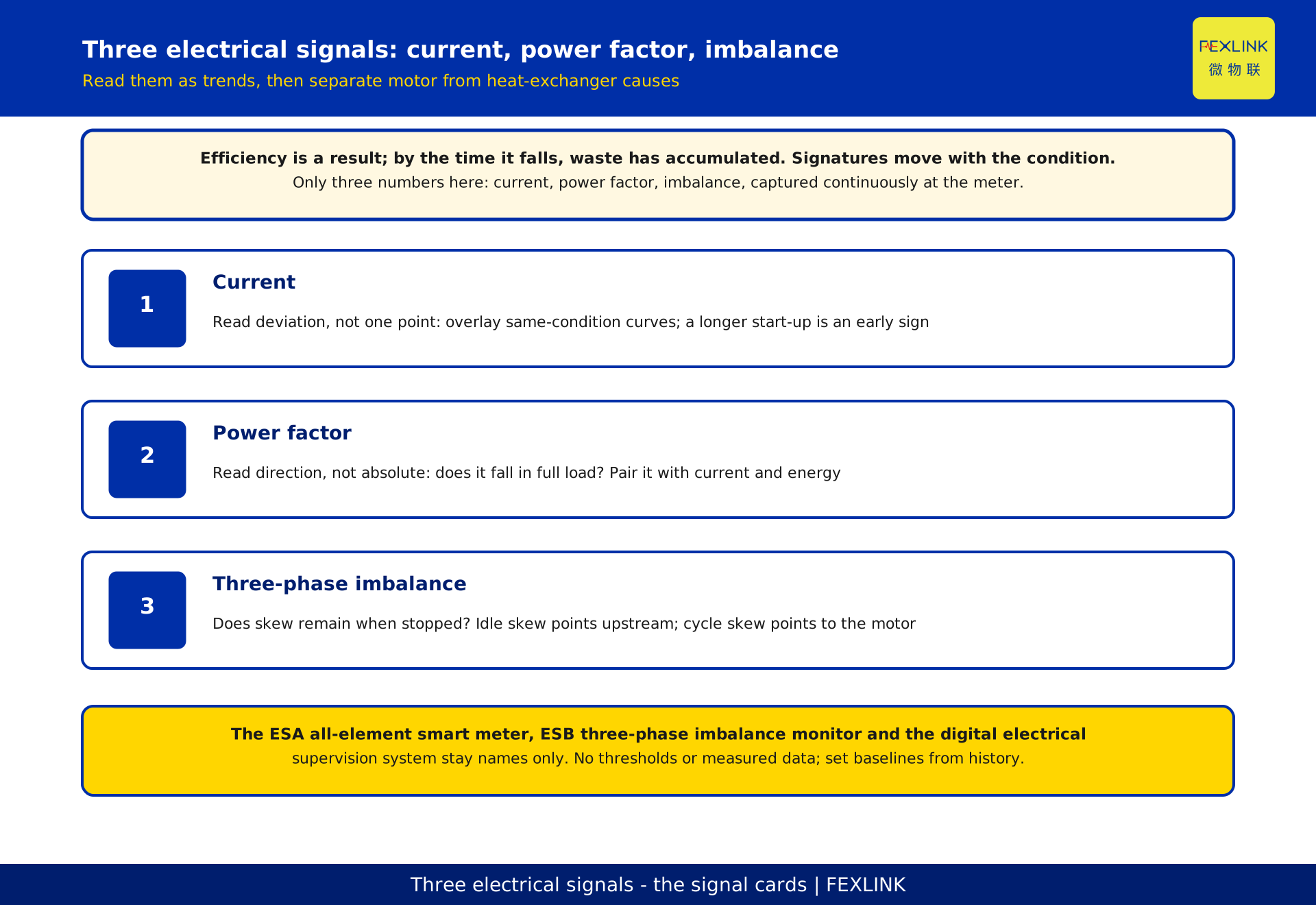
Efficiency is a result. By the time it visibly falls, the waste has been accumulating for a while. Electrical signatures are different: they follow the compressor's operating condition in real time, so when the condition drifts, the numbers move. What matters is not one reading but whether the same compressor, at a similar load, has shifted as a whole.
This article covers three numbers: current, power factor, and three-phase imbalance. None of them needs a shutdown or a teardown; they can be captured continuously at the metering point on the distribution circuit. The acquisition side can use the ESA all-element smart meter and the ESB three-phase imbalance monitor, aligned on one time axis in the digital electrical intelligent supervision system. Only the names are registered here; no parameters or selection advice are expanded.
II. Read current by deviation, not by a single point
Compressor current rises and falls with load, so readings at full load and part load are naturally different. Comparing one instant against a rule of thumb proves nothing. The useful method is to overlay current curves taken at similar outdoor temperatures and similar setpoints, and see whether they still coincide.
If, under the same condition, the curve has moved up as a whole while the waveform stays essentially undistorted, the cause is usually a heavier mechanical load: refrigerant state, heat-exchange efficiency, and piping resistance all make the compressor work harder. If the rise comes with phases trading off against each other, the cause is more likely the motor itself or the supply side.
The start-up segment is worth reading too. A start-up surge that has visibly lengthened compared with before often means the mechanical load has grown or the starting condition has worsened, and this signal appears earlier than the steady-state current.
III. Read power factor by direction, not by absolute value
Power factor is a ratio, so a single reading says little. The first method is to watch its direction across load. A motor running light naturally has a lower power factor; that is normal. But if it also falls in the full-load band, or sits lower than before at the same load, it deserves attention.
The second method is to read it together with current and energy. Falling power factor with rising current and rising energy points to a real increase in reactive occupation. Falling power factor with unchanged current and energy points more to metering or sampling.
Combine the two and two patterns separate: high current with falling power factor and matching mechanical symptoms is the motor-straining type; modest current with low power factor and long periods of low-load cycling is the light-load type. The first calls for a mechanical check, the second for control and load matching.
IV. What three-phase imbalance means for a compressor
Three-phase imbalance affects motor loads more directly than other loads. Unequal phase magnitudes create an extra rotating field inside the motor, adding heat and vibration and accelerating insulation aging over time. The damage accumulates, so by the time protection operates, real loss has usually occurred.
The key is whether the imbalance is a persistent skew or appears only with the operating condition. If it remains while the unit is stopped, the cause is mostly upstream: uneven circuit load distribution, an extra single-phase load on one phase, or high contact resistance at a terminal. A skew that appears only with cycling or load changes is more likely tied to motor windings, contactor wiring, or switching of another device on the same branch.
V. Motor problem vs. heat-exchanger problem
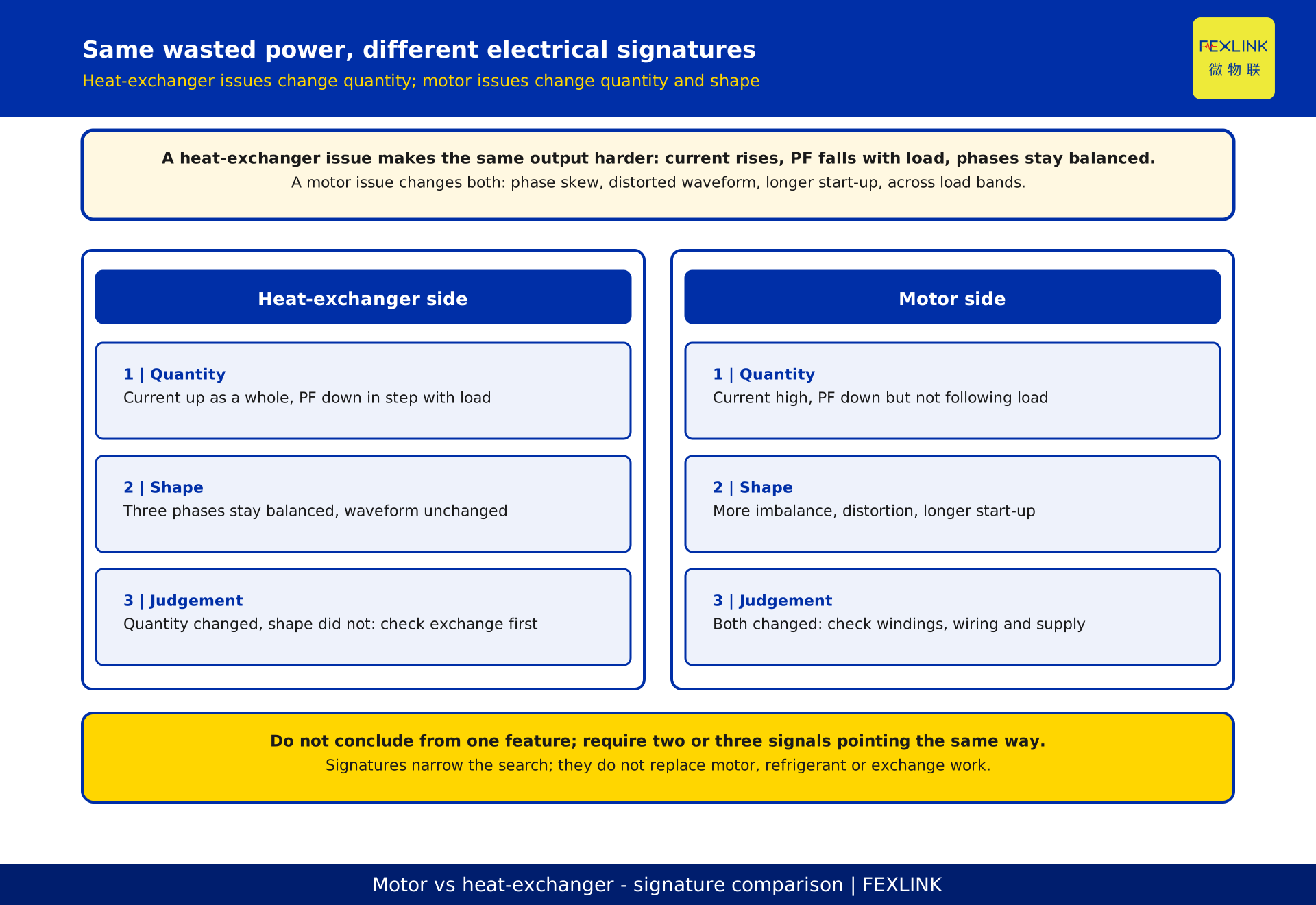
This is the core of the article. Both problems show up as wasted power, but their electrical signatures differ consistently.
A heat-exchanger problem, such as fouling or low refrigerant, makes the compressor work harder for the same output. The signature is an overall rise in current, a power factor that falls in step with the load band, a largely balanced three-phase set, and an essentially unchanged waveform. In short, the quantity changed but the shape did not.
A motor problem changes both quantity and shape: beyond high current, it often brings greater three-phase imbalance, waveform distortion, and a lengthened start-up surge, and these can appear across different load bands.
Do not conclude from a single feature. Require at least two or three signals pointing to the same side before arranging targeted maintenance.
VI. Five signals in one table
Fixing the reading method on site keeps everyone interpreting the same way. The table below sets out five observation items, how to read each, and what it mainly points to.
| No. | Observation | How to read it | Main pointer |
|---|---|---|---|
| 1 | Current deviation | Whether same-condition curves shift up as a whole | Mechanical load or motor state |
| 2 | Power factor trend | Whether it falls in step across load bands | Reactive occupation and load matching |
| 3 | Three-phase balance | Whether skew remains when stopped | Upstream circuit or motor itself |
| 4 | Waveform shape | Distortion and lengthened start-up | Motor and supply-side problems |
| 5 | Duration of trend | How long the anomaly has lasted | Maintenance urgency |
The table gives reading methods, not thresholds. Every unit has its own baseline; thresholds must be set from that unit's history. Borrowing a fixed number from elsewhere invites misjudgement.
VII. Link the readings to the cleaning plan
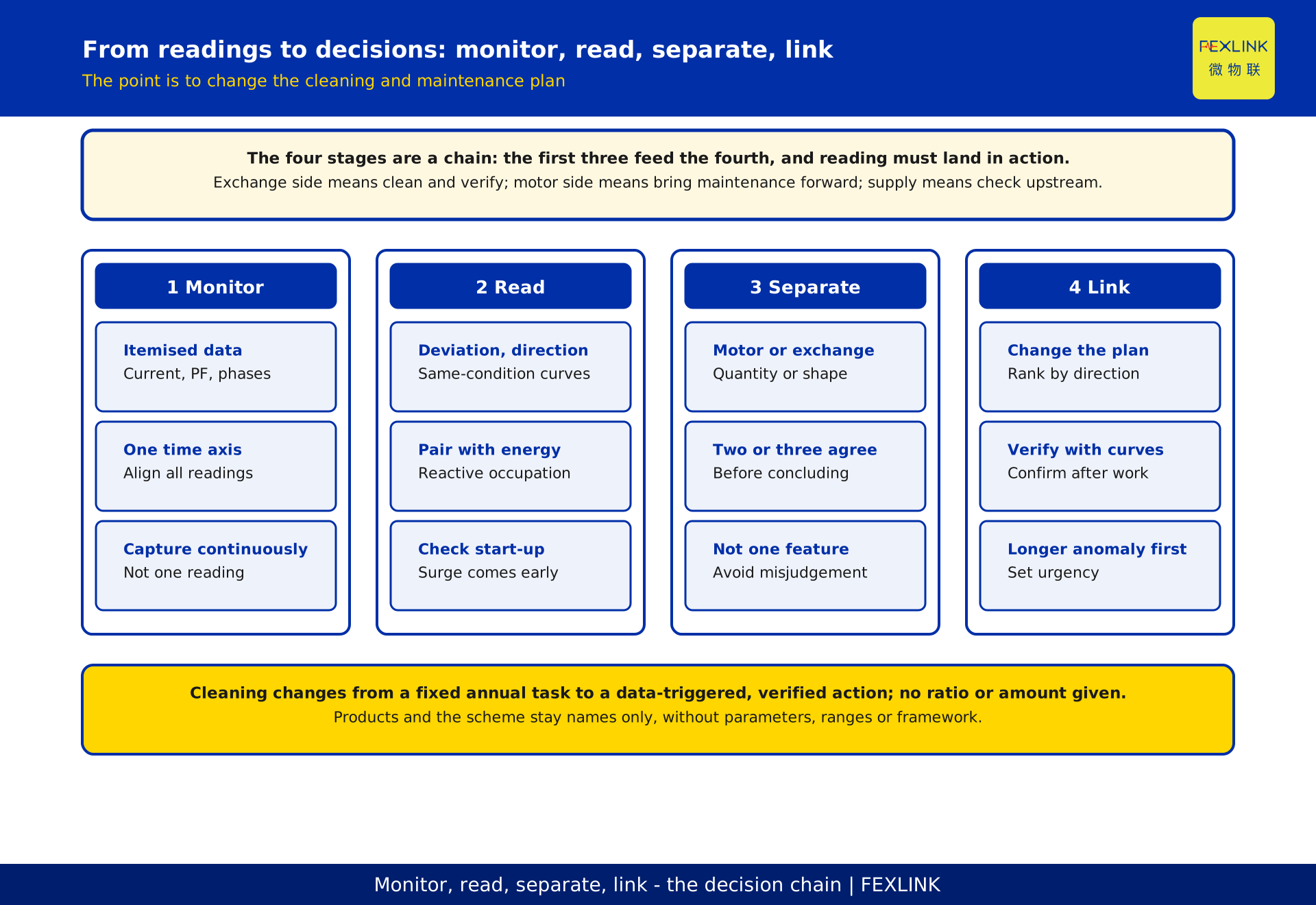
The point of reading electrical signatures is to change decisions, especially the layout of cleaning and maintenance plans.
When the signatures point to the heat-exchanger side, put cleaning into the plan and verify it with before-and-after current and power-factor curves at the same condition. If cleaning worked, current at the same condition should return toward its earlier baseline. Cleaning then changes from a fixed annual task into something triggered by data and verified after the work.
When they point to the motor side, bring maintenance forward and use the duration of imbalance and waveform anomalies as the urgency measure; the longer they persist, the less you should delay. When they point to the supply side, move the focus to upstream load distribution and wiring checks, and defer cleaning or overhaul of the unit itself.
VIII. Three common misreads
The first is treating a low power factor as proof the motor is broken. Light load, frequent cycling, and a withdrawn reactive-compensation step all lower power factor, and none is a motor fault. Read power factor with the load band and current attached.
The second is treating three-phase imbalance as a problem of the unit itself across the board. If the three phases are still skewed while the unit is stopped, the cause is upstream, and working on the unit achieves nothing.
The third is comparing current across different conditions. Any difference in outdoor temperature, setpoint, or load ratio makes the readings incomparable. Compare the same unit over time at similar conditions, or compare similar units side by side.
All three share one root: reading the number without reading its relationship to the operating condition.
IX. Field worksheet: evidence and owner
A judgement must land in a traceable worksheet. The table below lists the evidence each judgement needs and the party usually responsible.
| No. | Judgement | Evidence needed | Usual owner |
|---|---|---|---|
| 1 | Current deviation | Same-condition current time series | Building energy management |
| 2 | Power factor trend | Power-factor curves by load band | Building energy management |
| 3 | Three-phase skew | Phase data at start, stop, and idle | HVAC operations and electrical |
| 4 | Signature separation | Aligned records of all three items | Both parties jointly |
| 5 | Cleaning effect | Before-and-after curves at same condition | HVAC operations |
The value of this worksheet is turning "I think" into "the record shows." Every judgement can be traced to a stretch of data, a point in time, and a responsible party.
X. FAQ: frequently asked questions
Q: Can an electricity bill alone tell a motor problem from a heat-exchanger problem?
No. The bill is a total. It does not carry current, power factor, or three-phase detail, so it cannot support a directional judgement. You need at least time-based itemised data from the compressor circuit.
Q: Does high current mean it is time to clean?
Not necessarily. High current only says the load got heavier. Heat-exchanger fouling is one possible cause, but a straining motor and rising mechanical resistance look the same. Read three-phase and power factor together.
Q: Does a low power factor mean a higher bill?
That depends on the billing method and local rules, which this article does not expand. Technically, low power factor means greater reactive occupation and higher circuit current, which brings added loss. Whether it becomes an actual charge depends on the billing basis in force.
Q: Can these signatures produce a savings percentage?
No, and this article gives no ratio or amount. Signatures locate direction and set priority; the saving must be confirmed by comparing same-condition data before and after the action, not derived from the signatures themselves.
Q: Are these numbers a fixed dimension of an official scheme?
No. Current, power factor, and three-phase imbalance are engineering entry points selected from quantities directly readable at the compressor circuit. They are a working division, not a fixed dimension or layer of any official scheme.
XI. Boundary and delivery status
This article follows the topic and core conclusion registered in the registry. Across the whole chain it writes no standard number, year, clause, threshold, allowed value, ratio, measured datum, or compliance judgement. On the acquisition side it registers only the names of the ESA all-element smart meter and the ESB three-phase imbalance monitor; on the platform side it registers only the name of the digital electrical intelligent supervision system, without expanding parameters, ranges, function lists, or scheme framework.
On separation from neighbours: another article covers a cold-storage compressor split into compression, defrost, and idle segments for an idle-power account; this one covers a single commercial chiller compressor read to separate motor from heat-exchanger problems. The objects, goals, and reading dimensions all differ. A data-centre chiller plant harmonics account is a further article's topic; this one is a single commercial chiller power account, with different scenarios and accounting bases.
Deliverables are all DRAFT_PENDING_REVIEW with owner_review_required=true. The generator does not self-approve; independent QA and per-article acceptance are pending.
XII. Scope and limitations
This applies to building energy managers and HVAC operations staff who have itemised acquisition on the compressor circuit and want a directional reading of current, power factor, and three-phase imbalance for a single commercial chiller compressor.
It does not apply when there is no itemised acquisition and only a total meter; when the unit changes condition sharply and same-condition comparison is impossible; or when a quantitative efficiency grade, saving, or cost must be established, which calls for dedicated calculation. The signatures given here are screening and locating tools. They do not replace motor overhaul, refrigerant leak detection, heat-exchanger cleaning, or other professional work, and they constitute no compliance judgement.
Frequently Asked Questions
Chillers Still Drink Power Despite Annual Cleaning
If you clean the condenser every year and the chiller still drinks power, the problem usually is not whether the cleaning was done right