 FEXLINK Research Institute
The short answer
For a cold store compressor that cycles on and off, "how much can be saved" is not a percentage or amount to quote up front. It is an account that must be split before it can be settled. Reducible electricity hides in two places: standby draw when nothing is cooled, and low power factor periods. One main line: cut a continuous power curve by state into compression, defrost and standby, then align each segment's energy with its synced state. Without that split, waste is flattened into normal operating consumption.
It gives no savings ratio, amount, limit or payback period; numbers come only from site measurement and the documents in force. The ESA all-element smart meter is registered by name only as the acquisition boundary for a key circuit's curve; the digital electrical intelligent supervision system is registered by name only, with no framework expansion. The three-segment split is a working method, not a dimension or layer of any official solution.
Splitting one curve into three segments
After the compressor stops, control power, oil heating, fans, lighting and defrost residue still draw; during defrost the heating and drain branches work even if the main cooling circuit is off. Splitting only by high and low power misreads defrost as a spike and folds standby into off-peak consumption, so both wastes disappear.
The basis for splitting is synced state markers, not absolute power: the run signal, defrost command, thermostat contacts and chamber temperature records. The curve says which segment drew power and for how long; state markers say what the plant was doing. Both records must share one clock, one metering point and one convention, or the split is just pieces of a curve with no attribution. Each segment stands as its own account; that is the precondition for translating cost.
Lead with the conclusion: segment first, savings later
The usual site question is "how much can we actually save", but the order runs the other way: separate the three segments, put each segment's energy and synced state into a written worksheet, then let qualified parties translate it under the billing documents in force. Quoting a ratio without that worksheet replaces measurement with an unverified coefficient that cannot be reproduced or defended at settlement.
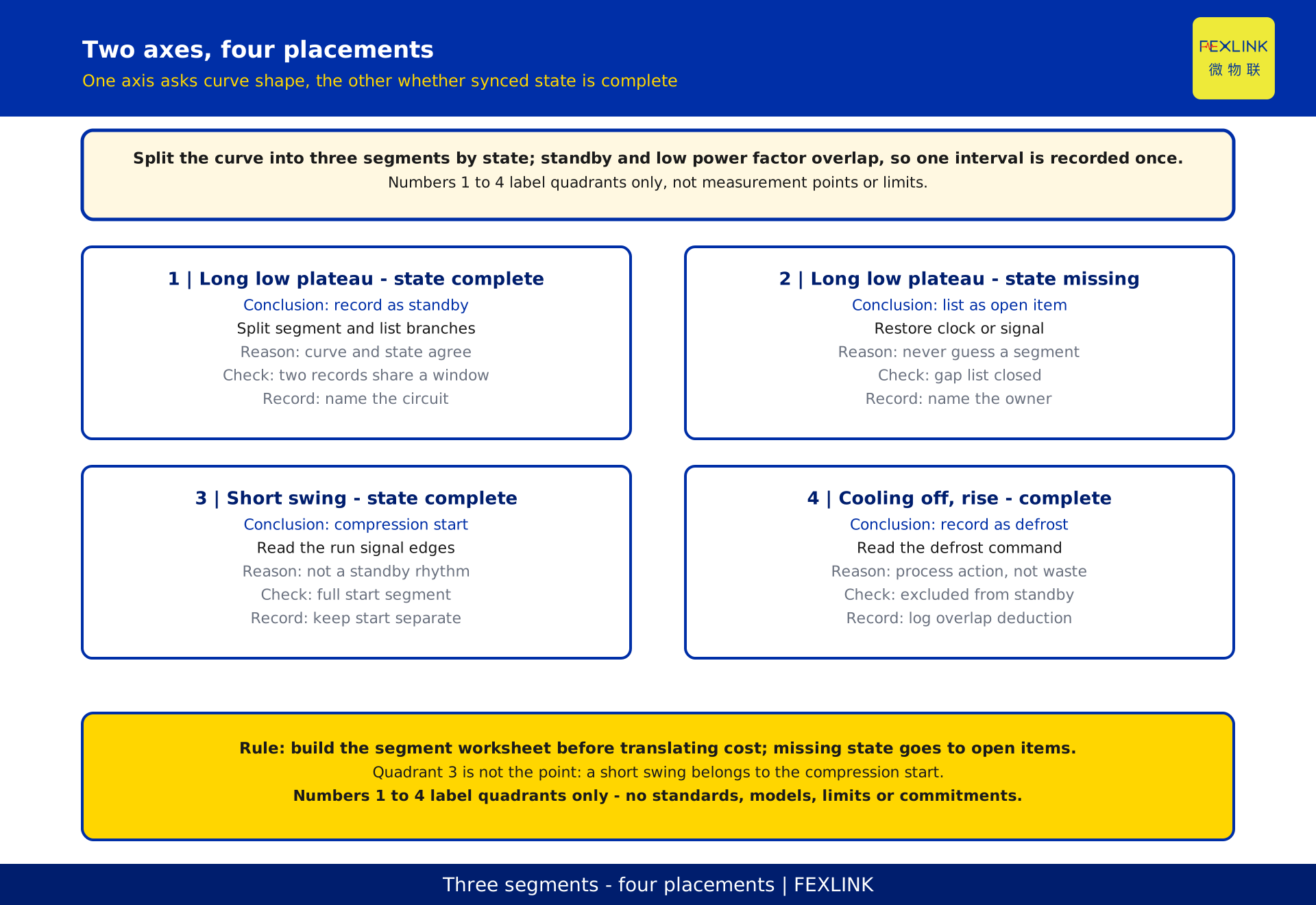
The conclusion: reducible electricity equals the switchable standby part plus the improvable part of low power factor periods, both deducting compression overlap and never counted twice. This article gives only structure and constraints, not numbers; segment separation and per-segment translation are a working division, not a dimension or layer of any official solution. Figure 1 lists four placements.
Compression: how to read the main work segment
Completeness means the curve covers start, steady state and shutdown, not just a steady middle slice; the short inrush is not steady state, and mixing them shifts every later boundary. Purity means nothing unrelated downstream of the metering point is folded in, or another device rewrites the curve.
The worksheet states metering point location, synced state source and boundary basis. Do not set a boundary by a power threshold; this article supplies no such value. Boundaries follow the run signal edges; the curve is only a cross-check.
Defrost is not an off state
The main cooling circuit is off while heating, drain and fan branches work, so the curve may rise differently; reading "compressor stopped" as "no consumption" means the segment is either missed or reported as a spike.
The evidence is the synced defrost command record, not the curve shape. The worksheet records defrost start and end and the temperature change, and states that defrost energy belongs to the operating account, not standby waste; otherwise the reducible space is overstated. Unlike no-load accounts or night-time idle diagnosis, this article handles three state-cut segments from a cold store compressor; defrost stands alone.
Standby: the power that stays when cooling stops
Standby is the interval in which power is still taken although nothing is cooled. After the compressor stops, control power, oil heating, fans, lighting and defrost residue form a low plateau; each branch is small, but the plateau can stretch out and the accumulated energy stops being a rounding error. A total-only view compresses it into "base load" with no state marker to question.
Recognition needs two things at once: a long low plateau and no run or defrost signal active. The worksheet separates process-necessary branches from switchable ones, recording only classification and basis, not power, duration, wattage or switchable fraction; those numbers come only from measurement. This article draws no inference from a cold store's measured results.
Why the sequence has to be this one
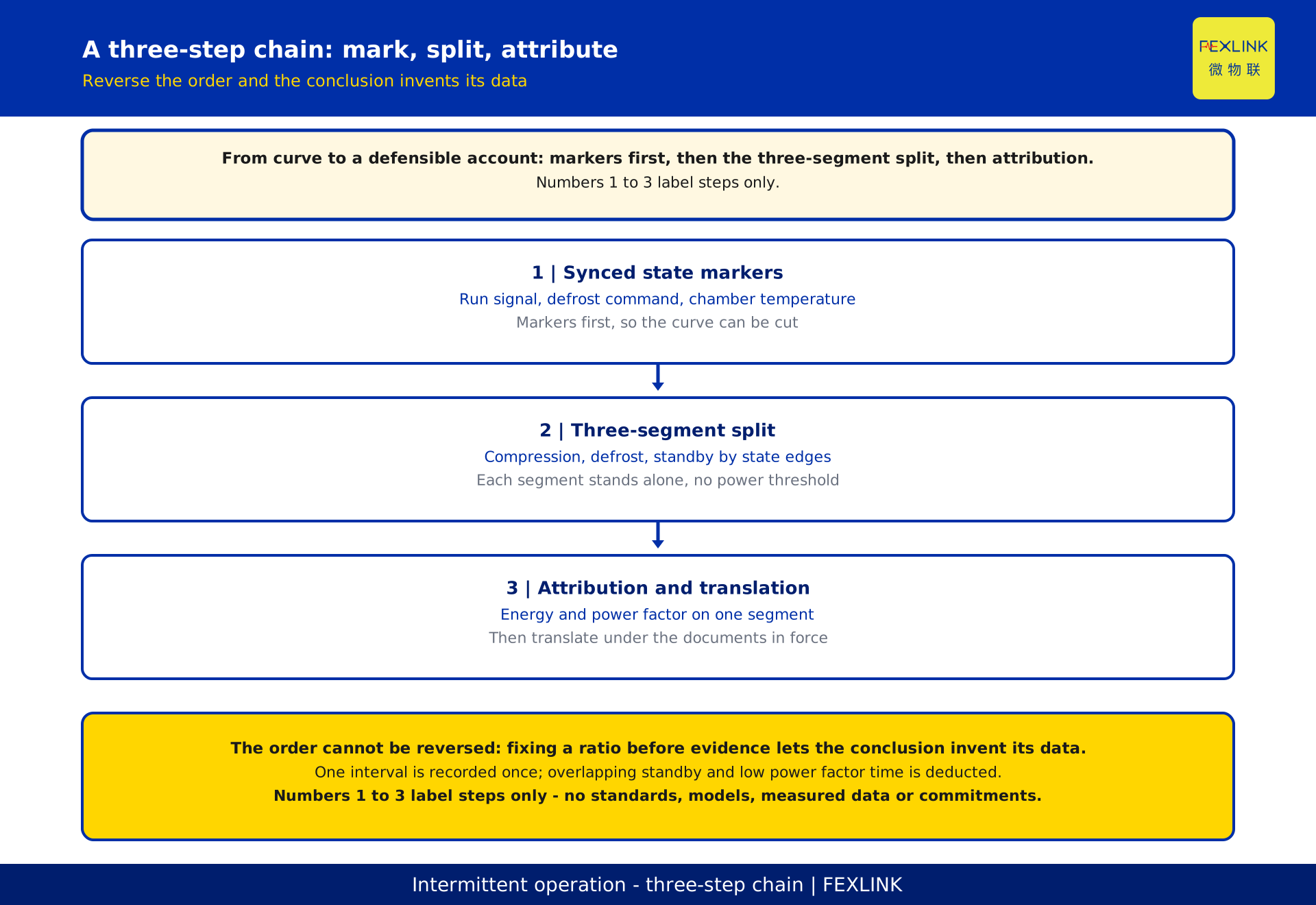
From curve to a defensible account there are three fixed steps: synced state markers first so the curve can be cut into three segments; with segments clear, energy and power factor recorded inside each one; only after attribution can cost be translated. Reverse the order and two errors appear: settling the total before splitting flattens waste, and fixing a ratio before evidence lets the conclusion invent its data.
Standby and low power factor periods overlap heavily, and compression start can also pull power factor down briefly. Make the time segment the only key, with energy and power factor as two fields on it. The ESA all-element smart meter carries the key circuit's power and energy curve here, registered by name only, with no selection advice; measuring range, channel count and communication interface are configurable, so a standard configuration must not judge a mismatch. Figure 2 draws the order as a chain that cannot be reversed.
Why a low power factor period adds a second line to the bill
After shutdown, small inductive loads leave active power low and reactive share high, so power factor falls. Low power factor does not mean more active energy, but occupies capacity, raises losses and produces a power factor adjustment; the mechanism has its own article.
This article assigns a low power factor period to one of the three segments so the line has an owner. Record the synced power factor shape per segment, mark whether it occurred during compression, defrost or standby, then decide whether it overlaps. No assessment value, limit or bill magnitude is written here; assessment and billing conventions follow the documents in force, and the version in force applies. The digital electrical intelligent supervision system is registered by name only here, with no framework expansion.
Translating three segments into cost: time split before attribution
The order matches what came before: cut the curve along the boundaries, align each segment's energy with its synced state and synced power factor, then translate each one under the billing convention. What matters is that the time split precedes attribution: multiply a total by a coefficient first and segment differences are erased, and overlap can no longer be deducted.
| 1 Segment | 2 State | 3 Evidence | 4 Excluded |
|---|---|---|---|
| Compression | Run active | Edges | Other loads |
| Defrost | Command and return | Edges and temperature | Overlap |
| Standby | Both off | Plateau | Start power factor |
| Open items | State missing | Gap list | Unmeasured |
The last row matters: missing state markers go to open items, not guesswork. The four rows are structural line numbers.
Spotting standby draw: curve shape and synced state
Recognition works in pairs: the curve supplies shape and the state supplies meaning. The table gives three placements and actions; only the criterion form, with no threshold, duration or power value.
| 1 Curve shape | 2 Synced state | 3 Action |
|---|---|---|
| Long low plateau | Both off | Standby, split branches |
| Cooling off, separate rise | Defrost active | Record as defrost |
| Short swing then fall | Rising edge | Assign to compression start |
One placement falls outside the three: a curve step with a missing state marker. It belongs neither to compression nor standby and goes straight to the open items list. The whole article carries no measured data, amounts, ratios or effect commitments, and the case is generalised as a cold store.
The site worksheet: evidence, owner, form
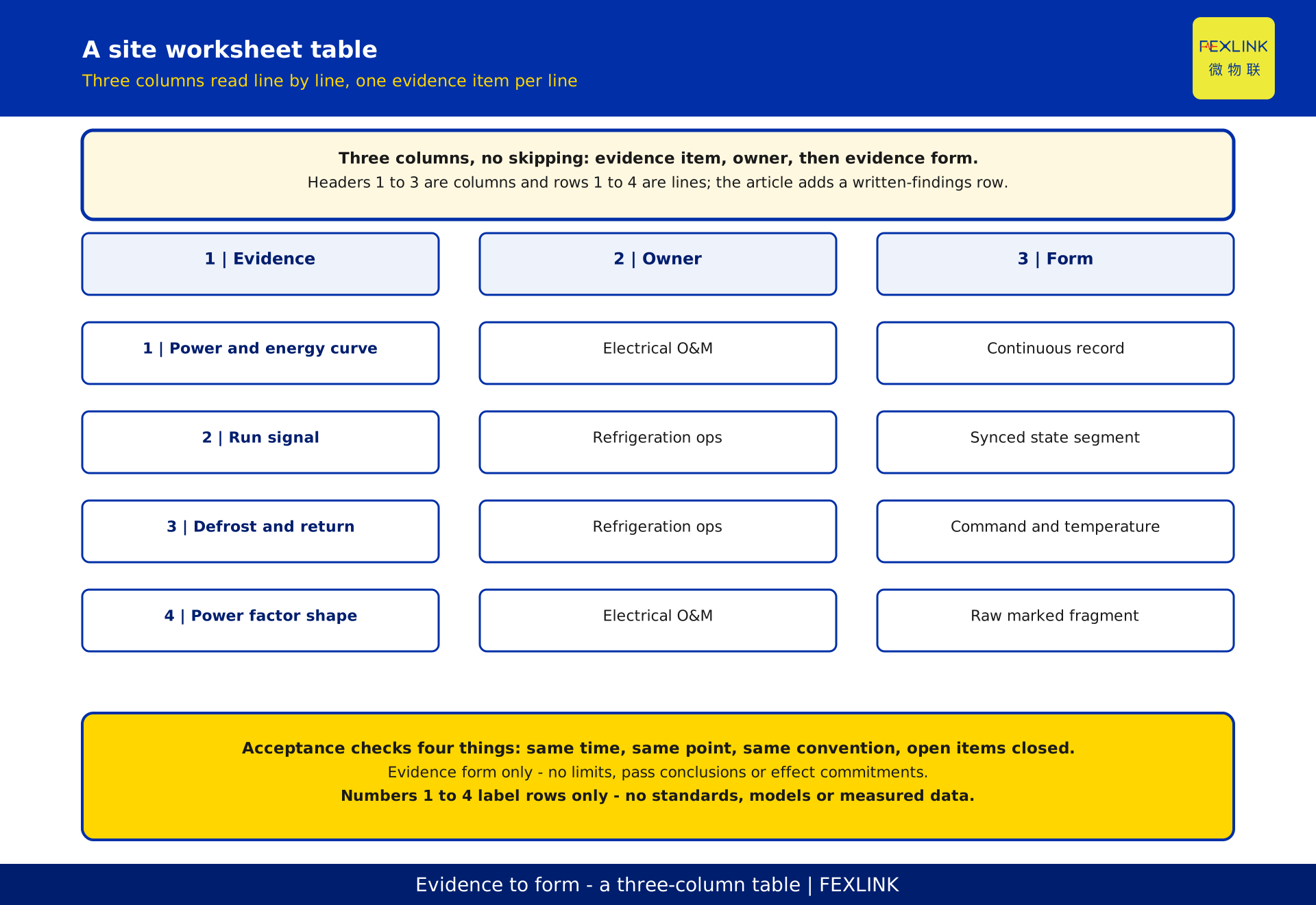
All of the above closes into one fillable worksheet with three columns that must not be skipped: evidence item, owner, then form. Owners are named by function; the form states only a record type, with no sampling rate or setting requirement.
| 1 Evidence | 2 Owner | 3 Form |
|---|---|---|
| 1 Power and energy curve | Electrical O&M | Continuous |
| 2 Run signal | Refrigeration ops | Synced state segment |
| 3 Defrost and return | Refrigeration ops | Command and temperature |
| 4 Power factor shape | Electrical O&M | Raw marked fragment |
| 5 Findings and open items | Energy management | Item list |
Acceptance checks four things: same time, same point, same convention, open items closed. The worksheet has no compliance column; this article provides a tool, not a verdict. Figure 3 draws it as a three-column decision table with four rows. The digital electrical intelligent supervision system is registered by name only, not used as a criterion.
FAQ: frequently asked questions
Q: Can standby waste be calculated from the bill alone?
No. A bill has no state markers, cannot cut the curve into segments, and cannot deduct overlaps. Confirm the metering point keeps a continuous curve and synced state; gaps go to open items.
Q: Does defrost energy count as waste?
No. Defrost is a process action in the operating account. Keeping defrost as its own account avoids that double count; overlap is deducted by synced marker.
Q: Does low power factor mean extra energy counted?
No. Billing settles active energy; reactive and apparent power do not enter the kilowatt-hour directly, though low power factor occupies capacity, raises losses and produces a power factor adjustment. This one only assigns a low period to a segment, with no assessment value.
Q: What savings ratio can be reported after splitting?
None is reported here. Reducible electricity depends on standby branches confirmed as switchable, the improvable part of low power factor periods, and the deduction of their overlap, all supported by measurement and the documents in force. this article provides, implies and commits to no ratio, amount or payback period.
Q: Is this split an official model layer?
No. The three segments are a time division by equipment state, a working method for reading a curve on site; they are not a dimension or layer of any official solution and form no model element. The digital electrical intelligent supervision system is registered by name only, with no expansion of dimensions, layers or elements, no invented framework and no white paper claim; the official definition rests with official documents and the knowledge base. This article cites no standard numbers; assessment conventions follow the text in force, and the version in force applies.
Boundaries and delivery status
Neighbouring articles cover: the air compressor station's unbalance and no-load account, night-time idle-load identification, power factor readings and bill magnitude, reactive-power mechanism, energy-diagnosis pitfalls and load-shiftability judgement each have their own article. This one adds only the three-segment split by state from a cold store compressor, per-segment attribution of energy and power factor, and a fillable worksheet; its increment is segment separation, per-segment translation and overlap deduction, not a repeat. Flexibility-potential surveys ask which loads can be adjusted; this article asks how one curve becomes one account. The two do not overlap.
The related product is registered by name only in the library's canonical wording, with no parameters, ranges, channel counts, supply modes and no selection advice; the related standards field is empty, so no standard numbers, years, clauses, limits or conformity judgements are cited; the related solution is registered by name only. There are no invented values, measured data, amounts, ratios or effect commitments, and the case is generalised as a cold store. The three-segment split, three-step chain and three-column worksheet are structural tools, not a dimension or layer of any official solution. All deliverables remain draft pending review, require owner review, are not self-approved and are unpublished; independent QA, acceptance, release registration and package verification are unfinished.
Scope and limitations
Applies to: cold rooms, cold-chain plant rooms and similar refrigeration stations using compressors that cycle on and off, where a continuous power and energy record and synced state markers exist or can be added. Use it to read one curve as a three-segment account and locate standby and low power factor periods.
Does not apply to continuously modulated units, sites without state markers, or briefs demanding savings amounts or pass conclusions. Conclusions involving assessment values, limits, tariff coefficients or conformity follow the documents in force; the version in force applies, subject to confirmation by qualified parties. This article is registered by name only, gives no selection advice, expands no official framework and claims no white paper source; the three segments are a working division, not a dimension or layer of any official solution. Its conclusions are no effect commitment and no basis for retrofit acceptance or settlement.
Frequently Asked Questions
Can standby waste be calculated from the bill alone?
No. A bill has no state markers, cannot cut the curve into segments, and cannot deduct overlaps. Confirm the metering point keeps a continuous curve and synced state; gaps go to open items.
Does defrost energy count as waste?
No. Defrost is a process action in the operating account. Keeping defrost as its own account avoids that double count; overlap is deducted by synced marker.
Does low power factor mean extra energy counted?
No. Billing settles active energy; reactive and apparent power do not enter the kilowatt-hour directly, though low power factor occupies capacity, raises losses and produces a power factor adjustment. This one only assigns a low period to a segment, with no assessment value.
What savings ratio can be reported after splitting?
None is reported here. Reducible electricity depends on standby branches confirmed as switchable, the improvable part of low power factor periods, and the deduction of their overlap, all supported by measurement and the documents in force. this article provides, implies and commits to no ratio, amount or payback period.
Is this split an official model layer?
No. The three segments are a time division by equipment state, a working method for reading a curve on site; they are not a dimension or layer of any official solution and form no model element. The digital electrical intelligent supervision system is registered by name only, with no expansion of dimensions, layers or elements, no invented framework and no white paper claim; the official definition rests with official documents and the knowledge base. This article cites no standard numbers; assessment conventions follow the text in force, and the version in force applies.