 FEXLINK Research Institute
Direct answer
A telecom site has mains power, a generator and a battery, yet it still drops off air. The problem is rarely whether backup exists, but whether the backup link has ever been checked: can the generator start on its own, and how much battery capacity is actually left. Both stay untested in normal operation. The moment mains fails is when a dead backup is discovered.
The answer is not to add another power source but to treat the backup link as something to manage: run regular generator self-start tests and keep the battery and distribution state under online monitoring, instead of feeling safe whenever mains is present. Mains, generator and battery each do a different job; the one most easily overlooked is the backup that almost never takes the stage.
The digital electrical intelligent supervision system is registered by name only, with no expansion of dimensions, layers or elements. This article states no standard number, year, clause, limit, permissible value or conformity judgement. Associated products are registered by name only, with no parameters and no selection advice; the whole piece carries no measured data, no limits, no ratios, no cost figures and no effect commitments.
1. Turn "a site dropped off air" into observable objects
The site reports we hear are "the site went down again", "power returned but it would not start" and "the battery was there but would not hold". These are consequences, not objects that can be aligned. The first step in troubleshooting is to translate them into quantities that can be pointed to on a drawing and aligned in a record: mains state, generator start state, battery state and the transfer process.
Talking about replacing equipment or adding power straight away mistakes a missing test regime for a product-quality fault. This article gives only observation positions and recording order; it gives no duration, capacity, voltage, current or pass boundary.
2. Three supply links, each covering a different stretch
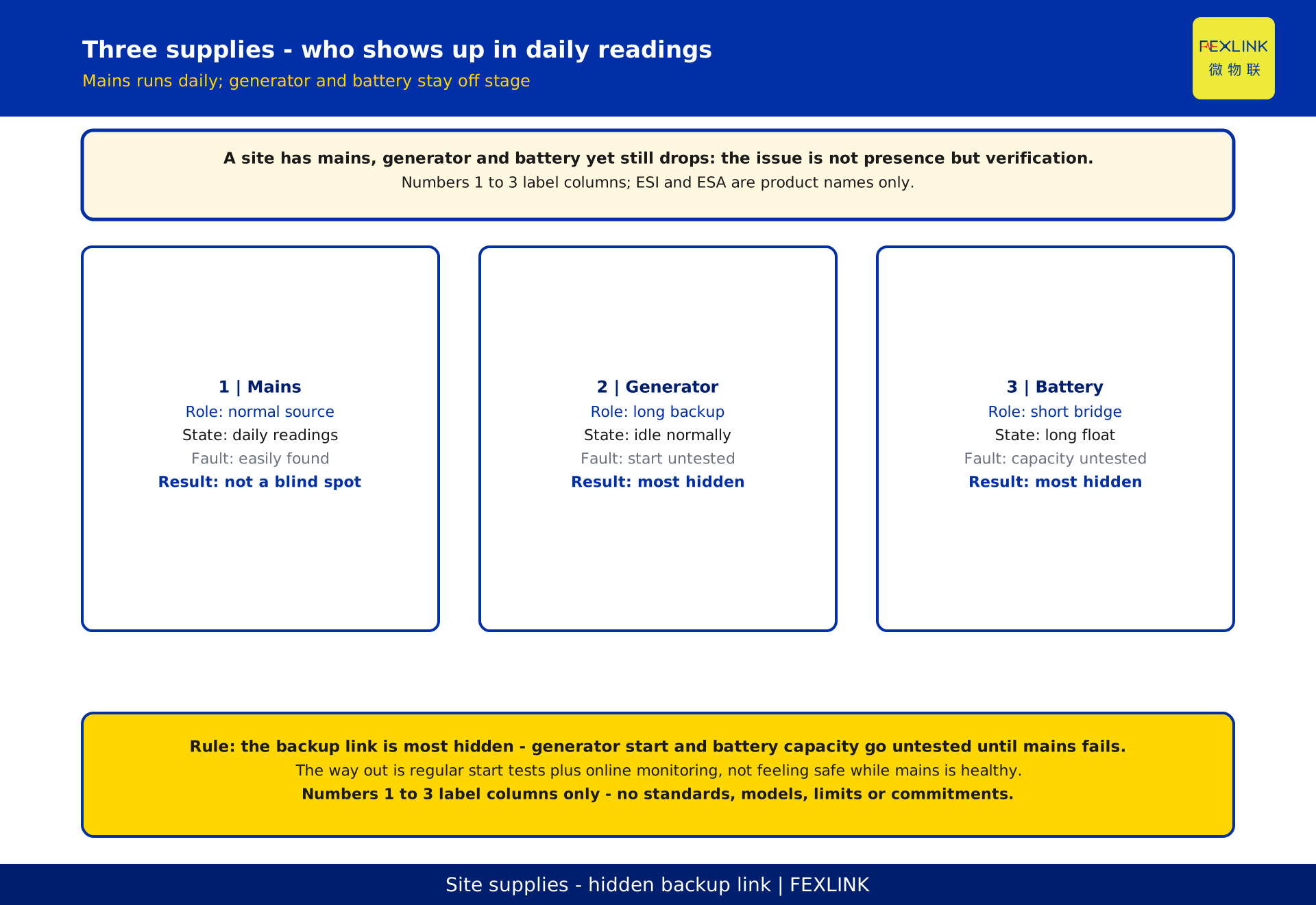
The three supplies are not three identical backups but three links with different jobs. Mains is the normal source and carries the whole daily load. The generator is long-duration backup and takes over after mains fails. The battery is the short, uninterrupted bridge that fills the gap between mains dropping and the generator settling.
Of the three, only mains is in daily use. The other two sit idle most of the time. While mains is healthy, the state of the generator and battery never enters any routine reading, so they have no chance to reveal a fault. Calling the three "backup" in one breath is where many judgements start to drift.
3. Why the backup link is the most hidden
The backup link is hidden not because it is complex but because it does not work or appear in normal times. If a generator is not exercised for months, nobody knows whether its starting battery is low, its fuel has degraded or its control signal is sound. A battery kept on float looks fine, but whether its real capacity has faded is invisible.
The main supply carries current and readings every day, so any anomaly is caught. The backup carries no load and makes no move, so it sends no signal. The fault is not concealed; it simply never gets a chance to show. So "no alarm" here does not mean "no problem".
4. Generator self-start testing: untested means absent
A generator's critical capability is self-start, and that capability is only used at the real moment of mains failure. Waiting for that moment to verify it costs one outage. The point of a regular start test is to turn "believed to work" into "verified to work".
A start test is not only about whether the engine turns. It also covers whether starting is smooth, whether transfer completes as intended and whether the unit stays stable under load. These are process records, not a single "tested" line. This article gives only the items and order to record, not a test interval, duration, load ratio or pass threshold.
5. Electrical signatures of battery ageing
Battery ageing is a slow process, easily masked by "the voltage still looks normal". Under float, terminal voltage can look right while load capability, internal resistance and usable capacity have already changed markedly; the weak spot only shows when mains fails and the battery must carry the load.
So a battery cannot be judged on standing voltage alone. Look at how it behaves during discharge and put records from different periods into one trend. This article only says which signatures to watch and how to keep evidence; it states no voltage, resistance or capacity values, no discharge rate and no service-life figure.
6. The transfer gap: between mains loss and a stable generator
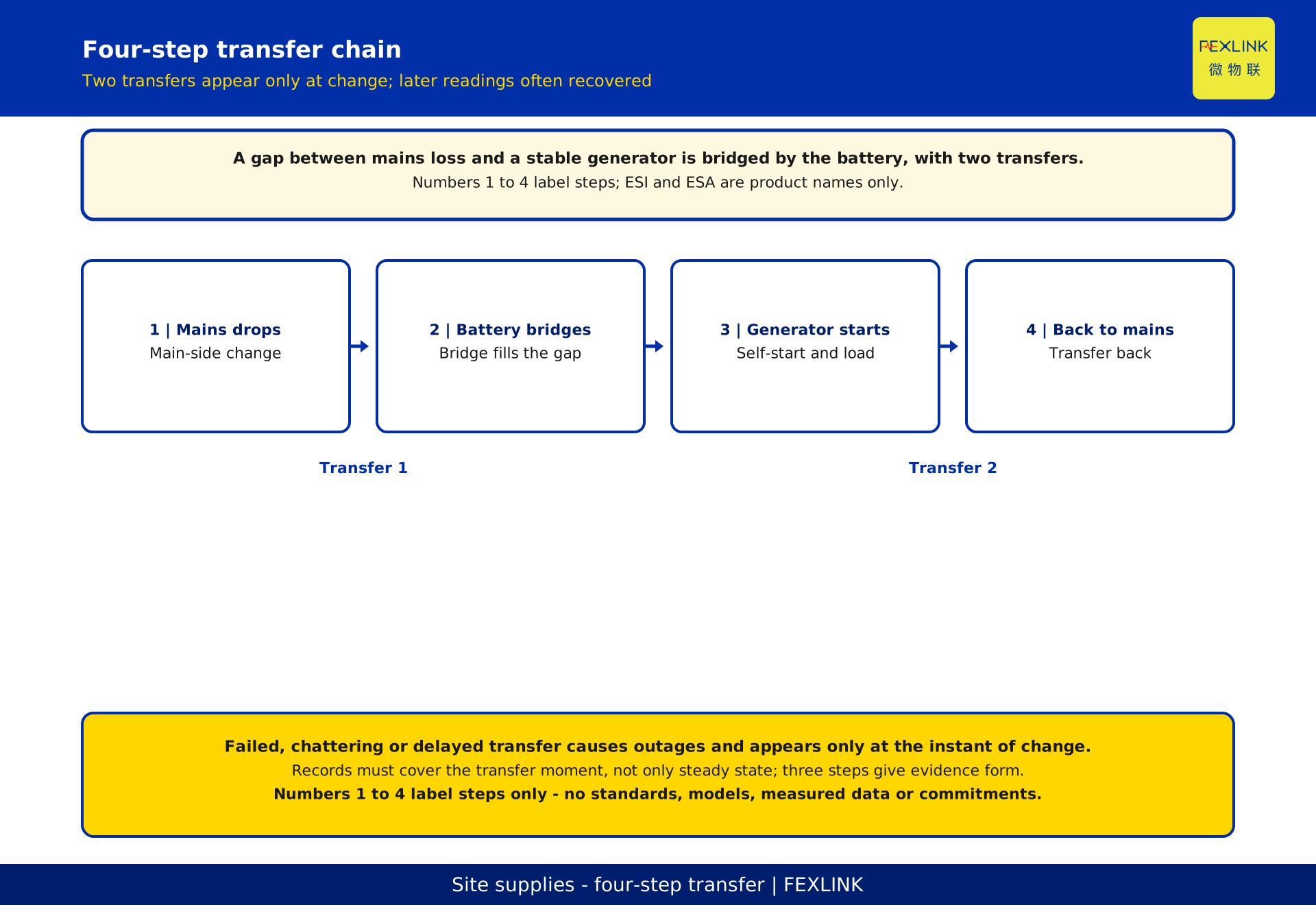
Between mains dropping and the generator settling there is a gap, bridged by the battery without interruption. The process involves two transfers: mains to generator, and generator back to mains when supply returns. Failed transfer, transfer chatter or delayed transfer can all cause an outage, yet they appear only at the instant of state change; by the time someone reads a value, it has often recovered.
To catch such problems, records must cover the moment of change, not just steady state. This article gives only the transfer nodes to record, not transfer time, permissible interruption duration or number of actions.
7. Hidden faults in each of the three supplies
The table lets different teams speak from one sheet; it gives only recording points, no thresholds or actions.
| 1 | Supply link | 2 | Likely hidden fault | 3 | Recording point |
|---|---|---|---|---|---|
| 1 | Mains | Frequent interruption, voltage variation | Log the moment of state change, not impressions | ||
| 2 | Generator | Failed self-start, unstable under load | Log the test process and transfer result | ||
| 3 | Battery | Faded capacity, voltage sag under load | Log load behaviour on one consistent trend |
8. Separating adjacent phenomena
Several problems coexist at a site; mixing them skews the remedy. The table gives only directional separation, repeats no other article's conclusion and cites no limit.
| 1 | Phenomenon | 2 | Trigger signature | 3 | Observation focus |
|---|---|---|---|---|---|
| 1 | Mains interruption | Caused on the mains side | Read the mains state record | ||
| 2 | Backup failure | Caused by long-term non-testing | Read generator tests and battery trend | ||
| 3 | Transfer problem | Caused at the instant of change | Read the process record at transfer |
Outdoor terminal selection has its own article; this piece does not repeat selection reasoning for supply modes. Lightning protection and equipotential bonding, off-grid microgrids and black start also have their own articles. The difference is that this piece covers only the verification logic of the backup link in a site's three supplies.
9. Monitoring positions: watch the transfer nodes and backup state
More sensors are not automatically better; the positions must be right. Step 1, place state monitoring at the mains incoming line, generator output, battery outlet and transfer nodes, so that "who is supplying" and "whether transfer completed" land in the same record. Step 2, pick one representative circuit to log electrical parameters as a load background. Step 3, align the clocks of the records and mark whether state changes coincide with the outage.
Without step 1 the transfer process is a blind spot; without step 2 load behaviour cannot be judged; without step 3 accountability becomes a matter of opinion. The three steps give only evidence form, no sampling rate, accuracy, duration, point count or protection setting.
The ESI digital status monitor is registered by its canonical name only, to explain that mains, generator, battery and transfer states need continuous, alignable digital records. The ESA all-element smart meter is likewise registered by name only, to explain that circuit parameters need alignable metering records. Neither carries stated parameters, ranges, accuracy or communication interfaces, and neither comes with selection advice.
10. Site checklist and evidence ledger
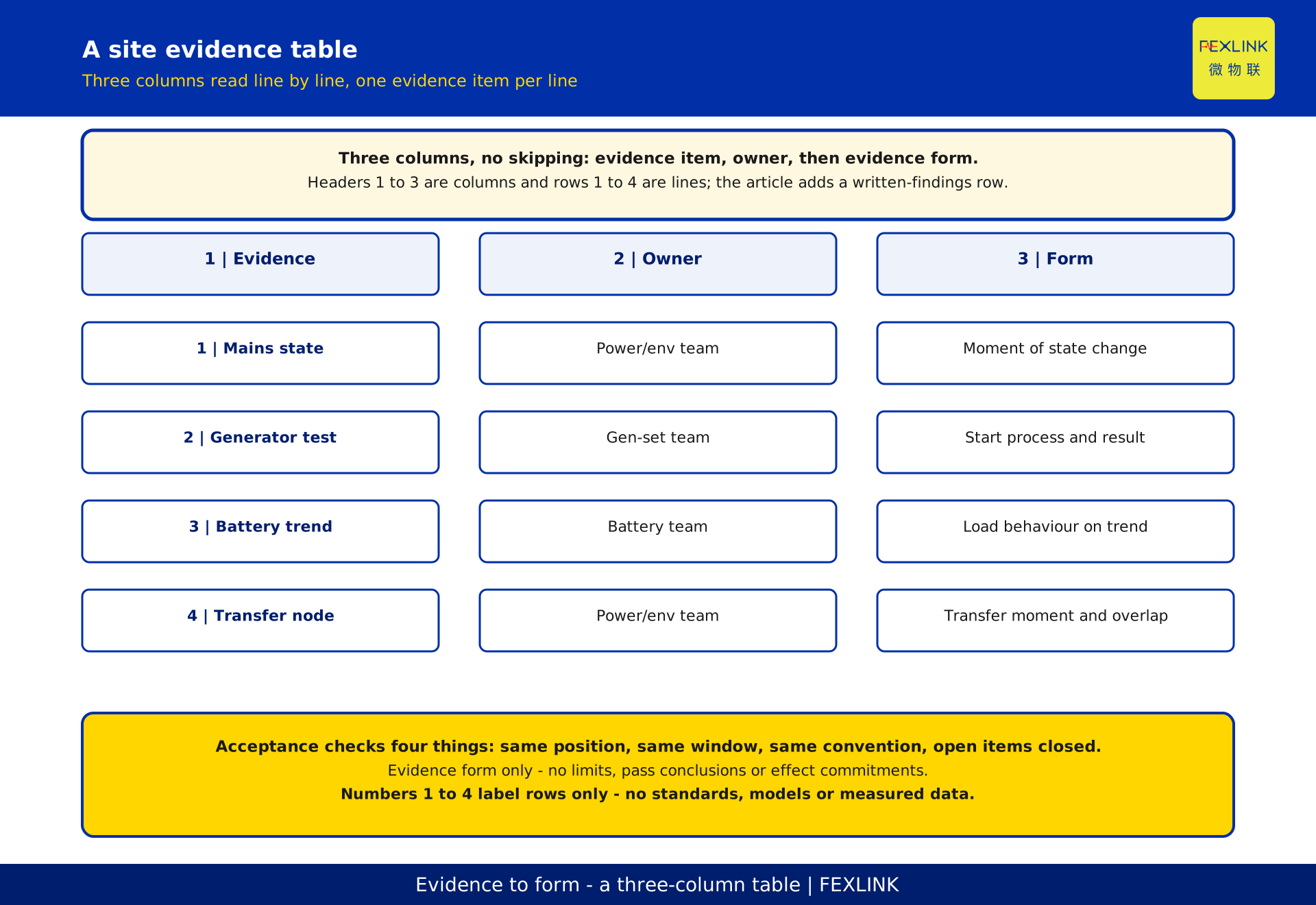
Compressing the earlier sections into one fillable draft is valuable because a different person, at a later date, can recompute under the same conditions. Five rows cover mains, generator, battery, transfer and written findings; a missing row means the job is incomplete.
| 1 | Evidence item | 2 | Owner | 3 | Evidence form |
|---|---|---|---|---|---|
| 1 | Mains state record | Power and environment team | Moment of incoming state change | ||
| 2 | Generator test record | Generator operations team | Start-process and result | ||
| 3 | Battery trend record | Battery operations team | Load behaviour on one trend | ||
| 4 | Transfer node record | Power and environment team | Transfer moment and overlapping segments | ||
| 5 | Written findings and open items | Owner and parties | Aligned conclusion, sign-off and update record |
The checklist has no "pass conclusion" column; this article does not sit in a judgement position. Whether a value exceeds a limit is confirmed by qualified parties against current texts and project files. Numbers 1 to 5 in the table are only item labels, not counts of points, records or priority weights.
Boundary and common misjudgements
Four misjudgements are common: treating every outage as a device fault and replacing parts one by one; monitoring only the mains side without backup background; drawing a conclusion from a single reading without position and clock source; and taking this article's work division as an official solution framework.
To restate the boundary: the two working lines of regular start testing and online monitoring, and the three observation positions and three steps, are this article's work division, not dimensions or layers of an official solution. The digital electrical intelligent supervision system is registered by name only; its official definition follows official documents and the knowledge base, and is not expanded, decoded, self-framed or claimed to come from a white paper. The whole piece carries no measured data, limits, ratios, cost figures, selection advice or effect commitments.
FAQ
Q: If all three supplies are present, why does the site still drop off air?
Because the backup link is never checked. While mains is healthy, whether the generator can self-start and how much capacity the battery retains never show in any reading; they surface the moment mains fails. The problem is not "whether it exists" but "whether it was verified".
Q: Does installing a generator make it reliable?
No. A generator's key capabilities are self-start and stability under load, and both can only be confirmed by a real action. Left untested for a long time, a starting battery, fuel or control signal fault can make it fail at the critical moment. That is why "believed to work" must become "verified to work".
Q: If battery voltage looks normal, is there no problem?
Not enough. A normal float voltage does not mean normal load capability; an ageing battery's weak spot only appears on discharge. Look at load behaviour and put records from different periods into one trend, rather than relying on a single standing reading.
Q: Is more monitoring always better?
This article gives no selection advice and discusses no budget. First separate whether the focus is the transfer node or the backup state, and whether state changes can be aligned with the outage. Whether equipment is needed, and which kind, belongs to later design files.
Q: Does this article give an official solution framework or product parameters, with models and specs?
Neither. The digital electrical intelligent supervision system is registered by name only; its official definition follows official documents and the knowledge base. The ESI digital status monitor and ESA all-element smart meter are registered by canonical name only, with no parameters, ranges, accuracy or communication interfaces and no selection advice. The whole piece carries no measured data, ratios, cost figures or effect commitments, and gives only observation positions, recording order and an evidence checklist.
Scope and limitations
This applies to site operations and power-and-environment monitoring staff at the review, troubleshooting and monitoring-planning stages, for turning "why does a site with three supplies still drop" into an alignable question about backup verification.
It does not apply to outdoor terminal selection, lightning protection and equipotential design, off-grid microgrids and black start, harmonic limits or meter selection; each has its own article. The difference is that this piece covers how generator self-start and battery capacity, the two backup links, go unchecked in normal times, and the observation and remedy order around the transfer nodes; it is neither supply-mode selection nor an energy-efficiency account.
This is not a work procedure and does not sit in a judgement position: it states no frequency, duration, voltage, current, capacity, resistance, discharge rate, time constant, cost figure, pass rate or conformity conclusion, makes no conformity judgement and gives no selection advice. Cases are generalised as "a certain site", with no customer name, region, scale or result data; numbers 1 to 5 are structural item labels, not measured values. The two working lines, three observation positions and three steps are work divisions and structural tools, not dimensions or layers of an official solution. All deliverables await review and owner verification; the author does not self-approve, and nothing is published.
Frequently Asked Questions
If all three supplies are present, why does the site still drop off air?
Because the backup link is never checked. While mains is healthy, whether the generator can self-start and how much capacity the battery retains never show in any reading; they surface the moment mains fails. The problem is not "whether it exists" but "whether it was verified".
Does installing a generator make it reliable?
No. A generator's key capabilities are self-start and stability under load, and both can only be confirmed by a real action. Left untested for a long time, a starting battery, fuel or control signal fault can make it fail at the critical moment. That is why "believed to work" must become "verified to work".
If battery voltage looks normal, is there no problem?
Not enough. A normal float voltage does not mean normal load capability; an ageing battery's weak spot only appears on discharge. Look at load behaviour and put records from different periods into one trend, rather than relying on a single standing reading.
Is more monitoring always better?
This article gives no selection advice and discusses no budget. First separate whether the focus is the transfer node or the backup state, and whether state changes can be aligned with the outage. Whether equipment is needed, and which kind, belongs to later design files.
Does this article give an official solution framework or product parameters, with models and specs?
Neither. The digital electrical intelligent supervision system is registered by name only; its official definition follows official documents and the knowledge base. The ESI digital status monitor and ESA all-element smart meter are registered by canonical name only, with no parameters, ranges, accuracy or communication interfaces and no selection advice. The whole piece carries no measured data, ratios, cost figures or effect commitments, and gives only observation positions, recording order and an evidence checklist.