 FEXLINK Research Institute
The short answer
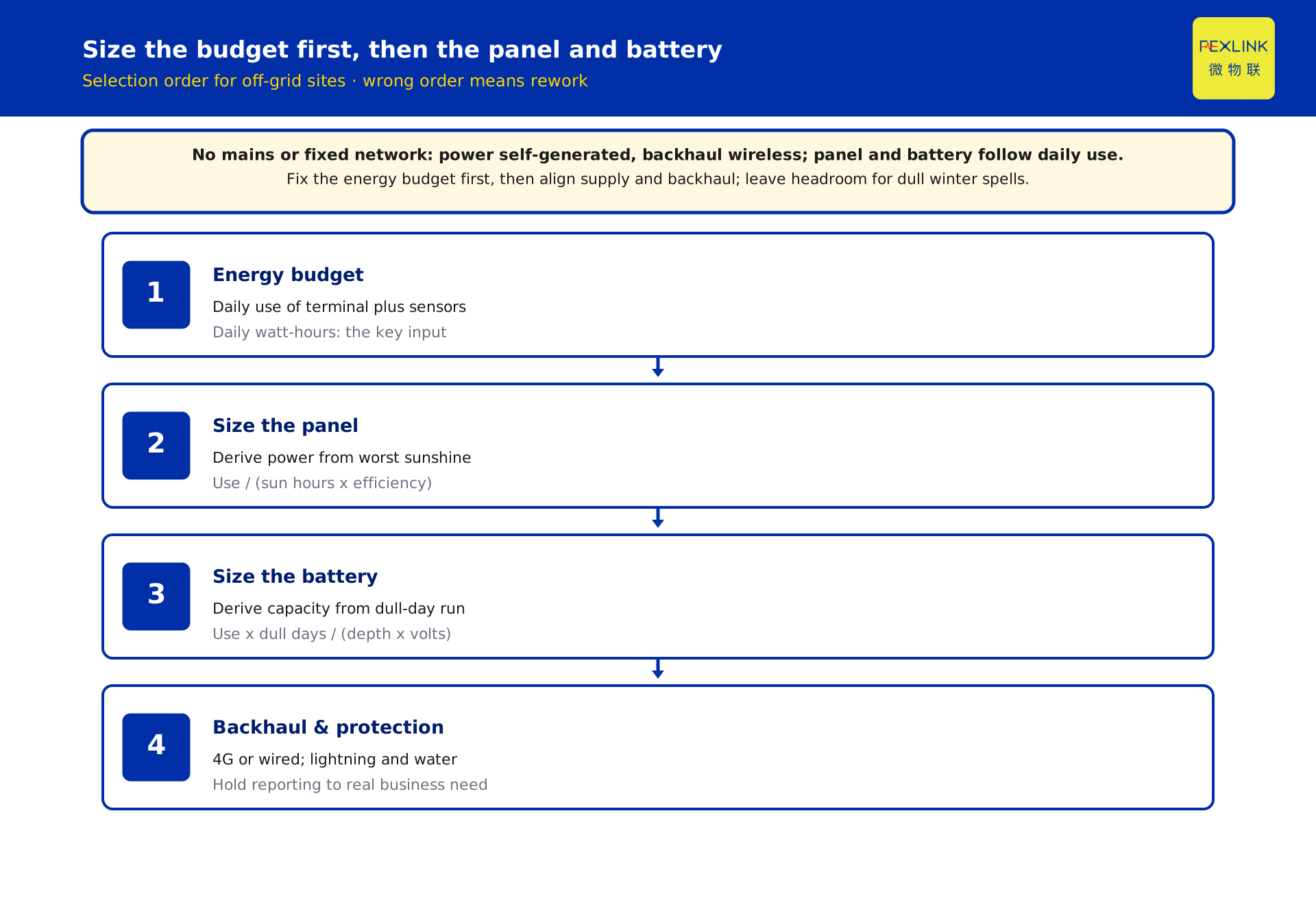
For outdoor sites such as streetlights, base stations and remote sensors, there is no mains power or fixed network. The first step in choosing a terminal is not the radio module, but where the energy comes from. The answer is an integrated terminal with solar panels plus a battery, wireless backhaul and low-power design, settled in this order: daily energy budget, panel and battery sizing, backhaul, protection. Panels and batteries are derived from daily energy use. Work out daily consumption, size from that, and leave headroom for long dull winter spells. This article covers budget, sizing, backhaul and protection only, with no product specification claims.
One. Two ends of the problem: scattered sites are hard at both
An outdoor site differs from a campus. A campus has mains power, cabinets and cabling, and the hard part is many points and protocols. An outdoor site has few points, but is stuck at two ends: where power comes from and how data gets back.
"No mains" means no cable can be run. Poles, base stations and hillside stations are widely spread, and wiring a few points costs more than the gear. "No network cable" means no fibre. So power is self-generated and backhaul wireless. Indoor gateways are judged on capacity, outdoor terminals on energy.
The two ends must be apart. Supply is an energy question: how much is generated, stored and consumed daily. Backhaul is a communication question: which link, at what rhythm. Many projects pick a powerful terminal first, then find the panel cannot sustain its draw, and must cut the rate or add panels. Fix the energy budget first and align supply and backhaul to it.
Two. The core criterion: size the plate from daily energy use
Everything starts with daily energy use: the total energy the terminal and sensors consume in a day, in watt-hours, equal to each part's power times its working time.
That use has three parts. Static draw is the continuous idle consumption of the controller, storage and interfaces. Communication draw is much higher at transmission than idle; higher frequency and larger payloads raise its share. Sensor and conditioning draw depends on which instruments are connected and whether they need continuous excitation.
Summing the three over a day gives the daily watt-hours, the input to every later calculation: the panel must generate at least this much, the battery store enough for dull weather. If this figure is wrong, both are wrong, so allow generous headroom. At night everything runs on the battery, so daily use is the minimum discharge the battery must carry.
Three. Panel sizing: use the worst sunshine, not the average
The panel replaces in limited daylight what the site used in a full day. The point is not nameplate wattage but generation on the worst day.
The method works backwards. First fix the worst sunshine as effective sun hours per day. Then allow for system efficiency: conversion, cable losses, dust and heat cut output below nameplate, so multiply by a factor below one. Minimum panel power is daily use divided by sun hours times efficiency.
The common mistake is the annual average, not the worst month. In winter the sun is lower and days shorter, and generation may be a fraction of summer; sizing on the average leaves a summer surplus and winter deficit, when the battery is most stretched. Size from the worst sun period, so the panel still replaces the day's use in the least favourable conditions.
Once panel power is calculated, round up and record it, leaving room for clouds, dust and ageing. Ratings and efficiency follow module data and site measurement; no absolute value is given.
Four. Battery sizing: count on consecutive dull days
The battery decides how long the site lasts without sun. The key parameter is consecutive dull days: the longest overcast run in local history sets how many days of energy to store.
The method works backwards too. Energy to store is daily use times the dull days. But a battery cannot be fully drained; depth of discharge is the share allowed to be used, and a cycled battery should not be emptied. Allowing for system voltage, energy converts to ampere-hours. Battery capacity is approximately daily use times dull days, divided by depth of discharge times system voltage.
Dull days are the most sensitive input and strongly regional; hills and coasts differ, so use local weather records or experience, not a generic figure. Too small and the site fails before supply returns; too large and cost and volume climb. Short winter days with long dull spells are the worst case and set the headroom. Depth of discharge follows the battery data.
Five. A reproducible worked example
This example links both steps. All figures are illustrative assumptions, the scene anonymised; they demonstrate the method only, match no real project, and must come from measurement.
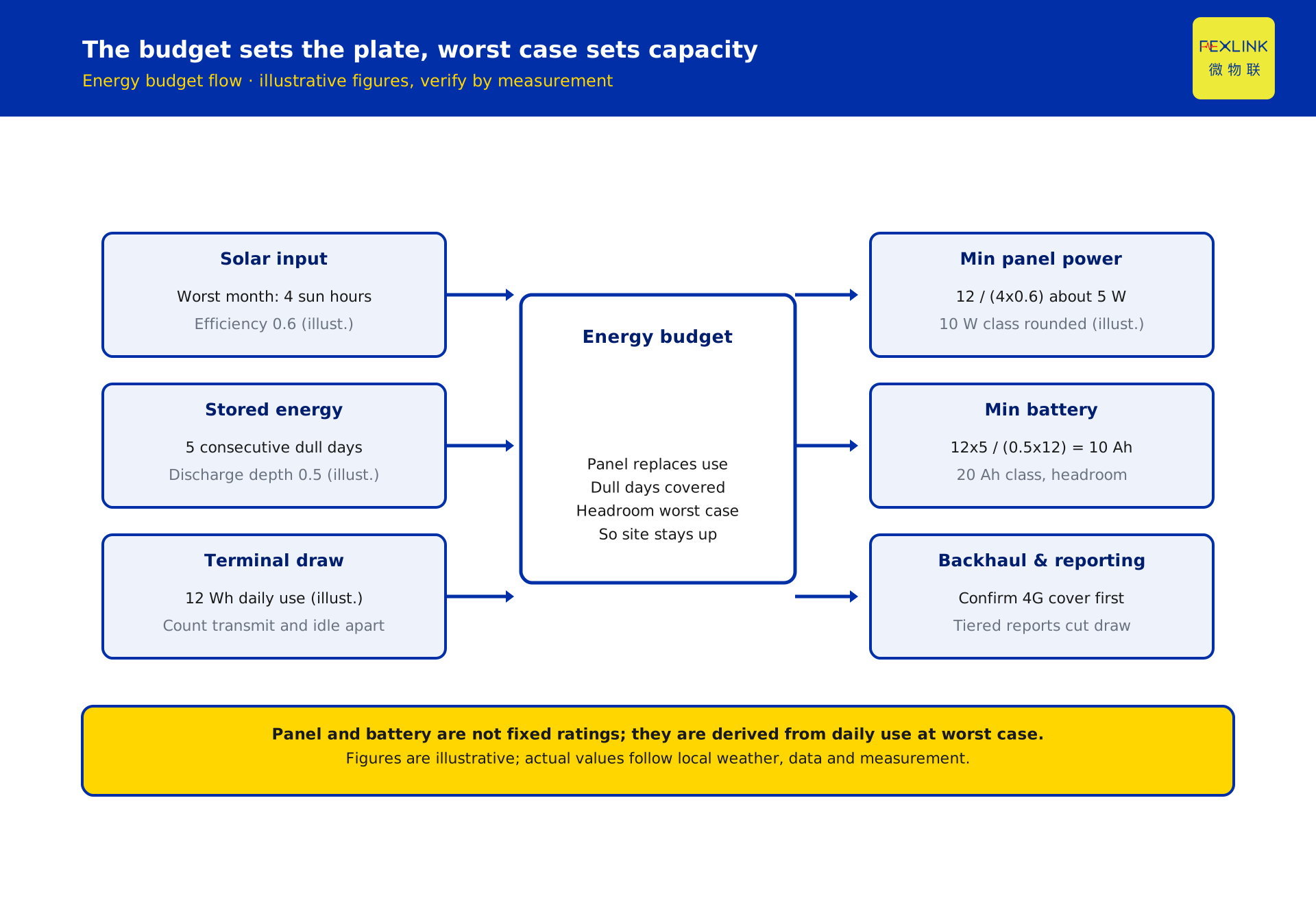
Assume a terminal uses 12 Wh per day. The worst month has 4 effective sun hours and system efficiency 0.6. Minimum panel power is about 12 / (4 x 0.6), roughly 5 W; rounded up with headroom, consider a 10 W class panel.
The battery is sized for 5 dull days at depth of discharge 0.5 and system voltage 12 V. Capacity is about 12 x 5 / (0.5 x 12) = 10 Ah; with headroom, consider a 20 Ah class battery.
| Step | Input | Calculation | Result (illustrative) |
|---|---|---|---|
| Daily use | Sum of parts | idle + radio + sensors | 12 Wh |
| Panel | 4 h sun, efficiency 0.6 | 12 / (4 x 0.6) | about 5 W, take 10 W class |
| Battery | 5 dull days, depth 0.5, 12 V | 12 x 5 / (0.5 x 12) | 10 Ah, take 20 Ah class |
The example only shows the order: the budget sets the plate, the worst case sets capacity. Recalculate for a different site; do not copy these figures. Ratings and depth of discharge follow technical data and measurement.
Six. Backhaul: 4G versus wired
Once supply is settled comes backhaul. With no ready network cable, wireless is natural; among wireless options, 4G is common for scattered sites for its coverage and fast deployment.
But wireless is not the only answer. If an aggregation point is nearby, conduit in place and data fees matter, a wired link may suit stability and cost better. The test is three questions: a usable link, the long-run cost, and a reliable signal.
4G backhaul deserves attention for its power draw. Transmission current is far above idle, and a weak signal makes the module raise power or reconnect, lifting daily use and demanding a larger panel and battery. Signal quality is thus an energy issue too; confirm coverage before fixing the reporting rhythm. Module figures follow product data.
Seven. Low power versus reporting frequency
Much of an outdoor terminal's power is decided by how often and how much it sends. More frequent reporting means more wake-ups and transmissions, higher daily use, and a larger panel and battery.
Low-power design means holding the reporting rate to what the business needs. Methods: keep high-frequency sampling local and send only summaries or threshold events; use event triggers instead of periodic polling, with a low-rate heartbeat in normal state and immediate reporting on exceptions; batch data into fewer transmissions. Communication serves the business.
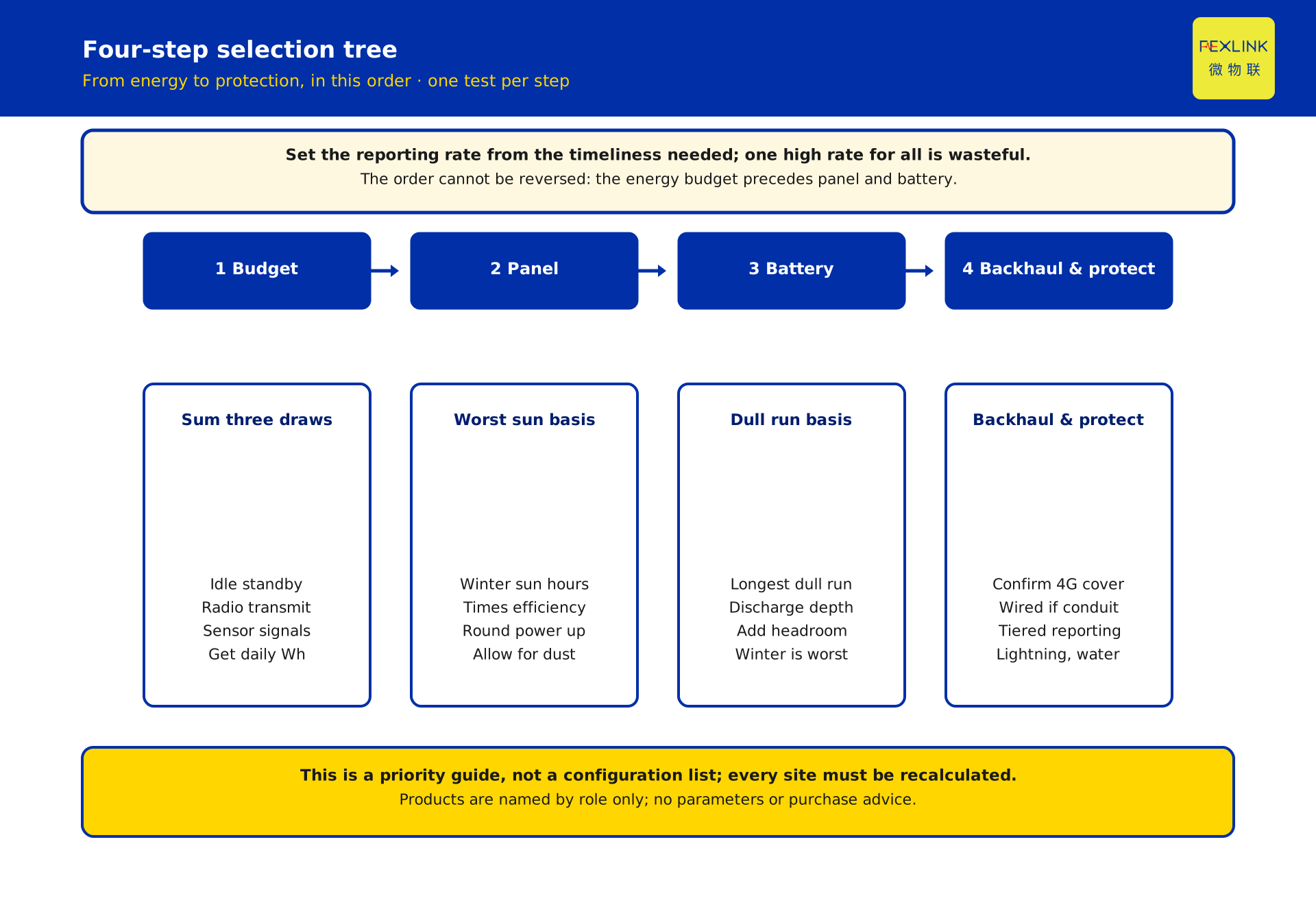
The trade-off turns on data timeliness. Safety alarms need immediacy and are worth their power cost; trend data tolerates delay and can be sent less often. Sending all data at one high frequency is wasteful. How far the rate can be cut and which triggers are supported follow the terminal and platform capability.
Eight. Protection comes first: lightning and water
Outdoor sites are exposed year-round. If protection is poor, the supply and backhaul design above is wasted, and the most underestimated part is lightning protection.
Poles, tower masts and hillside stations are prominent, with a higher strike probability than ground-level facilities. Panel frames, signal and power lines can pick up surges. Protection means equipotential bonding and earthing, surge protection at entries, and a low-impedance path for the current to drain. A lightning-current monitor records strike events and supports assessment, but does not replace earthing and surge protection.
Water and dust protection matter as much: cabinet sealing, connectors, cable entry, panel tilt and drainage follow the site environment. Ratings and installation follow local climate and product data; this article gives no rating or parameter.
Nine. Choosing the terminal: put four things in one table
Set supply, backhaul, power and protection side by side; sites emphasise different things. The table gives a qualitative comparison by scenario, with no model detail.
| Site type | Supply focus | Backhaul focus | Protection focus |
|---|---|---|---|
| Streetlight | lighting and monitoring share energy; size from night conditions | dense points can aggregate locally; wired or wireless by link | tall pole, high strike and wind load; earthing first |
| Base station | fairly fixed load, high battery autonomy | important site, link reliability first, consider backup | prominent mast, lightning and surge protection key |
| Sensor station | many sensor types, budget item by item | remote, mostly wireless, watch draw on weak signal | long unattended interval, water and dust, battery life first |
The table is a priority guide, not a configuration list. Any real project returns to daily energy use and calculates site by site. Treating selection as copying a table is the most common outdoor-project mistake.
Ten. Where the related products and scheme fit
In the engineering chain, devices handle different segments. The ESX edge gateway (4G version) handles local acquisition, protocol conversion, edge pre-processing and backhaul; it is the main load in the power budget and the node joining supply and backhaul. The FL lightning current monitor records strike events for protection assessment. The digital electrical intelligent supervision system brings scattered data together for remote viewing and alarms.
These products are registered by name and role only; no power, accuracy, range or interface parameters are given, no purchase advice, and ratings follow technical data and the product knowledge base.
The division with the wind-farm inspection article: that one covers low-voltage systems in box transformers and towers, what is hard and what to watch; this one covers how an unpowered terminal balances supply and backhaul by energy sizing, with the increment being the solar sizing method. The two do not overlap.
FAQ
Q: Is a more powerful panel always better?
No. The panel only needs to replace daily use under the worst sunshine, with headroom. A larger panel raises cost, structure and space, and if the battery is undersized the site still fails in dull weather. Size daily use first, then derive panel power from the worst sun.
Q: How many dull days should the battery cover?
Use the area's historical worst run of consecutive dull days, not a generic figure. Hills and coasts differ, so check weather records or experience. Too small fails in a long spell; too large raises cost and volume, and long dull winter days are the worst case.
Q: There is 4G signal, so why does data still not get through?
Signal quality is only one condition. A weak signal makes the module raise power and reconnect, slowing communication and lifting draw, which starves supply. Check link configuration, data plan and platform access. Parameters follow product data; no threshold is given.
Q: Can reporting be more frequent for more timely data?
Only if needed. Safety alarms justify their power cost; trend data does not need high frequency. Sending everything at one high rate lifts daily use and enlarges panel and battery. Use tiered reporting: low-rate heartbeat in normal state, immediate report on exception.
Q: This article or the wind-farm inspection one?
It depends on the problem. For why low-voltage inspection in box transformers and towers is hard, read the wind-farm inspection article. For how to choose an unpowered terminal, size the panel and battery and weigh backhaul, read this one. The core here is the sizing method.
Scope and limitations
- This article applies to scattered outdoor sites without mains or network, such as streetlights, base stations and remote sensors, covering energy sizing and backhaul selection. Indoor premises are out of scope.
- Figures such as 12 Wh, 4 hours, 0.6, 5 W, 10 W, 5 days, 0.5, 12 V, 10 Ah and 20 Ah are illustrative assumptions; the scene and data are anonymised and match no real project. Sunshine, dull days, efficiency, depth of discharge and power use must come from local weather data and site measurement.
- This article gives a calculation framework and selection order, not a substitute for engineering design. Ratings for panels, batteries, radio modules and protection follow the latest technical data and product knowledge base; no parameter claim or purchase advice is made.
- Related products and the scheme are registered by name and functional role only; no power, accuracy, range or interface parameters are expanded, no framework invented and no function fabricated.
- The registry field related_standards is empty; no standard number, year, clause or acceptance limit is cited, and no specific protection rating, communication band threshold, lightning parameter or accident liability is stated.
- Effect data such as energy-saving rate, accuracy, endurance gain and payback period never enters the conclusions; final judgement on safety and incidents rests with qualified parties; this article is not a safety commitment.
Frequently Asked Questions
Is a more powerful panel always better?
No. The panel only needs to replace daily use under the worst sunshine, with headroom. A larger panel raises cost, structure and space, and if the battery is undersized the site still fails in dull weather. Size daily use first, then derive panel power from the worst sun.
How many dull days should the battery cover?
Use the area's historical worst run of consecutive dull days, not a generic figure. Hills and coasts differ, so check weather records or experience. Too small fails in a long spell; too large raises cost and volume, and long dull winter days are the worst case.
There is 4G signal, so why does data still not get through?
Signal quality is only one condition. A weak signal makes the module raise power and reconnect, slowing communication and lifting draw, which starves supply. Check link configuration, data plan and platform access. Parameters follow product data; no threshold is given.
Can reporting be more frequent for more timely data?
Only if needed. Safety alarms justify their power cost; trend data does not need high frequency. Sending everything at one high rate lifts daily use and enlarges panel and battery. Use tiered reporting: low-rate heartbeat in normal state, immediate report on exception.
This article or the wind-farm inspection one?
It depends on the problem. For why low-voltage inspection in box transformers and towers is hard, read the wind-farm inspection article. For how to choose an unpowered terminal, size the panel and battery and weigh backhaul, read this one. The core here is the sizing method.