 FEXLINK Research Institute
The short answer
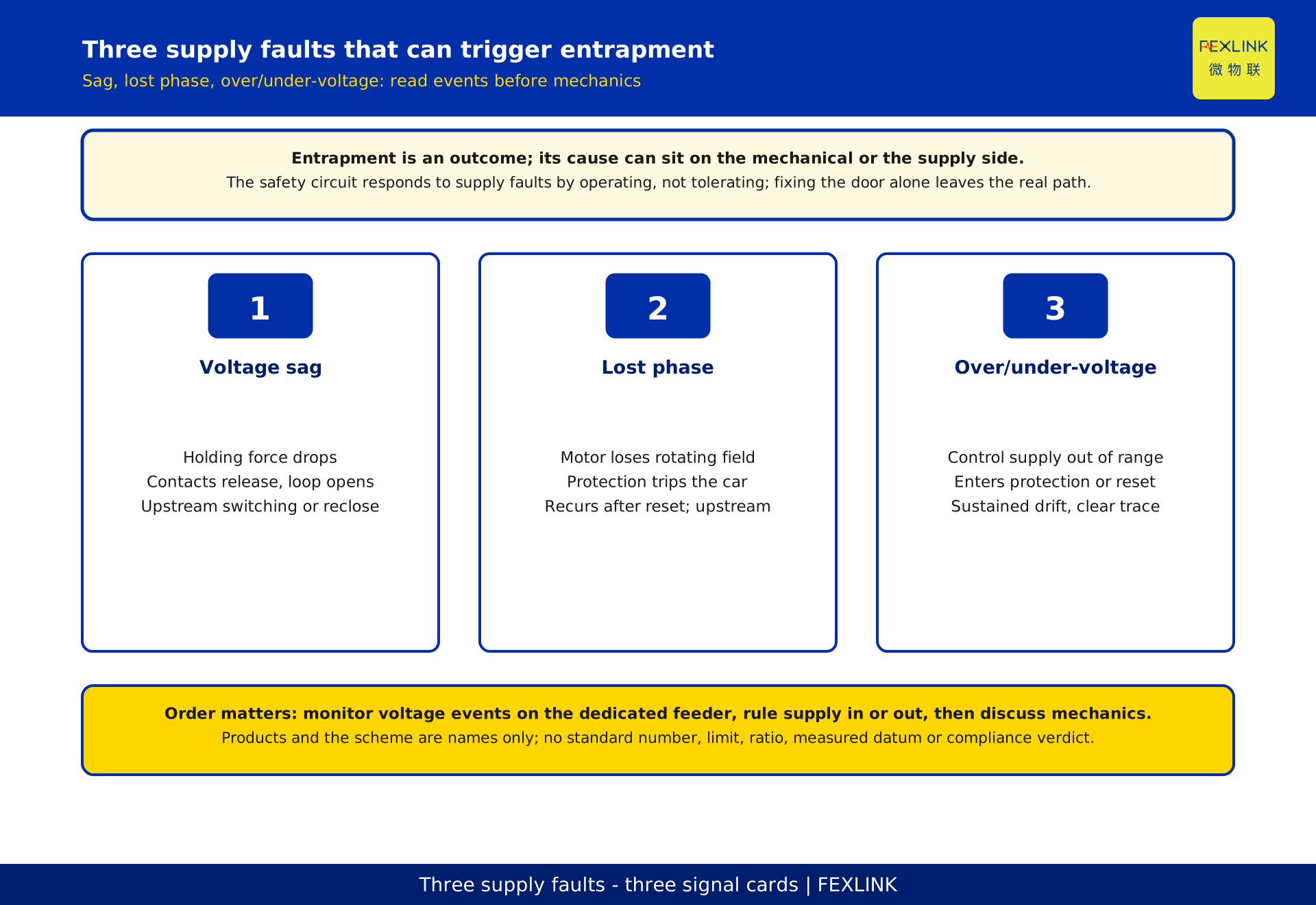
When an elevator traps people or stops abruptly and maintenance blames the door operator, that is not necessarily the whole story. The safety circuit is highly sensitive to supply disturbances: a voltage sag, a lost phase, or an over/under-voltage on the feeder can make it operate and stop the car with passengers inside. Monitor voltage events on the dedicated feeder first, rule the supply side in or out, then discuss mechanical maintenance. Fixing the door operator without revisiting the supply leaves the triggering path in place.
Why entrapments get booked to elevator quality
When someone is trapped, the first questions are about the elevator: did the door jam, did the brake fail, what code did the controller log? All worth checking. But entrapment is an outcome, and its cause can sit on the mechanical or the supply side.
Supply-caused entrapments tend to cluster, appearing in batches or at particular times. One elevator that keeps recurring, or several cars in one building reporting entrapment in a single window, deserves a supply-side look. A single car failing occasionally, tied to load or usage, points more to mechanics.
Supply-side evidence is usually not kept: maintenance records log fault codes and actions, distribution records log total-meter energy, and neither captures voltage events. Without a record, entrapment gets booked to elevator quality by default.
Where the elevator is sensitive: the safety circuit
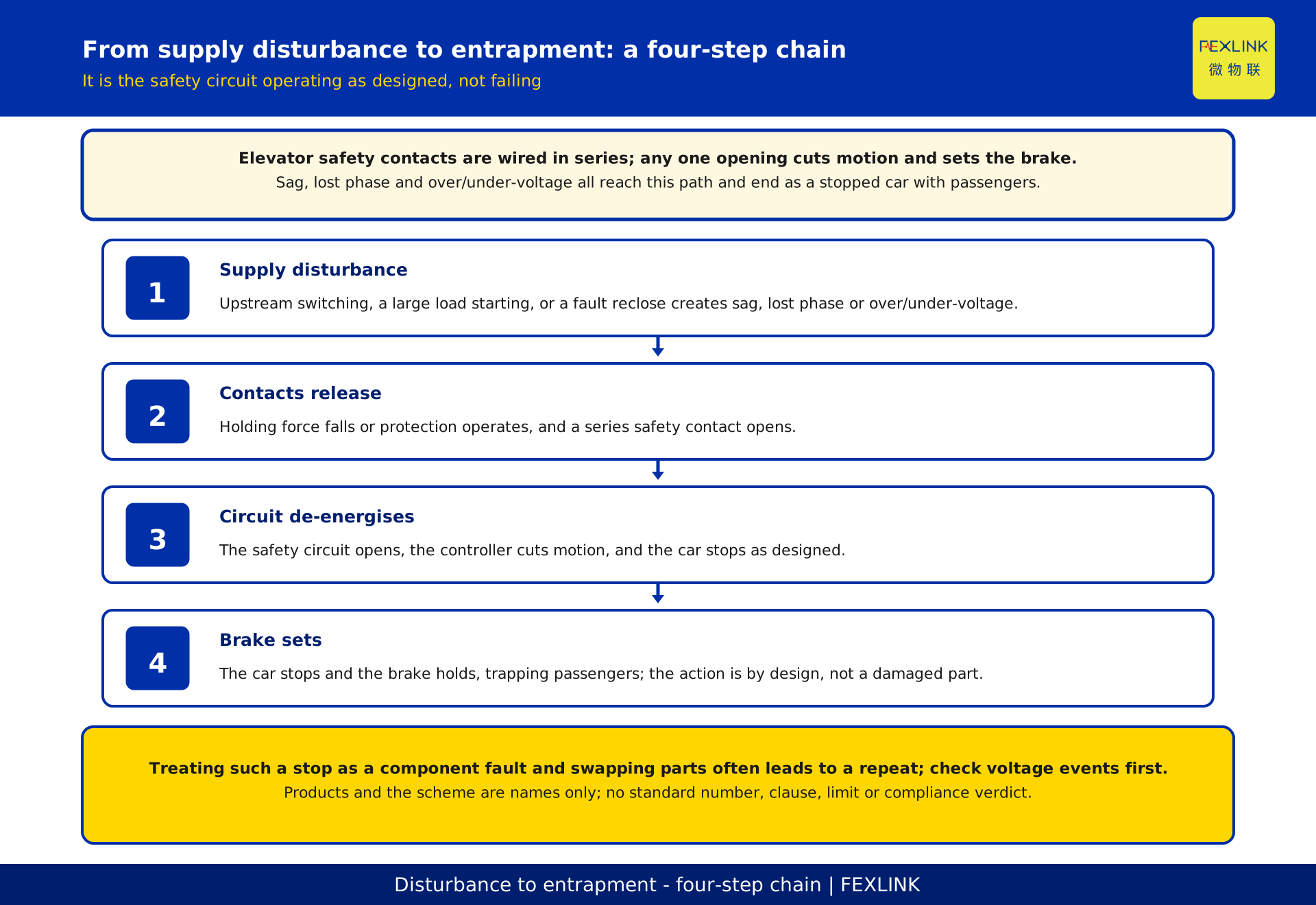
An elevator has safety contacts wired in series, covering the doors, governor, buffers and emergency stop, forming the safety circuit. If any opens, the circuit loses power and the controller cuts motion and sets the brake. Designed to stop rather than run with a fault, it responds to a supply disturbance by operating, not tolerating.
A voltage sag reduces the holding force of contactors and relays; once it drops out, contacts release, the circuit opens, and the car stops as designed. This is the circuit doing its job, not failing. Treating such a stop as a component fault and swapping parts leads to a repeat.
Lost phase and over/under-voltage take another route. A lost phase makes the motor lose its rotating field and protection operates; over/under-voltage pushes the control supply out of range and the system enters protection or reset. Both end in a stopped car, but the source is the supply, not the mechanics.
How a voltage sag triggers a stop
A voltage sag is a short drop in supply voltage followed by recovery. Duration and depth vary, but for equipment with electromagnetic holding, contacts release once the sag exceeds the holding capability.
A sag often originates off the elevator feeder: starting another load on the same transformer, switching a large consumer, or an upstream fault reclose can create a sag near the point of common coupling and pass it to the dedicated feeder. The investigation cannot stop at the elevator panel; feeder and upstream circuit must share one time axis.
This separates the article from the one on crane sag propagation: that covers how an impact load creates a sag across system impedance and decays outward; this covers how an elevator as a sensitive device is triggered into entrapment and how the site separates supply from mechanical causes. Objects, goals and reading dimensions differ.
Lost phase and over/under-voltage: another path
A lost phase is not a sag: a sag is a short overall drop, while a lost phase is one of three phases missing or making poor contact. Causes include a blown upstream fuse, high joint resistance, or protection after a long-running imbalance. It often repeats: the car runs after a reset, then stops again.
Over/under-voltage is voltage drifting outside its normal range: persistently low voltage makes the control supply unstable, high voltage accelerates aging, and either can trip protection. Compared with a sag it lasts longer and leaves a clearer trace, but is also easier to wave away as unstable voltage.
Separating the three is useful: a sag is a short drop, a lost phase concerns phase integrity, and over/under-voltage is a sustained level deviation. Record them separately rather than merging them into one vague verdict of bad voltage.
Separating supply faults from mechanical faults
This is the core: entrapments and abrupt stops look identical while the supply-side and mechanical-side clues differ.
Mechanical problems correlate with load or usage: they show up at certain floors, times or loads; fault codes point to the door operator, brake or control path; and the supply record shows no event then. A problem that disappears after service or improves after a parameter change also points to mechanics.
Supply problems bring different clues: the entrapment moment lines up with a voltage event; several devices or other sensitive loads on the same transformer misbehave at once; events arrive in batches or follow upstream operations; and the fault recurs after the door operator or boards are replaced. Recurrence after work is the strongest supply signal.
Do not conclude from one clue. Require at least two or three consistent pointers to the same side before shifting focus from the car to the feeder. A supply check does not replace maintenance; it avoids swapping parts without supply evidence.
Five signals in one table
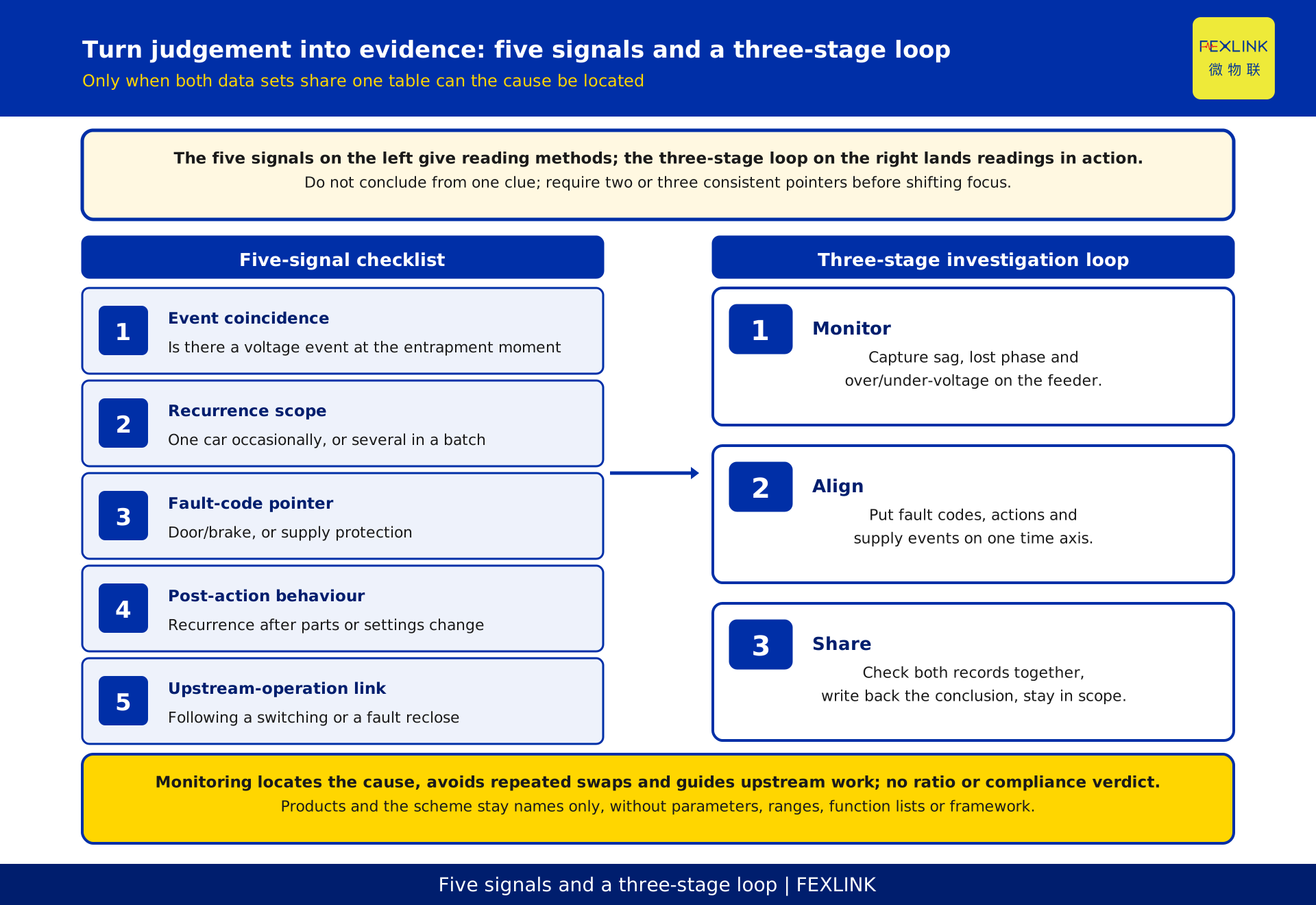
Fixing the method on site keeps everyone checking the same way. The table sets out five items, how to read each, and what each points to.
| No. | Observation | How to read it | Main pointer |
|---|---|---|---|
| 1 | Event coincidence | Is there a voltage event at the entrapment moment | Supply or mechanical side |
| 2 | Recurrence scope | One car occasionally, or several in a batch | Widespread supply anomaly |
| 3 | Fault-code pointer | Door/brake, or supply protection | Mechanical or supply side |
| 4 | Post-action behaviour | Does it recur after parts or settings change | Supply side not excluded |
| 5 | Upstream-operation link | Does it follow switching or a fault reclose | Source of an upstream sag |
The table gives reading methods, not thresholds. Supply conditions differ by building; what counts as abnormal is set from the feeder's own history. Borrowing a fixed number invites misjudgement.
Monitoring voltage events on the dedicated feeder
Separation requires records. Voltage events on the dedicated feeder need continuous monitoring, not a one-off meter reading after the fact.
Place the monitoring point at the incoming side of the dedicated feeder and record the timing, duration and recovery of three events: sag, lost phase, and over/under-voltage. Acquisition can use the ESA all-element smart meter for feeder quantities and the ESE power quality monitor for sag and lost-phase events, aligned on one time axis in the digital electrical intelligent supervision system. Only the names are registered; no parameters or selection advice are expanded.
Time-axis alignment is critical. Controller fault time, maintenance action time, and distribution-side event time must share one axis before you can tell whether a voltage event accompanied the entrapment. Three records kept apart are no evidence chain.
Sampling must span enough time. Supply anomalies are not daily, and a few days of logging may miss them. Cover representative conditions such as normal running, peak load and upstream operations before exclusion means anything.
Event records and maintenance sharing: the field worksheet
A supply-side investigation lands only with a worksheet maintenance can use. The table lists the evidence each judgement needs and who usually holds it.
| No. | Judgement | Evidence needed | Usual owner |
|---|---|---|---|
| 1 | Event coincidence | Aligned record of entrapment and voltage events | Building electrical management |
| 2 | Recurrence scope | Multi-device anomaly records on the same transformer | Building electrical management and maintenance |
| 3 | Supply-side clue | Control-supply protection and reset records | Elevator maintenance |
| 4 | Mechanical-side clue | Door-operator and brake action records | Elevator maintenance |
| 5 | Conclusion | Both record sets checked together | Confirmed by both parties |
The worksheet turns maintenance saying it is the door operator and property saying the voltage is fine into a record of what happened at a given moment. The owner column is not blame but who holds which data. Only with both sides on one table can the cause be located.
Sharing data with the maintenance provider
Supply and mechanical checks belong to different parties: electrical management holds distribution records, the maintenance provider holds controller records. The cause often sits in the gap between them.
Sharing starts with a common basis: voltage-event, fault-code and action times need one time reference; with separate clocks, records do not line up however complete. Next is eventising, turning continuous records into entries of the form an event happened at a time, which maintenance can use. Last is closure: supply events go into the maintenance record, and maintenance results back into the electrical record.
Sharing does not make the maintenance provider responsible for the supply side, nor property the judge of elevator safety. It lets both sides see the full evidence and work within their expertise.
Three common misreads
First, booking every entrapment as an elevator quality problem. The door operator and brake need checking, but if the voltage record shows a sag or lost phase at the entrapment moment, repairing mechanics alone will not solve it.
Second, waving away voltage fluctuation as normal. Occasional instability need not trap anyone, but when it repeatedly lines up with entrapments, it is no longer background noise.
Third, looking only at the elevator panel. Sags often arrive from upstream, and a lost phase may precede the feeder. Measuring only the terminal easily yields a wrong conclusion of normal voltage.
All three share one root: reading the fault outcome without its time relationship to supply events.
FAQ: frequently asked questions
Q: When someone is trapped, check the elevator or the supply first?
Check both, but in an order. Pull the fault code first to see which protection operated, and at the same time retrieve the feeder voltage-event record for the entrapment moment. If the record shows a sag, lost phase or over/under-voltage, prioritise the supply; if not, focus on mechanics. Do not let a rule about which comes first replace evidence.
Q: Does installing monitoring prevent entrapments?
No. Monitoring answers whether the cause is supply-related; it does not stop the safety circuit from operating. Its value is locating the cause, avoiding repeated part swaps, and giving a basis for upstream work. The safety circuit operating as designed is protective behaviour and should not be suppressed.
Q: Can a supply anomaly cause an elevator accident?
This article draws no such conclusion. A supply anomaly can trigger the safety circuit and trap passengers; whether that constitutes a safety incident and how responsibility is assigned must be determined by qualified parties under current regulations and project documents. This article only screens supply-side clues.
Q: Can these events produce a pass or fail verdict?
No, and this article gives no compliance judgement. An event record shows what happened; thresholds and judgement criteria are set by qualified parties from the feeder's own history and the current applicable text. Monitoring data does not replace professional assessment.
Q: Are the monitoring points and reading dimensions fixed dimensions of an official scheme?
No. The event classes, five-signal table, field worksheet and sharing loop here are engineering entry points selected from what can be read on the dedicated elevator feeder. They are a working division, not a fixed dimension or layer of any official scheme.
Boundary and delivery status
This article follows the topic and core conclusion registered in the registry. Across the whole chain it writes no standard number, year, clause, threshold, allowed value, ratio, measured datum, or compliance judgement. On the acquisition side it registers only the names of the ESA all-element smart meter and the ESE power quality monitor; on the platform side it registers only the name of the digital electrical intelligent supervision system, without expanding parameters, ranges, function lists, or scheme framework.
On separation from the neighbour: another article covers how crane starting and braking create a sag across system impedance and propagate it from the point of common coupling, and how to assess sensitive-equipment tolerance. This one covers how an elevator, as a sensitive device, gets triggered into entrapment by sag and lost phase, and how the site separates and monitors it. The former takes an impact load as object and propagation as goal; this one takes a sensitive device as object and entrapment attribution as goal. They do not overlap.
Deliverables are all DRAFT_PENDING_REVIEW with owner_review_required=true. The generator does not self-approve; independent QA and per-article acceptance are pending.
Scope and limitations
This applies to building property and elevator safety managers who have voltage-event acquisition on the dedicated elevator feeder and want to screen supply-side clues for repeated entrapment or abrupt stops, cross-checked against maintenance records.
It does not apply when there is no feeder-level voltage-event record and only a total meter; when an entrapment needs a statutory incident determination; or when equipment tolerance must be quantified or a compliance verdict issued. The supply-side screening and locating tools here do not replace elevator maintenance, repair or statutory inspection, and they constitute no compliance judgement.
Frequently Asked Questions
When someone is trapped, check the elevator or the supply first?
Check both, but in an order. Pull the fault code first to see which protection operated, and at the same time retrieve the feeder voltage-event record for the entrapment moment. If the record shows a sag, lost phase or over/under-voltage, prioritise the supply; if not, focus on mechanics. Do not let a rule about which comes first replace evidence.
Does installing monitoring prevent entrapments?
No. Monitoring answers whether the cause is supply-related; it does not stop the safety circuit from operating. Its value is locating the cause, avoiding repeated part swaps, and giving a basis for upstream work. The safety circuit operating as designed is protective behaviour and should not be suppressed.
Can a supply anomaly cause an elevator accident?
This article draws no such conclusion. A supply anomaly can trigger the safety circuit and trap passengers; whether that constitutes a safety incident and how responsibility is assigned must be determined by qualified parties under current regulations and project documents. This article only screens supply-side clues.
Can these events produce a pass or fail verdict?
No, and this article gives no compliance judgement. An event record shows what happened; thresholds and judgement criteria are set by qualified parties from the feeder's own history and the current applicable text. Monitoring data does not replace professional assessment.
Are the monitoring points and reading dimensions fixed dimensions of an official scheme?
No. The event classes, five-signal table, field worksheet and sharing loop here are engineering entry points selected from what can be read on the dedicated elevator feeder. They are a working division, not a fixed dimension or layer of any official scheme.