 FEXLINK Research Institute
The short answer
On the same line, one tool rides through a brief voltage drop while a whole line stops. The difference is not whether the tool "complies" but whether anyone placed that drop on the curve and saw which side of the boundary it landed on.
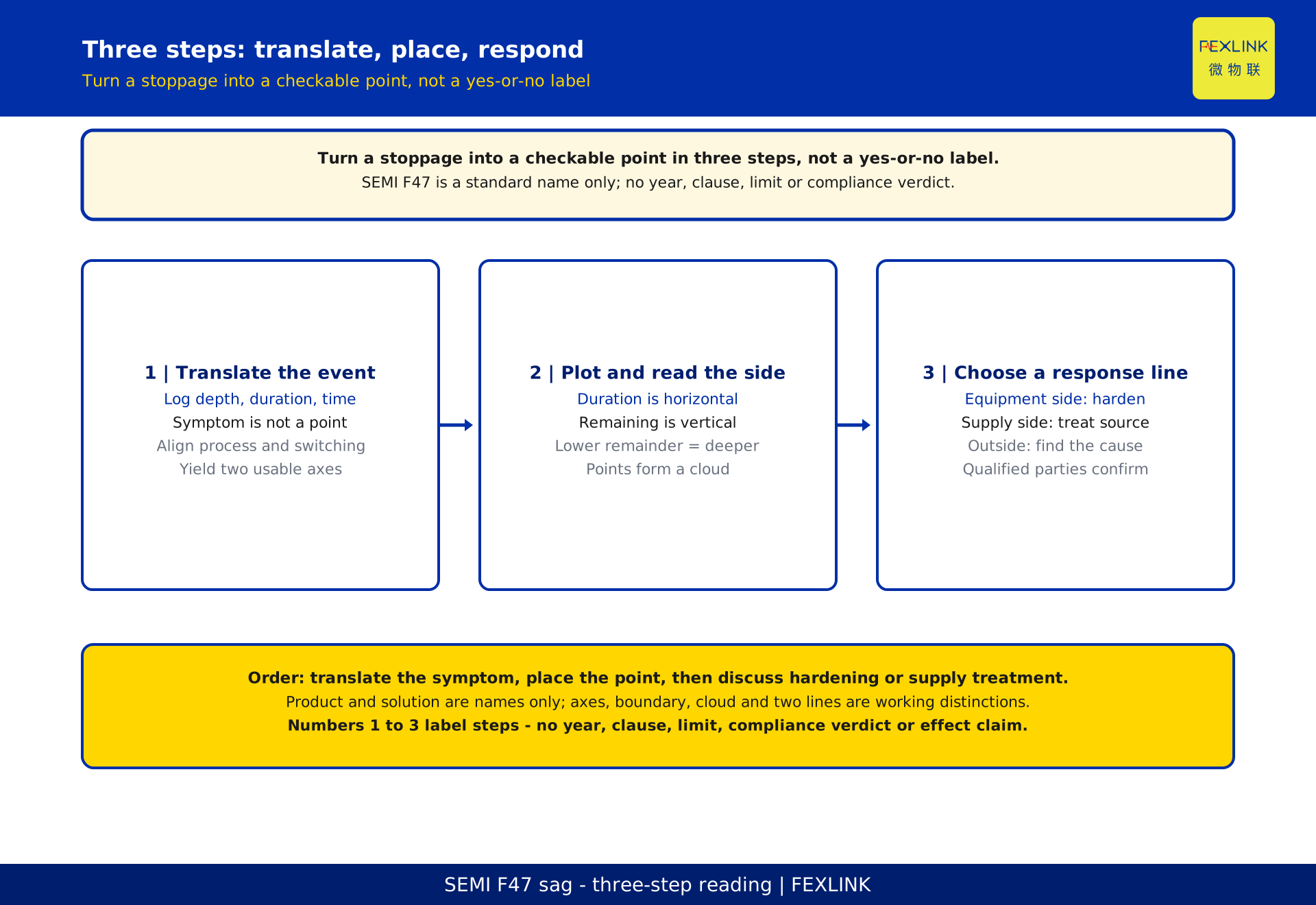
The SEMI F47 voltage sag immunity curve gives the boundary of what equipment must tolerate at each depth and duration. Three steps: turn each measured sag into a point of depth and duration; see if it falls inside or outside the boundary; then harden the equipment, treat the supply, or record and accept the risk. A point outside is not settled by calling it "non-compliant" — it means the event exceeded what typical equipment is expected to provide, and someone must act.
SEMI F47 is registered here as a standard name only; the version in force governs, and this article states no year, clause, limit, or compliance judgement. The digital electrical intelligent supervision system is a solution name only; the coordinates, boundary, point cloud, and two response lines are this article's working distinctions, not dimensions of any official scheme. The product is registered by name only, with no parameters or selection advice, and the whole article carries no measured data, limits, ratios, amounts, or performance promises.
I. Turn "the tool stopped again" into a sag event
The first report from a site is a symptom: "the voltage blinked," "the pump tripped," "the line stopped." These are effects, not objects to place on a graph. The first step is to translate them into one sag event with a depth, a duration, and a time of occurrence.
A voltage sag is a short fall well below normal followed by recovery, distinct from an outage and sustained undervoltage. Equipment rarely stops because voltage is low in itself; it stops when the voltage stays low deeply and long enough to trip protection or destabilise control.
"Complies with the curve" answers what combinations a tool should ride through; the site must answer which combination this event was. Until the two line up, the argument stays stuck on "but you said it was compliant." This article gives reading rules only, no amplitude, duration, or pass/fail threshold.
II. The two coordinates: duration and remaining voltage
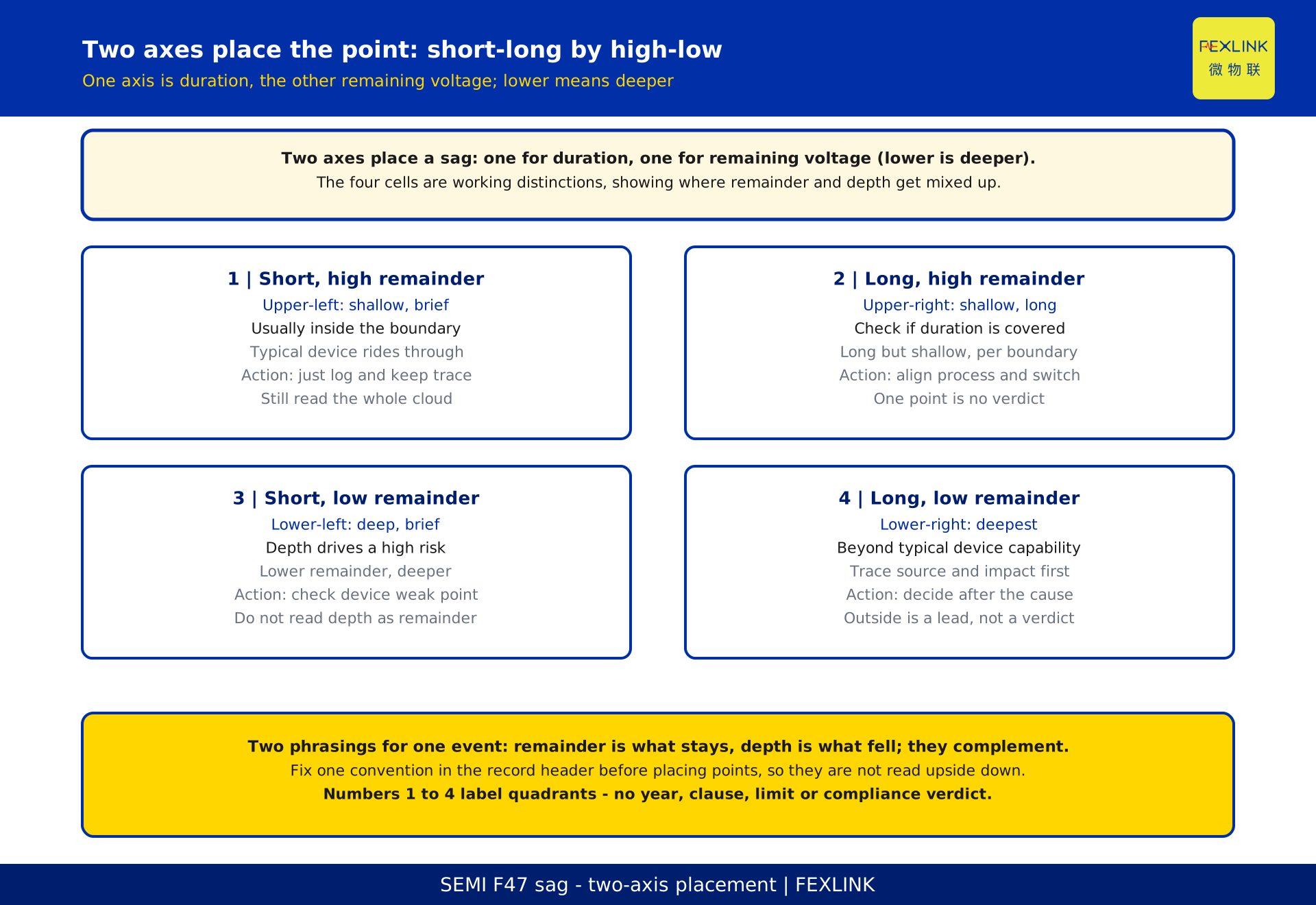
The curve is a two-dimensional plot. Read the axes first.
| 1|Coordinate | 2|What it means | 3|Reading cue |
|---|---|---|
| 1|Horizontal: duration | How long the voltage stays low | Further right means longer |
| 2|Vertical: remaining voltage | The fraction of nominal voltage left during the sag | Lower means deeper |
| 3|Boundary line | The line the tool should ride through | Above is promised, below is not |
No scale values are marked. Reading the curve is less about memorising points and more about a habit: any voltage event can be described by a pair — how deep, how long — giving it one unique position on the plot.
III. "Remaining" versus "depth": the easiest thing to read backwards
The most common error is confusing "how much fell" with "how much is left." One event, two phrasings, opposite readings.
Remaining voltage is the share of nominal voltage still present during the sag; depth is the part lost from normal. They are complementary: the lower the remainder, the greater the depth. Saying only "it dropped a lot" without stating the measure leaves no way to place the point.
A subtler mistake is reading depth as remaining. Fix one convention, use it throughout, and state it in the record header.
IV. What the boundary actually promises
The boundary is a line of equipment capability: events above it should be ridden through; events below it are outside the general promise.
Read three things. First, it describes equipment capability, not a grid allowance — what the tool must withstand, not how far the supplier may dip. Second, it is a supply-side target: keep sags inside the region and the tool should not stop. Third, falling outside is not automatically a breach, because the curve gives a typical device's minimum capability; any tool has its own weak point.
This article writes no boundary values and makes no compliance judgement; whether a level is reached is confirmed by qualified parties against the current text and field measurements.
V. Turn measured sags into points: which side is the cloud on?
The real use of the curve is to turn every sag into one point; many events form a cloud.
A cloud tells more than one event. A few points far outside mean occasional external events; a band hugging the boundary means frequent sags with little margin; a cloud inside while tools still stop suggests equipment weak points or settings, not supply.
| 1|Cloud shape | 2|Usually points to | 3|Next direction |
|---|---|---|
| 1|Few points far outside | Occasional external shock | Trace the source and switching actions |
| 2|Band near the boundary | Frequent sags, low margin | Assess supply treatment and operation |
| 3|Points inside, tools still stop | Equipment weak point or settings | Check ride-through capability and control logic |
The table only classifies directions, giving no counts, ratios, or thresholds. Interpreting a cloud requires professionals working with site conditions.
VI. What a point outside means: do not judge too fast
A point outside the boundary is quickly taken as proof that "the equipment failed" or "the supply failed." That conclusion comes too fast.
The safer reading is a lead: this depth and duration exceed what typical equipment is expected to withstand, so find the cause, affected processes, and whether it can recur. Harden equipment, treat supply, or accept a rare event — decide after the facts are clear.
ESE power quality monitor is registered only by canonical name, to explain that sags need continuous aligned records to form a cloud; no parameters, ranges, channel counts, supply modes, interfaces, or selection advice. SEMI F47 is a name only; the version in force governs. Whether it applies and how to judge it are confirmed by qualified parties against the current text and project documents; this article makes no compliance judgement.
VII. Telling sags apart from flicker and undervoltage
Several power quality phenomena coexist at a plant; blending them steers treatment wrong. The table gives directional distinctions only, without restating other articles or citing limits.
| 1|Phenomenon | 2|Trigger signature | 3|Observation focus |
|---|---|---|
| 1|Voltage sag | Short drop then recovery, placeable on the curve | Record depth, duration, and time |
| 2|Fluctuation and flicker | Continuous swings repeating with load rhythm | Watch rhythm and shared path |
| 3|Sustained undervoltage or outage | Low voltage that does not recover | Watch recovery and supply path |
Repeated-impact fluctuation and flicker have their own article; the distinction is "repeated swings" versus "one drop": fluctuation is about rhythm and shared path, a sag about one event's depth and duration. Clean-room monitoring design has its own article; this one does not cover point placement.
VIII. Observation order: build usable event records first
Without usable records the curve has nowhere to land. A record's value is not how many devices are installed but whether each event can be reconstructed as how deep, how long, when, and what it affected.
Step one: record voltage continuously on the affected line or bus so the device is online during an event — otherwise the cloud misses the best points. Step two: align the event with process state and switching actions so "voltage dropped" and "which tool stopped" sit on one timeline. Step three: label each event with remaining voltage and duration under one convention to form the cloud. These give evidence form only, no sample rate, accuracy, or settings.
The digital electrical intelligent supervision system is again a name only, with no dimensions unfolded. The coordinates, boundary, point cloud, and two response lines are this article's working distinctions, not an official scheme's dimensions; official definitions belong to official documents and the knowledge base, not quoted from a white paper.
IX. Hardening versus supply treatment: choosing between two lines
The reading leads to action, broadly along two lines.
The first is equipment-side: improve a critical tool's ride-through, for example hold-up in control circuits, energy storage in drives, or a review of protection settings, so it does not trip at a reasonable sag. The second is supply-side: assess the supply path and sag sources, distinguishing external grid events from in-plant large-load starts, and decide on local support or an operating change, to reduce events outside the boundary.
There is no universal choice; it rests on three criteria: a cloud mostly outside or inside the boundary decides supply or equipment; stops clustered in a few processes or plant-wide decide the scope of hardening; how responsibility and investment are divided decides who acts. This article gives the working lines, not a device list, capacity, limits, amounts, schedule, or selection advice.
X. A site reading table and evidence ledger
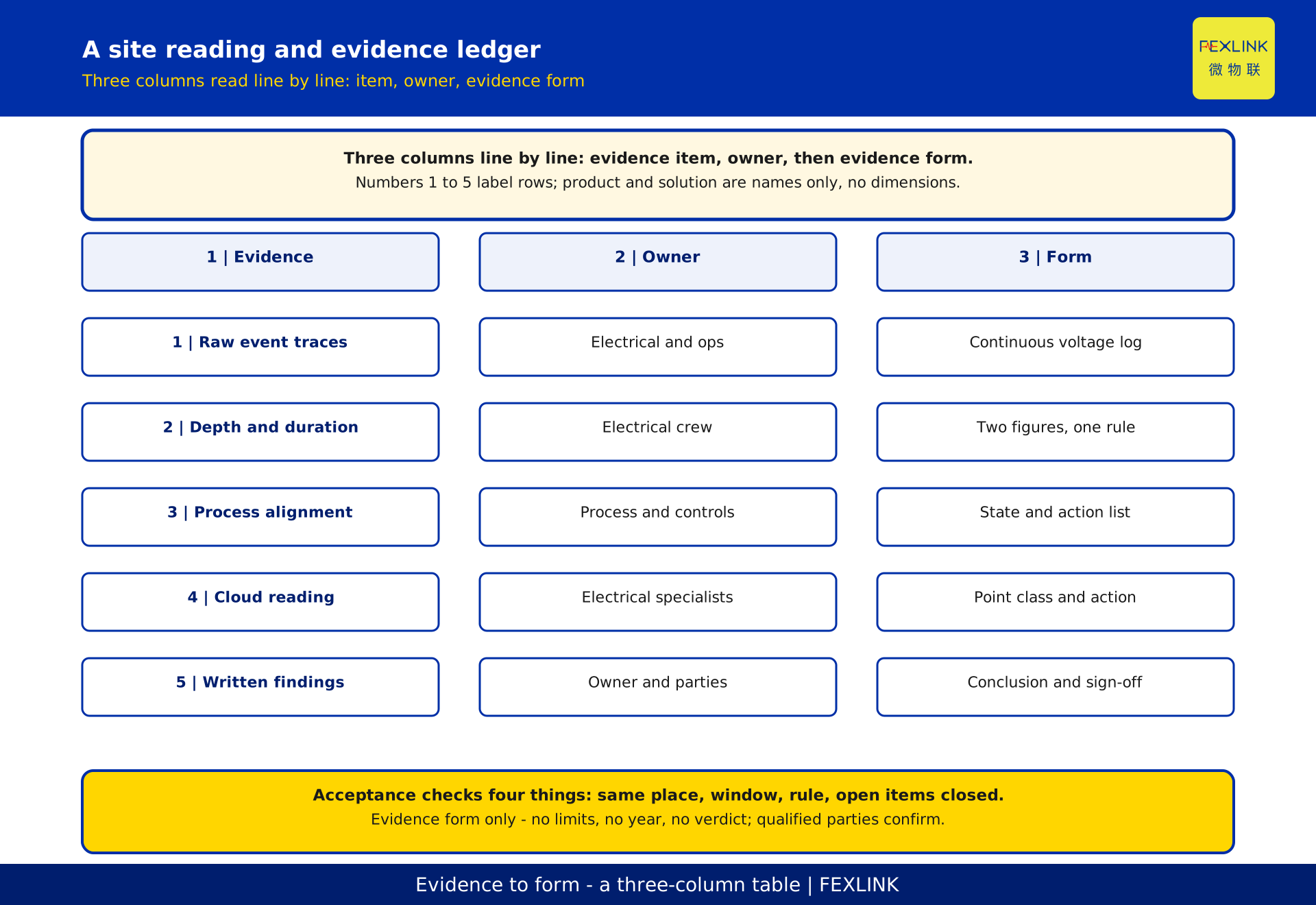
One fillable draft lets a different person later recalculate under the same criteria. Five columns cover record basis, cloud classification, event attribution, response direction, and written confirmation.
| 1|Evidence item | 2|Responsible party | 3|Evidence form |
|---|---|---|
| 1|Raw event records | Electrical and operations crew | Continuous voltage traces and time of occurrence |
| 2|Depth and duration labels | Electrical crew | Two-quantity records in one convention |
| 3|Process and switch alignment | Process and automation crew | Concurrent state and action list |
| 4|Cloud reading conclusion | Electrical and equipment specialists | Point classification and response direction |
| 5|Written findings and open items | Owner and relevant parties | Aligned conclusion, sign-off, and backfill record |
The ledger has no "pass/fail" column; this article does not sit in judgement. Whether a point falls inside the region is confirmed by qualified parties against the current text and project documents. The numbers one through five are only item labels, not counts or priorities.
XI. Boundaries and common misjudgements
Four misjudgements recur: reading "remaining" and "depth" alike; treating one point as a compliance verdict while ignoring the cloud; writing capacity and thresholds into conclusions and judging compliance for qualified parties; and taking this article's coordinates, boundary, cloud, and two response lines as an official scheme's framework.
To repeat the boundary: SEMI F47 is a standard name only; the version in force governs, with no year, clause, limit, allowable value, or compliance judgement. The digital electrical intelligent supervision system is a name only, with no decoding or self-invented framework. The article carries no measured data, limits, ratios, amounts, selection advice, or performance promises.
FAQ: frequently asked questions
Q: A tool is labelled compliant with the curve. Why did it still stop?
Compliance is a minimum promise about typical equipment, not immunity to every event. Judgement depends on which side of the boundary this event landed and whether the tool's weak points and settings deviate from typical conditions. A nameplate line is not enough.
Q: Does the vertical axis mean "how much is left" or "how much fell"?
Either describes the same event, but fix one convention. The vertical axis reads remaining voltage — the share left during the sag; depth is the part lost from normal. State the convention in the header before placing a point.
Q: If one point is outside the boundary, can the tool be called non-compliant?
No. It says this depth and duration exceed typical equipment capability — a lead to trace source and impact. Compliance is confirmed by qualified parties against the current text and field measurements; this article makes no such judgement.
Q: With a curve available, is hardening the equipment enough?
Not necessarily. Look at the cloud: points outside mean supply treatment and operation; points inside yet tools stopping mean equipment ride-through and settings. The two lines answer different questions; the choice depends on responsibility and investment.
Q: Will this article give standard limits, a scheme framework, or product model parameters?
No. SEMI F47 is a standard name only, with no year, clause, limit, or compliance judgement. The digital electrical intelligent supervision system is a solution name only; official definitions belong to official documents. The ESE power quality monitor is a canonical name only, with no parameter, range, channel count, supply mode, interface, or selection advice. The article carries no measured data, ratios, amounts, or performance promises — only judgement forms, record order, and a reading checklist.
Scope and limitations
This applies to electrical, procurement, and operations staff in semiconductor facilities, at equipment acceptance, stoppage review, and preliminary sag risk judgement, for turning "compliant with the curve" into checkable questions.
It does not apply to compliance determination, reading limits, clean-room monitoring layout and scheme design, or root-cause analysis of a single sag; each has its own article. Articles on algorithm and data-feature counts cover the scenario behind numbers, while this one covers judging measured sags against the immunity curve.
This is not a work procedure and does not sit in judgement: it states no frequency, amplitude, duration, limit, capacity, amount, pass rate, or compliance conclusion, and gives no selection advice. Cases are generalised as "a certain fab," with no client, region, scale, or result data. The numbers one through five are item labels, and the digits in SEMI F47 are part of a standard name; neither is a measurement. The coordinates, boundary, cloud, and two response lines are working distinctions, not an official scheme's dimensions. All deliverables await review; the generator does not self-approve and nothing is published.
Frequently Asked Questions
A tool is labelled compliant with the curve. Why did it still stop?
Compliance is a minimum promise about typical equipment, not immunity to every event. Judgement depends on which side of the boundary this event landed and whether the tool's weak points and settings deviate from typical conditions. A nameplate line is not enough.
Does the vertical axis mean "how much is left" or "how much fell"?
Either describes the same event, but fix one convention. The vertical axis reads remaining voltage — the share left during the sag; depth is the part lost from normal. State the convention in the header before placing a point.
If one point is outside the boundary, can the tool be called non-compliant?
No. It says this depth and duration exceed typical equipment capability — a lead to trace source and impact. Compliance is confirmed by qualified parties against the current text and field measurements; this article makes no such judgement.
With a curve available, is hardening the equipment enough?
Not necessarily. Look at the cloud: points outside mean supply treatment and operation; points inside yet tools stopping mean equipment ride-through and settings. The two lines answer different questions; the choice depends on responsibility and investment.
Will this article give standard limits, a scheme framework, or product model parameters?
No. SEMI F47 is a standard name only, with no year, clause, limit, or compliance judgement. The digital electrical intelligent supervision system is a solution name only; official definitions belong to official documents. The ESE power quality monitor is a canonical name only, with no parameter, range, channel count, supply mode, interface, or selection advice. The article carries no measured data, ratios, amounts, or performance promises — only judgement forms, record order, and a reading checklist.