 FEXLINK Research Institute
The short answer
For electrical monitoring retrofits in existing buildings, do not treat all-wireless versus a building-wide RS485 pull as one yes-or-no question. Ask instead which segment of the link must use cable and which can go wireless. The test is the point's topology tier and whether a cable route for that tier is usable.
After those two cuts, most existing buildings reach the same answer. Incomers, bus ties and low-voltage main feeders stay wired; scattered end points behind floor boards, under locked finishes and across tenant boundaries go wireless through LoRa or 4G collection. Both kinds converge at an aggregation gateway in a floor electrical room or riser, which provides one upward path: a mixed network. New fit-outs extend the wired portion; old buildings with locked finishes enlarge the wireless portion. Neither replaces the other.
This article gives a decision method, point tiering and an acceptance checklist. It gives no device list, unit prices, distance figures, limits or effect commitments. The digital electrical intelligent supervision system is registered here as a solution name only, with no expansion of its dimensions, layers or elements. Associated products are registered by canonical name only, with no parameters or configurations.
Stop asking which one, ask which segment
Deadlock starts when the network is framed as one building-wide choice. All-wireless must answer loss ownership and record continuity on incomers; fully wired must answer surface approval, restoration and outage scheduling. Neither extreme survives.
A link has two segments. The first runs from a point to the local aggregation point, either on a bus or via wireless collection. The second runs from the aggregation gateway to the platform and is normally a single upward path; it does not branch just because one point chose wireless. Almost every retrofit constraint sits in the first segment. Collapsing both produces the familiar rework of converting a whole trunk for a handful of end points.
The division of labour with adjacent topics is deliberate. Metering computes per-point charges, aggregation chooses a cloud path, campus chooses mounting form, and separate articles cover bus wiring and cabinet shielding. The test here is neither count, distance class, per-point tariff nor mounting form. It is the role of the point in the topology combined with the physical conditions of this building. The core, floor and end tiers used below are a working division for placement, not a dimension or layer of any official solution.
Four quadrants: where the two cuts land
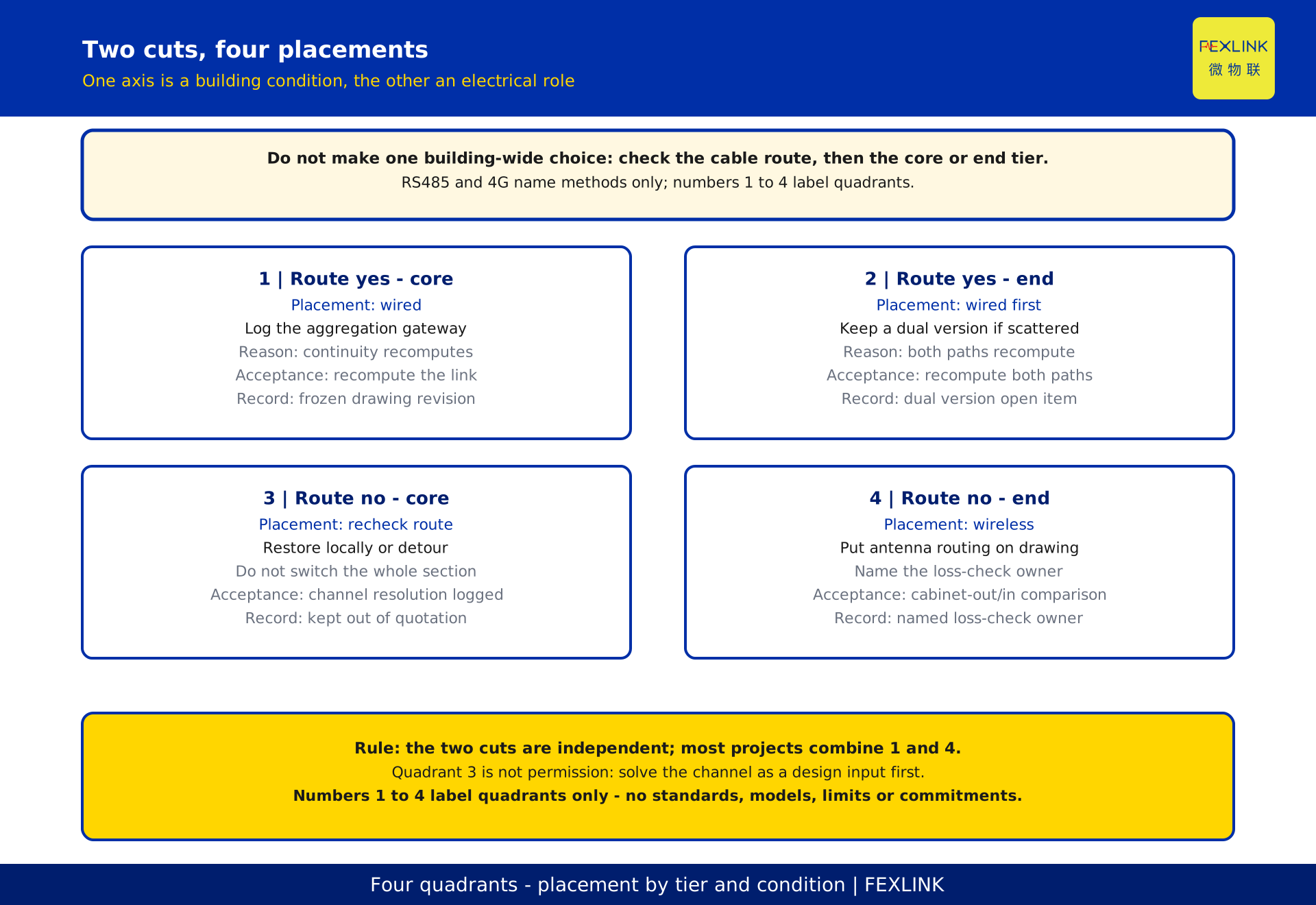
One axis is a building condition; the other is an electrical role. Neither substitutes for the other.
| Quadrant | Channel available | Point role | Placement |
|---|---|---|---|
| 1 | Yes | Core section | Wired; record the link ledger and the aggregation gateway |
| 2 | Yes | End section | Wired first; wireless if scattered, keep a dual-version open item |
| 3 | No | Core section | Recheck whether a channel can be restored; do not switch the whole section |
| 4 | No | End section | Wireless; put antenna routing and loss checks on the drawing |
The four numbers label quadrants only, not counts, budgets, ratios or priorities. Quadrant 3 is often misread as permission to make core sections wireless; it actually demands the channel problem be solved as a design input. Most projects combine Quadrant 1 and Quadrant 4.
Where wired cost and reliability sit
A wired RS485 scheme concentrates cost at construction: cable, conduit or tray, penetrations, installation, property and outage coordination. Once a trunk exists, adding a nearby point carries a small marginal cost. On reliability, point data does not depend on batteries or an external propagation path, so continuity is easier to recompute from a link ledger.
What is expensive in an old building is often not the cable but surface restoration, cross-tenant permission and a property-wide outage schedule. Calling wired cheap and stable while ignoring them stops a scheme at handover. One trunk failure affects a group of points, so the ledger must show each point's gateway and investigator. No unit prices, distances, node counts or pass-rate conclusions are given; actual values follow the agreed schedule, current standards and measured conditions.
Where wireless strengths and limits sit
Wireless LoRa or 4G collection concentrates its strengths in the first segment: no trunk cabling, freedom across floors and tenants, no damage to finished surfaces, short outage coordination and fast addition of points. For buildings that cannot stop or be opened, these are often the only workable starting conditions.
Its limits sit in the same segment and must be verifiable on site. Metal cabinets and risers change the propagation path, so antenna routing is settled by a cabinet-out versus cabinet-in survey comparison. Power and battery upkeep need a named owner; a loss of visibility spans node, path, gateway and upward link. Wireless depends more strongly on site conditions and therefore needs recomputable verification records. No frequency, power, distance class or signal figure is given, and the shielding mechanism is not expanded.
Four building-specific physical conditions
Record each condition explicitly, marking unavailable items as open rather than filling them from experience. This is the increment over campus, plant and metering scenarios.
| Condition | What to pin down | If unavailable |
|---|---|---|
| Trays and risers | Reusable route, cross-floor riser, who owns spare capacity | Mark open, assume unavailable, keep a dual drawing |
| Finished surfaces | Whether coring is allowed, who pays for restoration | Mark open, do not make coring a construction premise |
| Tenant and property boundary | Cross-tenant permit, drawing ownership, who opens doors | Mark open, plan wireless without crossing tenants |
| Outage window | Property-wide schedule or maintenance slot, staged outage possible | Mark open, keep out of the quotation annex |
Check in order, since later conditions are often blocked by earlier ones. Disguising open items as settled is where rework starts. Conditions and tiers are two independent cuts: an excellent floor may still be wired for core points, and a poor tenant zone may still force local channel restoration for continuous records.
A three-step decision chain
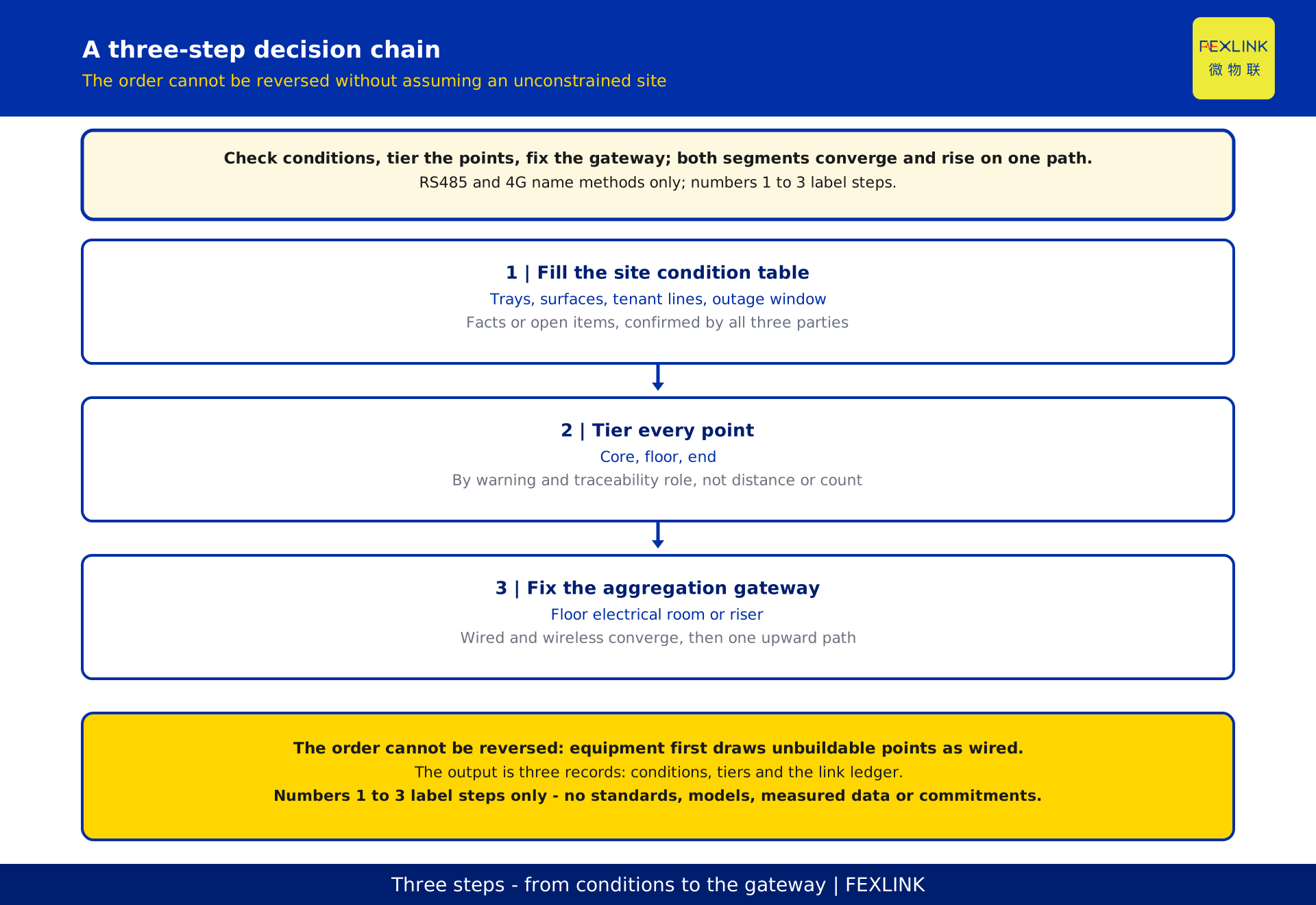
Reduce the above to a fixed order: fill the site condition table with design, property and installation; label every point core, floor or end by its role in warning and traceability; fix the aggregation gateway in a floor electrical room or riser so both segments converge.
The order cannot be reversed. Selecting equipment first draws unbuildable points as wired; fixing the gateway first detours wireless points to another floor; drawing the upward path first assumes an unconstrained first segment. Only then does each quadrant map to a gateway identifier and drawing revision. The output is three handover records: site condition table, point tier table and link ledger.
First cut: tier points by distribution topology
The core section covers incomers, bus ties, low-voltage main feeders and transformer low-voltage sides; a broken link affects a whole traceability record. The floor section covers floor distribution and zone main boards. The end section covers final branch boards and scattered points behind finished surfaces.
The tier follows the data's role in warning and traceability, not distance, count or price. Tiering by count or distance misfits electrical safety monitoring. The three tiers are a working division for owners, links and evidence; they are not dimensions, layers or elements of an official solution.
Second cut: which points favor wired or wireless
Overlay tiers and conditions to get a drawing placement. Wired is favored for core sections, usable channels, closed metal cabinets or points whose links must be recomputed at acceptance. Wireless suits scattered end points, locked finishes, tenant boundaries without permits and later additions. Floor sections are judged point by point.
Where both work, apply one test: can acceptance recompute the path and responsibility from one link ledger? If yes, place the lower-coordination version first and keep the other open; if not, return to the first step. Favored, suitable and open dual version are used rather than must or always, because conditions change; a placement is a traceable design decision.
The gateway architecture of a mixed network
Wired points reach the local aggregation gateway over a bus; wireless points reach the same gateway through wireless temperature nodes; both rise on one path. What matters is a single convergence point: sending every point to the cloud multiplies one link problem into many accounts, tariffs and responsibilities.
Gateway placement needs convenient power, an antenna routable outside the cabinet, maintenance access and clear door permissions; the four conditions decide which riser or floor room is chosen. The drawing must show each point's method, gateway, upward path and loss-check owner.
Associated products carry canonical names only: FEXLINK ESX edge computing gateway, CW industrial gateway and EST wireless temperature series. No configuration, parameters, ranges, channel counts, supply arrangements or interfaces are given, no selection advice is offered, and no standard-model configuration is used to judge an error. The digital electrical intelligent supervision system is likewise a name only, with no expansion of dimensions, layers or elements; official definitions rest with official documentation and the knowledge base, and no white paper is claimed as a source.
A point-condition-method table and acceptance checklist
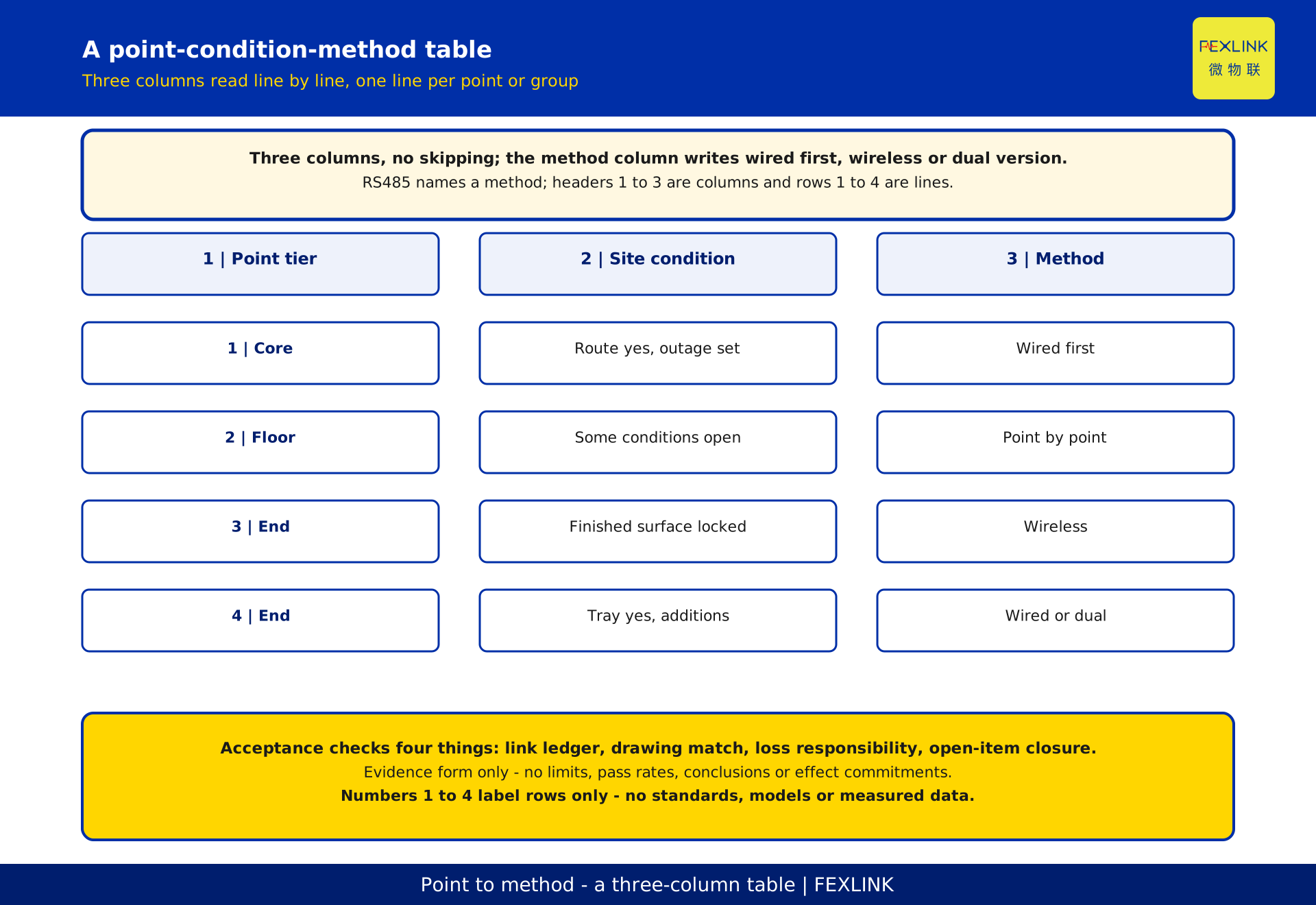
Three columns read line by line, one line per point or group sharing conditions; the method column never names a device model.
| Point tier | Site condition | Method |
|---|---|---|
| 1 - Core section | Channel available, outage window set | Wired first |
| 2 - Floor section | Some conditions open | Decide point by point, keep dual version |
| 3 - End section | Finished surface locked, cross-tenant | Wireless suitable |
| 4 - End section | Tray available, frequent additions | Wired first or dual version |
| 5 - Core section | Channel unavailable | Recheck the channel first |
Acceptance checks four things, evidence form only: the ledger shows each point's method and gateway; the mapping matches the as-built drawing under a frozen revision; loss fallback and responsibility boundaries are written down; every open item has a recorded resolution.
No conformity judgement, limits, pass rates or effect promises are made. The associated standards field is empty, so the article carries no standard number, year, clause, limit or conformity judgement; the table is an alignment tool, not a quotation or contract annex.
Boundaries and three common misjudgements
Three misjudgements: imposing one method across the building, burying Quadrant 3 and open items; deciding by point count rather than tier, missing the few core points that matter most; and treating wireless as acceptance-free, so nobody can say which gateway a point hung from. All three turn a design decision into an unrecorded verbal conclusion.
This is a decision method and acceptance checklist, not a construction procedure, selection table or quotation basis; in-cabinet work is decided by qualified personnel under applicable procedures. There are no invented figures, measured data, amounts, ratios or effect commitments, and any case is generalised as a building with no client, location, scale or result data. Solution and product names are registered only; dimensions, layers and elements of official frameworks rest with official documentation and the knowledge base.
FAQ: frequently asked questions
Q: An old building has no trays at all, so is all-wireless the only option?
No. Record the four conditions first, then check whether the core section can regain a local channel. The channel is a design input, not something wireless bypasses; only end points are usually wireless-only.
Q: Is wireless always cheaper than wired?
No unit prices or amounts are given. Wired cost concentrates in construction and surface restoration; wireless cost falls on power upkeep and loss investigation. What matters is which side has harder conditions, not a smaller device figure.
Q: Can the core bus section also go wireless with a wired path kept as backup?
That is redundancy design, not a network method choice, and needs its own safety and reliability argument. The choice, responsibility and acceptance evidence of a backup link are settled separately in design documents and by agreement.
Q: Does a mixed network complicate operations?
Complexity comes from the ledger, not the methods. With one convergence point and clear loss-check responsibility, both methods are branches of a single upward path. Sending every point to the cloud separately is what complicates operations.
Q: Is this an official solution's network specification, and does it give models and limits?
Neither. The digital electrical intelligent supervision system is registered as a name only, with official definitions resting on official documentation and the knowledge base; associated products are likewise registered by canonical name. The article carries no standard number, year, clause, limit, conformity judgement, selection advice or effect commitment, and gives only the form of a test, point tiering and an acceptance evidence checklist.
Scope and limitations
This applies to scheme review and survey of electrical monitoring retrofits in existing buildings, especially locked finishes, clear tenant boundaries and property-wide outage scheduling. Readers are building intelligence designers, pre-sales engineers and client electrical leads.
It does not cover embedded design, metering tariff modelling, aggregation upward paths, mounting-form selection, bus wiring or shielding diagnosis; each has its own article. This is not a work procedure, states no frequency, power, distance, node count or limit, and makes no conformity judgement or effect commitment. Site conditions, frozen definitions, quotations and contract terms follow the formal documents agreed by both parties, current standards and measured conditions. All deliverables remain pending review; the generator does not self-approve, and independent review, item-by-item owner acceptance and release registration are incomplete. Not published.
Frequently Asked Questions
An old building has no trays at all, so is all-wireless the only option?
No. Record the four conditions first, then check whether the core section can regain a local channel. The channel is a design input, not something wireless bypasses; only end points are usually wireless-only.
Is wireless always cheaper than wired?
No unit prices or amounts are given. Wired cost concentrates in construction and surface restoration; wireless cost falls on power upkeep and loss investigation. What matters is which side has harder conditions, not a smaller device figure.
Can the core bus section also go wireless with a wired path kept as backup?
That is redundancy design, not a network method choice, and needs its own safety and reliability argument. The choice, responsibility and acceptance evidence of a backup link are settled separately in design documents and by agreement.
Does a mixed network complicate operations?
Complexity comes from the ledger, not the methods. With one convergence point and clear loss-check responsibility, both methods are branches of a single upward path. Sending every point to the cloud separately is what complicates operations.
Is this an official solution's network specification, and does it give models and limits?
Neither. The digital electrical intelligent supervision system is registered as a name only, with official definitions resting on official documentation and the knowledge base; associated products are likewise registered by canonical name. The article carries no standard number, year, clause, limit, conformity judgement, selection advice or effect commitment, and gives only the form of a test, point tiering and an acceptance evidence checklist.