 FEXLINK Research Institute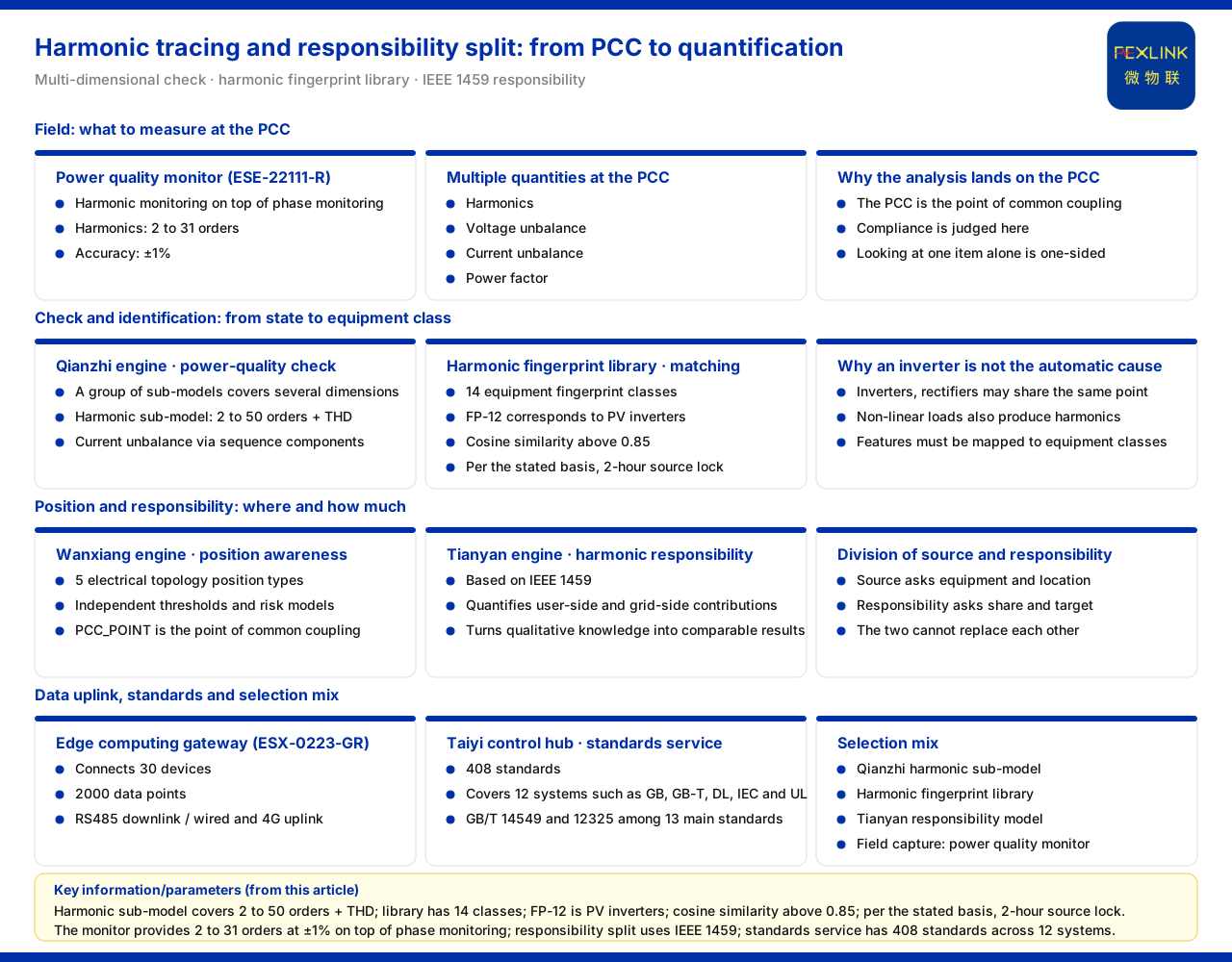
Direct answer
What exactly happens to power quality at the grid-connection point after distributed photovoltaic capacity is connected is a question of concern to both the owner and the grid. The judgement path given by the product material is: first acquire multi-dimensional data at the grid-connection point, including harmonics, voltage imbalance, current imbalance and power factor, and have the power-quality examination sub-models of the Qianzhi engine assess them separately; then use the harmonic fingerprint library to match harmonic features to an equipment type; and finally use the responsibility-allocation model to quantify the contributions of the user side and the grid side. Answering "what has the inverter brought to the grid" does not depend on looking at one value alone, but on the combination of multi-dimensional examination, equipment matching and responsibility quantification. This article explains this path according to the product material and does not derive additional field criteria.
What is seen at the grid-connection point after the inverter is connected
The inverter of a distributed photovoltaic system converts direct current into alternating current at the same frequency and phase as the grid and feeds it into the grid, and its power-conversion process produces harmonics at the grid-connection point. The grid-connection point is the point of common coupling, and whether power quality is acceptable is usually judged there, so it becomes the key position for observing the effect of the inverter. After connection, in addition to a possible change in harmonics, voltage imbalance, current imbalance and power factor may also change accordingly. These quantities are related to one another, and looking at only one of them easily leads to a one-sided conclusion.
Why "harmonics a little high" cannot be equated directly with the inverter
Harmonics being a little high at the grid-connection point cannot simply be attributed to the photovoltaic inverter. At the same grid-connection point there may also be variable-frequency drives, rectifier equipment, switching power supplies and other non-linear loads, and these devices also produce harmonics. Without further distinction, mitigation is easily applied to equipment that carries no responsibility. A process is therefore needed between "harmonics are a little high" and "who caused it" to correspond harmonic features to an equipment type, and this is exactly the problem that the harmonic fingerprint library solves.
The examination side: one set of sub-models looks at several dimensions together
The power-quality examination of the Qianzhi engine consists of a set of sub-models covering dimensions such as harmonics, voltage imbalance, current imbalance and power factor. The harmonic sub-model focuses on the 2nd to 50th harmonics and the total harmonic distortion, while current imbalance is analysed from the sequence-component angle. For a photovoltaic grid-connection point, this arrangement means the examination does not give a single conclusion of "harmonics are a little high" but presents several dimensions together, making it easier to judge which class of problem is more prominent. Presenting multiple dimensions at once also provides a more complete input for the subsequent equipment matching and responsibility allocation.
Field acquisition: what to measure at the grid-connection point
On the acquisition side, the ESE power-quality monitor (for example ESE-22111-R) provides 2nd to 31st harmonic monitoring on the basis of phase monitoring, with an accuracy of ±1%. It provides continuous, comparable electrical-quantity data at the grid-connection point and is the field source for harmonic analysis. Unlike steady-state harmonics, quantities that change with time, such as sags and fluctuations, need continuous monitoring to cover occasional events, so the continuity of acquisition is equally important.
The fingerprint library: matching harmonic features to equipment
A key step in harmonic tracing is to correspond the measured features to an equipment type. The harmonic fingerprint library of the Qianzhi engine contains 14 categories of equipment fingerprints, among which FP-12 corresponds to the photovoltaic inverter. Matching uses cosine similarity, and a similarity greater than 0.85 is judged to match; according to the existing formulation, the pollution source can be locked within 2 hours. For a distributed photovoltaic scenario, this capability can be used to match the harmonic features at the grid-connection point to the photovoltaic inverter and to distinguish it from other non-linear loads such as variable-frequency drives, thereby narrowing the tracing scope.
From "does it look like an inverter" to "how much responsibility"
Identifying the equipment type only answers the source question, not yet the responsibility question. The source question asks about equipment and position, while the responsibility question asks about contribution share and the object of mitigation, and the two cannot substitute for each other. Responsibility allocation is carried by the power-quality model of the Tianyan engine: harmonic responsibility allocation is based on IEEE 1459 and quantifies the harmonic contributions of the user side and the grid side. Its value is that it converts the common observation that "both sides have harmonics" into a comparable quantitative result, providing a basis for dividing mitigation work. According to the existing formulation, in practice it was once used to reduce the rectification cost from 80 to 28 (in ten-thousand yuan).
Position: why the analysis has to land at the grid-connection point
The judgement of power quality is strongly related to position. The Wanxiang engine maintains independent thresholds and risk models for 5 types of electrical topology positions, among which PCC_POINT is the point of common coupling. The same segment of harmonic data appearing at the grid-connection point and at a load terminal does not receive the same risk judgement. For photovoltaic grid-connection monitoring, the meaning of position awareness is to land the analysis at the grid-connection point rather than treating the whole supply chain as one homogeneous object. Position and source each have their own role: position solves "where", and the fingerprint solves "which class of equipment".
Data uplink and selection combination
According to the selection table in the material, the combination corresponding to harmonic tracing and responsibility allocation is the harmonic sub-model of the Qianzhi engine, the harmonic fingerprint library, and the responsibility-allocation model of the Tianyan engine. The power-quality monitor is chosen for field acquisition; if the data must be aggregated upward, the ESX intelligent edge-computing gateway (for example ESX-0223-GR) can be used, providing access capability for 30 devices and 2000 data points, with RS485 downward and wired and 4G upward. The three capabilities each perform their own function, and only together do they cover the whole process from acquisition to a responsibility conclusion.
Standard formulation
From the standard point of view, the standard service of the Taiyi intelligent control hub system contains 408 standards and covers 12 systems such as GB, GB-T, DL, IEC and UL; among them, GB/T 14549 (harmonics of public power grids) and GB/T 12325 belong to the 13 main standards already covered by the Qianzhi engine. Bringing regional and international standards into one standard service helps keep the formulation consistent in cross-regional projects and makes it easier to cite the same set of standard bases in the discussion of responsibility allocation.
Implementation order: data first, then features, then responsibility
Expanding this capability chain, the order also matters: first there is continuous data at the grid-connection point, then features that can be used for comparison, and only then responsibility allocation. Reversing the order leaves the conclusion without a basis. For example, using the data of one sample to make a responsibility judgement, or taking the matching result of the equipment type directly as a responsibility conclusion, both produce deviations. The material sets up the examination, the fingerprint and the responsibility allocation as separate capabilities precisely to avoid this confusion. For initial project planning, the choice and layout of acquisition devices actually determine how far the subsequent analysis can go.
Scope and limitations
- The content of this article is limited to the existing statements in the product material regarding the power-quality examination sub-models of the Qianzhi engine, the harmonic fingerprint library, the responsibility-allocation model of the Tianyan engine, the position awareness of the Wanxiang engine, the intelligent edge-computing gateway and the standard service.
- The dimensions covered by the sub-models, the harmonic order and accuracy, the fingerprint category count and similarity threshold, the equipment-matching duration, the number of position types, the gateway access capability and interfaces, and the standard-library count and number of systems are all formulations listed in the material.
- This article explains the capability combination for power-quality monitoring and responsibility allocation at a photovoltaic grid-connection point; it gives no specific mitigation scheme or responsibility-sharing ratio, and actual conclusions should be determined together with field data, equipment specifications and the project scheme.
- Other field conditions, installation methods and maintenance cycles not listed in the material are not inferred or promised here.