 FEXLINK Research Institute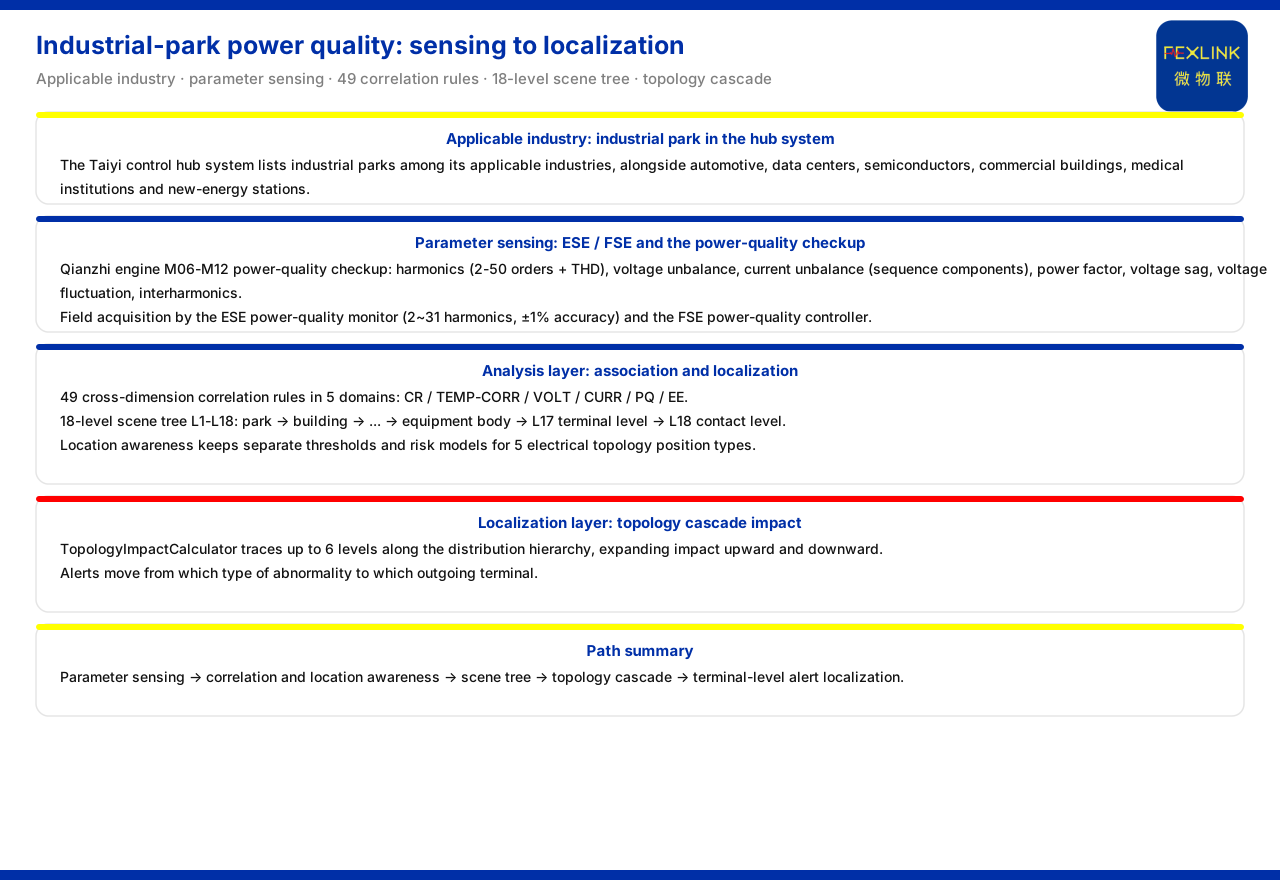
Direct answer
The power-quality problem of an industrial park is often not caused by one device alone but by several kinds of disturbance such as harmonics, three-phase imbalance and voltage sags superimposed, interacting with one another along the distribution hierarchy. The product knowledge base lists industrial parks among the applicable industries of the Taiyi intelligent control hub system, which shows that this scenario is handled uniformly by the hub system. On the analysis side, the Wanxiang engine uses 49 cross-dimension association rules, an 18-level scenario location tree and location-awareness capability to push an alarm from "which kind of anomaly" to "which outgoing terminal"; the power-quality health-check sub-models of the Qianzhi engine perform the parameter-level first screening; and the topology cascade impact analysis traces the impact up and down the distribution hierarchy. Field acquisition is carried by the ESE power-quality monitor and the FSE multi-parameter electrical intelligent controller (power quality type). This article explains the path from sensing to location for industrial-park power quality and marks the boundary of the material.
1. Why industrial parks are listed among the applicable industries
In the applicable-industry entry of the Taiyi intelligent control hub system, the product knowledge base explicitly lists industrial parks alongside automobile manufacturing, data centres, semiconductors, commercial buildings, medical institutions and new-energy stations. The meaning of this position is that an industrial park is not a marginal scenario outside the hub system but is brought into the same set of hub scheduling objects.
For a park this has practical significance. The electricity structure of a park usually contains production loads, motive loads and public-facility loads, with dispersed harmonic sources and large load variation, so an out-of-range single parameter often affects several classes of equipment and several distribution levels.
2. Wanxiang engine: 49 cross-dimension association rules and 5 domains
One core of the analysis side is the Wanxiang engine. The product knowledge base records that the Wanxiang engine has established 49 cross-dimension association rules, falling into 5 domains: 7 in the CR series, 7 in the TEMP-CORR series, 15 in the VOLT series, 14 in the CURR series, 3 in the PQ series and 3 in the EE series.
These numbers are worth breaking apart. The VOLT series with 15 is the largest domain, followed closely by the CURR series with 14; together they account for 29 rules, showing that voltage- and current-related associations are the heavily modelled objects; the PQ and EE series have 3 each, few in number but corresponding to the cross-cutting plane of power quality and energy efficiency. The value of cross-dimension association rules is that they do not treat each measuring point as isolated data but let different quantities corroborate one another.
3. The 18-level scenario location tree: from the park to the outgoing terminal
An alarm is only useful if it lands on a specific location. The product knowledge base records that the Wanxiang engine has an 18-level scenario location tree, from L1 to L18 in order: park, building, floor, distribution area, transformer area, main distribution room, main switchgear cabinet, busbar section, distribution board, branch circuit, trunk feeder, area distribution box, control circuit, branch switch, equipment supply, equipment body, down to the L17 terminal level and the L18 contact-point level.
The purpose of this tree is to converge the sentence "something is wrong somewhere in the park" step by step to "one particular outgoing terminal". The product knowledge base states in particular that an alarm can be located precisely to a specific outgoing terminal. For a park, whose distribution hierarchy is deeper than that of a single building, the 18-level location tree provides exactly the skeleton for passing through these levels without losing the location.
4. Location awareness: modelling for 5 electrical topology positions
Hierarchy alone is not enough, because the same line carries different risk at different topological positions. The product knowledge base records that the Wanxiang engine has location-awareness capability and maintains independent thresholds and risk models for 5 electrical topology position types: PCC_POINT the point of common coupling, MAIN_PANEL the main distribution panel, DISTRIBUTION_PANEL the distribution panel, FEEDER_LINE the feeder line, and LOAD_TERMINAL the load terminal.
Modelling separately by position means that the same anomaly can be judged differently at the point of common coupling and at the load terminal. The point of common coupling is closer to the system side and the load terminal is closer to the equipment side, and the two differ in sensitivity to and tolerance of disturbance.
5. Qianzhi engine power-quality health check: M06 to M12
Before the Wanxiang engine performs association and location, the parameter-level problem is first screened by the power-quality health-check sub-models of the Qianzhi engine. The product knowledge base records that these sub-models are numbered M06 to M12 and cover parameters including harmonics (orders 2 to 50 and THD), voltage imbalance, current imbalance (sequence components), power factor, voltage sags (ITIC and SEMI F47), voltage fluctuation (IEC 61000-4-15) and interharmonics.
This coverage shows that the health check does not look only at a single total harmonic distortion rate but examines harmonics, imbalance, sags and fluctuation by category. For a park, different loads produce different disturbance types, and only by checking them separately can it be made clear which parameter first deviates, before the result is handed to the subsequent association and location stages.
6. Topology cascade impact: tracing up to 6 levels
Once an anomaly occurs at a certain level, its impact does not necessarily stop there. The product knowledge base records that the topology cascade impact analysis tool of the Wanxiang engine can trace up to 6 levels and gives the quantitative value "cascade risk coverage 100%".
These two pieces of information point to the same thing: the analysis is not satisfied with locating a single point but must also say where this point will implicate. The 6 levels are the depth of tracing and 100% is the coverage measure, meaning the analysis range covers the determination of cascade risk rather than spot-checking a part. For a park with a deep distribution hierarchy and many circuits, tracing cascade impact is exactly the stage that links a local anomaly with the overall risk.
7. Field acquisition and selection: power-quality monitor and controller
Analysis needs data, and the data comes from field devices. The product knowledge base records that the ESE power-quality monitor adds harmonic monitoring on top of phase monitoring, covering harmonics of orders 2 to 31 with an accuracy of plus or minus 1%. In the scenario comparison, the product knowledge base lists the recommended combination for "power quality and dedicated harmonic treatment" as the ESE power-quality monitor, or the FSE multi-parameter electrical intelligent controller (power quality type), together with the harmonic analysis of the Tianyan engine.
The two classes of device differ slightly in role: the monitor focuses on continuous observation of power-quality parameters, while the controller additionally carries monitoring-and-control duties and can work with the harmonic analysis of the Tianyan engine. For a park, first using the power-quality monitor to see the harmonic distribution and then using the controller for the links that need interlocking is an executable combination path.
Scope and limitations
First, this article only restates the content listed in the product knowledge base; the factual boundary is limited to the applicable industries of the Taiyi intelligent control hub system, the relevant entries of the Wanxiang engine and the Qianzhi engine, and the records of the ESE power-quality monitor and the FSE multi-parameter electrical intelligent controller (power quality type).
Second, that industrial parks are listed among the applicable industries of the Taiyi intelligent control hub system is quoted as recorded in the product knowledge base; this article does not infer the specific capacity, wiring or configuration of that scenario.
Third, the 49 cross-dimension association rules of the Wanxiang engine and their 5-domain distribution (CR 7, TEMP-CORR 7, VOLT 15, CURR 14, PQ 3 and EE 3), the 18-level scenario location tree, the 5 electrical topology position types of location awareness, and the tracing of topology cascade impact up to 6 levels with 100% cascade risk coverage are all quoted as recorded in the product knowledge base.
Fourth, the parameters covered by the Qianzhi engine power-quality health check M06 to M12, including harmonics (orders 2 to 50 and THD), voltage imbalance, current imbalance (sequence components), power factor, voltage sags, voltage fluctuation and interharmonics, are quoted as recorded in the product knowledge base; this article does not infer health-check items not listed.
Fifth, the harmonics of orders 2 to 31 and the plus or minus 1% accuracy of the ESE power-quality monitor, and the recommended combination for power quality and dedicated harmonic treatment, are quoted as recorded in the product knowledge base; this article does not infer the performance of other models or unlisted combinations.
Sixth, this article explains only the path from parameter health check to association and location and then to field acquisition; it provides no specific engineering point layout, parameter setting or treatment scheme.