 微物联研究院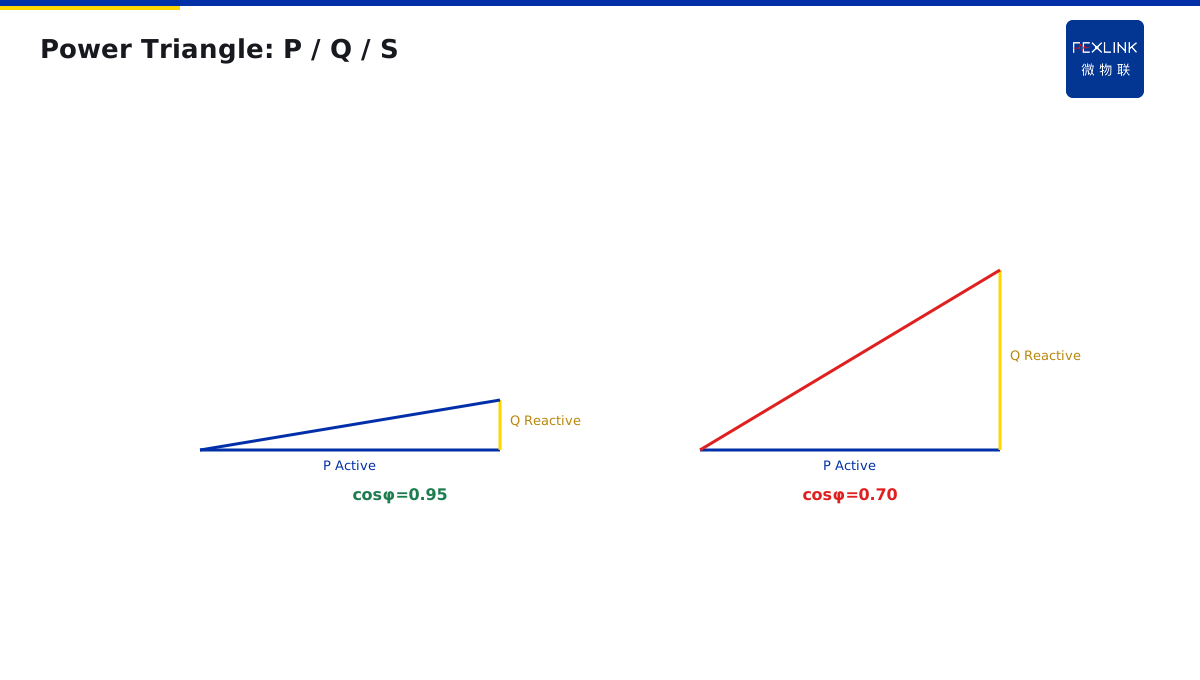
Direct Answer
Power factor = active power / apparent power. Low power factor means higher current for the same useful load, with higher line and transformer losses.
Utilities bill large customers on this. Monitoring power factor is not only about avoiding fines—it reveals reactive-load growth and prevents underestimated losses and temperature rise.
1. Why the Utility Cares
Suppose active power is 100 kW.
- cosφ = 0.95: apparent 105 kVA, current 152 A;
- cosφ = 0.70: apparent 143 kVA, current 206 A.
Same 100 kW useful work, but 36% more current. Transformers, cables and breakers must be sized for 206 A—wasteful. Utilities penalize large users below cosφ 0.9 to keep their assets from being inefficiently used.
2. Cost of Low PF
- Higher line loss (I²R);
- Transformer capacity consumed by reactive power;
- End-of-line voltage drop;
- Power-factor adjustment penalty on the bill.
3. How to Improve
- Local reactive compensation (capacitor banks);
- Choose high-cosφ VFDs / LED drivers;
- Avoid transformer light load (PF naturally drops at light load).
4. Why Monitor
ESA all-element smart meter and FSA multi-element controller monitor cosφ in real time. Value beyond fines:
- cosφ drifting down monthly → reactive load growing, add compensation;
- cosφ suddenly up → capacitor bank may have failed off;
- Compare circuits → find the reactive hog.
5. Common Mistakes
- Looking only at monthly average: daytime 0.95, night 0.6, monthly 0.85 looks fine but nights are bad;
- Manual capacitor switching: load changes, capacitors don't follow;
- No PF trend monitoring: wait until the utility fine arrives.
6. Real, Reactive, and Apparent Power
You may ask: what are real, reactive, and apparent power in power factor?
Analogy: you drink beer.
- Real power: the beer you actually drink (what quenches thirst).
- Reactive power: the foam (takes up glass volume, but does not quench thirst).
- Apparent power: the whole glass (beer + foam).
Power factor = beer / whole glass = how much is actually useful.
Power factor 1.0: whole glass is beer, no foam — ideal. Power factor 0.7: 30% is foam — bigger glass, but no more beer.
Why does the utility care? Because they must supply the "whole glass" (apparent power) — cables and transformers sized by apparent power. More foam = wasted equipment.
7. Why Low Power Factor Is Penalized
You may ask: why does the utility penalize low power factor?
Because utility equipment (transformers, lines) is sized by apparent power.
Suppose you need 100kW real power:
- cosφ = 0.95: apparent 105kVA — utility needs 105kVA transformer.
- cosφ = 0.70: apparent 143kVA — utility needs 143kVA transformer.
Same 100kW real power, low power factor consumes 38kVA more transformer capacity.
Utility transformer capacity is finite — you take more, others get less. So they penalize, forcing you to improve power factor and release capacity.
Penalty standards (vary by region):
- cosφ < 0.9: penalty 5–10% of electricity bill.
- cosφ < 0.8: penalty 15–20% of electricity bill.
- cosφ > 0.95: reward 0.5% of electricity bill.
8. How Capacitor Compensation Works
How to improve power factor? Answer: add capacitors.
Why do capacitors improve power factor?
Because motors and transformers are inductive loads — inductive loads need "reactive current" to build magnetic fields. This reactive current does no work, but flows in the line.
Capacitors are capacitive loads — capacitive loads produce "reverse reactive current".
Inductive reactive + capacitive reactive = cancel each other.
Result: reactive current in line decreases — total current decreases — power factor improves.
This is reactive power compensation principle: use capacitors to "neutralize" inductive load reactive power.
9. Why VFDs Lower Power Factor
You may ask: aren't VFDs energy-saving? Why do they lower power factor?
Because VFDs are rectifier bridge + capacitor — rectifier bridge produces harmonic current.
Harmonic current is a kind of "reactive" — it does no work, but flows in the line.
Result: power factor drops.
Old equipment (direct-on-line motor): power factor 0.85. New equipment (VFD): power factor 0.7–0.8.
This is why modern factories have lower and lower power factor — not you changed, but loads changed.
10. Why Capacitors Fail on Their Own
You may ask: capacitor bank installed a few years, why did power factor drop again?
Because capacitors age.
Capacitors contain insulating oil (or film) — long-term operation causes insulation aging, capacity drops.
Example: new capacitor 100kVar, after three years only 70kVar — compensation insufficient.
This is why you need to monitor power factor trend — if cosφ drops month by month, capacitors are aging, time to replace.
Without monitoring: you only find out when the utility penalty arrives — already tens of thousands.
11. How to Detect Reactive Compensation Failure
How do you know if your capacitor bank is failing?
Three signals:
- cosφ suddenly rises: all capacitors switched in, but cosφ unexpectedly high — may be capacitor short circuit (over-compensation).
- cosφ steadily declines: capacitor aging, insufficient capacity.
- Capacitor cabinet has abnormal noise / bulging: physical signs of capacitor failure.
ESA smart meter monitors cosφ in real time — trend anomalies auto-alarm.
12. ROI of Power Factor Management
Do the math:
- Power factor compensation cabinet: 50K.
- Annual penalty (cosφ 0.8): 30K.
- After compensation (cosφ 0.95): penalty 0, reward 5K.
Annual net benefit: 35K.
Payback: less than two years.
This is why power factor management is not a "cost", but an "investment".
13. One Sentence to Remember
Power factor is not "utility trying to collect more money" — it is a mirror of your electricity efficiency.
High cosφ = high efficiency = less waste = lower bill.
Managing power factor is managing your money. That is the meaning of power factor management.
14. Common Questions
Q: Can I just install a big capacitor bank and forget it? A: No. Capacitors age. You need to monitor cosφ trend and replace aging units. Otherwise, you will be penalized again.
Q: What is over-compensation? A: When you add too many capacitors, the system becomes capacitive instead of inductive. cosφ goes above 1.0, which is also bad — it can cause voltage spikes and equipment damage.
15. Quick Checklist
When managing power factor:
- Measure cosφ — if below 0.9, you are being penalized.
- Calculate required compensation — based on your inductive load.
- Install capacitor bank — with automatic switching.
- Monitor cosφ trend — aging capacitors cause gradual decline.
- Watch for over-compensation — cosφ above 1.0 is also bad.
This checklist covers the main points. Do not skip any.
16. Why This Matters
Power factor management is one of the most overlooked financial opportunities in any industrial or commercial facility. Most facilities pay penalty every month without ever thinking about it. They just see the bill, pay it, and move on.
But that penalty is a choice. It is a choice to not understand power factor. It is a choice to not install compensation. It is a choice to not monitor capacitors as they age.
Every year, companies pay tens of thousands in unnecessary penalties. Every year, capacitors fail silently until the next penalty arrives. Every year, engineers argue that "power factor is not our problem" — until the CFO asks why the electricity bill is so high.
These are not rare events. These are everyday events in modern facilities. And they are preventable.
The problem is that power factor is invisible. You cannot see it on a voltmeter. You cannot feel it on a cable. You have to measure it, trend it, and manage it.
That is why you need smart metering. That is why you need cosφ monitoring. That is why you need power factor management.
Power factor management pays for itself. A 50K capacitor cabinet saves you 35K per year. That is a sub-two-year payback.
This article gave you the fundamentals. Apply them to your next energy audit. Teach them to your team. Share them with your finance department.
Stay safe. Stay professional. Stay curious.
17. Final Thoughts
Power factor is one of those topics that sounds technical but has a very practical bottom line: money. Whether you are being penalized or rewarded, that number is on your bill every month.
The good news is that power factor management is straightforward once you understand the basics. Measure, compensate, monitor, and adjust.
Remember: your electricity bill is not fixed. You have more control over it than you think. Start with power factor, and you will be surprised how much you save.
Start today. Check your last electricity bill. Find the power factor number. If it is below 0.9, you are paying for foam. Fix it, and keep more beer for yourself.
That is all for today. Thank you for reading. Goodbye.
Stay safe and keep learning.
Bye bye for now.
See you soon.
Scope and Limitations
Applies to industrial / commercial PF management. ESA/FSA are FEXLINK references; parameters follow the latest catalogue.