 FEXLINK Research Institute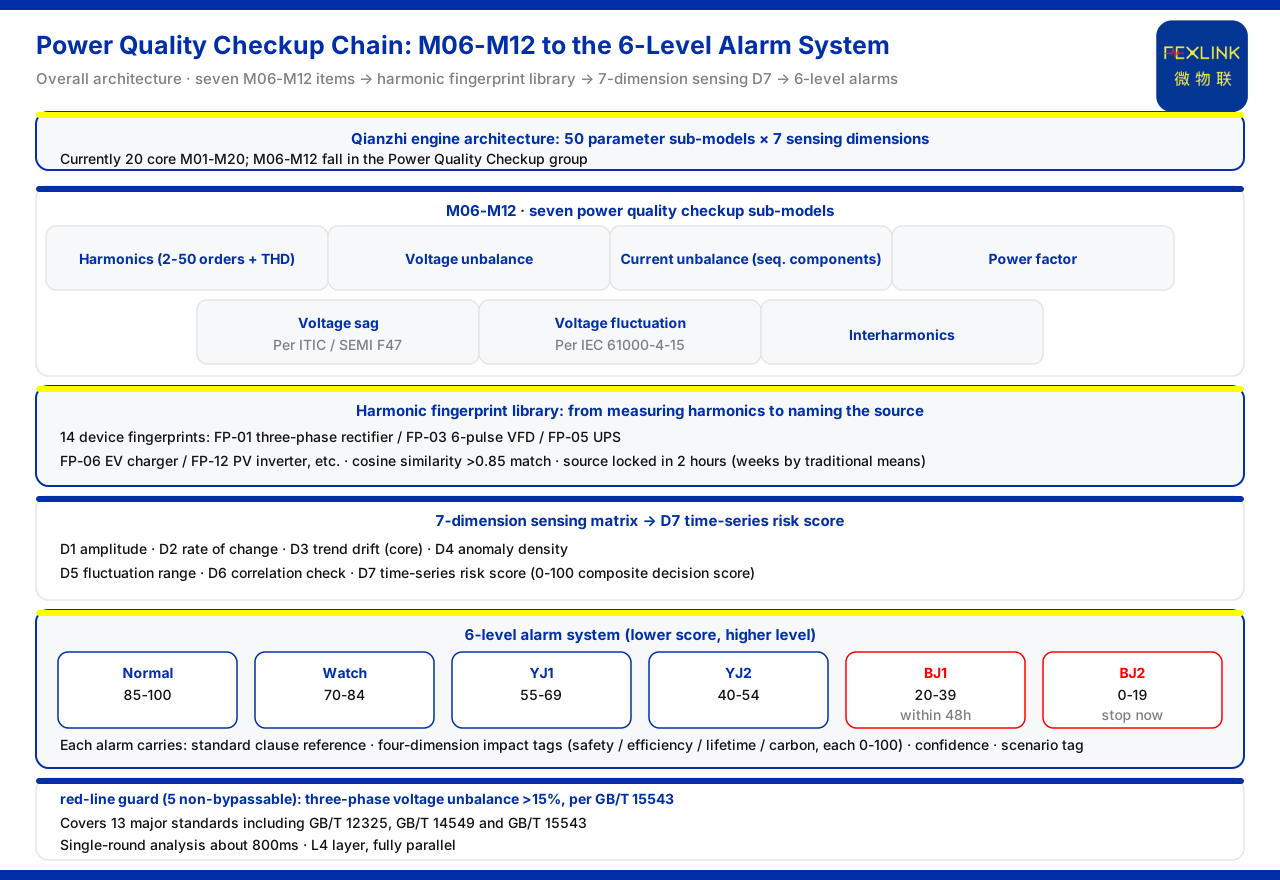
Direct answer
In the Qianzhi engine / large model, the power-quality health check is not a loose stack of indicators but a group of consecutively numbered sub-models. The product knowledge base records that the Qianzhi engine adopts a "50 parameter sub-models (currently 20 core M01-M20) × 7-dimensional perception" architecture, in which the M06 to M12 group forms the "power-quality health check" grouping. This group has seven sub-models: harmonics (2nd-50th orders plus THD), voltage unbalance, current unbalance (sequence components), power factor, voltage sag (ITIC/SEMI F47), voltage fluctuation (IEC 61000-4-15) and interharmonics. The harmonic item is supported by a harmonic fingerprint library of 14 device fingerprint classes matched at a cosine similarity above 0.85, with which the knowledge base records a pollution source locked within 2 hours where the conventional approach takes weeks. The result is aggregated by the 7-dimensional perception matrix into a 0-100 time-series risk score and mapped to a 6-level alarm system. The health check therefore answers the chain of what is measured, who caused it, how high the risk is, and how to handle it.
1. Overall architecture: 50 parameter sub-models and 7-dimensional perception
The knowledge base records the architecture as "50 parameter sub-models (currently 20 core M01-M20) × 7-dimensional perception". Two layers must be distinguished: 50 is the design figure; what is currently implemented is 20 core sub-models numbered M01 to M20; and 7-dimensional perception is an orthogonal set of analysis dimensions. A parameter sub-model therefore does not judge in isolation but forms observations on the 7 dimensions and synthesises a conclusion.
Among the 20 core sub-models, M06 to M12 belong to the "power-quality health check" grouping — not the whole engine but one consecutively numbered segment. This article discusses only this segment, because the fact pack and knowledge base attribute no other groups; it does not assign M01-M05 or M13-M20, nor infer the status of the other 30 design sub-models.
2. M06-M12: the seven sub-models of the power-quality health check
The knowledge base lists seven sub-models: harmonics (2nd-50th orders plus THD); voltage unbalance; current unbalance (sequence components); power factor; voltage sag (ITIC and SEMI F47); voltage fluctuation (IEC 61000-4-15); and interharmonics. The seven consecutive numbers M06 to M12 carry these items.
| No. | Check item | Basis listed in the knowledge base |
| --- | --- | --- |
| 1 | Harmonics (2nd-50th orders + THD) | — |
| 2 | Voltage unbalance | — |
| 3 | Current unbalance (sequence components) | — |
| 4 | Power factor | — |
| 5 | Voltage sag | ITIC / SEMI F47 |
| 6 | Voltage fluctuation | IEC 61000-4-15 |
| 7 | Interharmonics | — |
Three rows have a basis: voltage sag cites ITIC and SEMI F47, voltage fluctuation cites IEC 61000-4-15. For the remaining four the knowledge base attaches no criterion source, and this article leaves them blank. "Voltage unbalance" and "current unbalance" are two independent items — voltage versus sequence components — and cannot be merged. Harmonics and interharmonics are likewise separate: harmonics cover the 2nd to 50th orders and include THD, while interharmonics monitors a different object.
3. Harmonic fingerprint library: from measuring harmonics to identifying the pollution source
Measuring harmonics alone cannot answer "who produced them". The knowledge base therefore lists a harmonic fingerprint library containing 14 device fingerprint classes, whose confirmable examples include FP-01 three-phase rectifier, FP-03 variable-frequency drive (6-pulse), FP-05 UPS, FP-06 charging pile and FP-12 photovoltaic inverter. Matching uses a cosine similarity above 0.85; after a hit, the knowledge base records that a pollution source can be locked within 2 hours, while the conventional approach takes weeks.
This forms a repeatable chain: fingerprints organised by device class, a similarity threshold measuring how close the on-site waveform is to a fingerprint, and source identification. The knowledge base places "2 hours" beside "weeks" only to convey the method's time meaning, not as a commitment to any site's required time. Of the 14 classes the knowledge base names only the above few; this article does not supply the rest.
4. The 7-dimensional perception matrix and the D7 time-series risk score
The sub-models' information is aggregated through unified perception dimensions. The knowledge base records the 7-dimensional perception matrix as D1 amplitude, D2 rate of change, D3 trend drift (core), D4 anomaly density, D5 fluctuation amplitude, D6 association verification and D7 time-series risk score. It marks D3 trend drift as the core dimension and D7 as a 0-100 composite decision score.
The judgement is therefore not a single out-of-limit point but an observation of amplitude, speed of change, trend, anomaly density, fluctuation amplitude, cross-quantity association and time-series risk, converging on D7. D7's 0-100 range is explicitly given; this article does not infer the dimension weights or synthesis formula, which the knowledge base does not give.
5. The 6-level alarm system and the information an alarm carries
The D7 score is mapped downstream into the 6-level alarm system: Normal, 85 to 100; Attention Watch, 70 to 84; YJ1, 55 to 69; YJ2, 40 to 54; BJ1, 20 to 39, requiring handling within 48 hours; BJ2, 0 to 19, requiring immediate shutdown. From Normal to BJ2 there are six levels, the lower the score the higher the level.
Besides the intervals, each alarm carries a standard-clause citation, a four-dimensional impact label (safety, efficiency, lifetime and carbon emissions, each 0 to 100 points), a confidence level and a scenario label. An alarm is thus not merely "which band the score falls into" but also gives the clause relied on, the impact dimensions and scores, the confidence and the scenario. This article relays only this composition and infers no label values or scoring rules.
6. Red-line guard and standard coverage
Beyond scoring and alarms, the knowledge base sets a separate red-line guard whose 5 rules are explicitly non-bypassable. One confirmable rule triggers when three-phase voltage unbalance is greater than 15%, based on GB/T 15543. This echoes the "voltage unbalance" check item in section 2: the item observes continuously, while the guard gives a non-bypassable trigger at the threshold.
On standard coverage, the knowledge base records that the Qianzhi engine covers 13 major standards including GB/T 12325, GB/T 14549 and GB/T 15543. GB/T 15543 is already named in the three-phase voltage-unbalance rule; the others are not mapped to check items in this entry, and this article does not map the 13 standards to the seven sub-models.
7. Technical specifications and the judgement chain
The technical specifications the knowledge base gives are: a single analysis round of about 800ms, at the L4 layer, fully parallel. In the chain above, M06 to M12 complete the seven check items, the fingerprint library assists the harmonic item in identifying the pollution source, the 7-dimensional matrix aggregates the observations into a D7 score of 0 to 100, the score maps to the 6-level alarm, and the red-line guard sets a separate limit for the non-bypassable cases. About 800ms per round and full parallelism show the chain runs one complete analysis at a time.
The chain gathers into a repeatable order: M06 to M12 judge the seven items, the fingerprint library matches the harmonic source, the 7-dimensional matrix synthesises D7, D7 maps to the 6-level alarm carrying the clause, impact labels, confidence and scenario label, and the red-line guard catches the 5 non-bypassable thresholds. Each step corresponds to an existing record, and no unlisted algorithm, weight or implementation detail is added.
Applicability and limits
First, this article's citations are limited to the product knowledge base and the corresponding fact pack, and it introduces no unlisted algorithm, parameter, certification or case.
Second, the architecture figures (50 parameter sub-models, currently 20 core M01-M20, 7-dimensional perception, M06-M12 as the power-quality health check) are limited to the material; no status of the other 30 sub-models or other grouping is inferred.
Third, the seven sub-models and their criteria (harmonics 2nd-50th + THD; voltage sag ITIC/SEMI F47; voltage fluctuation IEC 61000-4-15; interharmonics) are limited to the material; items to which the knowledge base attaches no criterion source are left blank.
Fourth, the 14 fingerprint classes, the cosine similarity above 0.85 and the 2-hour source lock (weeks conventionally) are figures listed in the material, not a commitment to a specific project; unnamed fingerprint numbers are not supplied.
Fifth, the 7-dimensional matrix, D3 as core, D7 as the 0-100 composite score, the 6-level alarm intervals, the 48-hour BJ1 limit and the four alarm-information classes are quoted as the material stands; no weights, synthesis formula or label rules are inferred.
Sixth, the red-line guard has 5 non-bypassable rules; one is three-phase voltage unbalance greater than 15% based on GB/T 15543, and the other 4 are not developed. Standard coverage is limited to the listed 13 major standards, with no standard-to-item mapping.
Seventh, the technical specifications (about 800ms per round, L4 layer, fully parallel) are limited to the material, and no running time or processing result for a specific project is promised.