 FEXLINK Research Institute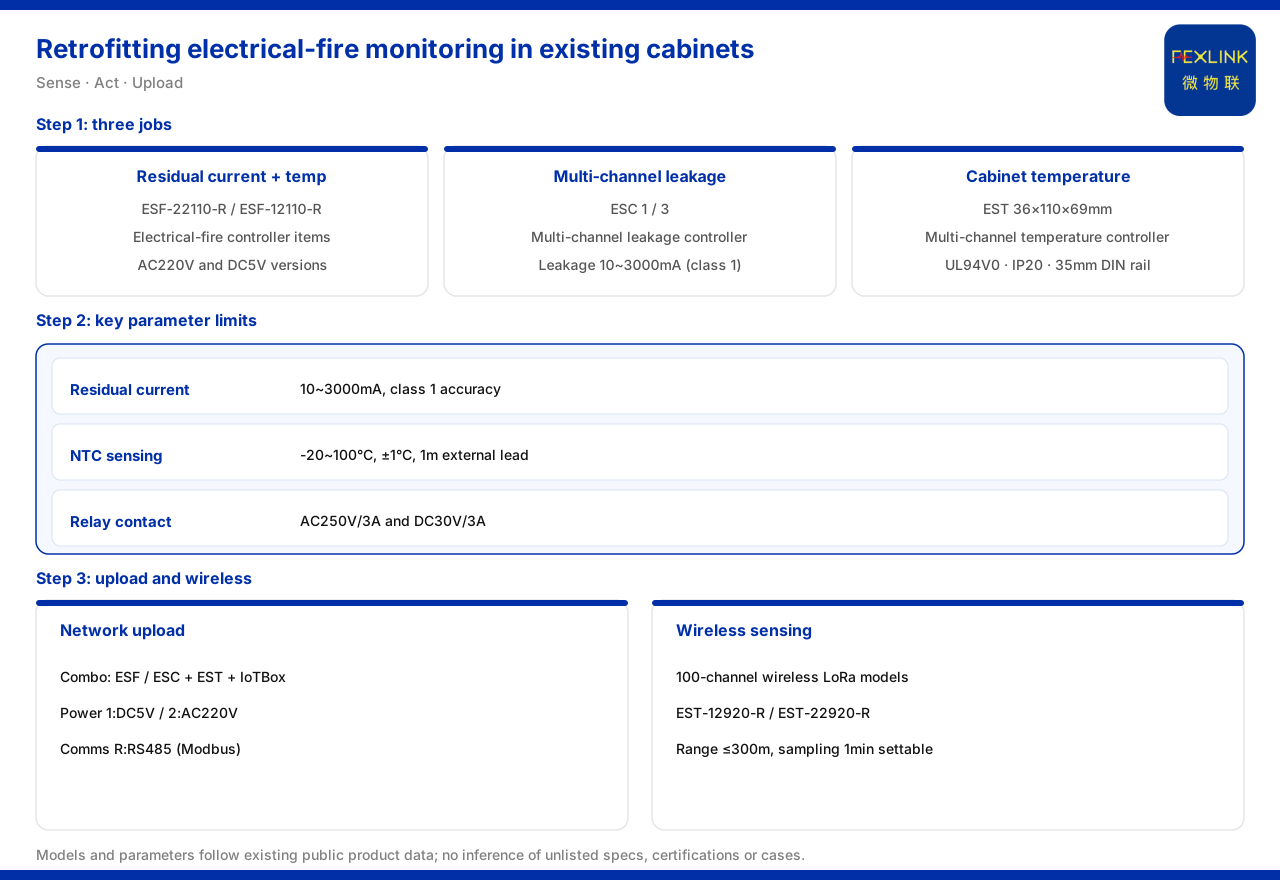
Direct answer
Retrofitting an existing low-voltage distribution cabinet for electrical fire monitoring can be broken into three things: monitor, actuate and upload. In the scenario mapping of the product knowledge base, low-voltage cabinet electrical fire pre-warning recommends the ESF electrical fire monitoring & control device, the ESC multi-channel leakage-current monitoring & control device and the EST multi-channel temperature intelligent controller, plus IoTBox. The electrical fire monitoring & control device handles residual-current and temperature monitoring and offers both AC220V and DC5V supply versions; the multi-channel leakage-current monitoring & control device offers 1-channel and 3-channel leakage monitoring; the multi-channel temperature intelligent controller handles cabinet temperature, with general specifications of 36×110×69 mm, a UL94V0 enclosure, IP20 and 35 mm DIN-rail mounting, suitable for fitting into an existing cabinet. If cabling inside the cabinet is constrained, the multi-channel temperature intelligent controller also offers a 100-channel wireless LoRa temperature model (EST-12920-R and EST-22920-R), with an effective distance no greater than 300 m and a sampling period settable at 1 min, which reduces wired cabling. In retrofit selection, supply conditions, monitoring channel count and installation method are three boundaries to confirm first.
1. Why retrofit starts with installation and supply
An existing cabinet differs from a new one in that physical space and existing wiring are already fixed. The product knowledge base records that the EST multi-channel temperature intelligent controller has general specifications of power consumption no greater than 2 W, operating temperature -20 to 60 ℃, dimensions 36×110×69 mm, a UL94V0 enclosure, IP20 and 35 mm DIN-rail mounting. These specifications directly decide whether it can find a mounting position in an existing cabinet and whether it can draw power locally. In particular, power consumption no greater than 2 W means limited heat, the operating temperature covering -20 to 60 ℃ matches most distribution-room environments, and IP20 protection with 35 mm rail mounting shows it is meant for in-cabinet installation rather than exposed outdoor use. Selection should check the rail, space and operating temperature inside the cabinet before discussing monitoring functions; confirming installation and supply first avoids discovering on site that it will not fit or that power is inconvenient.
2. Electrical fire monitoring & control device: choose one of two supply versions
The product knowledge base records that the ESF electrical fire monitoring & control device includes models such as ESF-22110-R and ESF-12110-R. The ESF-22110-R model is AC220V, OLED display, 1-channel residual current, 4-channel temperature, 2 digital inputs, 1 relay output and RS485; the ESF-12110-R model is DC5V, OLED display, 1-channel residual current, 4-channel temperature, 1 relay output and RS485. The two are close in monitoring channel count and differ mainly in supply method, so an existing retrofit can choose between them by the on-site supply conditions: take the former when AC220V is convenient inside the cabinet, and the latter when DC5V is needed.
3. Residual current and temperature: parameter boundaries
The second layer of selection is confirming the measurement range. The product knowledge base records that the ESF electrical fire monitoring & control device has a residual-current range of 10 to 3000 mA with accuracy class 1, and an NTC temperature range of -20 to 100 ℃ with an accuracy of plus or minus 1 ℃ and an external lead length of 1 m. These parameters give the range and error boundaries of monitoring: residual current from the milliamp level to the ampere level, and temperature covering the common in-cabinet temperature-rise interval. On this basis a project judges whether the measured quantity falls within range and whether accuracy requires a particular choice, rather than treating the parameters as a qualitative description.
4. Relay output: the contact boundary for interlock configuration
A retrofit often involves alarm interlocking, so the relay contact capacity must also be checked. The product knowledge base records that the ESF electrical fire monitoring & control device has a relay contact capacity of AC250V/3A and DC30V/3A. This decides the range of load the relay can directly drive. Selection should compare the working voltage and current of the interlocked object with this capacity: beyond the capacity an intermediate stage must be added, rather than assuming the relay can directly drive any load. Including contact capacity in the confirmation list keeps an interlock scheme from stopping at the level of having a relay output.
5. Multi-channel leakage-current monitoring & control device: choose by circuit count
For cabinets needing multi-circuit leakage monitoring, the product knowledge base also has the ESC multi-channel leakage-current monitoring & control device. It offers AC220V and DC5V supplies, 1-channel and 3-channel leakage monitoring, 1 relay output and RS485, with key parameters of a leakage range of 10 to 3000 mA and accuracy class 1. Compared with the electrical fire monitoring & control device, it puts the emphasis on leakage channel count, convenient for monitoring several circuits separately. The distinction to make is that the multi-channel leakage-current device stresses leakage channels while the electrical fire device stresses comprehensive electrical fire quantities; their monitoring objects overlap but are not equivalent, and selection should follow the quantity the site needs to stress. In a retrofit, if the cabinet has many circuits that all need leakage monitoring, take this model by channel count; if comprehensive electrical fire monitoring dominates, keep the electrical fire device as the main unit.
6. Unified terms for supply and communication
When several modules are mixed, whether the interface terms are unified affects networking. The product knowledge base records that the common electrical-safety module code specifies supply 1 as DC5V and 2 as AC220V, and communication R as RS485 (Modbus). This shows that modules of the same kind share a unified expression on the supply and networking side: supply is chosen between DC5V and AC220V, and networking mainly uses RS485. If a retrofit scheme selects the electrical fire device, the multi-channel leakage-current device and the multi-channel temperature controller together, supply and communication can be checked against this code so that each branch joins the same monitoring network instead of acting separately.
7. Wireless temperature: a supplementary path when cabling is constrained
A common problem in an existing cabinet is difficult routing. The product knowledge base records that the EST multi-channel temperature intelligent controller offers the 100-channel wireless LoRa temperature models EST-12920-R and EST-22920-R, with an effective distance no greater than 300 m and a sampling period settable at 1 min. For a cabinet with constrained cabling, these models reduce wired provisioning and gather temperature points wirelessly. If a cabinet has both wired and wireless temperature points, the models can be combined: wired points connect nearby, wireless points gather via LoRa, and both feed the same monitoring. If a site is inconvenient to cable, this path can be considered beyond the wired temperature models; the wireless scheme still has to check whether the effective distance and sampling period meet the monitoring requirement.
Scope and limitations
First, this article only restates what the product knowledge base lists; its factual boundary is limited to the models, general specifications and key parameters of the ESF electrical fire monitoring & control device, the ESC multi-channel leakage-current monitoring & control device and the EST multi-channel temperature intelligent controller, and to the recommended scenario combination, and it introduces no unlisted parameter, certification or case.
Second, the power consumption, operating temperature, dimensions, enclosure, protection rating and installation method of the EST multi-channel temperature intelligent controller, the wireless LoRa channel count, effective distance and sampling period of EST-12920-R and EST-22920-R, the supply, display, residual-current and temperature channel counts, digital inputs and relay outputs, communication and the residual-current, NTC temperature and relay contact capacity parameters of ESF-22110-R and ESF-12110-R, the supply and leakage parameters of the ESC multi-channel leakage-current device, and the supply and communication values of the common module code are all quoted on the terms listed in the product knowledge base.
Third, this article only explains the selection comparison and parameter boundaries of an electrical fire monitoring retrofit for an existing distribution cabinet; it provides no specific engineering retrofit scheme, interlock design or setting calculation, and the related conclusions must be verified against the on-site cabinet conditions and the project scheme, subject to the latest product materials and the project scheme.