 FEXLINK Research Institute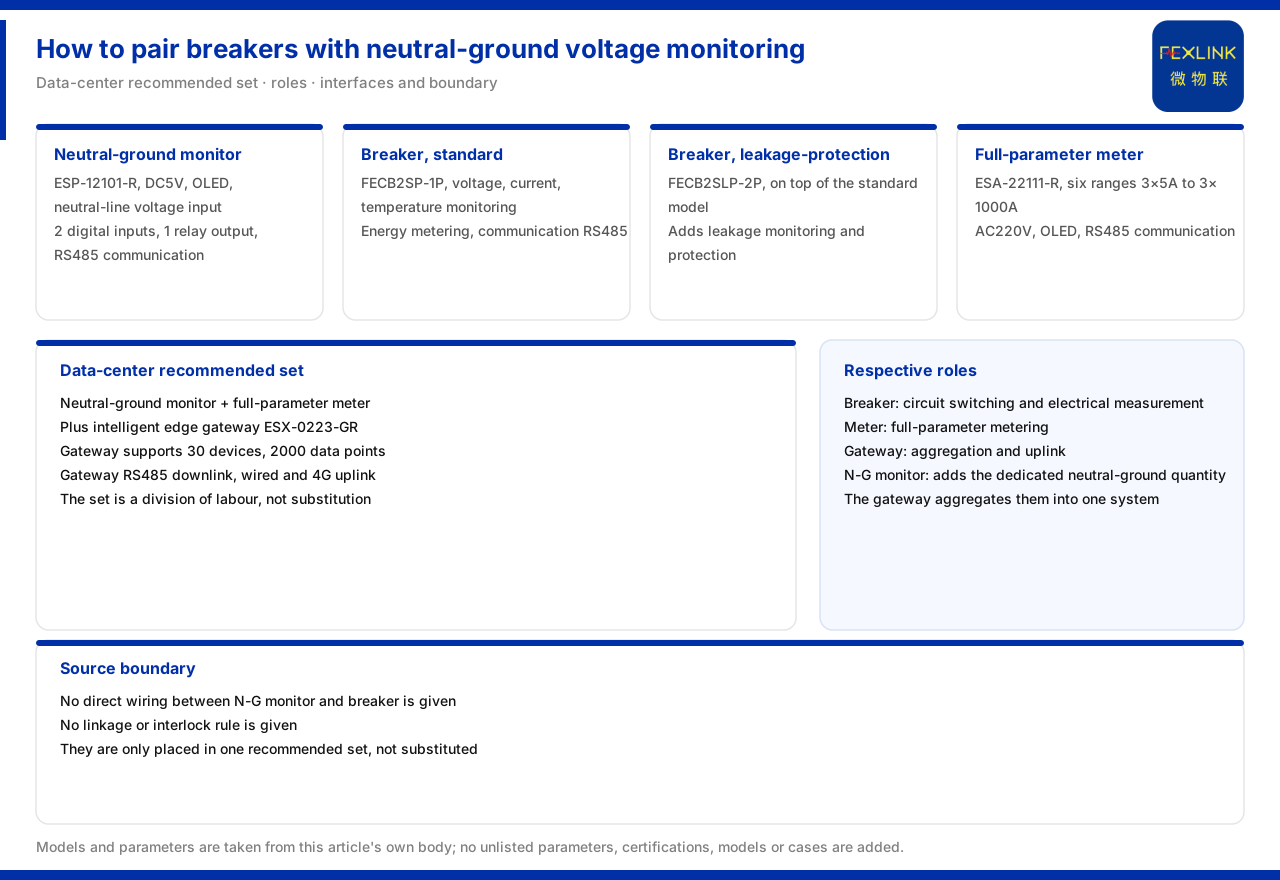
Direct answer
On how breakers and neutral-to-ground voltage monitoring are configured together, the product knowledge base lands on a typical application scenario: the recommended combination for data-center neutral-to-ground voltage and distribution monitoring is three items - the neutral-to-ground voltage monitor (ESP-12101-R), the all-parameter smart meter (ESA-22111-R), and the intelligent edge-computing gateway (ESX-0223-GR). Their division of labour can be summarised as: breaker-class devices handle circuit execution and electrical parameter acquisition, the neutral-to-ground voltage monitor handles the dedicated neutral-to-ground quantity, the smart meter handles all-parameter metering, and the gateway handles aggregation and uplink. The material gives no direct electrical wiring or interlock coordination rule between the neutral-to-ground voltage monitor and the breakers; it only places them in the same recommended data-center combination. This article therefore explains how to combine and divide roles within one distribution system, not the interlocking relationship between the two.
1. Attribution and model of the neutral-to-ground voltage monitor
The product-line overview of the product knowledge base lists the neutral-to-ground voltage monitor under the digital power-consumption and electrical-safety monitoring product line, showing that it belongs to the power-consumption and electrical-safety monitoring system rather than to an independent branch. In the model table, the only model listed for this product is ESP-12101-R, supplied at DC5V, with an OLED display, a voltage (neutral) input, two switching-value inputs, one relay output, and RS485 communication.
The model information gives its interface profile: one dedicated voltage input, several switching values and one relay output, and RS485 communication. The relay output and switching-value inputs show it has local-linkage capability, but the material does not specify the relay-output action logic.
2. Division of roles among breaker, meter and gateway
In the recommended data-center combination, the roles of the three classes of device do not overlap. The standard intelligent circuit breaker (FECB2SP-1P) faces the circuit and provides voltage, current and temperature monitoring plus energy metering, with RS485 communication; the intelligent circuit breaker with residual-current protection (FECB2SLP-2P) adds leakage monitoring and residual-current protection on that basis. The all-parameter smart meter handles all-parameter metering, and the intelligent edge-computing gateway handles aggregation and uplink.
Once the division is clear, the logic of the combination becomes clear: the breaker realises circuit-level monitoring and execution, the smart meter realises overall all-parameter metering, and the gateway aggregates the data and sends it to the cloud. The neutral-to-ground voltage monitor joins them to add the dedicated neutral-to-ground voltage measurement.
3. The recommended data-center combination
The product knowledge base writes the recommended combination for data-center neutral-to-ground voltage and distribution monitoring as the neutral-to-ground voltage monitor plus the all-parameter smart meter plus the intelligent edge-computing gateway. This is the authoritative source of the combination relationship and the landing point of this discussion.
The combination contains no special device beyond the separately named execution equipment, which shows that neutral-to-ground voltage monitoring is an item "added" to an existing distribution monitoring system in the data-center scenario, not a replacement for the original circuit devices. Its position is to add a quantity, not to substitute.
4. What the breaker side provides
In its intelligent circuit breaker entry, the product knowledge base lists that both the standard model and the residual-current model support voltage, current and temperature monitoring and energy metering, with RS485 communication; the residual-current model additionally includes leakage monitoring and residual-current protection. This constitutes the product capability on the execution side of the distribution circuit.
For neutral-to-ground voltage monitoring, the voltage and temperature parameters on the breaker side provide background data for distribution health. Only when the two classes of data stand side by side in the same system can a more complete picture of distribution state be formed. The material gives a parallel relationship and no data-fusion rule.
5. Specifications of the all-parameter meter
The product knowledge base lists that the all-parameter smart meter offers six current grades, from three-by-five amperes to three-by-one-thousand amperes, with the whole series supplied at AC220V, an OLED display and RS485 (Modbus) communication, and no phase or harmonic monitoring. Its position is the all-parameter metering device, the metering body in the data-center combination.
Note that the material states explicitly that this meter has no phase or harmonic monitoring; if a scenario needs phase or harmonics, the material offers a corresponding product. This shows the combination is not "one meter that does everything" but takes each element from the product suited to it.
6. Gateway aggregation and uplink
The intelligent edge-computing gateway has an access capability listed as thirty devices and two thousand data points, with RS485 downstream and wired plus 4G communication upstream. It undertakes edge aggregation and uplink in the combination, gathering the data of the breakers, the meter and the neutral-to-ground voltage monitor into one place before sending it to the cloud.
The gateway turns the combination from "several devices" into "one system": without aggregation and uplink, the various monitoring points are only independent readings; with the gateway, they enter the same platform for subsequent analysis.
7. Material boundary: no wiring or interlock rules
The product knowledge base gives no direct electrical wiring or interlock coordination rule between the neutral-to-ground voltage monitor and the breakers. The data-center scenario only places them in the same recommended combination. What can therefore be confirmed is the combination relationship and their respective capabilities; what cannot be confirmed is how the relay output is wired to a breaker, whether there is interlocking, and what the action conditions are.
Keeping combination and interlock apart avoids misreading "combined in the same cabinet" as "directly interlocked". Combination shows they can appear in the same distribution monitoring system; interlock involves specific wiring and control logic, a part not covered by the material.
8. Why neutral-to-ground voltage stands as its own item
The product knowledge base lists the neutral-to-ground voltage monitor under the digital power-consumption and electrical-safety monitoring product line, alongside the breakers and the meter. Its input is the neutral voltage, and its output is one relay and RS485 data; the breaker monitors the circuit voltage, current and temperature plus energy. The physical quantities they measure differ, so neutral-to-ground voltage needs an independent device rather than being handled incidentally by a breaker.
This division explains why the data-center combination lists the neutral-to-ground voltage monitor separately: it is not duplicate metering but an added observation quantity in the distribution system that differs from circuit electrical parameters. The value of the combination is that each physical quantity is collected by a suitable device and then merged at the gateway.
Seeing this layer makes the meaning of "configure together" clear: the breaker and the neutral-to-ground voltage monitor do not replace each other but each occupy a place in the same distribution cabinet or monitoring system, with the gateway converging the data. This is the parallel division the material gives.
Scope and limitations
First, this article restates only what the product knowledge base lists. The attribution and model of the neutral-to-ground voltage monitor, the breaker capability, the all-parameter meter specification, the gateway access capability, the recommended data-center combination, and the material boundary are all cited as recorded.
Second, the material gives no direct electrical wiring or interlock coordination rule between the neutral-to-ground voltage monitor and the breakers; this article does not infer electrical interlocking or execution linkage, and gives no wiring scheme.
Third, the meter specification is cited as listed; this article does not infer phase or harmonic monitoring capability from it.
Fourth, the specific distribution-cabinet combination and data architecture must be fixed against the site circuits and maintenance requirements; this article provides no selection or configuration calculation.