 FEXLINK Research Institute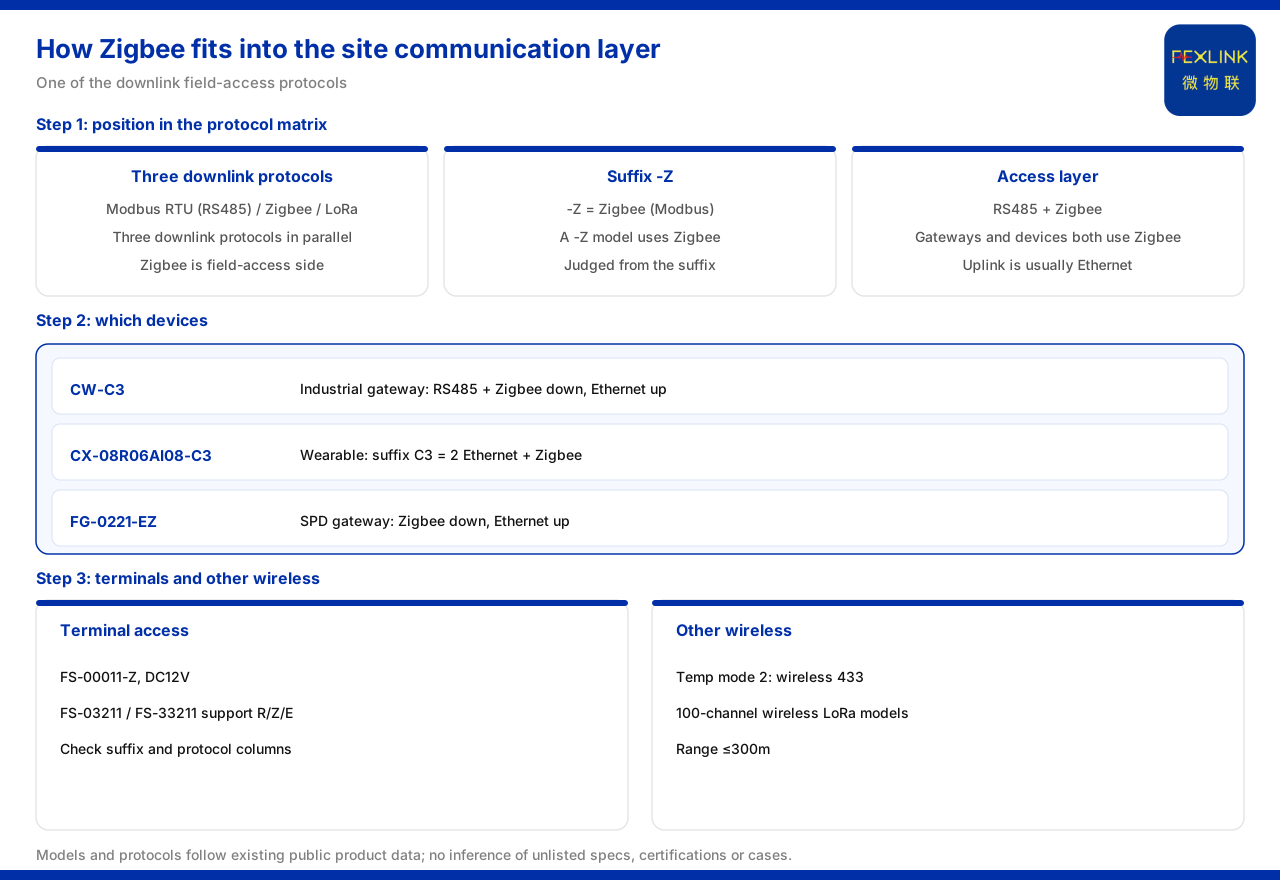
Direct answer
In the system communication architecture, Zigbee is a protocol on the field-access side. The communication protocol matrix of the product knowledge base lists the device downlink protocols as Modbus RTU (RS485), Zigbee (Modbus) and LoRa; the general suffix table further makes clear that the suffix -Z stands for Zigbee (Modbus). A product whose model carries -Z therefore uses Zigbee communication, from which its networking method can be judged quickly. Several device classes in the product knowledge base fall under this term: the industrial gateway (CW-C3) has RS485 plus Zigbee downlink and Ethernet uplink; the industrial wearable controller (programmable device wearable) (CX-08R06AI08-C3) likewise has RS485 plus Zigbee downlink and Ethernet uplink, with the C3 suffix defined as 2 Ethernet plus Zigbee; the FG lightning-protection smart gateway (FG-0221-EZ) has Zigbee downlink and Ethernet uplink; the FS surge protective device monitor also has a Zigbee-suffix model (FS-00011-Z). Zigbee thus appears both on the downlink side of gateways and on the access side of terminal devices. To select a device supporting Zigbee, check both the suffix and the protocol column.
1. Where Zigbee sits in the protocol matrix
First clarify Zigbee's position in the system. The communication protocol matrix of the product knowledge base lists the device downlink protocols as Modbus RTU (RS485), Zigbee (Modbus) and LoRa. These three protocols sit side by side on the downlink side, showing that Zigbee is one of the system's field-access protocols rather than an uplink protocol. For selection, this position means Zigbee mainly solves the last hop from a device to a gateway or from a device to the system, not a channel for a device to reach a remote end directly. Taking the uplink protocols into account makes the position clearer: it carries device-side access, data gathers through a gateway, and then goes uplink over Ethernet and similar channels, a different division of labour. Only by separating downlink and uplink can one understand why in many device descriptions Zigbee always appears together with downlink communication.
2. Suffix -Z: recognising the networking method at a glance
The simplest basis for judging whether a device uses Zigbee is the suffix. The general suffix table of the product knowledge base makes clear that the suffix -Z stands for Zigbee (Modbus). Accordingly, as long as a model ends in -Z, it can be taken to use Zigbee communication. The point of this rule is that it writes the networking method into the model: selection need not look up every parameter table but can do a preliminary screen by suffix. Conversely, a model without -Z should not be assumed to support Zigbee; communication should follow the suffix or the parameter column and not be inferred from appearance or series. Note that the suffix expresses the communication method and does not change the monitoring function; the same device with a different suffix usually differs only in access protocol.
3. Gateway downlink access: RS485 plus Zigbee
A gateway is an important place where Zigbee enters the system. The product knowledge base records that the industrial gateway (CW-C3) is DC24V supplied, can carry 30 devices and 2000 data points, and has RS485 plus Zigbee downlink and Ethernet uplink. This shows the gateway offers both a wired downlink and a Zigbee downlink: it can serve both wired devices and Zigbee devices at once. If a site has both RS485 devices and Zigbee devices, this gateway can gather both kinds on one unit and then send them to the back end over the uplink Ethernet. The industrial gateway (CW-C3) is DC24V supplied, and this supply condition must also be checked against the on-site DC power conditions so that the networking scheme does not mismatch on supply.
4. Industrial wearable: the networking meaning of suffix C3
Besides gateways, acquisition-class devices can also have Zigbee downlink. The product knowledge base records that the industrial wearable controller (programmable device wearable) (CX-08R06AI08-C3) has RS485 plus Zigbee downlink and Ethernet uplink, with the model suffix C3 defined as 2 Ethernet plus Zigbee. Compared with the industrial gateway (CW-C3), both belong to Zigbee-downlink access models, and the C3 suffix directly states the combination of Ethernet and Zigbee. Seeing the suffix C3, one can judge that the device has two Ethernet ports and Zigbee networking capability, on which to arrange on-site wiring and protocol.
5. Zigbee access in the lightning-protection subsystem
Zigbee can also serve as the downlink protocol of a lightning-protection monitoring subsystem. The product knowledge base records that the FG lightning-protection smart gateway (FG-0221-EZ) is DC12V supplied, has protocol-conversion capability, and has Zigbee downlink and Ethernet uplink. This shows that on the lightning-protection side Zigbee is used for the subsystem's field access: the gateway gathers sub-devices over Zigbee downward and sends data over Ethernet upward. If a lightning-protection monitoring subsystem uses Zigbee networking, this kind of lightning-protection smart gateway with Zigbee downlink should be taken to match the sub-device protocol.
6. Terminal devices accessing directly by Zigbee
Not only gateways: terminal devices themselves can also use Zigbee. The product knowledge base records that the FS surge protective device monitor offers the Zigbee-suffix model FS-00011-Z, DC12V supplied; in the same series, the surge protective device monitor models FS-03211 and FS-33211 support the three communications -R, -Z and -E. This shows a terminal device can either access directly by Zigbee or choose a different suffix by communication within the same model. If a site uses Zigbee networking, take the -Z suffix model; if the communication method is not yet fixed, choosing the same model that supports several suffixes leaves room for later adjustment.
7. Local networking methods beyond Zigbee
The system does not have only one local networking method. The product knowledge base records that in the model rule of the EST multi-channel temperature intelligent controller, temperature-measurement method code 2 is wireless 433, and it offers the 100-channel wireless LoRa models of the multi-channel temperature intelligent controller, EST-12920 and EST-22920, with an effective distance no greater than 300 m. This shows that besides Zigbee the system also offers wireless 433 and LoRa local networking routes. Selection should follow the on-site conditions: when matching a Zigbee gateway, take -Z suffix devices; when a long-distance, low-power wireless route is needed, LoRa models can be considered. One practical question is whether the device and the gateway share a protocol: if the gateway downlink supports Zigbee, the terminal should preferably take the -Z suffix; if downlink RS485 dominates, it can access by wire. Only by matching the networking method to the on-site conditions can the chosen devices truly join the existing monitoring network.
Scope and limitations
First, this article only restates what the product knowledge base lists; its factual boundary is limited to the device downlink protocols of the communication protocol matrix, the general suffix meanings, the networking specifications of the industrial gateway and industrial wearable, the downlink and uplink of the lightning-protection smart gateway, and the terminal-device suffixes and wireless-networking models, and it introduces no unlisted parameter, certification or case.
Second, the device downlink protocols Modbus RTU (RS485), Zigbee (Modbus) and LoRa, the suffix -Z standing for Zigbee (Modbus), the supply, device and data-point scale, downlink and uplink communication of the industrial gateway (CW-C3), the downlink and uplink communication and the C3 suffix definition of the industrial wearable controller (programmable device wearable) (CX-08R06AI08-C3), the supply, protocol-conversion capability, downlink and uplink of the FG lightning-protection smart gateway (FG-0221-EZ), the communication suffix range of the surge protective device monitor FS-00011-Z, FS-03211 and FS-33211, and the wireless 433 temperature-measurement method and the 100-channel wireless LoRa models and effective distance of the EST multi-channel temperature intelligent controller are all quoted on the terms listed in the product knowledge base.
Third, this article only explains Zigbee's protocol position, recognition method and typical access devices in the system; it provides no specific engineering networking design, address planning or selection calculation, and the related conclusions must be verified against the on-site network conditions and the project scheme, subject to the latest product materials and the project scheme.