 微物联研究院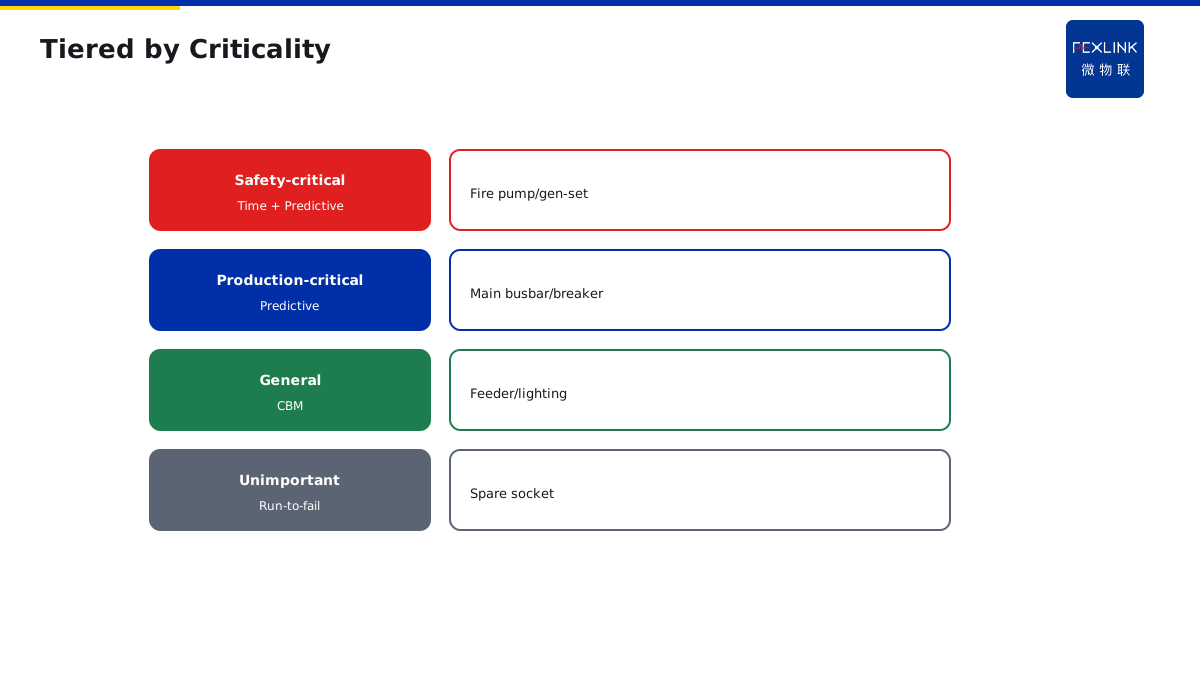
Direct Answer
Four maintenance strategies—run-to-failure, time-based, condition-based, predictive—differ not in *whether* you fix, but in when and on what basis.
- Run-to-failure: fix only when broken;
- Time-based: fix by calendar or running hours, one-size-fits-all;
- Condition-based: fix when parameters cross a threshold;
- Predictive: predict remaining useful life from continuous data and fix in the optimal window.
The key leap is from time/threshold trigger to trend prediction. The first three are all "react after the event"; only predictive maintenance arranges the fix *before* failure. Its prerequisite is not a fancy algorithm—it is whether you have continuous time-series data. Without data, "prediction" is just guessing.
1. The Essential Difference
| Trigger | Basis | Cost profile | Risk | |
|---|---|---|---|---|
| Run-to-failure | After fault | Broken before you know | Low direct cost | High outage loss |
| Time-based | Calendar/hours | Clock or runtime | Over-maintenance waste | Fixing the wrong thing |
| Condition-based | Threshold breach | Alarm signal | On-demand repair | Missed (trend bad but threshold not crossed) |
| Predictive | Trend forecast | RUL model | Precision repair | Needs data and model |
These are not "new replaces old"—they coexist. A mature O&R system runs all four at once: critical equipment on predictive, general equipment on condition-based, unimportant on run-to-failure, safety-critical on time-based (by regulation).
2. Run-to-Failure: The Cost of Waiting
Run-to-failure sounds primitive, but it is rational in some places.
Where it fits: cheap, easily replaced items (bulbs, fans); failures that do not affect safety (a standby indicator light); redundant N+1 systems.
Where it fails: critical-circuit breakers—failure means outage or fire; fire pumps—failure means uncontrolled fire; busbar joints—loosening to fire may take only days.
The hidden cost is outage time. One critical-equipment unplanned shutdown can cost 10–100× the repair bill. One park board: a breaker contact eroded; the repair cost RMB 800, but the production line was down 4 hours—loss RMB 120,000.
3. Time-Based: The Waste of One-Size-Fits-All
Time-based (preventive) maintenance is what most enterprises do: annual outage overhaul, retorque screws, replace parts, test insulation by the calendar.
Its benefit is certainty—you know when maintenance happens and can plan. Its problem is over-maintenance: screws that were not loosened get retorqued; parts that still work get replaced; insulation that is fine gets tested.
A more hidden issue: overhaul itself introduces faults. You open a healthy joint and reassemble it—wrong torque or contaminated contact surface creates a new hazard. One airport terminal: within a week of annual overhaul, three joints overheated—all caused by uneven retorquing.
Time-based is right where regulation mandates it: fire equipment, cranes, pressure vessels. Regardless of condition, you inspect on schedule—it is safety, not efficiency.
4. Condition-Based: Act on the Signal
Condition-based maintenance (CBM) is the evolution of time-based: not the calendar, but equipment state.
You fit sensors, monitor temperature, vibration, insulation resistance, arc events. Parameters cross a threshold → alarm → send someone. No alarm → leave it alone.
This saves over-maintenance cost. But it has a fatal weakness: the threshold is static.
Example: a busbar joint at 35 °C normal, threshold 60 °C. It drifts from 35 °C to 55 °C over three months—no alarm. But its trend is already wrong (a healthy joint's temperature should be flat). By the time it hits 60 °C, fire is near.
This is the "threshold blind zone": equipment below threshold but trend already bad. The Qianzhi engine's CUSUM early warning fills this—it does not look at absolute threshold, it looks at cumulative deviation from baseline.
5. Predictive Maintenance: Fix in the Optimal Window
Predictive maintenance is the next step beyond CBM: not just current state, but predicting where and when it will fail.
Its core is Remaining Useful Life (RUL). The model works on continuous time-series data: temperature slope steepening → contact resistance degrading faster; arc-event frequency doubling weekly → loosening accelerating; insulation resistance dropping 5% per year → at that slope, crosses safety line in 3 years.
With RUL, O&R is not "wait for alarm" but plan ahead: this joint has ~60 days of life, schedule it in next month's maintenance window—no emergency, no outage waiting for spares.
One port substation, using FEXLINK-BMS continuous busbar temperature monitoring: the Tianyan engine found joint #3's temperature slope rose from +0.1 °C/day to +0.5 °C/day over 30 days, predicting 45 days of remaining life. Taiyi auto-generated a work order, scheduled for a night window two weeks later. On disassembly, the contact face was already oxidised black—two more weeks and it would have failed.
This is predictive maintenance's value: not fixing earlier, but fixing more precisely.
6. The Prerequisite: Do You Actually Have Data?
Many enterprises hear "predictive" and want to buy AI. But the prerequisite is not algorithm—it is continuous time-series data.
You need: sampling every 5 minutes or every second; at least 6 months of data to build a baseline; clean data with no gaps or jumps; fault history records that map to the data.
Without these, "prediction" is guessing. One enterprise bought a predictive-maintenance system, only to find sensor data had 2–3 gaps daily—baseline could not be built. After six months the model's accuracy was under 30%.
FEXLINK's deployment path: first fit ESA multi-element smart meters and FEXLINK-BMS busbar monitoring to collect data; after 6 months, Qianzhi does single-parameter anomaly detection; after 1 year, Tianyan does CUSUM trend warning; after 2 years, RUL prediction becomes credible. You cannot skip steps—without history, what would the model learn?
7. How Four Strategies Coexist in One Project
A mature O&R system does not "go all predictive"—it tiers by equipment criticality:
| Tier | Strategy | Examples |
|---|---|---|
| Safety-critical | Time-based (mandatory) + predictive (trend warning) | Fire pumps, emergency generators |
| Production-critical | Predictive | Main busbar, incomer breaker, production lines |
| General | Condition-based (threshold alarm) | Ordinary feeders, lighting circuits |
| Unimportant | Run-to-failure | Spare sockets, auxiliary power |
FEXLINK's three-tier AI engine mirrors this: Qianzhi single-parameter anomaly detection (CBM); Tianyan CUSUM trend warning (early predictive); Wanxiang multi-parameter fusion scenario tree (full predictive).
Scope and Limitations
Applies to four maintenance strategies in LV distribution. HV, rotating machinery and chemical equipment follow different predictive models. RUL is a general framework; specific models follow vendor algorithm notes. ESA and FEXLINK-BMS are FEXLINK capability references; deployment follows the latest catalogue.