 FEXLINK Research Institute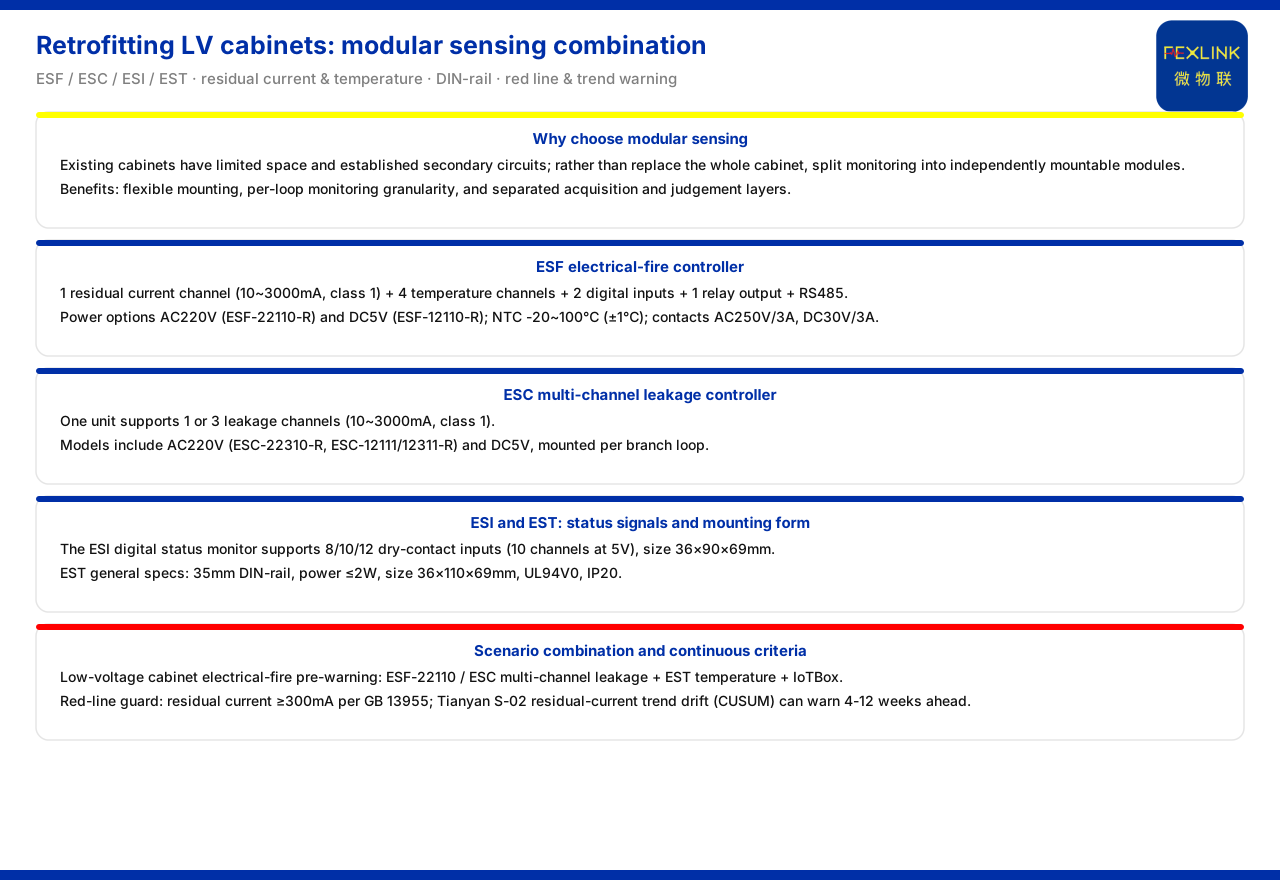
Direct answer
The core constraint in adding residual-current monitoring to an existing low-voltage distribution cabinet is not whether the function exists but whether key quantities such as residual current, temperature and switch status can be acquired without changing the original cabinet structure and connected to the existing monitoring and platform system. According to the product material, this kind of retrofit can be done by a group of modular monitoring and control devices working together: the ESF electrical fire monitoring & control device handles comprehensive quantities such as residual current and temperature, the ESC multi-channel leakage-current monitoring & control device handles leakage monitoring of branch circuits, the ESI digital-input status monitor handles switch and breaker status quantities, and the EST multi-channel temperature intelligent controller with its general mounting specification provides the formal basis of modular DIN-rail mounting. Centred on these four modules, this article explains their respective capabilities, parameter figures and combination, and gives the continuous monitoring criteria after the retrofit.
1. Why retrofitting an existing cabinet needs modular sensing
An existing cabinet is characterised by limited space and an already-formed secondary circuit. To add monitoring under these conditions, the most realistic approach is not to replace the whole cabinet but to split the monitoring capability into several independently mountable modules and add them point by point and branch by branch as needed. Modularity brings three benefits: first, flexible mounting position, able to be arranged along the existing DIN rail and secondary-side space; second, a monitoring granularity split by circuit, making the location of a branch anomaly more direct; third, layered acquisition and judgment, with the front-end modules responsible for taking the data and the back-end system for assessment. The several classes of module in the product material are organised along exactly this line.
2. The capability of the ESF electrical fire monitoring and control device
In the product material, the ESF electrical fire monitoring & control device provides one channel of residual-current monitoring, four channels of temperature monitoring, two channels of digital input, one channel of relay output and RS485 communication; its residual-current measurement range is 10 to 3000 milliamperes with an accuracy of class one. Its models are divided by power supply into AC 220V and DC 5V, making it easy to select the retrofit according to the supply condition of the original secondary circuit. During selection one can first confirm the supply available on site and then choose the corresponding model. AC 220V and DC 5V correspond to different ESF electrical fire monitoring & control device models (for example the AC-side ESF-22110-R and the DC-side ESF-12110-R). This model layout of "one function, two supplies" is exactly the compatibility space reserved for existing-cabinet retrofit.
3. The key-parameter figures of the ESF
The product material also gives the key parameters of the ESF: residual current 10 to 3000 milliamperes with an accuracy of class one; temperature monitoring using NTC with a measurement range of minus 20 to 100 degrees Celsius and an accuracy of plus or minus 1 degree Celsius; and a relay contact capacity of AC 250V, 3A and DC 30V, 3A. These figures show the module's range and output capability: the residual-current range covers the interval from small leakage to larger leakage, the temperature range covers the temperature-rise range common in a distribution cabinet, and the contact capacity determines the load scale the relay output can drive.
4. Branch adaptation of the ESC multi-channel leakage-current monitoring and control device
When the monitoring object extends from the whole cabinet to branch circuits, single-channel residual-current monitoring is often not enough. The ESC multi-channel leakage-current monitoring & control device in the product material supports one or three channels of leakage monitoring per unit, with a leakage measurement range of 10 to 3000 milliamperes and an accuracy of class one. Its models are divided by power supply into two groups, AC 220V and DC 5V: the AC side is the multi-channel leakage-current monitoring & control device (ESC-22310-R, ESC-22111-R, ESC-22311-R), and the DC side is the multi-channel leakage-current monitoring & control device (ESC-12111-R, ESC-12311-R). They can be added separately per branch circuit to suit the space of an existing cabinet. Mapping each channel to one branch means that when leakage occurs it can be narrowed directly to a specific circuit, without having to search the whole cabinet first.
5. Status acquisition of the ESI digital-input status monitor
Beyond residual current and temperature, the open/closed status of switches and breakers is also important information for the operation of a distribution cabinet. The ESI digital-input status monitor in the product material supports eight, ten and twelve channels of dry-contact input with a built-in supply; under a 5V supply condition it can only be used as ten-channel input. The device measures 36 by 90 by 69 millimetres. Dry-contact input means it can acquire the status of unpowered contacts, thereby obtaining switch-quantity information without interfering with the primary circuit.
6. EST and general mounting specifications
Whether the modular retrofit can be implemented depends to a large extent on the mounting form. In the product material, the general mounting specification of the series to which the EST multi-channel temperature intelligent controller belongs is 35 millimetre DIN-rail mounting, a power consumption of no more than 2 watts, a size of 36 by 110 by 69 millimetres, a flame-retardant enclosure rating of UL94V0 and an ingress protection rating of IP20. These specifications show that this series of modules uses a DIN-rail form, suiting retrofit on the secondary side of an existing cabinet: DIN-rail mounting is easy to fix and extend, the lower power consumption reduces the additional burden on the cabinet supply, and the definite size makes it easy to calculate the layout within limited space. It should be noted that what is quoted here is the general mounting specification of the series; this article makes no further inference about the differences of specific models.
7. Combination in a typical scenario
The typical application scenarios and selection comparison of the product material give the combination for low-voltage distribution cabinet electrical fire early warning: the ESF electrical fire monitoring & control device and the ESC multi-channel leakage-current monitoring & control device carry leakage and temperature monitoring, used together with EST temperature monitoring and the IoTBox. Comparing this combination with the module capabilities above reveals the division of work: the ESF covers the comprehensive quantities of the whole cabinet, the ESC covers the leakage of branch circuits, the EST supplements the temperature dimension, and the IoTBox handles access and aggregation.
8. Continuous monitoring criteria after the retrofit
The retrofit is only the starting point; whether it can continue to work depends on the criteria. The safety red line in the product material specifies that it triggers when the residual current reaches 300 milliamperes or above, according to GB 13955; the leakage sub-model of the Qianzhi engine uses time-series trend analysis and moves the safety red line to the pre-stage. On the prediction side, the Tianyan engine has a residual-current trend-drift model using the cumulative-sum algorithm, which can give an early warning 4 to 12 weeks ahead while the leakage is still within the safe range, for example at 18 milliamperes. This means that monitoring after the retrofit does not rely only on an out-of-limit alarm: before the red line is reached, the trend drift can give an early signal, leaving a time window for disposal. This article makes no further inference about the specific implementation of that algorithm.
Scope and limitations
- This article is limited to the existing statements of the product material on the ESF electrical fire monitoring & control device, the ESC multi-channel leakage-current monitoring & control device, the ESI digital-input status monitor, the general mounting specification of the EST series, the typical-scenario selection and the leakage-monitoring criteria; it makes no inference about unlisted parameters or deployment conclusions.
- The parameters in this article (residual current 10 to 3000 milliamperes, accuracy class one, temperature minus 20 to 100 degrees Celsius, relay AC 250V/3A and DC 30V/3A, rail 35 millimetres, power consumption no more than 2 watts, size and protection rating, dry contact 8/10/12 channels, the 300 milliampere red line, and the 4 to 12 week advance) are all figures listed in the product material and do not constitute a commitment to the results of a specific project.
- The correspondence between models and power supplies (the electrical fire monitoring & control device and multi-channel leakage-current monitoring & control device models for AC 220V and DC 5V) is limited to the figures listed in the product material; selection should be subject to the latest product material and project scheme.
- The example values of the trend-drift early warning are used only to illustrate the form of the criteria; this article does not present them as a result reproducible on any site.
- This article does not constitute a commitment to any unlisted capability; actual capability is subject to the latest product material and project scheme.